

Yen on the Rise: How a Pension Giant and Producer Inflation Are Changing the Balance in the Currency Market
Introduction: A Quiet Shift in the Asian Market
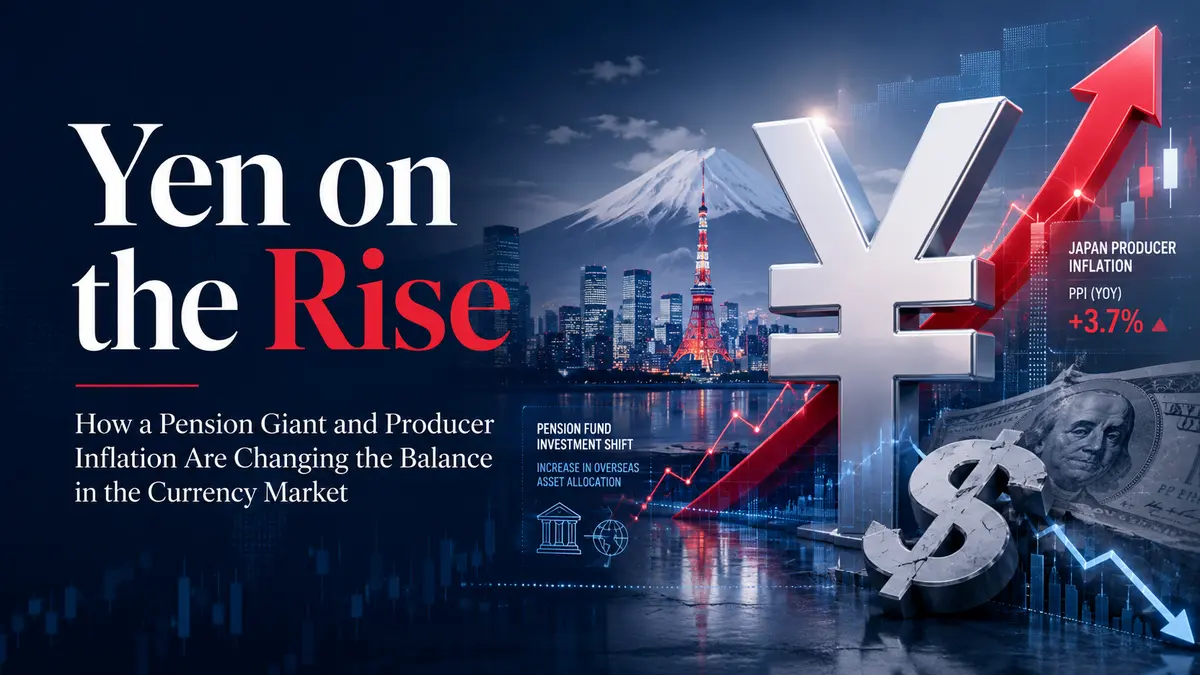
Friday trading on Asian exchanges brought a surprise that many analysts had predicted, but few expected to see right now. The Japanese yen, long considered an underperformer in the currency market, unexpectedly led gains among Asian currencies. The reason? Not one, but two powerful events that shook the financial world: Tokyo’s announcement that it intends to encourage the world’s largest pension fund to increase investments in domestic assets, and producer inflation data that exceeded all forecasts.
The U.S. dollar, meanwhile, is showing signs of weakness. Geopolitical tensions around Iran, divided opinions within the Federal Reserve, and overall investor caution are creating the conditions for a reassessment of the dollar’s position. What is behind these movements, and what consequences could they have for the global economy? Let’s examine this in detail.
Tokyo’s Pension Plan: A Strategic Move or a Necessity?
The Government Pension Investment Fund as a Tool of Influence
The statement by Finance Minister Satsuki Katayama came like a bolt from the blue. Tokyo intends to encourage the Government Pension Investment Fund to increase investments in local assets. At first glance, this may sound like a routine decision, but when it involves a fund managing more than one and a half trillion dollars in assets, every word carries weight.
This giant institution, the largest pension fund in the world, has always been considered a model of conservative management. Its investment decisions have traditionally focused on diversification, with an emphasis on foreign assets. Now, however, the Japanese government is signaling a shift in direction.
An increase in the fund’s investments in domestic bonds and other local assets could create strong demand for the yen. The mechanism is simple: to invest in Japanese securities, the fund needs to convert foreign currency into the national currency. The more such operations take place, the stronger the upward pressure on the yen.
Two Signals at Once
It is telling that this statement came at a time when the Japanese economy is trying to cope with the challenges of decades of deflation. The government is effectively sending a double signal: to international investors and to its own central bank. To the former, it signals that Japan is serious about supporting its currency. To the latter, it signals that the country is ready for further normalization of monetary policy.
The bond market’s reaction was also significant. The yield on 10-year Japanese government bonds fell by 3.4% almost immediately after the minister’s remarks. This is a classic reaction: when the largest player in the market signals an intention to increase purchases, prices rise and yields fall.
Producer Inflation: An Unexpected Ally of the Yen
PPI Data: What Lies Behind the Numbers
If the pension plan became the trigger for the yen’s rise, then Producer Price Index data became the fuel that helped sustain that growth. The figures are impressive: in June, Japan’s PPI rose at the fastest pace in more than three years.
What does this mean in practice? Producer inflation is the temperature of the economy. When producers are forced to pay more for energy, raw materials, and components, they are highly likely to pass these costs on to consumers. A high PPI is almost a guaranteed sign of rising consumer inflation in the coming months.
For the Bank of Japan, this is a particularly important signal. For many years, the regulator fought deflation, and every step toward raising interest rates was a difficult decision. Now the central bank has additional arguments for continuing its monetary tightening cycle.
The Energy Factor
It is important to note that energy prices were the key driver of the PPI increase. Japan is a country highly dependent on energy imports. Any fluctuations in global energy markets are immediately reflected in its domestic economy.
This is where we reach the intersection with geopolitics. Escalating tensions around Iran, which we will discuss separately, have a direct impact on oil prices. For Japan, this means a double blow: on the one hand, more expensive energy fuels inflation; on the other, it makes the yen more attractive as a safe-haven asset.
At the same time, however, a stronger yen can become a double-edged sword. An overly strong national currency makes Japanese exports less competitive, and exports are a critically important sector of the country’s economy. This very concern has long held the Bank of Japan back from taking more active steps to strengthen the yen.
The Dollar Under Pressure: Between Geopolitics and Internal Divisions
The Iran Factor: How War Affects the Exchange Rate
While the yen was strengthening due to domestic factors, the dollar was weakening under the weight of external problems. The situation around Iran became more than just another news headline for the markets; it turned into a full-fledged uncertainty factor that forced investors to rethink their strategies.
The beginning of the week was marked by escalation: the resumption of hostilities between the United States and Iran triggered a natural market reaction — a flight to safe-haven assets, which briefly supported the dollar. But then came a tectonic shift: President Trump first announced that the ceasefire had ended, and then said that Iran had made contact for new negotiations.
Such geopolitical volatility is an ideal environment for currency fluctuations. Investors do not like uncertainty; they prefer clarity. When even the U.S. president changes his rhetoric within a few days, confidence in the dollar as a stable asset begins to waver.

Internal Contradictions Within the Fed
The second factor putting pressure on the dollar was internal disagreement within the Federal Reserve. The minutes of the June meeting revealed a picture that surprised many: members of the Federal Open Market Committee were significantly divided over the future path of interest rates.
Some policymakers support further hikes, fearing that inflation may prove more persistent than previously expected. Others, by contrast, point to signs of economic slowdown and call for caution. Both sides present convincing arguments, creating a stalemate.
Weak employment data published a week earlier became a strong argument for the “doves” — those who oppose further tightening. The labor market has always been considered one of the key indicators of economic health, and its cooling suggests that inflationary pressure may ease without additional rate hikes.
Inflation Expectations as a Limit on Losses
Interestingly, the dollar’s losses were limited. The main factor here was once again geopolitics. The conflict around Iran and its inflationary consequences create a situation in which the Fed may be forced to raise rates even if domestic economic indicators do not require it.
Wars and military conflicts traditionally put upward pressure on energy prices. Rising oil prices are a direct path to higher overall inflation. As a result, the Iran factor affects the dollar in two opposing ways: on the one hand, it creates uncertainty and reduces risk appetite; on the other, it keeps rate-hike expectations alive, which supports the currency.
Asian Currencies: Moving in Unison, but Not Without Exceptions
On Friday, most Asian currencies strengthened amid a weaker dollar. The Chinese yuan continued to rise after inflation data released on Thursday confirmed the recovery of China’s economy.
The Singapore dollar and the Australian dollar also showed positive momentum. The latter case is especially interesting: the Australian dollar is sensitive to commodity prices, and its rise reflects not so much the strength of the local economy as the broader weakness of the U.S. currency.
However, there were exceptions. The South Korean won declined despite the overall trend. The reason was increased volatility in local stock markets. This case is especially revealing: it reminds us that currency markets do not move as a single unit; each currency has its own unique pressure factors.
South Korea’s launch of round-the-clock trading in the won-dollar pair earlier this week added an element of instability. Extending trading hours, which should theoretically increase liquidity, often leads in practice to higher volatility during the transition period.
Interim Results of the Week: Cautious Optimism
By the end of the week, Asian currencies are showing only minor changes. This is perhaps the main characteristic of the current moment: markets are moving cautiously, without sharp swings, weighing a wide range of conflicting factors.
On the one hand, investors have strong reasons to buy Asian assets: Japan is seeing positive shifts in monetary policy, China is showing signs of recovery, and the dollar looks vulnerable. On the other hand, the situation around Iran could change at any moment, while internal disagreements within the Fed offer no clear understanding of the future direction of U.S. interest rates.
This combination creates an atmosphere of heightened caution. Investors are ready to move toward stronger Asian currencies, but without excessive enthusiasm, preserving the ability to retreat quickly if the geopolitical situation deteriorates.
Looking Ahead: What Awaits the Yen and the Dollar Next
If we try to look beyond the next few trading sessions, the picture appears ambiguous. The yen currently has a unique set of supporting factors: the government’s pension plan, strong PPI data, and the overall weakening of the dollar. However, its long-term outlook remains uncertain.
The yen is still near its lowest levels in 40 years. This means that even a significant rise in percentage terms does not yet return it to historical norms. The Bank of Japan must act very carefully: tightening policy too quickly could harm the economy, while moving too slowly could undermine all efforts to fight deflation.
For the dollar, the Iran issue will remain key. If negotiations are successful and geopolitical tensions ease, the U.S. currency may face additional downward pressure. If the conflict escalates, however, rising energy prices could force the Fed to act more aggressively, which would support the dollar.
Conclusion: The New Reality of Currency Markets
The current situation in the currency market is a vivid example of how domestic economic factors and foreign-policy risks intertwine. The Japanese yen is strengthening not simply because of abstract “market sentiment,” but because of concrete government actions and objective economic data.
The U.S. dollar is weakening not because the American economy is in poor shape, but because too many uncertainty factors have accumulated: military actions in the Middle East, disagreements within the Fed, and general investor fatigue from constant surprises.
For the average investor, this means one thing: the era of simple decisions in the currency market is over. Every movement now requires careful analysis of multiple factors, and even the most obvious trends can be reversed by an unexpected geopolitical event.
But this complexity is precisely what makes financial markets fascinating. They are never static; they are always in motion. And today’s rise of the yen amid pension investments and producer inflation is merely another episode in the endless story of the global economy — a story that continues to surprise even the most experienced market participants.

Comments
No comments yet. Be the first to share your thoughts!
Authentication Required
You must be logged in to post a comment.