

Why Tamron Shares Surged 28%: A Breakdown of the Medium-Term Plan That Shook the Market
The day an optical giant rewrote the rules of the game
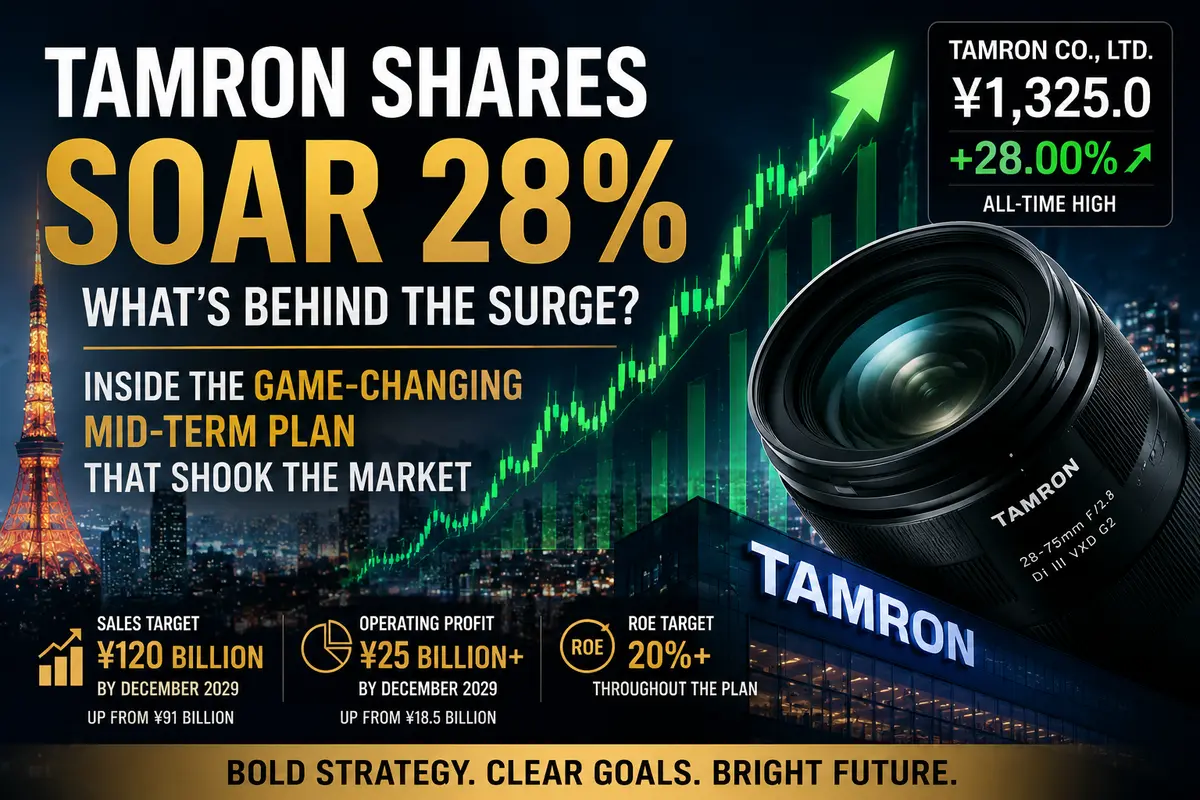
The Tokyo Stock Exchange witnessed a rare spectacle yesterday. Shares of Tamron—a company many investors have long viewed as a modest but reliable lens manufacturer—soared 28% in a single trading session. The price of ¥1,325.0 per share is not just a number; it is an all-time high that forced investors around the world to open their spreadsheets and recalculate their portfolios.
But what exactly triggered this explosive rally? The answer is not a one-off deal or a short-lived hype around the photography industry. It lies in a fundamental overhaul of the company’s strategy, unveiled in its medium-term management plan running through December 2029. And that plan is impressive not only for its ambition, but also for its level of detail—something institutional investors value highly.
Let’s break down what the market saw in this document and why the reaction was so powerful.
Tamron’s Medium-Term Plan — Numbers That Speak for Themselves
From ¥91 billion to ¥120 billion: why the market believed in revenue growth
The main news that shook the market was a revision of financial targets. Tamron announced that it aims to reach ¥120 billion in sales by December 2029. To understand the scale: the previous target was ¥91 billion by December 2026. In other words, this is not just growth—it is a structural leap of roughly 32% compared to earlier expectations.
But why did investors interpret these figures not as empty promises, but as a credible roadmap? The answer lies in specificity. Tamron did not simply state ambitious numbers—it clearly outlined the segments driving growth. The company is focusing on three key areas:
Photography optics — Tamron’s traditional core business, where it has a strong reputation for producing high-quality zoom lenses for DSLR and mirrorless cameras. Growth here is expected from expanding product lines for new mounts and increasing average selling prices.
Video surveillance systems — a segment often underestimated, but one showing steady growth amid rising global demand for security systems. Tamron holds a strong position here thanks to optical quality and reliability.
Automotive optics — arguably the most promising and fastest-growing segment. This includes automotive cameras, driver assistance systems (ADAS), and optical components for autonomous driving technologies. Analysts believe this driver could deliver the breakthrough embedded in the plan.
The market concluded that the company is not attempting to grow “in all directions” through questionable diversification, but instead is leveraging its core strengths and expanding within familiar yet growing niches.
Operating Profit of ¥25 Billion — Margins as an Art Form
Revenue is only half the story. Far more important is how much a company earns from each unit sold. Here Tamron delivered another surprise: a target operating profit of ¥25 billion or more by December 2029, compared to the current target of ¥18.5 billion for the fiscal year.
Let’s do the math. If current operating margin is around 20% (¥18.5 billion vs ¥91 billion), the new target implies roughly 20.8% (¥25 billion vs ¥120 billion). On the surface, this seems unremarkable. But the key nuance is this: maintaining high margins while scaling the business is a sign of maturity and efficiency. Many companies sacrifice profitability when chasing growth. Tamron, however, claims it can grow without losing efficiency.
What does this mean for investors? It means each additional yen of revenue should consistently generate profit. In an environment of rising inflation and component costs, this is especially valuable. The company is likely betting on production optimization, economies of scale, expansion into higher-margin segments such as premium automotive optics, and tighter supply chain control—critical after the disruptions of the COVID era.
The market saw not just arithmetic, but a well-structured strategy for cost management and pricing power.
ROE Above 20% — A New Standard of Efficiency
The plan also includes a return on equity (ROE) target of 20% or higher throughout the entire period. This is perhaps the most ambitious and revealing metric.
For a Japanese company—traditionally known for conservative capital management and large cash holdings—an ROE of 20% represents a true revolution. For comparison, the average ROE in the Nikkei 225 index is around 10–12%. Tamron aims to be twice as efficient as the market.
How can this be achieved? There are two paths (and the company appears to be pursuing both). First, increasing net profit through operational efficiency and possibly tax optimization. Second, more efficient capital use, including reducing excess cash reserves, share buybacks, and higher dividends.
This second point is directly linked to the capital return policy that became another major driver of the stock surge.
Generosity as Strategy: Why Dividend Growth Changed Perception
From 40% to a new reality: what changed in dividend policy
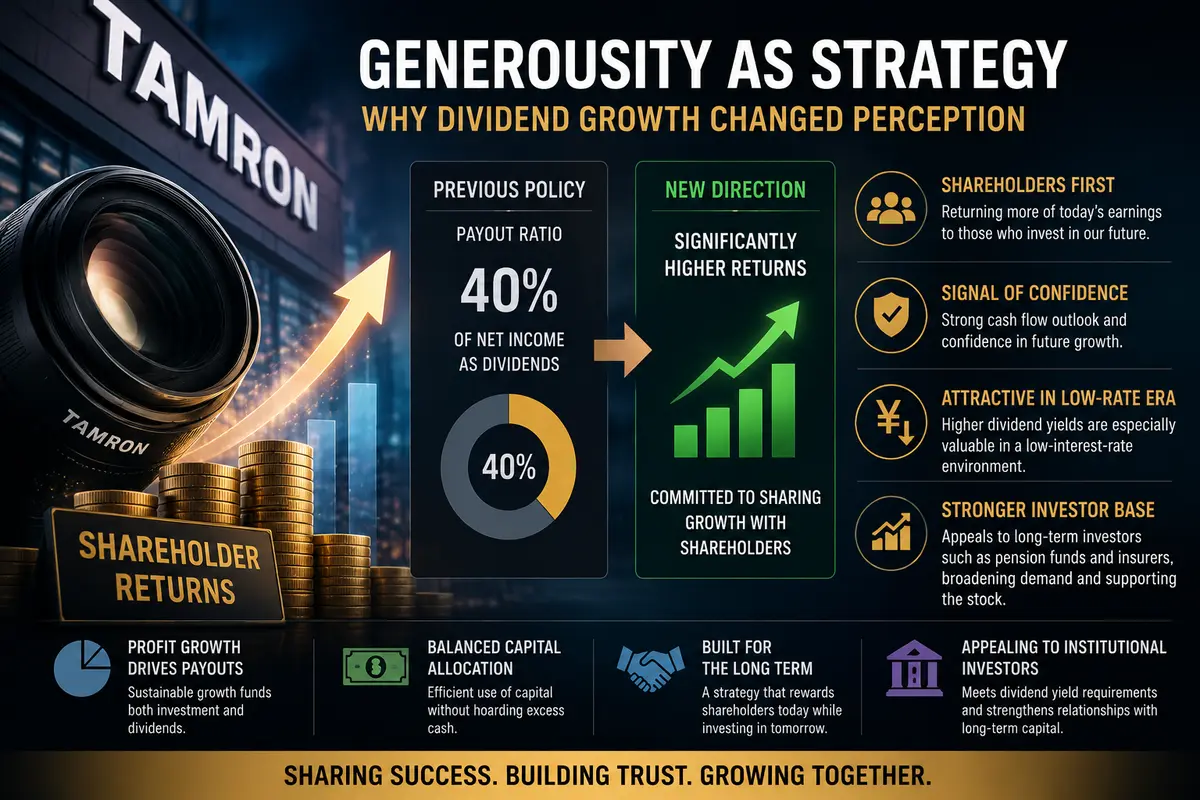
The second major announcement that delighted the market concerns shareholder returns. Tamron has replaced its previous policy of a 40% payout ratio with a more generous framework.
What does this mean in practice? Previously, 40% of net income was distributed as dividends. Now, the company is signaling significantly higher returns. While no fixed new ratio was clearly defined, the direction of change is unmistakable.
Markets always respond positively to higher dividend yields, especially in a low-interest-rate environment. But the deeper message is confidence: management believes in stable future cash flows and sees no need to hoard capital for uncertainty. Tamron is willing to share its growth with shareholders now, rather than promising returns “someday.”
For the Japanese market—historically characterized by relatively low dividend yields compared to the U.S. or Europe—this is a particularly strong signal. It attracts not only traders but also long-term income-focused investors.
A Signal of Confidence: How Higher Payouts Affect Risk Perception
When a company raises dividends, it does more than redistribute profit. It sends a clear message: “We know what we are doing, and we are confident in the future.”
In Tamron’s case, this message was reinforced by the combination of aggressive growth targets and higher shareholder payouts.
Investors interpret this as follows: if the company is willing to pay more now, its profit forecasts must be highly credible. It is not afraid of running out of funds for reinvestment because expected earnings growth should cover both capital expenditures and increased dividends.
Moreover, this move makes the stock more attractive to pension funds and insurance companies, which often have strict dividend yield requirements. That broadens the investor base and creates additional demand, supporting the share price.
Market Context: Why the Reaction Was So Strong
Investors are tired of uncertainty
The year 2025 has been full of surprises for global markets—from geopolitical tensions to currency volatility and supply chain instability. In such an environment, investors value companies that provide clear, measurable, and achievable guidance.
Tamron delivered exactly that: ¥120 billion in revenue, ¥25 billion in operating profit, and ROE above 20%. And it did so while many other companies were lowering forecasts. The contrast was striking.
Additionally, Japanese equities are experiencing a resurgence of foreign investor interest, driven in part by Tokyo Stock Exchange reforms aimed at improving corporate governance and transparency. Tamron aligned itself with these trends, presenting itself as a company operating under new standards—making its shares even more attractive to Western funds.
Technical factor: breakout from resistance
A technical aspect also played a role. Tamron shares had been trading in a range for years, and many traders were waiting for a catalyst. The medium-term plan became exactly that catalyst.
When a stock breaks an all-time high, it often triggers a chain reaction: short sellers are forced to cover positions, margin calls accelerate buying, and momentum pushes prices even higher. The 28% surge was partly the result of this technical dynamic layered on top of strong fundamentals.
But without real business changes, such a breakout would have been short-lived. In Tamron’s case, fundamentals and technicals aligned perfectly, creating a “perfect storm” for growth.
Looking Ahead: What Comes After the Surge
Execution is the key question
The most important question now is whether Tamron can deliver on its promises. The market believes in the plan—but belief is only the first step. Now comes the execution phase.
Upcoming quarterly results will be closely watched. Investors will compare actual growth with the trajectory required to reach ¥120 billion by 2029. Any significant deviation could trigger a correction—but that is the nature of growth: it is never linear.
Still, Tamron has strong advantages. First, a solid brand reputation in photography optics that supports premium pricing. Second, long-term contracts with automakers that ensure predictable revenue in automotive optics. Third, a technological edge in high-performance lenses that is difficult for competitors to replicate.
Competitive landscape: who else is in the game
Tamron does not operate in isolation. Its main competitors include Canon and Nikon, as well as Chinese manufacturers rapidly expanding in the mass market. However, Tamron has carved out a niche: it does not compete in low-end lenses but focuses on quality and innovation.
In automotive optics, competition is even more intense, with global leaders such as Bosch, Continental, and Japan’s Denso. Tamron positions itself as an optical specialist rather than an electronics company, allowing it to supply components to these systems rather than compete directly.
This strategy—being the best in a narrow field rather than trying to dominate everything—is what makes the plan so credible.
The Day That Changed Perception
Yesterday’s surge in Tamron shares is not just a story about good news lifting a stock. It is a story about a company long overshadowed by larger players deciding to speak loudly and clearly.
The medium-term plan is a statement of confidence:
-
confidence that the photography optics market is not dying but evolving
-
confidence that automotive optics will grow exponentially
-
confidence that the company can maintain margins in a volatile global environment
And most importantly, confidence that shareholders are part of this future—not just observers, but beneficiaries through real cash returns.
Of course, risks remain: macroeconomic shocks, yen fluctuations, supply disruptions, and rising competition. But in finance, certainty is rare. The market said yesterday: “Tamron, we believe you.” And that belief was priced in with a 28% surge—one of the most impressive single-day moves in the Japanese market this year.
Now the ball is in the company’s court. Whether it delivers by 2029 remains to be seen. But it has clearly won the first round by a landslide.

Comments
No comments yet. Be the first to share your thoughts!
Authentication Required
You must be logged in to post a comment.