

Wells Fargo Throws in the Towel: U.S. Bank Closes Trades Against the Chilean and Argentine Pesos
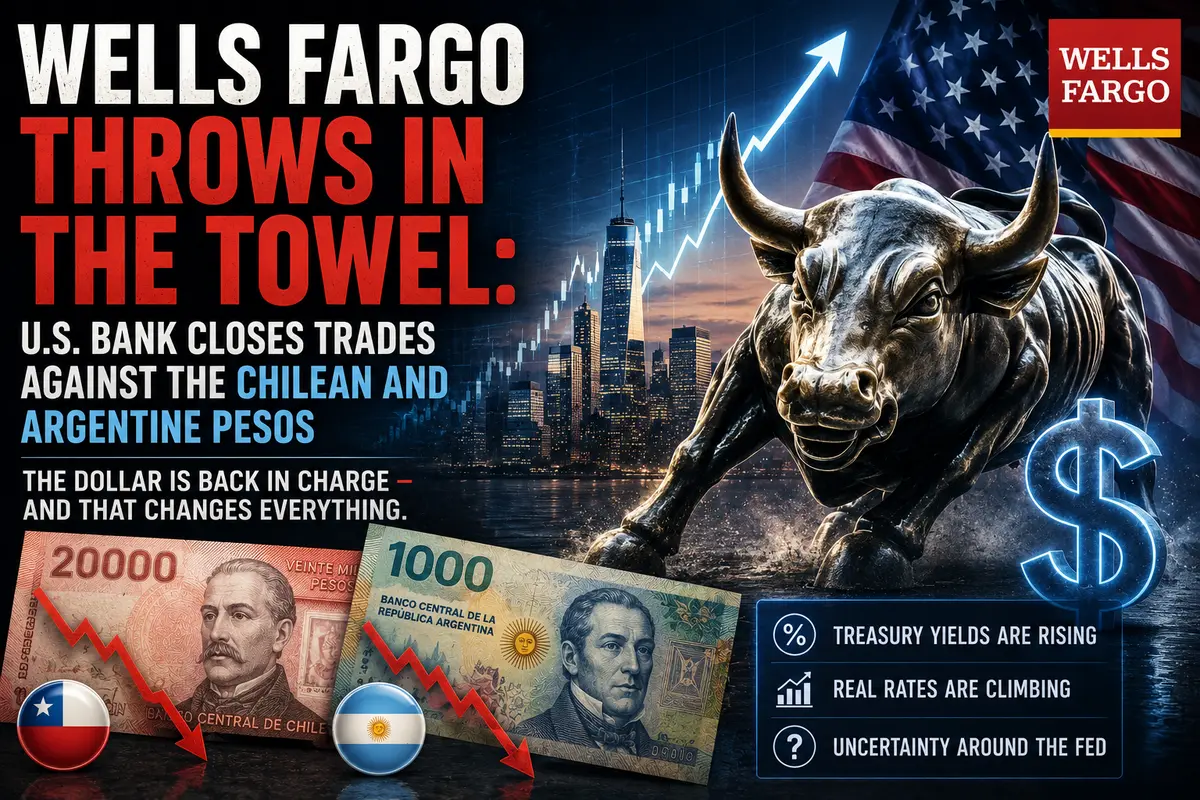
The Dollar Is Back in Charge — and That Changes Everything
In the world of finance, there are trades that rarely make headlines for the general public. Carry trades, short positions, structured longs—it’s the kind of jargon that can make anyone’s head spin. Yet sometimes even these seemingly dry developments reveal important shifts taking place in the global economy.
One such signal came on Monday from Wells Fargo, the third-largest U.S. bank by assets.
The bank’s emerging markets strategy team made a decision that caused many investors to rethink their views on Latin America: they closed their positions in the Chilean and Argentine pesos. Not because the trades had been wildly successful across the board, but because they concluded that the environment had changed and the original thesis was no longer as compelling.
Put simply, Wells Fargo had been short the U.S. dollar against both currencies—in other words, it was betting that the pesos would strengthen while the dollar weakened. In Argentina, that bet worked exceptionally well, generating a return of more than 10%. In Chile, it did not, producing a loss of roughly 1%. Yet the bank exited both positions. And the reasons behind that decision are more important than the profits and losses themselves.
Alvaro Vivanco Explains: It’s All About Rates
Alvaro Vivanco, Wells Fargo’s emerging markets strategist, cited three key reasons for closing the trades:
-
Rising U.S. Treasury yields
-
Higher real interest rates
-
Uncertainty surrounding the Federal Reserve
At first glance, these may sound like technical buzzwords. But they tell a straightforward story.
U.S. Treasury yields represent the return investors receive for lending money to the U.S. government. When those yields rise, the dollar becomes more attractive.
Investors around the world begin asking themselves:
“Why take currency risk in emerging markets when I can buy virtually risk-free U.S. Treasuries and earn 5–6% annually?”
As a result, they sell pesos, buy dollars, and move money into Treasuries. The peso weakens. The dollar strengthens.
Real interest rates—bond yields adjusted for inflation—have also been rising in the United States. This reflects confidence in the U.S. economy and in the Federal Reserve’s ability to control inflation. Higher real rates generally support the dollar and weigh on emerging-market currencies.
Finally, there is uncertainty surrounding the Fed.
Paradoxically, uncertainty often benefits the dollar. When investors are unsure about future interest-rate policy, they tend to seek safety and liquidity. The dollar remains the world’s most liquid and trusted currency, making it the preferred refuge during uncertain times.
Together, these factors convinced Wells Fargo that it was time to reassess its Latin American currency exposure.
Argentina: A Trade That Earned 10.6%—Yet Was Still Closed
The Argentine peso trade was a success.
Vivanco’s team held a structured long position in the peso, expecting the currency to strengthen. That view proved correct, generating a total return of approximately 10.6%—an impressive result for a currency trade, where gains of 2–3% are often considered attractive.
Why did the peso strengthen despite Argentina’s long history of crises, defaults, inflation, and IMF programs?
Vivanco points to one primary factor: steady inflows from agricultural exports.
Argentina is one of the world’s largest exporters of soybeans, corn, wheat, and beef. When global food prices are favorable, Argentine farmers and agribusiness firms earn billions of dollars in export revenues. Those dollars are converted into pesos to pay wages, taxes, and operating expenses, creating demand for the local currency.
The resulting support was strong enough to offset many of Argentina’s traditional weaknesses.
Investors took notice, and Argentine carry trades became increasingly popular.
A carry trade involves borrowing in a low-interest-rate currency—such as the dollar or yen—and investing in a high-yielding currency. Argentina’s interest rates can reach 50–70% annually, creating enormous yield differentials. If the currency also appreciates, investors enjoy a double benefit.
Ironically, that popularity became part of the problem.
As Vivanco noted, Argentina had become a crowded trade among a particular segment of investors. Wells Fargo expects some capital outflows going forward.
The logic is simple: as Treasury yields rise and the dollar strengthens, investors who enjoyed strong gains in Argentina may decide to lock in profits. That means selling pesos and buying dollars, creating downward pressure on the currency.
Wells Fargo chose to exit before that process accelerates.
The bank secured a 10.6% gain and stepped aside—a classic example of disciplined risk management.
Chile: A 1% Loss and a Neutral Stance
The Chilean peso story was less successful.
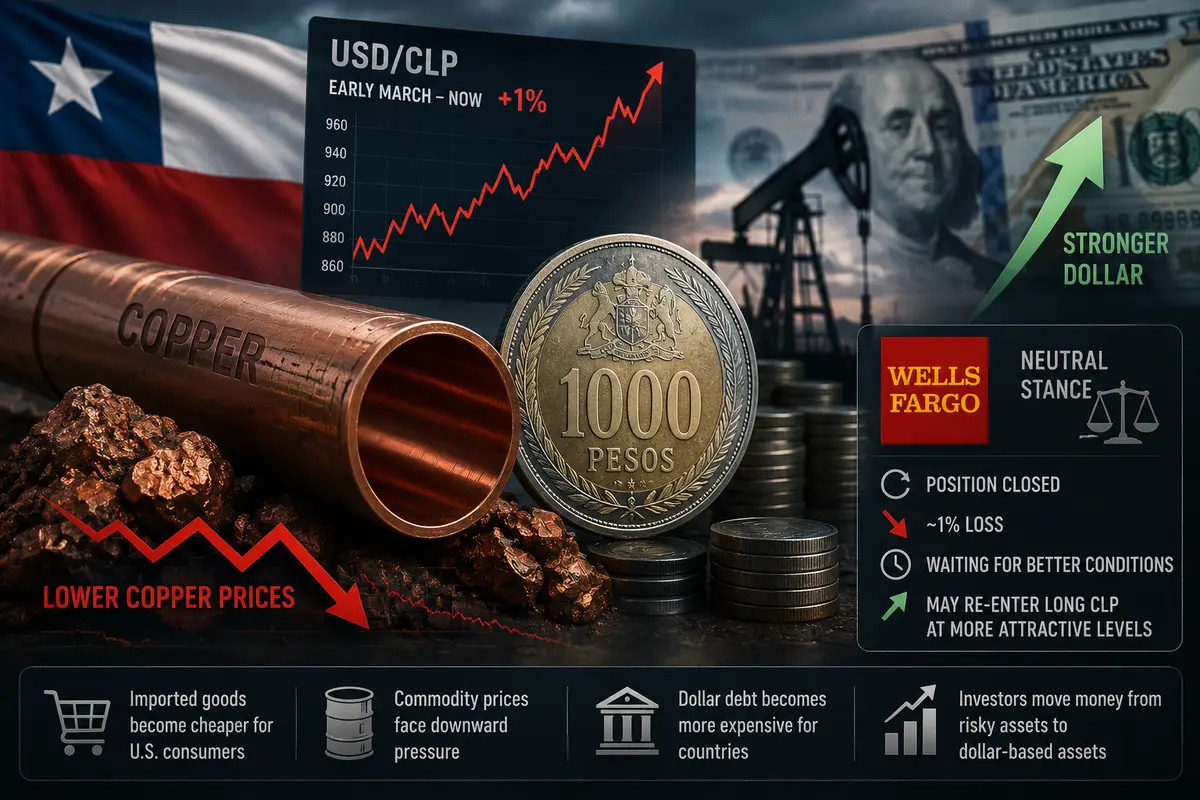
Wells Fargo initiated a tactical short-dollar position against the Chilean peso in early March, expecting the peso to strengthen. Instead, the trade lost approximately 1%.
A 1% loss is hardly catastrophic in foreign-exchange markets, where such moves can occur in a single day. Nevertheless, it highlights the challenges facing Chile’s currency.
Chile’s economy is heavily dependent on copper exports. The country is the world’s largest producer of copper, and when global growth slows, copper demand often weakens.
Lower copper prices typically translate into a weaker Chilean peso.
With U.S. rates rising and the dollar strengthening, commodity-linked currencies—including the Chilean peso—have come under pressure.
Wells Fargo acknowledged the changing environment, closed the position, absorbed the modest loss, and moved to a neutral stance.
Importantly, Vivanco emphasized that the bank may re-enter long Chilean peso positions at more attractive levels and once there is greater clarity regarding Federal Reserve policy.
In other words, Wells Fargo has not abandoned Chile. It is simply waiting for better conditions—perhaps a softer dollar, lower U.S. rates, or stronger copper prices.
This illustrates how large institutional investors operate. They rarely abandon a thesis permanently. Instead, they step aside when conditions become unfavorable and return when the odds improve.
Why Should Anyone Care?
Many readers might wonder:
“Why should I care that a bank closed positions in two Latin American currencies?”
Because large institutions like Wells Fargo often act as an early-warning system for broader market trends.
If Wells Fargo is reducing exposure against the dollar in Latin America, it suggests that the bank expects continued dollar strength, at least in the near term.
And a stronger dollar affects everyone.
When the dollar rises:
-
Imported goods become cheaper for American consumers.
-
Commodity prices such as oil, copper, soybeans, and gold often face downward pressure because they are priced in dollars.
-
Countries with dollar-denominated debt face higher repayment burdens.
-
Investors tend to pull money out of riskier emerging-market assets and move it into dollar-based investments.
The implications extend far beyond Argentina and Chile.
What’s Happening in the U.S. Economy?
To understand Wells Fargo’s thinking, it’s necessary to look at the United States itself.
The strength of the dollar ultimately reflects the strength of the U.S. economy.
Recent labor-market data showed continued resilience:
-
Job creation remained strong.
-
Unemployment stayed low.
-
Consumer spending remains healthy.
-
Businesses continue hiring.
While this is good news for the U.S. economy, it is less favorable for emerging-market currencies.
A strong labor market gives the Federal Reserve more flexibility to keep interest rates elevated. Higher rates support Treasury yields and strengthen the dollar.
Add geopolitical tensions in the Middle East and rising oil prices—which can fuel inflation—and the case for imminent Fed rate cuts becomes even weaker.
The result is an environment highly supportive of the U.S. dollar.
Wells Fargo simply decided not to stand in front of that trend.
Argentina: A Story Without a Happy Ending?
Argentina remains one of the world’s most fascinating economic laboratories.
The country has experienced:
-
Dollarization experiments
-
Sovereign defaults
-
IMF rescue programs
-
Hyperinflation
-
Currency controls
-
Parallel foreign-exchange markets
Under President Javier Milei, economic conditions have stabilized somewhat. Inflation has moderated from extreme levels, agricultural exports continue generating foreign currency, and investor sentiment has improved.
Yet fundamental challenges remain:
-
Fiscal deficits
-
Limited access to international capital markets
-
Large monetary overhangs from previous governments
-
Heavy dependence on weather conditions and agricultural production
Wells Fargo’s profitable exit demonstrates how sophisticated investors often approach emerging markets.
They enter when fear is extreme, wait for conditions to improve, take profits, and leave before the crowd rushes for the exits.
Whether new investors will replace those leaving remains an open question.
Chile: Betting on Copper
Chile faces a very different set of challenges.
Unlike Argentina, it enjoys relatively stable institutions, a credible central bank, and a history of responsible fiscal policy.
Its vulnerability is concentration.
Copper accounts for roughly half of the country’s exports.
When copper prices fall, the effects ripple throughout the economy—affecting growth, government revenues, trade balances, and the peso itself.
Copper prices are currently under pressure for two main reasons:
-
Slower growth in China, which consumes more than half of global copper production.
-
High interest rates in developed economies, which weigh on industrial activity and metals demand.
Wells Fargo’s decision to move to the sidelines reflects caution rather than pessimism.
Should the Fed signal future rate cuts, China launch meaningful stimulus measures, or copper prices recover, the bank may once again become bullish on the Chilean peso.
What Are Other Banks Doing?
Wells Fargo is not alone.
Major institutions such as JPMorgan Chase, Goldman Sachs, and Morgan Stanley also maintain positions across Latin American currencies.
They all face the same macroeconomic backdrop:
-
Strong U.S. economic data
-
Rising Treasury yields
-
A stronger dollar
-
Geopolitical uncertainty
-
Elevated energy prices
Under such conditions, market consensus tends to become more defensive.
Investors close long positions in emerging-market currencies and move capital back into dollars.
This creates a self-reinforcing cycle:
The stronger the dollar becomes, the more investors exit anti-dollar positions. The more investors exit those positions, the stronger the dollar becomes.
Outlook: What’s Next for the Pesos?
Short Term (1–2 Months)
Pressure on both currencies is likely to persist.
If U.S. inflation remains elevated and Treasury yields continue rising, the dollar could strengthen further.
Argentina’s peso may face greater downside risk due to profit-taking and capital outflows following the success of carry trades.
Chile’s peso is also vulnerable, though perhaps less dramatically.
Medium Term (3–6 Months)
Much depends on the Federal Reserve.
If U.S. rates remain high or rise further, both currencies could weaken.
If the Fed signals eventual easing, the dollar could soften, creating room for recovery.
For Argentina, agricultural exports and harvest conditions will remain crucial.
For Chile, the key variable is copper.
A rebound in Chinese industrial activity could support copper prices and, by extension, the Chilean peso.
The Bottom Line: The Dollar Is Still King—But Not Forever
A year ago, many investors expected the dollar to weaken as inflation declined and Fed rate cuts approached.
Reality unfolded differently.
The U.S. economy remained resilient.
The labor market stayed strong.
Inflation proved stubborn.
And the Federal Reserve repeatedly delayed rate cuts.
Wells Fargo has simply adjusted to that reality.
The bank closed positions that depended on dollar weakness, locked in substantial gains in Argentina, accepted a small loss in Chile, and stepped aside to wait for the next opportunity.
There is a lesson here for investors of every size.
Markets are unpredictable. Forecasts are often wrong. Successful investors are not those who stubbornly cling to a view regardless of changing conditions. They reassess, adapt, take profits when available, admit mistakes when necessary, and preserve capital for the next opportunity.
The Argentine and Chilean pesos may yet have their day again.
Perhaps Wells Fargo will return to both trades six months from now, at more attractive levels.
But for now, the bank has pressed the pause button.
And when a major institution like Wells Fargo does that, the rest of the market pays attention.

Comments
No comments yet. Be the first to share your thoughts!
Comments only for logged-in users.