

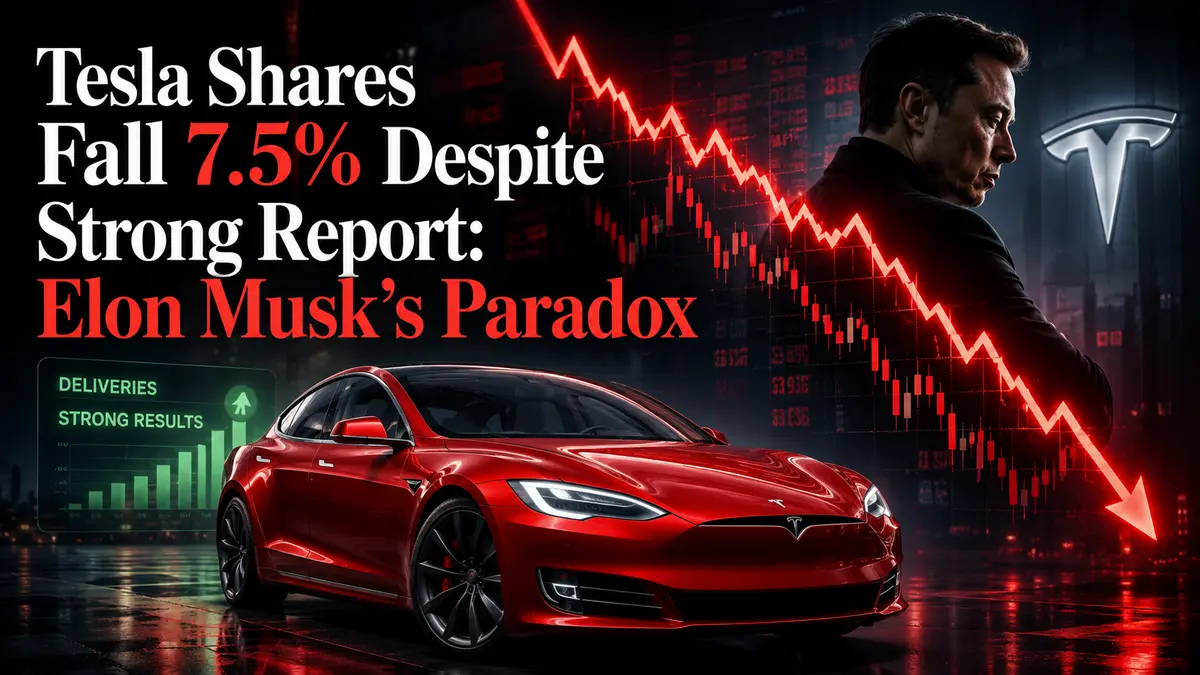
Tesla Shares Fall 7.5% Despite Strong Report: Elon Musk’s Paradox
Introduction: When Good News Becomes a Bad Signal
Thursday should have been a triumph for Tesla. The company reported its second-quarter delivery numbers, and the figures exceeded analysts’ expectations by a wide margin. 480,126 vehicles delivered, 451,758 produced — growth of 25% year over year and 34% compared with the first quarter. The market had expected roughly 406,000 deliveries, while Tesla delivered almost 20% more. It seemed like a reason to celebrate.
But the market decided otherwise. Tesla shares plunged 7.49% — their worst day in almost a year. This was not a coincidence. It was a trend: the stock has fallen after each of the last three quarterly delivery reports. This time was no exception. Investors voted with their wallets against a company that had done everything it could to please them.
So what is happening? Why is Tesla, which seemingly met and exceeded its targets, being punished by the market? The answer does not lie in the numbers themselves, but behind them: in Elon Musk’s political rhetoric, in competitive pressure from Chinese manufacturers, in growing consumer fatigue with electric vehicles in the United States, and in the fact that even the best delivery numbers in the world cannot compensate for fundamental problems that have been building up for years.
Let’s break down why Tesla has found itself in this paradoxical situation, where a strong report turns into a stock decline, and what it means for the company’s future.
Delivery Report: Numbers That Should Have Encouraged Investors
Record Deliveries and Their Structure
Let’s start with the good news. Tesla delivered 480,126 vehicles in the second quarter. This was not just a good result — it marked a return to growth after several disappointing quarters. A year ago, the company reported 384,000 deliveries, while in the first quarter of 2026 it delivered 358,023 vehicles. Growth of 25% year over year and 34% quarter over quarter is a serious leap forward.
Model 3 and Model Y played the main role. These two models accounted for 467,762 deliveries, or 97% of the total volume. The budget sedan and the popular crossover became the engines of growth, while the flagship Model S and Model X are fading into the past. Tesla officially announced the end of their production, freeing up manufacturing lines in Fremont for new projects.
Tesla’s own consensus, published last week, had projected 406,024 deliveries. StreetAccount analysts gave a similar estimate. The company exceeded expectations by almost 20%. This was a huge positive surprise that should have pushed the stock higher. But that did not happen.
Price Incentives and Their Cost
To achieve this growth, Tesla took a classic step — it began offering cheaper versions of the Model 3 and Model Y. This worked in the short term: sales increased and buyers returned. But there is another side to this. Lower prices mean lower margins. Each vehicle sold brings in less profit than before.
Investors see this and are worried. Yes, deliveries increased, but at what cost? If the trend toward lower margins continues, the company could face problems even with rising volumes. The market evaluates not only current deliveries but also future profits. And Tesla’s future profits are looking increasingly uncertain.
In addition, cheaper models may affect brand perception. Tesla has always positioned itself as a premium electric car and a technological leader. If it starts competing on price with the mass market, the brand risks losing part of its appeal. This is a delicate balance that Musk and his team will have to maintain in the coming years.
The Political Factor: When the CEO Becomes a Liability
Musk’s Brand vs. Tesla’s Brand
One of the main reasons investors remain cautious is Elon Musk’s political rhetoric. Tesla has long ceased to be just an automotive company. It has become an extension of the personality of its founder and CEO. And that personality has become increasingly controversial in recent years.
Musk has supported anti-immigrant radicals in Europe. He actively cooperates with the Trump administration on reducing the size of the government apparatus. His political statements have alienated some buyers, especially in Europe, where attitudes toward this kind of rhetoric are particularly sensitive.
Consumer protest against Musk has become a real factor affecting sales. Many Europeans who previously viewed Tesla as an environmentally friendly choice now associate the brand with political positions that feel alien to them. This is not a mass phenomenon, but it is visible enough to affect sales.
The irony is that Europe was one of the main growth drivers in the first half of the year. Rising gasoline prices caused by the war in Iran pushed Europeans to switch more actively to electric vehicles. But now that oil has returned to pre-crisis levels, the incentive has disappeared, while the political factor remains.
Loss of the Tax Credit in the United States
Another blow to Tesla came from the United States. The federal tax credit for electric vehicle buyers was partially cancelled or reduced, making Tesla more expensive for American consumers. This is especially painful because the United States is where Tesla faces the strongest competition.
According to Dan Hirsch of AlixPartners, American buyers have cooled toward fully electric cars in favor of hybrids. The reason is simple: the United States is a huge country, and people live far from one another. Unlike Europe, where charging infrastructure is better and distances are shorter, hybrids offer the ideal balance between environmental friendliness and practicality in the United States.
This is a structural challenge for Tesla, and no price incentives can solve it. Convincing Americans to buy electric vehicles requires more than just price. It requires infrastructure, trust, and the feeling that it is genuinely convenient. Until Tesla can offer that, sales in the United States will remain under pressure.
Competitive Environment: The Chinese Are Advancing
BYD, Nio, Xiaomi: A New Wave
Tesla is no longer the only serious player in the electric vehicle market. Chinese manufacturers such as BYD, Nio, and Xiaomi are increasing production and expanding globally. They offer vehicles of comparable quality at lower prices, and they do not carry Musk’s political baggage.
BYD is especially dangerous. It is not just an electric vehicle manufacturer, but a vertically integrated giant that produces its own batteries, electronics, and other components. This gives it a significant cost advantage that Tesla cannot offset.
Xiaomi, the well-known smartphone manufacturer, has also entered the electric vehicle market. Its cars are already available in China and are beginning to appear in Europe. The Xiaomi brand is known for quality and affordability, which makes it a serious competitor to Tesla in the mass-market segment.
Nio focuses on the premium segment and offers unique services such as battery swapping. For those concerned about charging time, this is a powerful advantage. And although Nio’s volumes are still smaller than Tesla’s, its growth is steady and confident.
Hyundai and Volkswagen: Europe’s Response
Hyundai Motor Group and Volkswagen are two giants of the traditional automotive industry that are actively increasing electric vehicle production. Volkswagen has announced major investments in new models and battery plants. Hyundai offers competitive models with strong specifications and affordable prices.
For Tesla, this means that its first-mover advantage is rapidly disappearing. European and Korean manufacturers are not merely catching up — in many areas they have already surpassed Tesla: build quality, service, and brand perception. Previously, Tesla was the choice for those who wanted to be at the cutting edge of technology. Now it is just one of many options.
New Projects: Betting on a Future That Has Not Yet Arrived
Cybercab, Semi, Optimus: How Far Are They from Profitability?
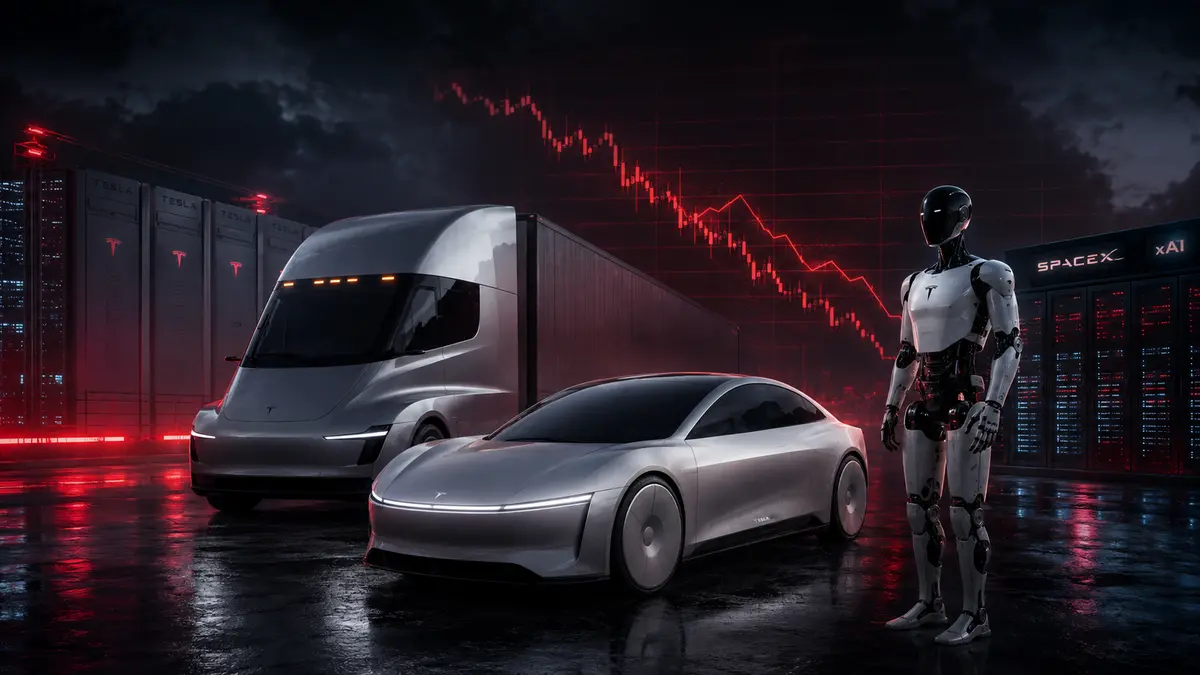
Musk is betting on several new projects that are supposed to drive long-term growth. These include the Semi electric truck, the driverless Cybercab, and the Optimus humanoid robots. In its first-quarter report, the company said it was “optimizing” its model lineup with a focus on vehicles for a “fully autonomous future.”
But all these projects are still in the early stages. Semi is only beginning to ramp up production. Cybercab has not yet entered the market. Optimus is an experimental technology that may generate revenue only years from now — if it ever can.
Investors want to see profits today, not promises for tomorrow. And today, Tesla’s profits depend on sales of the Model 3 and Model Y, which are under pressure. Until the new projects begin bringing in real money, the market will remain skeptical of these ambitions.
SpaceX and xAI: Related-Party Transactions
In April, SpaceX, Musk’s other company, bought $269 million worth of Tesla Megapacks to reduce electricity costs at xAI data centers near Memphis. This is positive news for Tesla as an energy solutions manufacturer, but it raises questions about corporate governance. Related-party transactions between companies owned by the same person always make investors cautious.
A year earlier, SpaceX spent $131 million purchasing Cybertrucks for its own needs. This represented a noticeable share of total pickup sales — 20,237 units for all of 2025. Such transactions can distort the real picture of demand. If large purchases come from related parties, they do not reflect true consumer demand.
In its delivery report, Tesla did not disclose whether related-party transactions affected the strong figures. This leaves room for doubt. Investors want to know that sales growth is organic, not artificial.
Economic Background: Inflation, Chips, and Trade Wars
Rising Component Costs
According to analysts, the second half of the year will bring new challenges for the American auto industry. Inflation, changes in trade policy, and rising costs for chips and other components are all factors that will pressure the margins of all manufacturers, including Tesla.
Chips remain a critical component for electric vehicles. Their cost is rising due to increased demand from other industries, especially artificial intelligence. Tesla, which uses a large number of semiconductors, will feel this pressure especially sharply.
Changes in trade policy also add uncertainty. Trump, actively supported by Musk, introduced new tariffs on imports from China, which could affect Tesla’s supply chains. The irony is that Tesla has factories in China, and these tariffs could make Chinese-made Tesla cars more expensive for the American market.
Inflation and Consumer Demand
Inflation remains high, reducing consumers’ purchasing power. High prices for goods and services force people to postpone major purchases such as cars. Even if the price of an electric vehicle declines, the overall household budget remains under pressure.
The decline in oil prices that followed the peace agreement with Iran also worked against Tesla. Cheaper gasoline makes electric vehicles less attractive from an economic standpoint. Europeans who bought electric vehicles en masse in the first half of the year because of expensive fuel may now switch back to hybrids or even gasoline-powered cars.
This creates the risk that the current growth in deliveries will prove temporary. If oil prices remain low and inflation continues to pressure household budgets, Tesla may face a decline in demand in the second half of the year.
What Awaits Tesla in the Second Half of the Year
Competition Is Intensifying
In the second half of the year, competition in the electric vehicle market will continue to grow. Chinese manufacturers are increasing exports, European and Korean giants are expanding their model ranges, and American startups are not giving up. Tesla will find it increasingly difficult to maintain its positions, especially in segments where it was once the undisputed leader.
In addition, consumer protest against Musk may intensify, especially against the backdrop of the U.S. presidential campaign. Musk’s political rhetoric makes him a figure around whom different, often polarizing, opinions concentrate. This inevitably affects brand perception.
Margins Under Pressure
Lower prices for the Model 3 and Model Y, rising component costs, and inflation — all these factors will pressure Tesla’s margins. The company has already reported a decline in operating profit in the first quarter, and the second quarter is unlikely to bring improvement.
Investors will closely watch the financial results that Tesla will present on July 22. If margins continue to decline, the stock may fall even further. But if the company can maintain profitability at an acceptable level, this could become a positive signal.
Conclusion: Tesla’s Paradox
Tesla shares fell 7.5% after a strong delivery report. This is a paradox that reflects all the contradictions of the company. Yes, deliveries increased, but the growth was achieved through price cuts. Yes, the Model 3 and Model Y are selling well, but the market is crowded with competitors. Yes, Tesla has ambitious projects, but they are not yet generating money.
Investors see all these problems and are voting with their feet. They do not want to wait years for Optimus to start working or for Cybercab to hit the roads. They want to see sustainable profit today. And until Tesla can provide it, the stock will remain under pressure.
Musk, who has always known how to surprise people, failed this time to convince the market. Even record deliveries were not enough to offset the company’s fundamental problems. And that is the main lesson of today: even the most innovative company can lose trust if its CEO becomes a political figure and its business model becomes vulnerable.
Tesla stands at a crossroads. Either it will manage to transform itself from an electric vehicle manufacturer into a new kind of technology giant, or it will remain hostage to its own past success. And the shares, down 7.5%, are not a verdict — only a warning that the time for compromises is over.

Comments
No comments yet. Be the first to share your thoughts!
Authentication Required
You must be logged in to post a comment.