Bar Pipa
We pay for a post of 10$

SEK

Lin Brings

Viaplay: The Nordic Streamer Emerging from the Storm

Viaplay: The Nordic Streamer Emerging from the Storm

Second-Quarter Figures: Not as Bad as Feared

Swedish media group Viaplay has reported its second-quarter results, and the figures were not merely acceptable — they were encouraging. The company’s net sales reached SEK 5.51 billion, exceeding the result recorded in the same period last year. However, the most important news is not the revenue growth itself, but the fact that Viaplay, which was still losing money not long ago, returned to profitability during the quarter.

Net profit amounted to SEK 70 million. Admittedly, this is a modest sum for a company of Viaplay’s size, but the return to profitability is itself an important signal to the market. A year ago, Viaplay was reporting losses, and investors were seriously questioning whether the streaming service, once regarded as one of Europe’s leading players, could survive in an intensely competitive environment. That question is no longer as pressing.

The company’s operating profit for the second quarter reached SEK 253 million. This is more than simply breaking even. It is a meaningful result showing that the business is beginning to generate money rather than merely spending it on content and marketing.

Streaming Is Growing, but Not Through New Subscribers

Organic sales from streaming subscriptions increased by 7% compared with the previous year. This is solid growth, but there is one important detail: it was not driven by the acquisition of new subscribers. Instead, it came from higher average revenue per user. The subscriber base remains stable, but each customer is paying slightly more.

This is both good news and a cause for concern. It is positive because the company has learned to monetize its existing audience more effectively than before. This may be the result of price increases, which are always a risky move for streaming services. If subscribers do not leave after prices...


Continue reading...
0
0

Swedbank Reports: Profit Falls, but the Market Is Not Disappointed

Swedbank Reports: Profit Falls, but the Market Is Not Disappointed

Friday’s Report: The Numbers That Surprised Investors

Swedish banking giant Swedbank SWDBF ... released its second-quarter results on Friday, presenting a classic case of “good bad news.” Net profit fell by 9% compared with the previous year, reaching SEK 7.20 billion, equivalent to approximately $750 million.

At first glance, the decline may appear concerning. However, as is often the case, the market looked beyond the headline figure—and investors liked what they saw.

The bank exceeded analysts’ expectations. The Visible Alpha consensus forecast cited by Jefferies analysts had anticipated slightly weaker results. Swedbank’s net profit came in 1% above expectations, while its pre-provision operating profit also exceeded the forecast by 1%. In banking analysis, where every tenth of a percentage point matters, such results are considered a success.

Profit before tax declined by 9% to SEK 9.15 billion. Once again, this was a decrease, but it had been expected. What mattered more was how the bank generated its revenue rather than how much it spent—and its revenue performance was relatively strong.

Revenue Is Growing, but Expenses Disappointed

Swedbank’s total revenue increased by 7% year over year, reaching SEK 18.10 billion. This represents solid growth, particularly at a time when many European banks are struggling with stagnation. What helped the bank increase its revenue?

The main contributor was fee and commission income. The bank earned more from customer services, advisory activities, and asset management. Another important factor was income from trading operations. Market volatility, which often worries investors, became an additional source of revenue for Swedbank’s trading divisions.

Net interest income also increased, although only moderately. This means that the bank earned slightly more from the difference between the interest charged on loans and the interest paid on deposits. However, growth in this area was less impressive than the increase in fee and...

Continue reading...
0
0

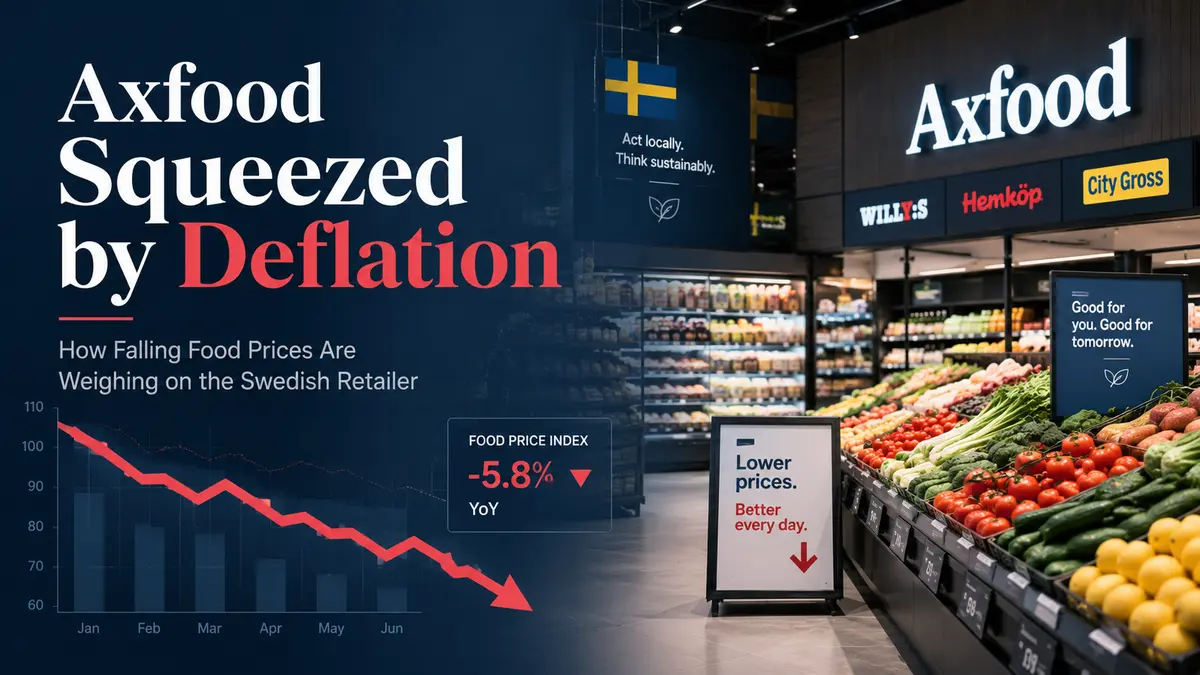
Axfood Squeezed by Deflation: How Falling Food Prices Are Weighing on the Swedish Retailer

Axfood Squeezed by Deflation: How Falling Food Prices Are Weighing on the Swedish Retailer

Introduction: When Deflation Becomes a Problem

The second quarter of 2026 was a disappointing period for Swedish grocery retailer Axfood AXFOF ... . The company reported revenue of SEK 23.2 billion SEKUSD ... , an increase of 0.9% compared with the previous year, but below analysts’ expectations. Operating profit also fell short of forecasts, reaching SEK 964 million.

The main reason was food price deflation, which put pressure on the company’s growth. While many businesses struggle with inflation, Axfood has encountered the opposite problem: falling food prices are reducing revenue and profit margins. Calendar effects also played a role, creating additional pressure.

However, the situation is not entirely negative. The Hemköp supermarket chain recorded growth of 7.4% and increased its market share. The company also reaffirmed its intention to bring the City Gross chain to profitability in the second half of 2026. In this article, we will examine the key factors affecting Axfood, assess its prospects, and explore how the company plans to address these challenges.

Financial Performance: Disappointing Figures

Revenue Below Forecasts

Axfood’s revenue for the second quarter amounted to SEK 23.2 billion, representing an increase of 0.9% compared with the previous year. However, analysts had expected SEK 23.67 billion, and the SEK 470 million shortfall was a significant disappointment.

Revenue growth of only 0.9% is minimal and indicates that the company is experiencing difficulties in expanding its sales.

Operating Profit Falls Short of Expectations

Operating profit amounted to SEK 964 million, below the analysts’ forecast of SEK 1.008 billion. The EBIT margin stood at 4.20%, which was also lower than expected.

The decline in operating profit reflects pressure from deflation and rising costs.

Net Profit and Earnings per Share

Net profit for the quarter amounted to SEK 647 million, while adjusted earnings per share came to SEK 2.94. Both figures...

Continue reading...
0
0

Dometic in the Storm: How Falling RV Demand Hit the Swedish Giant

Dometic in the Storm: How Falling RV Demand Hit the Swedish Giant

Introduction: When Leisure Is No Longer a Priority

Swedish outdoor technology manufacturer DTCGF ... faced a harsh reality in the second quarter of 2026. Sales declined by 5%, falling short of analysts’ forecasts. Operating profit amounted to SEK 513 million, compared with the expected SEK 637.75 million. The main reason was weak demand in the recreational vehicle and marine markets.

For a company that had grown for decades on the back of increasing interest in outdoor recreation and travel, this represented a serious blow. Faced with inflation, high interest rates, and geopolitical uncertainty, consumers began cutting their spending on leisure products. Recreational vehicles, yachts, and related accessories were no longer considered priorities.

However, the situation is not entirely negative. Growth in the service and aftermarket channel, which generates higher margins, helped support the company’s gross margin. Dometic also launched a restructuring program expected to deliver annual savings of SEK 150 million by mid-2027. In this article, we will examine every aspect of the current situation, assess the company’s prospects, and try to understand where Dometic is heading.

Financial Performance: Disappointing Figures

Revenue Below Expectations

Dometic’s revenue for the second quarter amounted to SEK 5.97 billion, below the SEK 6.004 billion expected by four analysts. A 5% decline in sales represents a serious setback for a company accustomed to growth.

The decline was caused by weak demand in the recreational vehicle and marine sectors. Consumers are postponing purchases and choosing to save money on leisure-related products.

Operating Profit Disappoints

Operating profit amounted to SEK 513 million, compared with the forecast of SEK 637.75 million. This significant shortfall was caused not only by declining sales but also by additional expenses.

Profitability was negatively affected by SEK 52 million in doubtful debt expenses related to West Marine’s Chapter 11 bankruptcy filing. Although this was...

Continue reading...
0
0

Bufab: How the Swedish Supply Chain Solutions Provider Is Weathering the Storm

Bufab: How the Swedish Supply Chain Solutions Provider Is Weathering the Storm

Introduction: Growth Despite Uncertainty

In a world where global supply chains continue to face pressure and geopolitical uncertainty has become the new normal, Swedish company Bufab is demonstrating impressive resilience. The company’s net sales increased by 11% in the second quarter, while organic growth reached 5.3%. Earnings per share rose from SEK 0.80 to SEK 1.07 compared with the same period last year.

What is driving this success? Market share gains, the implementation of major projects—particularly in the Western region—and an improved gross margin due to a more favorable customer and product mix. However, the picture is not entirely positive. Demand varies significantly across industries: energy, digital infrastructure, and defense are showing strong activity, while construction, kitchens and bathrooms, and the automotive sector remain weak.

In this article, we will examine the key factors behind Bufab’s success, assess its risks and prospects, and explore the company’s strategy amid global uncertainty.

Financial Performance: Encouraging Figures

Sales Growth of 11%

Bufab’s net sales increased by 11% to SEK 2.27 billion. This is an impressive result, particularly against the backdrop of global uncertainty and fluctuating demand across different industries. Organic growth amounted to 5.3%, indicating that the company is expanding not only through acquisitions but also by strengthening its position in existing markets.

Organic growth was driven by market share gains and the implementation of major projects, particularly in the company’s Western region. This suggests that Bufab is actively attracting new customers and expanding its cooperation with existing ones.

Earnings per Share Increased to SEK 1.07

Earnings per share increased to SEK 1.07, compared with SEK 0.80 during the same period last year. This represents growth of more than 30%, which is impressive even when inflation and currency fluctuations are taken into account.

The increase in earnings per share reflects not only higher...

Continue reading...
0
0
Navigation menu
instaforex banner