

Bufab: How the Swedish Supply Chain Solutions Provider Is Weathering the Storm

Introduction: Growth Despite Uncertainty
In a world where global supply chains continue to face pressure and geopolitical uncertainty has become the new normal, Swedish company Bufab is demonstrating impressive resilience. The company’s net sales increased by 11% in the second quarter, while organic growth reached 5.3%. Earnings per share rose from SEK 0.80 to SEK 1.07 compared with the same period last year.
What is driving this success? Market share gains, the implementation of major projects—particularly in the Western region—and an improved gross margin due to a more favorable customer and product mix. However, the picture is not entirely positive. Demand varies significantly across industries: energy, digital infrastructure, and defense are showing strong activity, while construction, kitchens and bathrooms, and the automotive sector remain weak.
In this article, we will examine the key factors behind Bufab’s success, assess its risks and prospects, and explore the company’s strategy amid global uncertainty.
Financial Performance: Encouraging Figures
Sales Growth of 11%
Bufab’s net sales increased by 11% to SEK 2.27 billion. This is an impressive result, particularly against the backdrop of global uncertainty and fluctuating demand across different industries. Organic growth amounted to 5.3%, indicating that the company is expanding not only through acquisitions but also by strengthening its position in existing markets.
Organic growth was driven by market share gains and the implementation of major projects, particularly in the company’s Western region. This suggests that Bufab is actively attracting new customers and expanding its cooperation with existing ones.
Earnings per Share Increased to SEK 1.07
Earnings per share increased to SEK 1.07, compared with SEK 0.80 during the same period last year. This represents growth of more than 30%, which is impressive even when inflation and currency fluctuations are taken into account.
The increase in earnings per share reflects not only higher sales but also improved operating efficiency. The company is generating more profit from the capital invested in the business, which is a positive signal for investors.
Improvement in Gross Margin
Bufab’s gross margin improved during the quarter due to a more favorable customer and product mix, purchasing savings, and price adjustments. The company expects its gross margin to continue improving throughout 2026.
This is an important signal. An improving margin indicates that the company can raise prices or shift toward more profitable products and customers without losing sales volumes. It is a sign of a strong market position.
Key Growth Drivers
Market Share Gains
One of the main factors behind the company’s growth was an increase in market share. Bufab is actively attracting new customers and expanding its relationships with existing ones. This is particularly evident in the Western region, where the company is implementing major projects.
Gaining market share during a period of uncertainty is a sign of a strong brand and an effective strategy. A company that can grow while others stagnate demonstrates a clear competitive advantage.
Implementation of Major Projects
Bufab has reported the implementation of several major projects, particularly in its Western region. These projects may be connected to investments in energy, digital infrastructure, and defense—sectors that are currently showing high levels of activity.
Major projects not only generate revenue but also strengthen the company’s reputation, creating a foundation for future growth.
Purchasing Savings
The company managed to improve its gross margin through purchasing savings. This means that Bufab is managing its supply chain effectively by identifying more competitive suppliers or negotiating better purchasing terms.
This is particularly important amid rising procurement prices in Asia. The ability to contain or even reduce costs is a key competitive advantage.
Industry Overview: Who Is Growing and Who Is Stagnating
Energy, Digital Infrastructure, and Defense: The Engines of Growth
The energy, digital infrastructure, and defense industries are demonstrating strong activity. These sectors continue to invest despite global uncertainty, and Bufab is successfully benefiting from this demand.
The energy sector is growing due to elevated energy prices and investment in renewable energy sources. Digital infrastructure is benefiting from the boom in artificial intelligence and cloud computing. The defense industry is expanding because of increasing geopolitical risks.
Construction, Kitchens and Bathrooms, and Automotive: Areas of Weakness
Demand remained weak in construction, the kitchen and bathroom industry, and the automotive sector. These sectors are particularly sensitive to macroeconomic factors such as interest rates, inflation, and consumer confidence.
High interest rates and inflation are putting pressure on construction and consumer goods manufacturing. The automotive industry is also suffering from component shortages and changing consumer preferences toward electric vehicles.
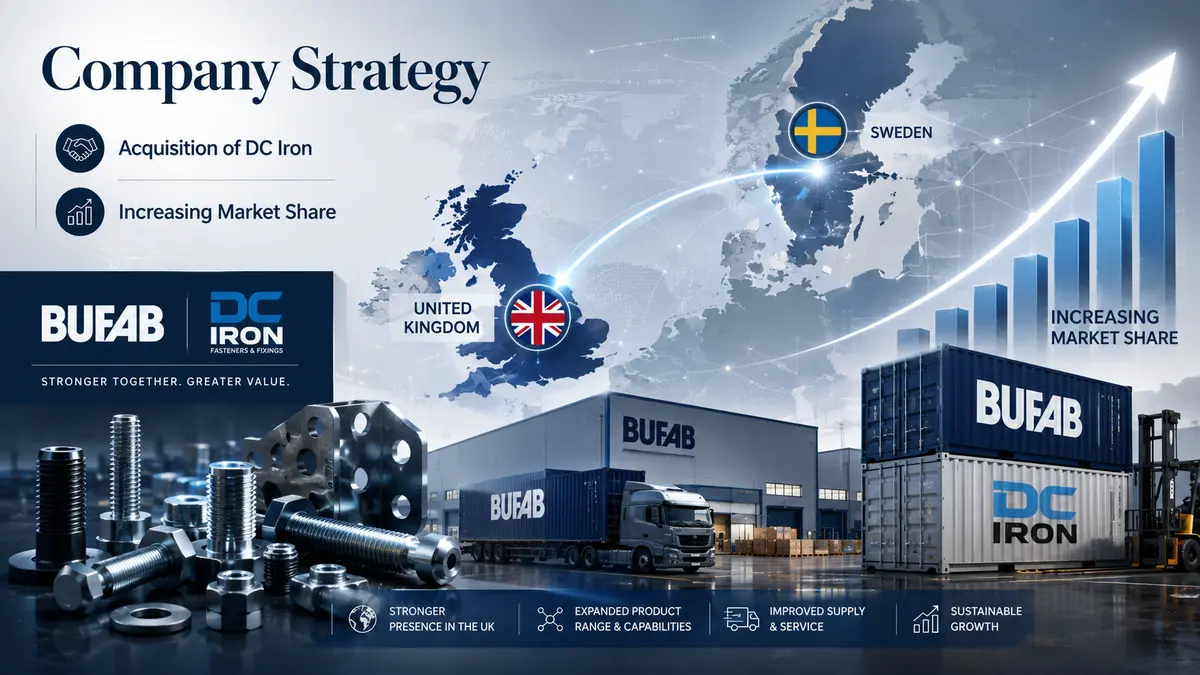
Company Strategy
Acquisition of DC Iron
After the end of the quarter, Bufab acquired the British company DC Iron to expand its presence in the niche components segment. This strategic move strengthens the company’s position in the UK market and broadens its product portfolio.
Acquisitions are one of Bufab’s growth strategies. The company has demonstrated an ability to integrate new assets and generate synergies, allowing it to expand faster than would be possible through organic growth alone.
Increasing Market Share
Bufab has announced its intention to continue gaining market share amid the current uncertainty. This is an ambitious goal, but the company has demonstrated its ability to achieve it by delivering organic growth and implementing major projects.
Increasing market share while demand remains weak in certain sectors is a challenge. However, Bufab appears prepared to meet it.
Cost Optimization
The company continues to optimize costs to maintain its competitiveness. Purchasing savings, improved operating efficiency, and price adjustments are among the tools Bufab is using.
Cost optimization is becoming increasingly important amid rising procurement prices in Asia. A company that can contain cost increases has an advantage over its competitors.
Risks and Challenges
Cautious Consumer Demand
Bufab is facing cautious consumer demand, particularly in sectors that are sensitive to macroeconomic conditions. If interest rates remain high and inflation continues to rise, demand may weaken in other sectors as well, creating additional risks for the company.
Cautious demand requires flexibility and the ability to adapt quickly to changing conditions.
Rising Procurement Prices in Asia
The company has reported rising procurement prices in Asia. This puts pressure on production costs and margins. Bufab is attempting to offset these increases through savings and price adjustments, but the risks remain.
Rising procurement prices are part of a global trend caused by inflation and supply chain disruptions. Companies must adapt, and Bufab is demonstrating that it is capable of doing so.
Geopolitical Uncertainty
Global uncertainty, including conflict in the Middle East and international trade tensions, creates risks for the business. Bufab depends on stable supply chains, and any disruption could negatively affect its results.
Geopolitical uncertainty has become the new normal, and companies are learning to operate within this environment. As a supply chain solutions provider, Bufab is particularly sensitive to these risks.
Prospects and Forecasts
Further Margin Improvement Expected
The company expects its gross margin to continue improving throughout 2026. This signals to the market that management is confident in the company’s capabilities and sees opportunities to improve efficiency further.
Margin improvement provides a path to higher profits even when sales growth slows. Investors value companies that can manage costs effectively.
Growth in Energy and Defense
Demand in energy, digital infrastructure, and defense is expected to remain strong. This creates opportunities for Bufab, which is already delivering solid results in these sectors.
If these trends continue, Bufab will be able to maintain its growth and offset weakness in other industries.
Recovery in Construction and Automotive
A recovery in the construction and automotive sectors may take more time, but Bufab expects conditions to improve gradually. If interest rates begin to fall and inflation slows, these sectors may return to growth.
The timing of the recovery will depend on macroeconomic factors that are difficult to predict.
What This Means for Investors
A Positive Signal
Bufab’s second-quarter results represent a positive signal for investors. Sales growth, improved margins, higher earnings per share, and market share gains all point to a strong company that is capable of expanding in challenging conditions.
Investors tend to value such companies, particularly during periods of uncertainty.
Diversification as an Advantage
Bufab demonstrates the advantages of diversification. The company operates across a range of industries, allowing growth in stronger sectors to compensate for weakness in others.
Investors should take this factor into account when assessing the company.
Risk and Reward
Like any company, Bufab faces risks. Cautious demand, rising procurement prices, and geopolitical uncertainty could negatively affect its performance. However, the company has shown that it can adapt.
Investors should weigh the risks against the potential rewards while assessing the company’s long-term prospects.
Conclusion: Resilience in an Era of Turbulence
Bufab delivered impressive results in the second quarter of 2026. An 11% increase in sales, an improved gross margin, and market share gains all point to a strong company that is capable of expanding even amid global uncertainty.
The key growth drivers—energy, digital infrastructure, and defense—are expected to continue supporting the company. The acquisition of DC Iron expands Bufab’s presence in niche components, while cost optimization and purchasing savings are helping improve profitability.
However, risks remain. Cautious demand in construction and automotive, rising procurement prices in Asia, and geopolitical uncertainty could create challenges. Nevertheless, Bufab is demonstrating an ability to adapt and continue growing.
For investors, Bufab’s results represent a positive signal. The company has shown that it can control costs, increase market share, and benefit from favorable trends in high-growth sectors. This makes it an attractive option for long-term investment.
In a world where uncertainty is becoming the norm, companies such as Bufab are emerging as islands of stability. They are not simply surviving—they are growing, strengthening their positions, and creating value for shareholders. In the current environment, this may be the most important factor of all.

Comments
No comments yet. Be the first to share your thoughts!
Authentication Required
You must be logged in to post a comment.