

Bar Pipa
We pay for a post of 10$

Importers

Same Tariff Announcement, Two Completely Different Outcomes; Here’s Why China Lost and the EU Didn’t
Same Tariff Announcement, Two Completely Different Outcomes; Here’s Why China Lost and the EU Didn’t

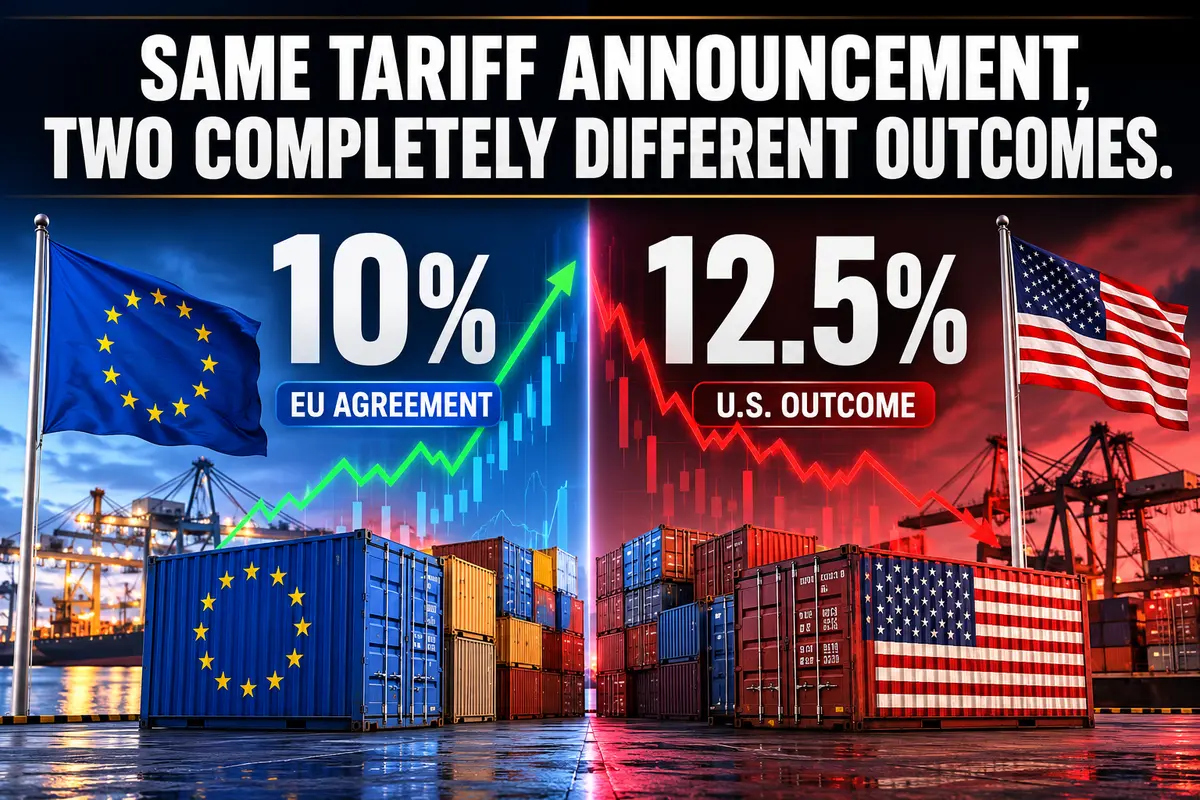
Friday's new US tariffs hit 60 economies at once, all under the same forced-labor justification, announced in the same Federal Register notice, at the same moment. And yet China and the European Union walked away with completely different results. China got the highest rate in the entire framework, 12.5%. The EU got the lowest, 10%, and its own trade officials are annoyed about being included at all rather than panicked about the number.

That gap isn't about who actually has a forced-labor problem. It's about who showed up with a deal already on the table.

Same Justification, Same Day, Different Rooms

The mechanics of Friday's action are simple on paper: countries with a forced-labor import ban in place, or a credible commitment to introduce one, got 10%. Everyone else got 12.5%. China, Japan, South Korea, and Switzerland landed in the higher bracket.

The EU, UK, Canada, and Mexico landed in the lower one.

But the justification doesn't actually hold up evenly across that split, and the EU's own reaction proves it. Bernd Lange, who chairs the European Parliament's trade committee, called the forced-labor framing "crazy," pointing out the EU already has legislation on this that's arguably stronger than what the US enforces itself. If the EU's rules are genuinely tougher and it still got tariffed, the forced-labor rationale isn't really deciding who pays what. Something else is.

What Actually Decided the Rate

That something else is the Turnberry framework, the trade pact Trump and European Commission President Ursula von der Leyen hammered out last summer.

The EU's 10% rate under Friday's action wasn't earned through forced-labor compliance. It was already baked into a separate, pre-negotiated deal, and Washington structured this week's tariff to sit inside that existing arrangement rather than stack on top of it.

China had no equivalent deal...
Continue reading...
0
0

The Tariff Cut Everyone’s Talking About Isn’t the One That Matters This Week

The Tariff Cut Everyone’s Talking About Isn’t the One That Matters This Week

A tweet went around this week: China and the US are working on a tariff cut plan agreed during their summit. Technically true. Also, in my view, badly timed to be read at face value.

Here's what's actually happening in the background while that headline circulates: the 10% global tariff the US has been applying under Section 122 expires tomorrow, July 24. It's expected to be replaced by an entirely different tariff mechanism, Section 301, hitting 60 countries including China. That's not part of the "cut" conversation anywhere. Nobody's tweeting about it. And I think it matters more than the headline that is getting tweeted about.

A Friendly Headline, Badly Timed

Trade headlines involving China have a way of landing exactly when traders are least equipped to evaluate them properly. This one dropped in the middle of a legal transition most people aren't tracking. If you only read the tweet, you'd walk away thinking US-China trade friction is broadly de-escalating. That's not wrong, exactly. It's just incomplete in a way that matters if you're pricing risk this week specifically.

What the "Cut" Actually Covers

The May Summit Framework

Back in May, Trump and Xi sat down in Beijing, Trump's first trip to the Chinese capital since 2017, and floated a "Board of Trade" concept: each side identifying roughly $30 billion worth of non-sensitive goods to cut tariffs on. 

That framework got a follow-up in early July, when both governments agreed in principle to fold agricultural products into it too.

Why This Is Narrower Than It Sounds

Here's my issue with how this gets reported: "tariff cut plan" makes it sound like a broad rollback. It isn't. It's a defined, negotiated list of specific goods, soybeans, certain agricultural categories, a bucket of "non-sensitive" industrial products. It's real, and it's good news...

Continue reading...
0
0
Navigation menu
instaforex banner
