

Moonshot AI Wants to Become a $30 Billion Unicorn: China’s Answer to OpenAI Is Raising More Cash—and Isn’t Shy About Its Ambitions
A Third Funding Round in Six Months—Something We’ve Never Seen Before
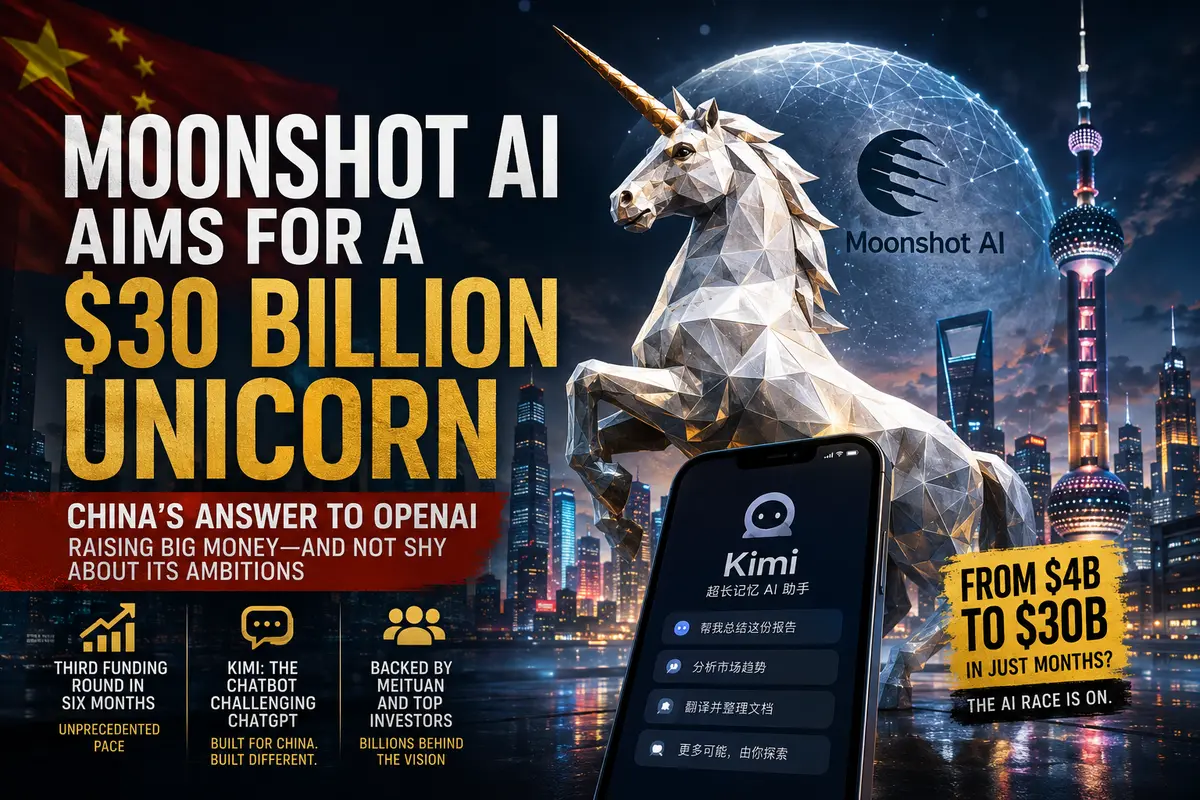
The artificial intelligence industry is in the middle of a full-blown gold rush. Yet even against this backdrop, the latest news from China is making traders and venture capitalists around the world raise their eyebrows. Moonshot AI—a company that, until recently, was barely known outside Beijing and Shenzhen—is reportedly in talks to raise up to $2 billion in a new funding round. What makes this remarkable is that the startup has already secured funding in two previous rounds… within the last six months.
Just think about the numbers. Moonshot AI wants investors to value the company at $30 billion. Thirty billion dollars. That’s more than the market capitalization of many public companies that have been operating profitably for decades. Moonshot, meanwhile, is still a startup. It has a chatbot called Kimi, a team of talented engineers, and plenty of ambition. But a $30 billion valuation is a serious statement.
And that’s only part of the story. According to Bloomberg, citing sources familiar with the matter, Moonshot is already close to completing another funding round led by Meituan, China’s delivery and services giant. That round is expected to value the company at around $20 billion after the deal closes. The subsequent round now under discussion would push the valuation even higher—to $30 billion.
In other words, Moonshot’s valuation could increase sevenfold in just a matter of months compared to last December, when the startup was valued at slightly over $4 billion. A sevenfold increase in half a year would have looked extreme even during the dot-com bubble. Yet in today’s AI market, almost nothing seems impossible.
Kimi: The Chinese Chatbot That Knows More Than You Think
Behind all this money stands a product. Moonshot AI’s flagship offering is a chatbot called Kimi. If you live outside China, chances are you’ve never heard of it. But perhaps you should have. Within China, Kimi has become one of the leading competitors to domestic ChatGPT alternatives.
What sets Kimi apart from dozens of other Chinese chatbots?
First, it can handle extremely long contexts. We’re talking about millions of Chinese characters in a single session. That capability is particularly valuable for analyzing lengthy documents, scientific papers, legal contracts, and other materials where conventional models often struggle after just a few pages.
Second, Kimi positions itself as a more “friendly” chatbot. That matters in China, where many users have grown tired of AI products that feel overly formal, rigid, or heavily sanitized. Kimi aims to sound more natural and human—while still operating within the boundaries of Chinese regulations.
Third, and perhaps most importantly, Moonshot has focused heavily on ecosystem integration. Kimi is not just a standalone application. It can be embedded into messaging platforms, office software, and enterprise services. Users can access it directly within the tools they already use, rather than constantly switching between different apps.
The strategy appears to be working. Kimi has rapidly gained popularity, especially among young professionals in technology and finance. Rather than trying to be a universal assistant like ChatGPT, it focuses on solving specific problems effectively. So far, that approach seems to be paying off.
Meituan and Others: Who’s Behind the Money?
The fact that Meituan is leading one of the funding rounds deserves special attention. Meituan is a heavyweight in China’s digital economy. What began as a Groupon-like service has evolved into a platform spanning food delivery, hotel bookings, ticket purchases, ride-hailing, and countless other services. Its monthly user base numbers in the hundreds of millions.
What does this mean for Moonshot?
It means Kimi could eventually be pre-installed within Meituan’s ecosystem, deeply integrated into its services, and exposed to an enormous user base. Imagine ordering food through Meituan and having an AI assistant automatically recommend restaurants based on your order history. Or searching for a hotel while Kimi analyzes reviews from dozens of sources to identify the best option. These aren’t futuristic concepts—they’re capabilities modern AI systems can already provide.
For Meituan, investing in Moonshot is about more than financial returns. It’s a hedge against the future. If AI truly transforms every industry as many predict, companies without strong AI capabilities risk falling behind. Through Moonshot, Meituan gains not only expertise but potentially privileged access to cutting-edge technology.
Who else is backing Moonshot? Bloomberg’s sources have not disclosed all the names, but there is speculation that the investor base includes major state-backed funds as well as Western venture capital firms that, despite geopolitical tensions, do not want to miss China’s AI boom. Money follows opportunity, and AI remains one of the most attractive opportunities in the market today.
Why $30 Billion? Ambition or Reality?
A $30 billion valuation is more than just a number. It is a declaration of leadership. It sends a message to the market: “We are China’s leading AI startup, and if you want exposure to this story, you’ll have to pay for it.”
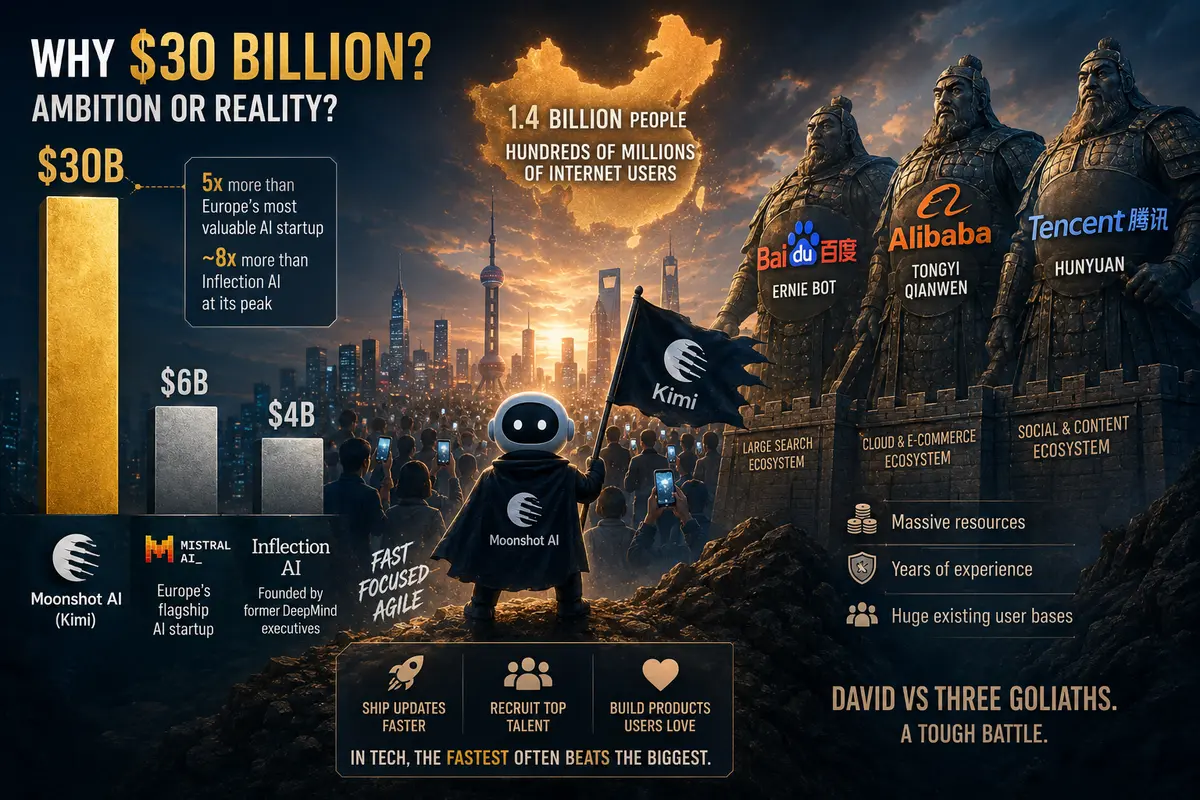
For comparison, Mistral AI, Europe’s flagship AI startup, has been valued at around $6 billion. Inflection AI, founded by former DeepMind executives, was valued at roughly $4 billion before Microsoft hired away much of its leadership team. Moonshot is therefore seeking a valuation five times higher than Europe’s most valuable AI startup and nearly eight times higher than Inflection at its peak.
Is that justified?
On one hand, China represents a massive market. With 1.4 billion people and hundreds of millions of active internet and mobile users, the upside is enormous. If Kimi becomes the standard chatbot platform for Chinese consumers and businesses, its potential audience could reach hundreds of millions. Unlike Europe’s fragmented landscape of languages and markets, China offers a relatively unified ecosystem.
On the other hand, Moonshot faces formidable competition. Baidu has Ernie Bot. Alibaba has Tongyi Qianwen. Tencent has Hunyuan. These are companies with immense financial resources, years of experience, and, perhaps most importantly, existing user bases.
Baidu can distribute Ernie Bot through one of China’s largest search engines. Alibaba can integrate its AI directly into cloud infrastructure and e-commerce platforms. Compared with them, Moonshot resembles David taking on three Goliaths at once.
Yet investors continue to show enthusiasm. In technology, the fastest company often beats the biggest. Moonshot has demonstrated an ability to ship updates quickly, recruit talent aggressively, and build products that users genuinely want to use rather than merely tolerate because they are bundled into existing platforms.
China’s AI Battlefield: Competition Without Rules
The AI race in China is unique.
In the West, competition largely revolves around companies such as OpenAI, Google, Anthropic, and a handful of startups. The rivalry is intense but relatively orderly, with companies competing through benchmarks, research papers, and product releases.
China’s landscape feels different. The stakes are exceptionally high because the Chinese government has explicitly identified AI as a strategic priority. Companies that succeed may receive favorable policies, government contracts, tax incentives, and institutional support. Those that fail risk being acquired—or disappearing altogether.
In this environment, Moonshot possesses one significant advantage: it is still a startup.
It has no legacy products to defend, no sprawling bureaucracy, and no layers of middle management slowing down decision-making. If market conditions change overnight, Moonshot can pivot overnight. Companies like Baidu, Alibaba, and Tencent operate much larger ships, and large ships turn slowly.
Moonshot has also managed to attract some of China’s brightest engineering talent. In a country where graduates from elite institutions such as Tsinghua University and Peking University are heavily recruited by state enterprises and global tech giants, assembling a world-class team is a major achievement. The company offers more than compensation—it offers autonomy. Engineers are given room to experiment, fail, and build. In today’s China, that freedom carries significant value.
What Does a Startup Do With $2 Billion?
Spending $2 billion on a company that has yet to become profitable is no trivial task. In AI, however, the primary costs are not marketing or sales—they are computation.
Training large language models is extraordinarily expensive. Clusters containing thousands of NVIDIA H100 GPUs, each costing tens of thousands of dollars, operate for months while consuming enormous amounts of electricity. A single training run for a frontier model can cost tens of millions of dollars before accounting for engineering salaries, data centers, cooling systems, and infrastructure maintenance.
And the costs don’t stop once the model is trained.
Every user query requires computation. If Kimi reaches millions of active users, annual cloud-computing expenses alone could reach hundreds of millions of dollars. That’s before earning a meaningful amount of revenue.
Viewed from that perspective, $2 billion is less a luxury than a necessity. Without substantial funding, Moonshot would struggle to compete with rivals that own their own cloud platforms and can run AI workloads at significantly lower cost.
A large portion of the capital will likely be directed toward research and development. The AI race is not only about engineering—it is also about scientific breakthroughs. New model architectures, training techniques, compression methods, and efficiency improvements all matter. If Moonshot wants to outperform Baidu and Alibaba, simply replicating ChatGPT in Chinese will not be enough. It will need genuine innovation.
That is an ambitious goal—but ambition is the price of admission in this industry.
Risks: Politics and the Possibility of a Bubble
No discussion of Chinese AI would be complete without addressing the elephant in the room: geopolitics.
U.S.-China tensions present a major risk for every Chinese technology company. The United States has already imposed restrictions on exports of the most advanced NVIDIA chips to China. Moonshot cannot simply purchase H100s or next-generation B200s in the same way American firms can. Instead, it must rely on approved alternatives or domestic hardware that still lags behind global leaders.
This creates a fundamental constraint. Even the world’s best engineers face limitations when their computing infrastructure is significantly weaker than that of their competitors. Experiments take longer. Models are smaller. Innovation cycles slow down.
China is investing heavily in domestic semiconductor development, but current AI chips from Huawei and other Chinese firms still trail NVDIIA by a substantial margin. Closing that gap will not be easy.
The second major risk is the market itself.
Is this all a bubble?
When startup valuations increase sevenfold in six months while business models remain largely unproven, skepticism is inevitable. We have seen similar episodes before. During the dot-com era, companies achieved multi-billion-dollar valuations only to disappear months later.
Will Moonshot become another Pets.com, or will it become the next Amazon?
Nobody knows.
History suggests that when capital floods into a small number of fashionable sectors, expectations can become detached from reality. If chatbot markets prove smaller than expected, if customers refuse to pay, or if technological progress slows, then a $30 billion valuation could look wildly excessive in hindsight.
What Happens Next?
The coming months will reveal whether Moonshot’s ambitions are realistic.
If the company successfully raises $2 billion at the proposed valuation, it will send a powerful signal to global markets. It would suggest that major investors see Chinese AI as a durable long-term opportunity rather than a passing trend—and that Moonshot represents one of the most compelling bets in the sector.
If negotiations drag on or the valuation is revised downward, it could indicate that investor enthusiasm is beginning to cool.
The broader market environment remains uncertain. Weakness in technology stocks, geopolitical tensions, and questions surrounding global interest rates all make investors think carefully before writing nine-figure checks to unprofitable startups.
Moonshot, however, is not standing still. Even while fundraising discussions continue, the company keeps releasing Kimi updates, hiring engineers, and signing new partnerships. Its philosophy is straightforward: while competitors deliberate, Moonshot executes.
The integration with Meituan may be only the beginning. Future partnerships with major banks, telecom operators, and state-owned enterprises are entirely plausible. In China, where government agencies are increasingly adopting AI technologies, a single major public-sector contract could generate stable revenue for years.
If that happens, a $30 billion valuation may no longer seem so far-fetched.
One investor, speaking anonymously, reportedly compared Moonshot to Elon Musk’s SpaceX—not because it builds rockets, but because it is attempting something many considered impossible. Challenging China’s three largest technology giants with a fraction of their resources sounds irrational. Yet history often rewards those willing to pursue seemingly impossible goals.
The question now is whether Moonshot has enough talent, determination, and luck to finish what it has started.

Comments
No comments yet. Be the first to share your thoughts!
Authentication Required
You must be logged in to post a comment.