

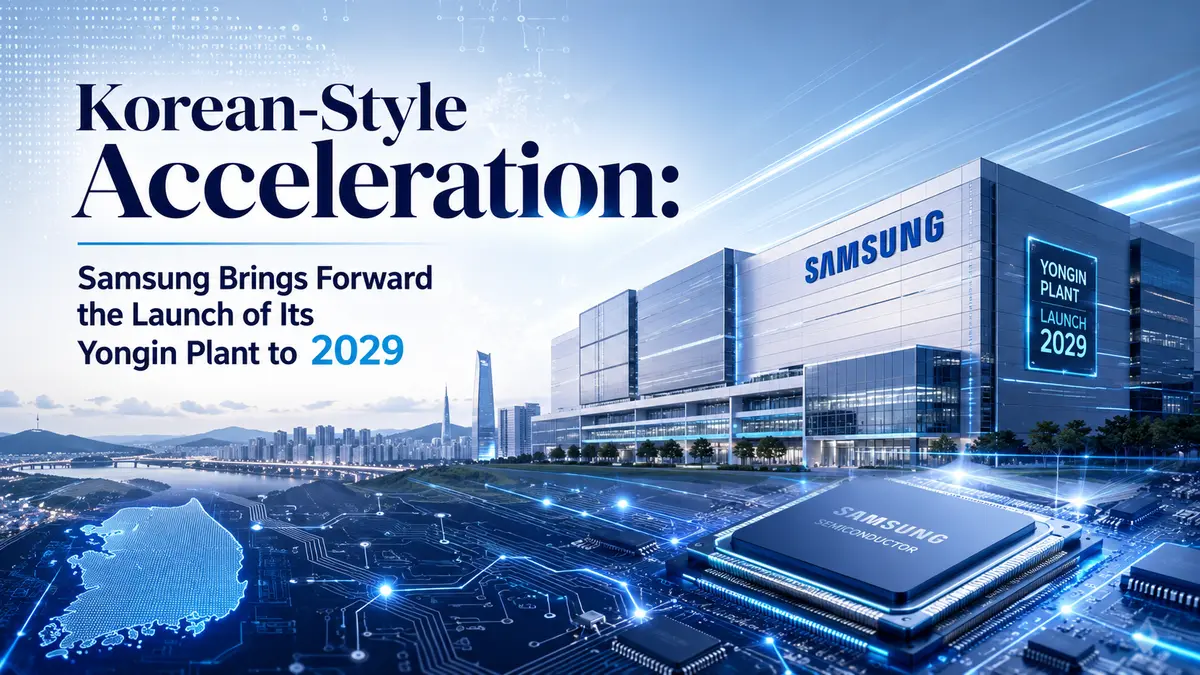
Korean-Style Acceleration: Samsung Brings Forward the Launch of Its Yongin Plant to 2029
Introduction: The Race for Semiconductor Leadership
In the semiconductor industry, time is not merely money. It is the very essence of survival. Every day of delay means lost revenue, surrendered market share, and an advantage handed to competitors. Samsung Electronics, the world’s largest memory chip manufacturer, understands this perfectly. That is why the news that the company plans to begin operating its first plant in the Yongin cluster as early as 2029 sounds like a warning signal to its rivals.
The original plans were more conservative: the plant was expected to open one or two years later. However, the South Korean government decided to accelerate the development of the Yongin National Industrial Complex, a strategic project of national importance. Samsung, as the primary beneficiary of this decision, is adjusting its schedule accordingly.
What is driving this acceleration? What plans does Samsung have for Yongin? And how will this change affect the global semiconductor landscape? Let us take a closer look.
Yongin: The New Capital of South Korean Microelectronics
Strategic Location
Yongin is located south of Seoul, close to several of South Korea’s other major industrial clusters. This location was not chosen by chance. Its geographical proximity to existing manufacturing facilities in Pyeongtaek, research centers, and major transportation routes creates synergies that make Yongin an ideal location for a new semiconductor powerhouse.
The South Korean government sees Yongin not simply as another industrial complex, but as the country’s primary center for next-generation semiconductor production. It is a strategic project of national importance intended to strengthen South Korea’s position in the global semiconductor race.
The First of Six
The plant scheduled to begin operations in 2029 will be only the first of six semiconductor facilities planned for construction within the Yongin industrial complex. This means Samsung is not merely building a single factory. It is laying the foundations for an entire cluster that will continue to expand and develop for many years.
Each of the six plants will likely specialize in different types of semiconductor products. This will allow Samsung to diversify its manufacturing capabilities and reduce its dependence on fluctuations in demand for individual chip categories.
Breathtaking Investment Figures
KRW 2,030 Trillion in Pyeongtaek and Yongin
Last month, Samsung announced plans to invest KRW 2,030 trillion in its semiconductor clusters in Pyeongtaek and Yongin. To understand the scale, KRW 2,030 trillion is approximately USD 1.35 trillion. This amount exceeds the gross domestic product of many countries.
These investments will be used to construct new plants, modernize existing facilities, develop new technologies, and expand research centers. It is the largest investment plan in Samsung’s history and one of the largest in the history of the global semiconductor industry.
KRW 400 Trillion in Gwangju
However, Samsung is not limiting its ambitions to Pyeongtaek and Yongin. The company has also announced its intention to invest KRW 400 trillion in the construction of two new chip manufacturing plants in Gwangju, a city located approximately 270 kilometers south of Seoul.
Gwangju is already an important industrial center, and the new plants will strengthen its position in the semiconductor sector. This also indicates that Samsung is considering expanding its geographical presence within South Korea, creating jobs and stimulating regional development.
Reasons for the Acceleration
The Government’s Decision
The main reason Samsung is accelerating the launch of its Yongin plant is the government’s decision to speed up the development of the National Industrial Complex. The South Korean government likely recognizes that time is working against the country. China is actively developing its semiconductor industry, the United States is imposing restrictions on technology exports, and Taiwan remains the leader in the production of the most advanced chips.
Under these circumstances, South Korea cannot afford to delay. Accelerating the development of the Yongin complex is a way to preserve the country’s competitiveness and prevent it from falling behind in the race for technological leadership.
Competition with TSMC and Intel
Samsung competes with TSMC for leadership in the production of the world’s most advanced chips. Taiwan-based TSMC is the world’s largest contract semiconductor manufacturer. Intel, the American technology giant, is also actively expanding its manufacturing capabilities as part of its IDM 2.0 strategy.
Accelerating the construction of plants in Yongin will allow Samsung to increase its production capacity more quickly and catch up with its competitors. Every year of delay could mean losing market share and falling further behind technologically.
Demand for Semiconductors
Despite cyclical fluctuations, long-term demand for semiconductors remains strong. Artificial intelligence, cloud computing, electric vehicles, and the Internet of Things all require an increasing number of chips. Samsung wants to be prepared to meet this demand, and doing so requires new production capacity.
Bringing forward the launch of the Yongin plants will allow the company to respond more quickly to rising demand and secure a stronger position in the market.
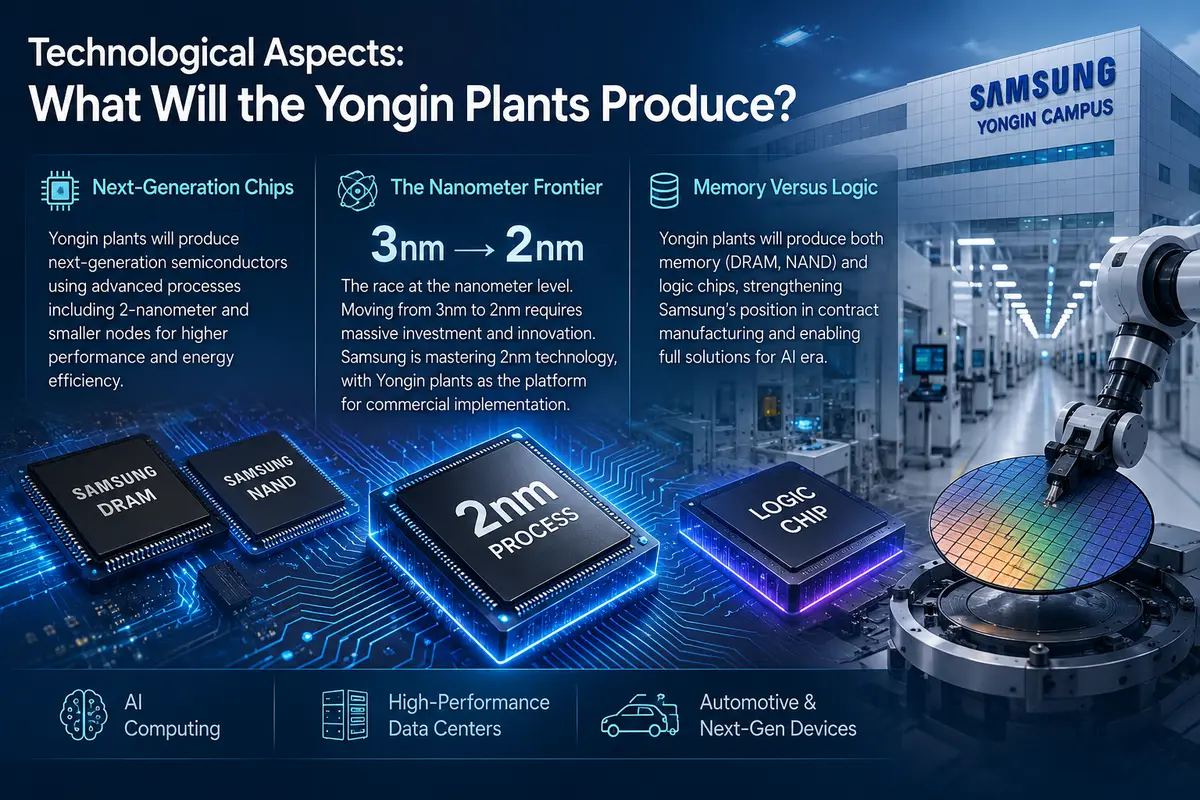
Technological Aspects: What Will the Yongin Plants Produce?
Next-Generation Chips
The Yongin plants will focus on producing next-generation semiconductors. This means they will use the most advanced manufacturing processes, including 2-nanometer technology and smaller nodes. These technologies make it possible to create chips with higher performance and greater energy efficiency.
This is critically important for Samsung. The company wants not only to maintain its leadership in memory chips but also to strengthen its position in other segments, including logic chips and contract manufacturing. The Yongin plants are expected to serve as the foundation for this growth.
The Nanometer Frontier
The current semiconductor technology race is taking place at the nanometer level. Moving from 3-nanometer to 2-nanometer technology represents an enormous leap that requires vast investments and extraordinary engineering efforts. Samsung is actively working to master the 2-nanometer manufacturing process, and the Yongin plants will become a platform for its commercial implementation.
It is important to note that manufacturing processes are becoming increasingly complex, while the cost of developing new technologies is growing exponentially. Samsung’s investment in Yongin is a bet that the company will be able to remain at the forefront of technological progress despite rising expenses.
Memory Versus Logic
Samsung has traditionally been associated with memory products, particularly DRAM and NAND. In recent years, however, the company has been actively developing its contract manufacturing business for logic chips in an effort to challenge TSMC. The Yongin plants will likely produce both memory and logic chips, allowing Samsung to offer customers a broader range of services.
This is especially important in the context of artificial intelligence. AI systems require both high-performance computing chips and large amounts of memory. Samsung wants to become a full-service supplier for AI customers.
Impact on the Global Semiconductor Market
An Increase in Supply
Samsung’s new plants will increase the global supply of semiconductors. This could help balance the market and reduce the chip shortages that periodically affect the industry. However, it could also result in oversupply and falling prices, particularly in the memory segment.
The memory market has historically been cyclical, and Samsung’s new capacity could accelerate the arrival of the next downturn. In the long term, however, increased production is justified by growing demand for chips.
A Shift in the Balance of Power
Accelerating the construction of the Yongin plants strengthens Samsung’s position in the global market. The company will become more resilient to geopolitical risks, including conflict between the United States and China or potential threats surrounding Taiwan.
This development will also put pressure on Samsung’s competitors. TSMC and Intel will be forced to respond to Samsung’s expansion, which could lead to additional investment and new technological breakthroughs.
The Geopolitical Factor
Like Taiwan, South Korea is at the center of geopolitical tensions between the United States and China. Accelerating the development of the Yongin semiconductor cluster is not only an economic decision but also a political one. The government wants to demonstrate that the country can protect its critical industries and reduce its dependence on imported technologies.
In addition, having powerful domestic chip production capabilities strengthens national security. In the event of a geopolitical crisis, South Korea will be able to rely on its own semiconductor manufacturing infrastructure.
What This Means for Investors
Long-Term Prospects
For Samsung investors, the accelerated construction of the Yongin plants is a positive signal. The company is demonstrating its willingness to invest in the future and strengthen its market position. In the long term, this should contribute to revenue and profit growth.
However, it is important to remember that investments of this magnitude take time to generate returns. In the short term, they could put pressure on the company’s profit margins.
Stock Volatility
Samsung shares, like those of other semiconductor companies, can be volatile. News of new investments may cause a short-term rise in the share price, but it could also trigger a decline if investors become concerned about increasing capital expenditure.
Investors should closely monitor the company’s financial results and indicators of semiconductor demand. The success of Samsung’s investments will depend on how quickly demand for next-generation chips increases.
Conclusion: A Race for Survival
Moving the opening of the Yongin plant forward to 2029 is not simply a scheduling adjustment. It is a strategic move that reflects Samsung’s ambitions and its recognition that the semiconductor industry is engaged in a state of permanent warfare.
Samsung is investing KRW 2,030 trillion in Pyeongtaek and Yongin and KRW 400 trillion in Gwangju. These are not merely numbers. They represent a bet that semiconductors will remain the foundation of the global economy for decades to come. They reflect a belief that artificial intelligence, cloud computing, and electric vehicles will create enormous demand for chips.
The South Korean government is supporting this bet by accelerating the development of the Yongin National Industrial Complex. It understands that time is working against the country and that further delay is not an option.
Competitors are not standing still. TSMC is building new plants in the United States and Japan. Intel is increasing its production capacity in Europe and North America. Chinese companies, although constrained by export sanctions, are investing heavily in their own technologies.
In this environment, Samsung cannot afford to fall behind. Every year of delay means lost market share. Accelerating the opening of the Yongin plant is therefore not a luxury but a necessity. It is a matter of survival in an industry where technological progress moves at extraordinary speed and the cost of a mistake can reach billions of dollars.
For South Korea, Yongin is becoming a symbol of technological sovereignty and economic independence. For Samsung, it is the foundation of future growth. For the global economy, it represents another step toward a digital future in which chips become as essential as air and water.
Investors are closely watching this process. They see that Samsung is not simply building factories—it is redrawing the map of the global semiconductor industry. Those who correctly assess these changes may be able to generate substantial long-term returns.
However, the path to success will not be easy. The memory market remains cyclical, geopolitical risks persist, and competition continues to intensify. Samsung will have to overcome these challenges to realize its ambitions in Yongin and its other semiconductor clusters.
History has shown, however, that the South Korean company knows how to overcome difficulties. If Samsung succeeds in launching the Yongin plant in 2029, it will represent an important milestone on the company’s path toward global leadership in the semiconductor industry.

Comments
No comments yet. Be the first to share your thoughts!
Authentication Required
You must be logged in to post a comment.