

Golden Reversal: Why Hopes for Peace with Iran Sent Gold Prices Soaring
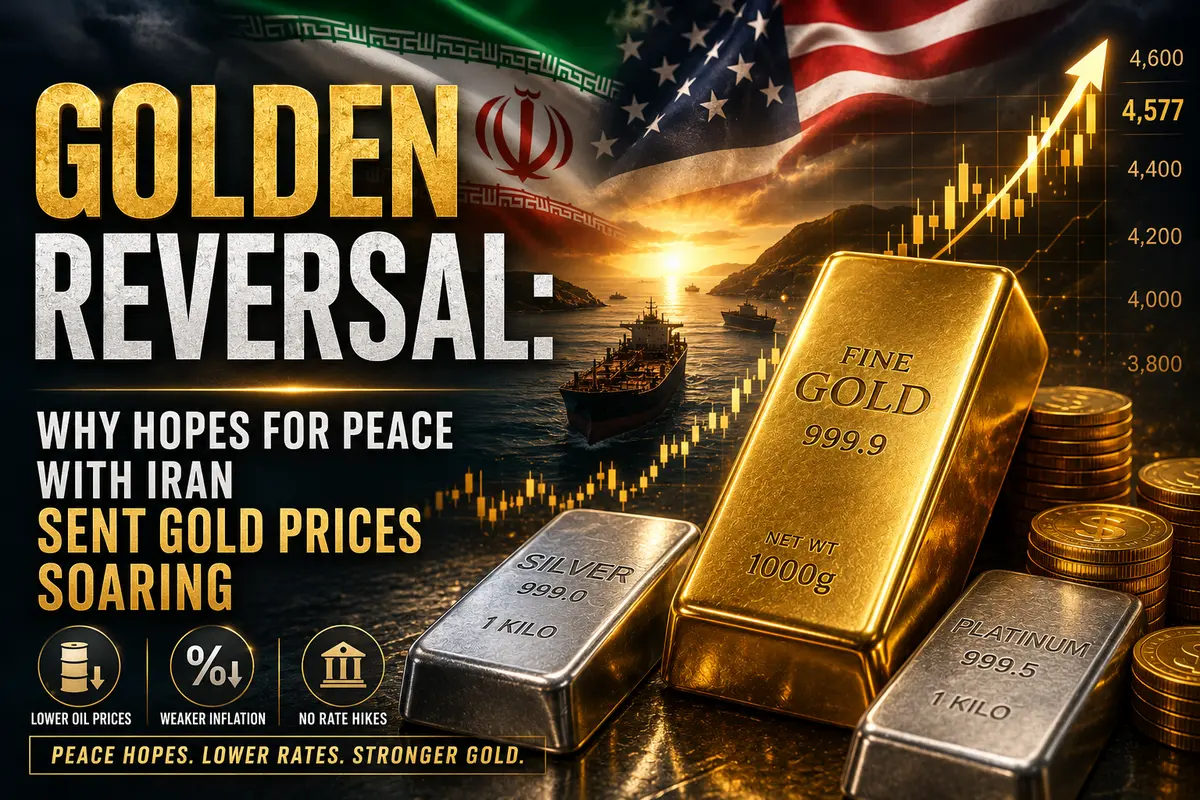
Monday’s Asian trading session delivered a surprise that many gold traders did not expect. Spot gold jumped by one and a half percent, reaching $4,577 per ounce. Futures followed, gaining 1.2% and climbing above $4,600. Silver posted an even more explosive move — up 3.8% in a single session. Platinum added 2%. The entire precious metals sector seemed to awaken from hibernation and surge higher. And the reason behind this rally was not fear or panic, but something entirely opposite — hopes for peace.
At first glance, this seems paradoxical. Gold is traditionally viewed as a safe-haven asset, a refuge during wars and crises. When the world descends into chaos, the yellow metal usually rises, and when peace appears on the horizon, it tends to fall. But today we are witnessing the opposite. The explanation lies in how the conflict with Iran has affected gold over recent months — not directly, but through a complex chain of macroeconomic consequences.
How War Suppressed Gold — and Why Peace Is Setting It Free
The war with Iran triggered an energy crisis. The disruption of shipping through the Strait of Hormuz pushed oil prices above $110 per barrel. Rising energy costs accelerated inflation worldwide. Higher inflation, in turn, forced the Federal Reserve and other major central banks to discuss raising interest rates. And it was this final link in the chain — the threat of higher rates — that became gold’s biggest enemy.
Gold does not generate income. It pays no dividends, no coupons, no interest. When interest rates rise, the opportunity cost of holding gold becomes enormous. Why hold bullion sitting in a vault when you can buy Treasury bonds and earn a guaranteed return? That logic has pressured gold for months. The war was raging, geopolitical risks were extreme, yet gold failed to rally because markets focused not on the conflict itself, but on its monetary consequences.
Now the chain is unwinding in reverse. Trump stated that the framework for a peace agreement with Iran is “largely agreed upon.” According to media reports, the potential deal includes extending the ceasefire and, critically, reopening shipping through the Strait of Hormuz. That would restore oil supplies to global markets. Restored supply means lower oil prices. Lower oil prices mean weaker inflationary pressure. Lower inflation means the Fed may not need to raise rates. And the absence of rate hikes is a green light for gold.
That is precisely why hopes for peace pushed precious metal prices sharply higher. The market finally saw light at the end of the tunnel — not the light of explosions and fires, but the light of normalization, where central banks no longer need to tighten policy to the extreme. Gold reacted immediately, recovering losses accumulated during months of inflation fears.
The Dollar and Bond Yields Retreat
At the same time as oil prices fell and inflation expectations eased, two additional developments supported gold. The U.S. dollar weakened, and Treasury yields declined.
The relationship between the dollar and gold is almost physically inverse. Gold is priced in dollars. When the U.S. currency strengthens, gold becomes more expensive for holders of other currencies, demand weakens, and prices fall. When the dollar weakens, gold becomes cheaper for the rest of the world, demand rises, and prices move higher. On Monday, the dollar index declined, giving gold an immediate tailwind.
Bond yields are the second factor. In recent weeks, yields on 10-year and 30-year U.S. Treasuries surged to multi-year highs. That made bonds an extremely attractive alternative to gold. Why buy a non-yielding metal when you can earn nearly 5% annually in dollar-denominated government debt? But once yields started to fall — driven by softer inflation expectations — that competitive advantage began to fade. Gold once again started to look attractive, especially for investors who believe long-term inflation will remain above pre-crisis levels even if it temporarily cools.
Silver and Platinum: The Younger Brothers Gain Momentum
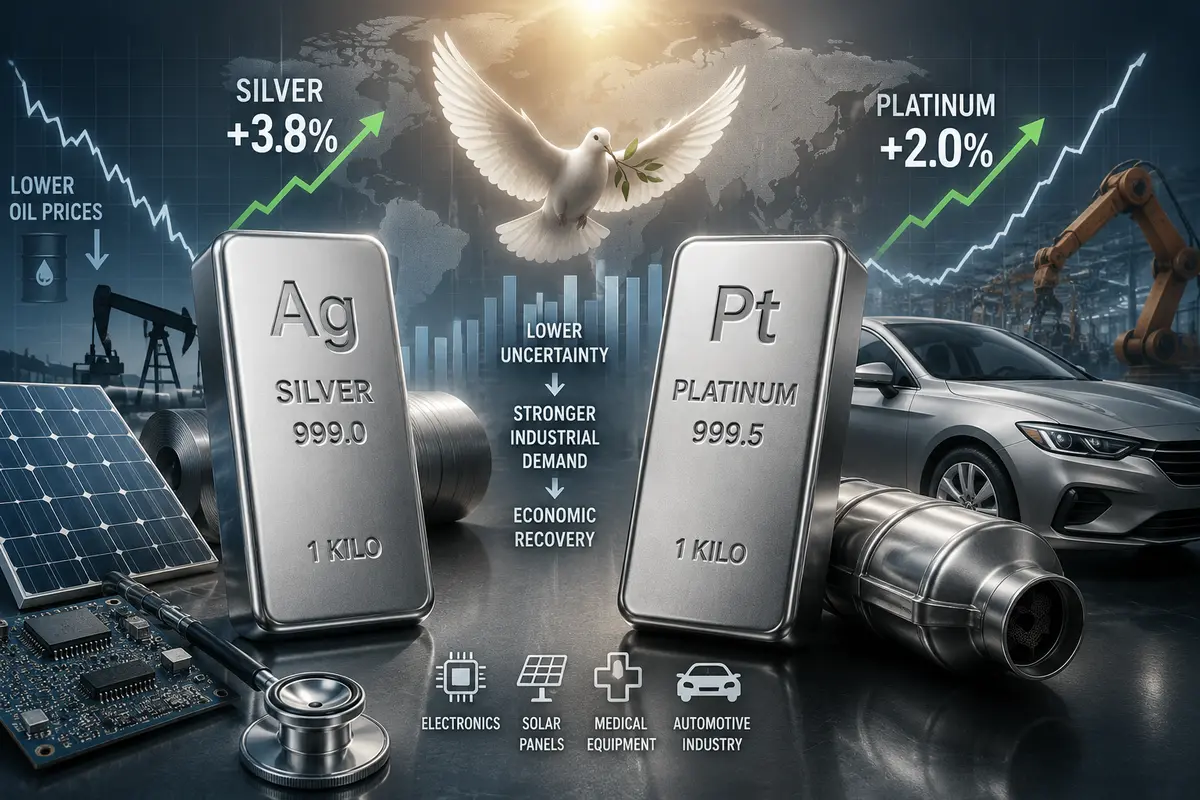
Silver’s 3.8% surge in a single session deserves special attention. Silver is a metal with a dual nature. On one hand, it is a precious metal that traditionally follows gold. On the other, it is an industrial metal whose demand depends heavily on the global economy. And here, hopes for peace play an especially powerful role.
Peace with Iran would mean not only lower oil prices, but also a broader reduction in geopolitical uncertainty. Lower uncertainty encourages industrial investment, equipment purchases, and construction activity. Silver is widely used in electronics, solar panels, medical equipment, and the automotive industry. If the global economy gets a chance to normalize, industrial demand for silver could increase substantially. The market is already pricing in that potential.
Platinum’s 2% rise tells a similar story. The metal is critical for the automotive industry because it is used in catalytic converters. Peace, lower oil prices, and a recovery in normal economic activity all support a rebound in the auto sector — and therefore stronger platinum demand.
Trump Is Not Rushing: Peace Is Far from Guaranteed
Despite Monday’s wave of optimism, it would be naïve to assume that a peace deal with Iran is already finalized. After making his bold statement about progress, Trump immediately added that he is in no hurry to close the agreement. The U.S. naval blockade of Iran remains in place. Moreover, Iranian officials have largely rejected Washington’s demand to surrender existing stockpiles of enriched uranium — one of the key points in the negotiations.
This means that even after jumping 1.5%, gold remains trapped in uncertainty. If negotiations do lead to a signed agreement, the rally could continue as yields decline further and the dollar weakens. But if talks collapse, gold could fall sharply as fears of future rate hikes return. Paradoxically, peace now matters more for gold than war. During the conflict, gold suffered from the monetary consequences of war. Peace removes those consequences — and that is exactly why the yellow metal reacted so aggressively to the weekend headlines.
A Market That Has Learned to Think Several Steps Ahead
Monday’s gold rally is a lesson in how modern financial markets no longer react to events in a simplistic way. In the past, news of progress in peace negotiations would have caused gold to fall because the geopolitical risk premium would disappear. Today, the same news triggers a rally because markets are calculating the chain of consequences several steps ahead. Peace lowers oil prices, lower oil prices reduce inflation, lower inflation removes the threat of higher interest rates, and the removal of that threat becomes a signal to buy gold.
This does not mean gold has stopped being a safe-haven asset. It means the nature of the threat has changed. The biggest danger for gold in recent months was not the war itself, but the monetary response to the war. And as soon as that threat began to recede, gold was finally able to breathe freely again.
The days and weeks ahead will determine whether this move marks the beginning of a new bullish trend or merely a temporary correction in a thin holiday market. Much will depend on what Trump, Iranian leaders, and incoming macroeconomic data say next. But one thing is certain: gold has once again shown its ability to surprise. And its logic, however paradoxical it may seem, remains perfectly rational. It simply requires the ability to think not one move ahead — but three.

Comments
No comments yet. Be the first to share your thoughts!
Authentication Required
You must be logged in to post a comment.