

Gold Falls Again: What Is Behind the Decline During the Asian Session?
Thursday Morning: Gold Opens in Negative Territory
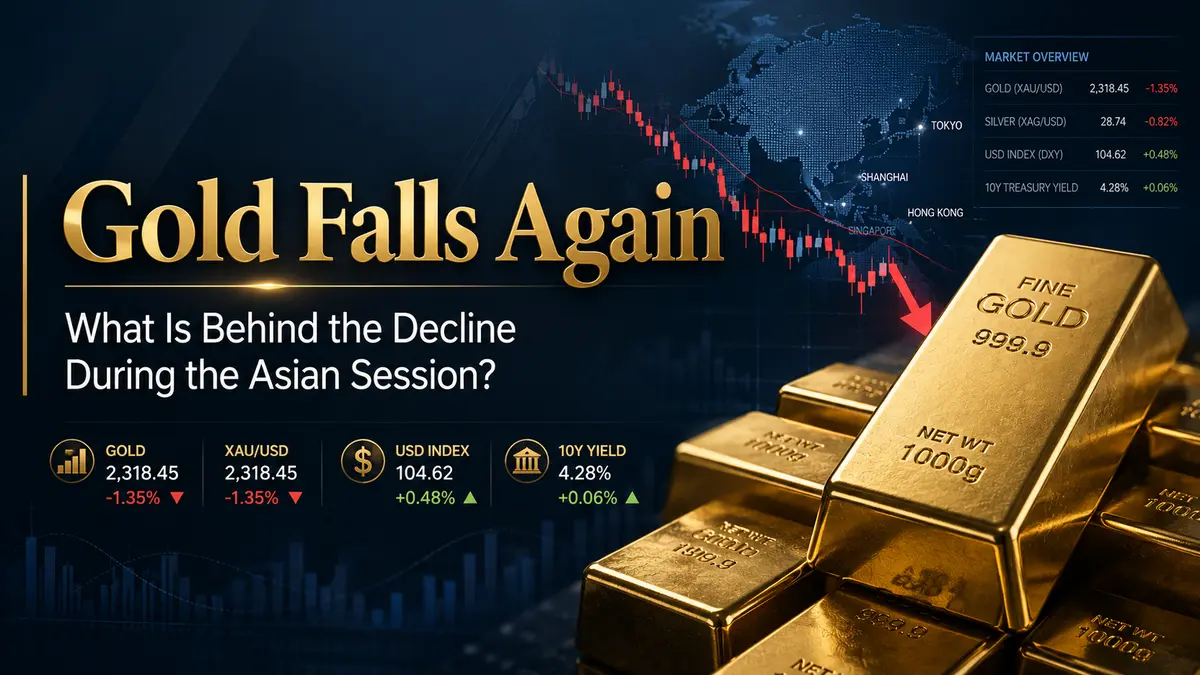
Asian trading on Thursday began with the gold market deciding to cool off slightly. COMEX gold futures for August delivery fell by approximately half a percent, settling at around $4,032 per troy ounce. At first glance, the decline appears modest—just 0.49%. However, in the gold market, even movements of this size are rarely accidental. Behind every change in price are investors’ expectations, fears, and calculations.
Interestingly, the decline is taking place against a backdrop of rather contradictory signals from global markets. On the one hand, the US dollar strengthened slightly, with the USD Index rising by a symbolic 0.03% to 100.30. This movement can hardly be described as a confident surge, but because gold generally has an inverse relationship with the US currency, even a slight indication of dollar strength can be enough to trigger a price correction.
On the other hand, the geopolitical situation remains tense, which would normally encourage investors to move into safe-haven assets—gold above all.
However, markets, as we know, do not always behave according to textbooks. The current dynamics of gold provide a perfect example.
Technical Picture: The Levels Everyone Is Watching
Technical indicators present a highly revealing picture. The low of today’s session was $3,990.40 per ounce. This is not merely a random figure—it represents a significant support level that traders have been monitoring for several weeks. A break below this level could open the way for a deeper correction, but buyers are continuing to defend it for now.
Resistance is located considerably higher, at $4,144.60. The price is fluctuating between these two levels as it attempts to find equilibrium. A range of almost $150 is substantial for gold, but looking at the metal’s performance over recent months, the market has already become accustomed to such price swings. Volatility has become the new normal, and investors are gradually learning to live with it.
It is also worth noting that the current decline follows a prolonged period of strong gold price growth. Many market participants are taking profits, which is entirely normal after a solid rally. The only question is whether this is a temporary pause or the beginning of a deeper correction.
Silver and Copper: Diverging Movements in the Commodity Market
While gold was declining, its smaller counterpart, silver, also came under pressure. Silver futures XAGUSD ... for September delivery lost 0.16%, falling to $57.34 per ounce. The decline was not as sharp as gold’s, but the overall trend is clearly visible.
Silver has always been more volatile than gold, and its movements often serve as an early indication of more significant changes across the precious metals market.
Copper HGUSD ... , meanwhile, surprised the market by moving higher. Futures for the industrial metal with September delivery gained 0.49%, reaching $6.41 per pound. This is an interesting signal: while investors remain cautious about gold, they are still prepared to invest in copper, which reflects expectations for industrial activity.
Could the market be less pessimistic about global economic growth than it initially appears?
Alternatively, the move may simply reflect individual developments from China, the world’s largest consumer of copper. Any indication of new stimulus measures from Beijing could explain the increased demand for the industrial metal. Even without specific news, however, copper’s rise against the backdrop of falling gold prices appears unusual.
Why Is Gold Falling When It Should Be Rising?
This brings us to the most important question. Against a backdrop of geopolitical tensions, instability in the Middle East, and general nervousness across financial markets, gold XAUUSD ... would normally be expected to rise.
The traditional logic is straightforward: uncertainty leads investors toward safe-haven assets, which pushes gold prices higher. In practice, however, the situation is more complicated.
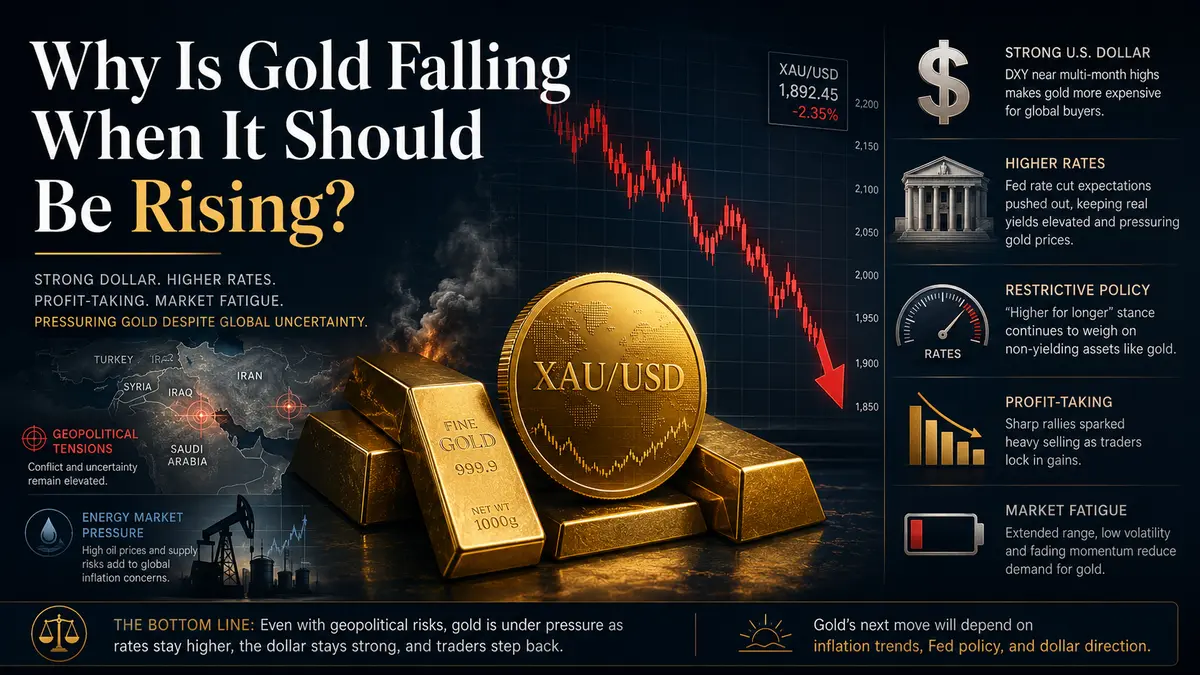
First, weakness in the dollar, which has also been discussed in relation to Asian currencies, does not necessarily lead to an immediate rise in gold. Numerous other factors are involved, including expectations regarding interest rates.
If markets believe that the Federal Reserve will maintain interest rates at their current level, the opportunity cost of holding gold remains high. Gold does not generate interest income, so when rates are elevated, investors often prefer to hold dollars or other income-generating assets.
Second, despite the seriousness of the current situation in the Middle East, it has not yet resulted in actual disruptions to energy supplies. Markets gradually become accustomed to recurring news, and each new US strike on Iranian facilities no longer provokes the same intense reaction as the first one.
This phenomenon is sometimes described as “news fatigue,” and it is currently working against gold.
Third, Thursday morning’s decline may simply be a technical correction following the previous advance. Gold has gained significantly over recent weeks, and many traders holding long positions have chosen to take profits.
The downward movement may therefore have little connection to fundamental factors and may simply reflect internal market dynamics and investor psychology.
What Comes Next: Possible Scenarios for Gold
Forecasting gold prices under current conditions is an uncertain exercise, but several key scenarios can be identified.
The first scenario is a continuation of the correction. If the dollar continues to strengthen and geopolitical tensions do not escalate to a critical level, gold could test lower price levels.
The next major support level is located near $3,950. A break below it could open the way toward $3,800. However, this scenario currently appears relatively unlikely, as too many factors continue to support gold at elevated levels.
The second scenario is consolidation. Gold may remain within its current range of approximately $3,990 to $4,140 while waiting for new market drivers.
This is probably the most realistic outcome over the next several days. The market appears to be saying, “We will wait until the situation becomes clearer.” There is nothing unusual about such a period of waiting, as consolidation often precedes a powerful price movement.
The third scenario is a resumption of growth. If new negative developments emerge—such as actual disruptions to oil supplies or an escalation of the conflict into a broader regional confrontation—gold could quickly return above $4,100 and potentially reach new highs.
The geopolitical premium currently included in the gold price does not appear excessive, meaning that further upside potential remains.
The Dollar and Gold: A Complex Dance
The relationship between the dollar and gold remains central to understanding the current market dynamics. As noted earlier, the USD Index increased slightly to 100.30, but this was a relatively insignificant movement.
The dollar has lost considerable ground over recent weeks after retreating from its highs, which theoretically should have supported gold. Yet this support has not materialized.
Why?
The answer is that the market is currently focused on inflation expectations. US consumer and producer inflation figures came in below forecasts. On the one hand, softer inflation weakens the dollar because it reduces the need for tighter monetary policy. On the other hand, it also reduces the attractiveness of gold as an inflation hedge.
It may sound paradoxical, but when inflation is not accelerating, the need to hold gold as a protective asset declines slightly.
In addition, there is growing discussion in the market that US inflation may have already passed its peak. This means real interest rates could remain elevated for some time.
That represents a direct challenge for gold because high real rates increase the opportunity cost of holding the metal and make it less attractive compared with income-generating assets.
Markets Are Waiting for Signals
Looking at the broader picture, the current decline in gold is not a catastrophe but a normal market correction. Investors—particularly institutional participants—are currently processing an enormous volume of information, ranging from inflation data and geopolitical news to statements from central bank officials and movements in industrial metals.
Gold has always been an asset that requires patience. It does not rise every day, and its declines often create attractive entry points for long-term investors.
The key question is how deep the current correction will become and what signals the market will receive over the next several days.
Silver is also declining, but at a slower rate, which may indicate that the weakness in gold is temporary. Silver frequently moves more aggressively during both rallies and downturns, so its more limited decline could suggest that sellers are not entirely confident in their positions.
Copper’s rise adds another interesting detail to the picture. As an industrial metal, copper is highly sensitive to expectations regarding economic growth. The fact that copper is rising while gold is falling may indicate that markets are not expecting a global recession.
Without the threat of a recession, there is less reason for investors to make panic-driven purchases of gold.
Conclusion: A Decline or an Opportunity?
The current fall in gold futures during Thursday’s Asian session appears to be more of a technical correction than the beginning of a long-term downward trend.
The fundamental factors supporting gold have not disappeared. Geopolitical tensions remain elevated, the dollar is not demonstrating sustained strength, and central banks in many countries continue to purchase gold to diversify their reserves.
The support and resistance levels visible on the charts indicate that the market is currently searching for equilibrium. Buyers defended the session low near $3,990, and if this support level holds, a rebound could occur in the coming days.
However, everything will depend on external developments. If the conflict in the Middle East enters a new phase, gold could quickly recover its losses. If the news environment remains relatively calm, the metal will most likely continue trading within a range while waiting for new catalysts.
For investors, the current situation is not a reason to panic but an opportunity to reassess their positions. Gold remains one of the most important defensive assets in any investment portfolio, and temporary corrections often create favorable entry points.
The most important principle is to avoid emotional decisions and remember that financial markets always move in cycles.

Comments
No comments yet. Be the first to share your thoughts!
Authentication Required
You must be logged in to post a comment.