

Europe’s Debt Nightmare: How $100 Oil and Bond Yields Are Suffocating the Economy
A Return to 2011: Bund Yields at Record Highs and Inflation at the Door
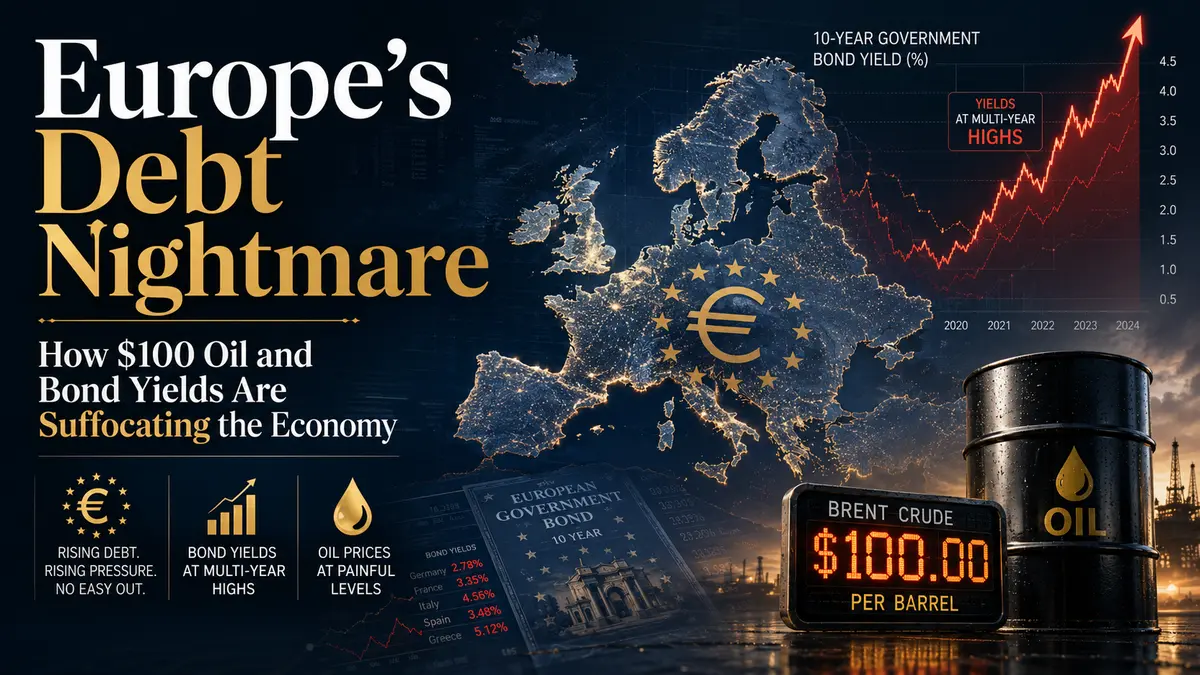
Friday morning brought European markets yet another wave of anxiety. Eurozone government bond yields remained close to multi-year highs, and this stagnation at the top is not a sign of stability but a symptom of deep economic distress. Two-year German Bund yields BONDUSD ... , which react sensitively to every move by the European Central Bank, declined to 2.85%. However, even this decrease is misleading: yields remain at levels not seen since mid-2024. Meanwhile, ten-year Bunds, the benchmark for the entire European bond market, are trading at around 3.19%, marking a return to borrowing costs last recorded in the distant year of 2011.
At that time, the world was struggling with the consequences of the global financial crisis, Greece was on the verge of default, and the European Central Bank was only beginning its battle to preserve the euro. Today’s situation is different, but no less alarming. The main driver behind the rise in yields has been oil, which suddenly surged above $100 per barrel. The reason is not merely seasonal demand, but the genuine threat of military strikes against key transit routes in the Middle East, combined with new US tariffs on European goods. It is a perfect storm hitting the eurozone economy, and the bond markets were the first to feel its full force.
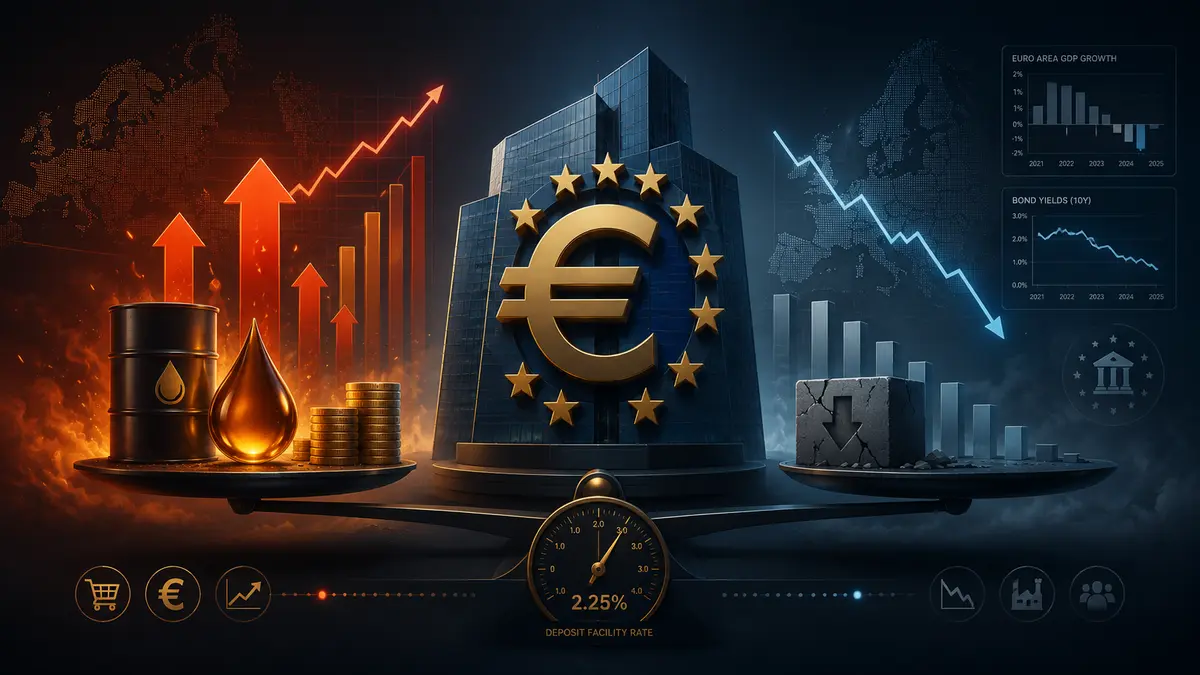
For Europe, which is already balancing on the edge of recession, such a surge in energy prices is potentially catastrophic. The ECB, which had only just kept its deposit facility rate unchanged at 2.25%, explicitly warned that the full inflationary impact of the energy shock had not yet materialized. In other words, conditions are likely to get worse—considerably worse.
The Middle East Factor: An Oil Shock Hitting European Wallets
To understand why oil has such a powerful effect on European bonds, it is necessary to recognize how dependent the eurozone economy is on imported energy. Unlike the United States, which became a net oil exporter following the shale revolution, or Russia, with its enormous reserves, Europe is forced to purchase oil and gas on global markets. When those markets are disrupted, Europe is among the first to suffer.
In recent days, tensions in the Middle East have reached a new level. Threats of large-scale military strikes against major transit routes are not merely rhetoric. Strikes against Iran and attacks by Yemen’s Houthis on tankers in the Red Sea create a genuine risk of supply disruptions. Oil prices are already incorporating a significant risk premium, which could rise even further if the conflict escalates.
There is also a second factor: US tariffs on European goods. The Trump administration, which has never concealed its skepticism regarding the trade deficit with Europe, introduced new duties, placing additional pressure on the European economy. European exporters, already struggling with expensive energy, must now pay even more for access to the US market. This reduces profitability, discourages investment, and ultimately slows economic growth.
As a result, Europe is facing a paradoxical situation. The European Central Bank is tightening monetary policy in an attempt to contain inflation, while the oil shock is adding fuel to the fire and pushing prices even higher. Bond yields are rising because investors are demanding greater compensation for inflation risk. However, higher yields also increase borrowing costs for governments and businesses, further weakening the economy. It is a vicious cycle from which Europe will find it extremely difficult to escape.
The Periphery Under Pressure: Italian and French Debt as a Warning Signal
The so-called peripheral countries of the eurozone—Italy, France, Greece, and Portugal—are facing particularly severe pressure. Their debt burdens were already high, and now, as bond yields rise, the cost of servicing that debt is becoming increasingly difficult to sustain. Ten-year Italian government bonds are yielding approximately 4.02%, a serious figure considering that the Italian economy is growing at a very slow pace.
The spread between Italian and German bond yields—a key barometer of investor confidence in Southern European countries—remains close to 81 basis points. This means that investors are demanding an additional premium of almost 0.8% per year to invest in Rome’s debt rather than Berlin’s. During calmer periods, this spread tends to be narrower, but markets are clearly nervous now.
France, traditionally regarded as a less risky borrower, is also under pressure. Its debt burden has increased in recent years, forcing the government to allocate a growing share of its budget to debt servicing. This limits its ability to finance social programs and public investment. At a time when energy-driven inflation is already squeezing household finances, the government has increasingly limited room for maneuver.
The situation is further complicated by the fact that when the ECB raises interest rates to fight inflation, it automatically increases borrowing costs for every eurozone member state. The consequences, however, are uneven. Germany, as the region’s strongest economy, can withstand the pressure with relatively limited damage, while Italy or Greece may suffer far more severely. This creates risks for the stability of the eurozone as a whole because financial problems in one country can spread to others through closely interconnected banking systems.
The Corporate Borrowing Crisis: Expensive Credit Is Suffocating Businesses
Government debt problems are only one side of the issue. The other, equally important side is corporate borrowing. When sovereign bond yields rise, they pull corporate borrowing rates higher as well. Loans become more expensive, forcing companies to reduce their investment programs.
According to the latest ECB data, eurozone banks have already moderately tightened their lending standards for corporate loans and consumer mortgages. This means that obtaining credit has become both more difficult and more expensive. The situation is particularly painful for small and medium-sized enterprises, which form the backbone of many European economies. Unlike major corporations, they do not have direct access to international capital markets and remain dependent on local banks.
When energy becomes more expensive and credit becomes less accessible, business profitability declines. Companies are forced to cut jobs, postpone expansion plans, and potentially even close down operations. This, in turn, reduces tax revenues, further aggravating government budget problems. It is yet another turn in the same vicious cycle.
Energy-intensive industries such as chemicals, metals, and automobile manufacturing are especially vulnerable. They consume large amounts of energy, which means that rising oil and gas prices hit them hardest. Germany, Europe’s industrial heartland, is suffering particularly severely. Its economy is already showing signs of stagnation, and expensive credit could accelerate this deterioration.
The ECB Caught Between a Rock and a Hard Place: Inflation Versus Recession
The European Central Bank has found itself in an extremely difficult position. On the one hand, it must combat inflation, which is accelerating due to the oil shock. On the other hand, raising interest rates to control inflation slows economic growth and could push the region into recession. It is a classic monetary policy dilemma, and the ECB has no simple solution.
At its latest meeting, the bank kept the deposit facility rate unchanged at 2.25%, while warning that the inflationary impact of the energy shock had not yet been fully reflected in the economy. This suggests that further rate increases may eventually be required. However, every additional step in that direction would intensify pressure on economic activity and national budgets.
Some analysts are already warning about the risk of stagflation—a combination of economic stagnation and persistently high inflation. This is one of the most dangerous scenarios for any central bank because it is impossible to address both problems simultaneously with conventional monetary policy. If the ECB raises rates to curb inflation, it may trigger a recession. If it keeps rates low, inflation could spiral out of control.
The situation is further complicated by the external nature of the oil shock. The ECB cannot influence global oil prices or US trade policy. It can only respond to the consequences. This means that the central bank will constantly be playing catch-up while the economy continues to suffer.
Impact on Markets and Investors: A Flight to Safety
In such an uncertain environment, investors begin searching for safe-haven assets. German Bunds, despite the rise in their yields, are still considered the safest government bonds in Europe. Yet even their appeal is diminishing because yields are increasing alongside inflation expectations.
European equities are also coming under pressure. Rising energy and borrowing costs are weakening corporate earnings forecasts, prompting investors to shift capital from stocks into bonds, even though bonds do not necessarily provide complete protection against inflation. This is generating volatility across all financial markets, and that volatility is likely to persist over the coming weeks.
Another interesting factor is the behavior of gold. Traditionally, the precious metal tends to appreciate during periods of uncertainty, but its current performance is mixed. On the one hand, investors are seeking protection against inflation. On the other, many prefer the US dollar, which is strengthening amid elevated US interest rates. This creates a complicated investment landscape in which no single asset offers complete security.
Conclusion: Europe at a Crossroads
Friday’s developments in the eurozone bond markets were not merely a technical price movement. They reflected deep structural problems that had been accumulating for years and are now becoming fully exposed. Dependence on imported energy, heavy debt burdens, and vulnerability to external shocks make Europe particularly sensitive to the challenges it is currently facing.
Oil at $100 per barrel is not merely a number. It is a burden placed on consumers, businesses, and governments. It accelerates inflation, slows economic growth, and raises serious questions about the sustainability of Europe’s entire economic model.
The coming weeks and months will be decisive. Will the ECB be able to find a balance between controlling inflation and supporting economic growth? Will the governments of peripheral eurozone countries withstand the pressure of rising interest expenses? Will Europe manage to adapt to the new energy reality? The answers to these questions will determine not only the direction of financial markets but also the lives of millions of people.
For now, investors and analysts continue to watch every movement in bond yields and every fluctuation in oil prices. One thing is certain: calm conditions are unlikely to return to the European debt market anytime soon. Every new day will bring fresh challenges—and new opportunities for those prepared to recognize them.

Comments
No comments yet. Be the first to share your thoughts!
Authentication Required
You must be logged in to post a comment.