

USD/INR – RBI Reserve Accumulation, Crude Import Burdens, and Offshore NDF Market Dynamics
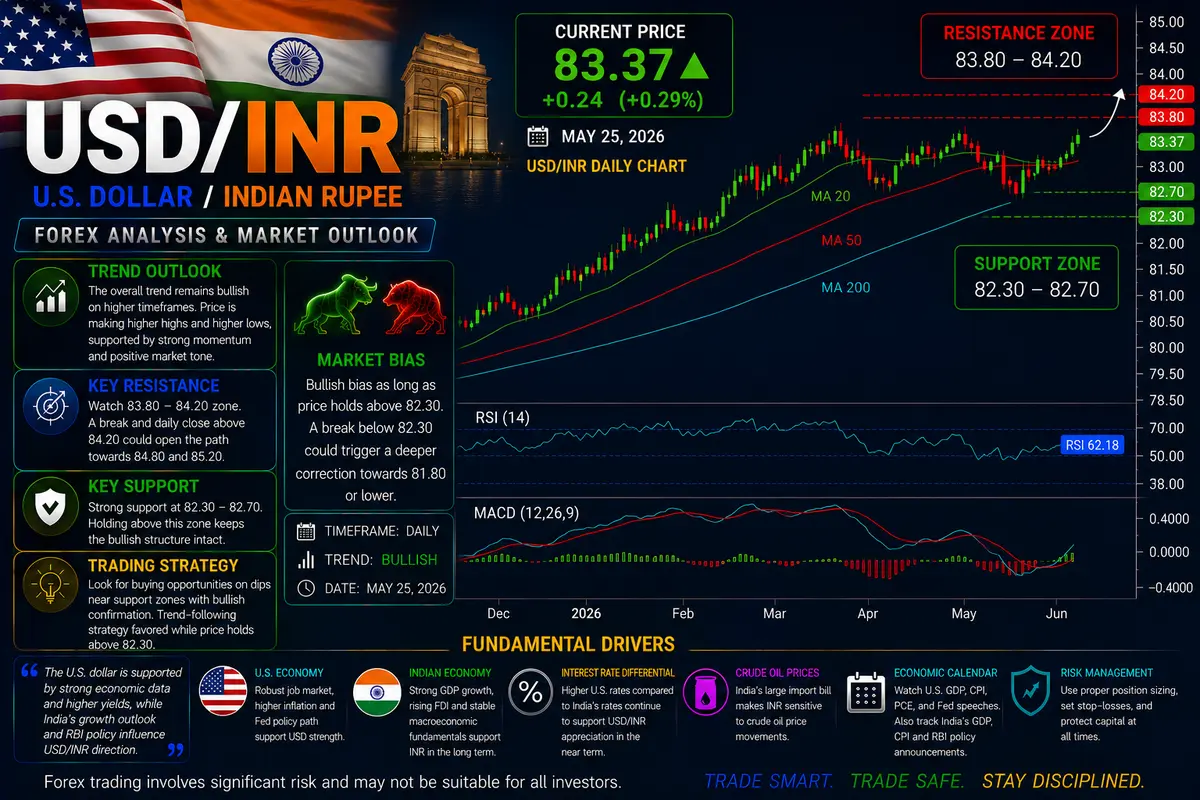
If you take a look at the USD/INR chart over almost any multi-month period, you’ll notice something strange compared to other emerging market currencies. Where pairs like USDZAR ... or USDMXN ... move in wide, jagged swings, USDINR ... trades in flat, horizontal steps separated by sudden, controlled shifts.
That isn’t organic price discovery. It’s the footprint of the Reserve Bank of India (RBI).
The Rupee operates under a managed float where the central bank acts as the dominant buyer and seller on the order book. To trade this pair profitably, you can’t rely on standard technical breakouts. You need to understand how the RBI manages liquidity, how crude oil imports drive commercial dollar demand, and how offshore trading desks interact with the onshore market.
1. How the RBI Controls the Order Book
The Reserve Bank of India doesn’t try to lock the currency to a fixed rate. Instead, its primary goal is to suppress intraday and weekly volatility.
               RBI Market Intervention Mechanics

  Inflow Phase: Heavy foreign investment in stocks & bonds
  -------------------------------------------------------------
  Demand for INR rises  --->  RBI buys USD on spot desks
                        --->  Builds foreign exchange reserves
                        --->  Caps Rupee appreciation

  Outflow Phase: Global sell-off / Energy prices spike
  -------------------------------------------------------------
  Demand for USD rises  --->  RBI sells USD from reserves
                        --->  Supplies dollar liquidity
                        --->  Prevents rapid Rupee depreciation
This intervention style alters standard market behavior in two distinct ways:
-
Inflow Absorption: When international capital flows into Indian equities or corporate debt, the RBI steps in as a dollar buyer. By absorbing foreign currency, the central bank builds its reserve balance while preventing the Rupee from strengthening too quickly.
-
Outflow Smoothing: During global panics or oil price shocks, foreign capital leaves domestic markets. The RBI responds by selling dollars directly into the interbank market, supplying liquidity to meet import demands and dampening potential upside spikes.
Because the central bank operates as a counterparty on both sides of the market, momentum breakouts frequently fail. When price approaches obvious support or resistance zones, central bank intervention usually absorbs the volume, pushing price back into range-bound consolidation.
2. The Crude Oil Transmission Mechanism
India’s current account balance has a permanent structural weakness: a heavy reliance on imported energy.
The country imports over 80% of its crude oil requirements. Because international oil contracts settle in US Dollars, any significant increase in energy prices translates immediately into commercial dollar demand across domestic banks.
-
Rallying Energy Prices: When Brent crude advances, state-run and private refiners must convert larger sums of Rupees into Greenbacks to pay for physical shipments. This commercial order flow creates persistent, real-money buying pressure on USD/INR.
-
Declining Energy Prices: When oil trends lower, India’s monthly import bill shrinks. The reduced demand for dollars relieves pressure on the current account, allowing the currency to stabilize.
Macro traders track Brent crude trends alongside monthly trade deficit data. A sharp rally in energy futures often serves as an early signal that USD/INR will experience upward pressure, regardless of local equity performance.
3. Onshore Spot vs. Offshore NDF Trading
Due to local capital account regulations, trading in USD/INR takes place across two separate markets:
Onshore Spot (Mumbai)
The onshore market operates out of domestic dealing desks during local banking hours (04:00 to 09:30 UTC). It handles real-economy commercial conversions, corporate hedging, and approved institutional investment flows under direct RBI supervision.
Offshore Non-Deliverable Forwards (NDF)
Foreign funds and corporate treasuries that lack onshore trading accounts manage their Rupee exposure through the offshore Non-Deliverable Forward (NDF) market. The primary NDF liquidity hubs are Singapore, London, and New York. NDF contracts are cash-settled in US Dollars based on the difference between the agreed forward price and the official onshore fixing rate.
During overnight market stress outside Asian trading hours, foreign asset managers often buy USD/INR in the offshore NDF market to hedge equity holdings. This creates a price gap between the offshore NDF rate and the onshore spot rate. When Mumbai dealing desks open the following morning, arbitrage desks execute offsetting trades across both markets, pulling the spread back into alignment.
Practical Execution Rules
-
Focus on Mumbai Hours: Execute positions between 04:00 and 09:30 UTC. This window offers the deepest liquidity and tightest spreads before local interbank desks close.
-
Avoid Chasing Parabolic Breakouts: Resist buying into sudden upward moves near round-number resistance levels. The RBI routinely steps in to supply dollar liquidity near technical extremes to prevent market panic.
-
Monitor Foreign Institutional Flows: Keep track of daily Foreign Institutional Investor (FII) net equity transactions. Consistent net buying by foreign funds provides underlying support for the Rupee, while sustained net selling signals upward pressure on USD/INR.

Comments
No comments yet. Be the first to share your thoughts!
Authentication Required
You must be logged in to post a comment.