

X Energy’s Nuclear Renaissance: How the Trump Administration and the AI Revolution Woke Investors Up
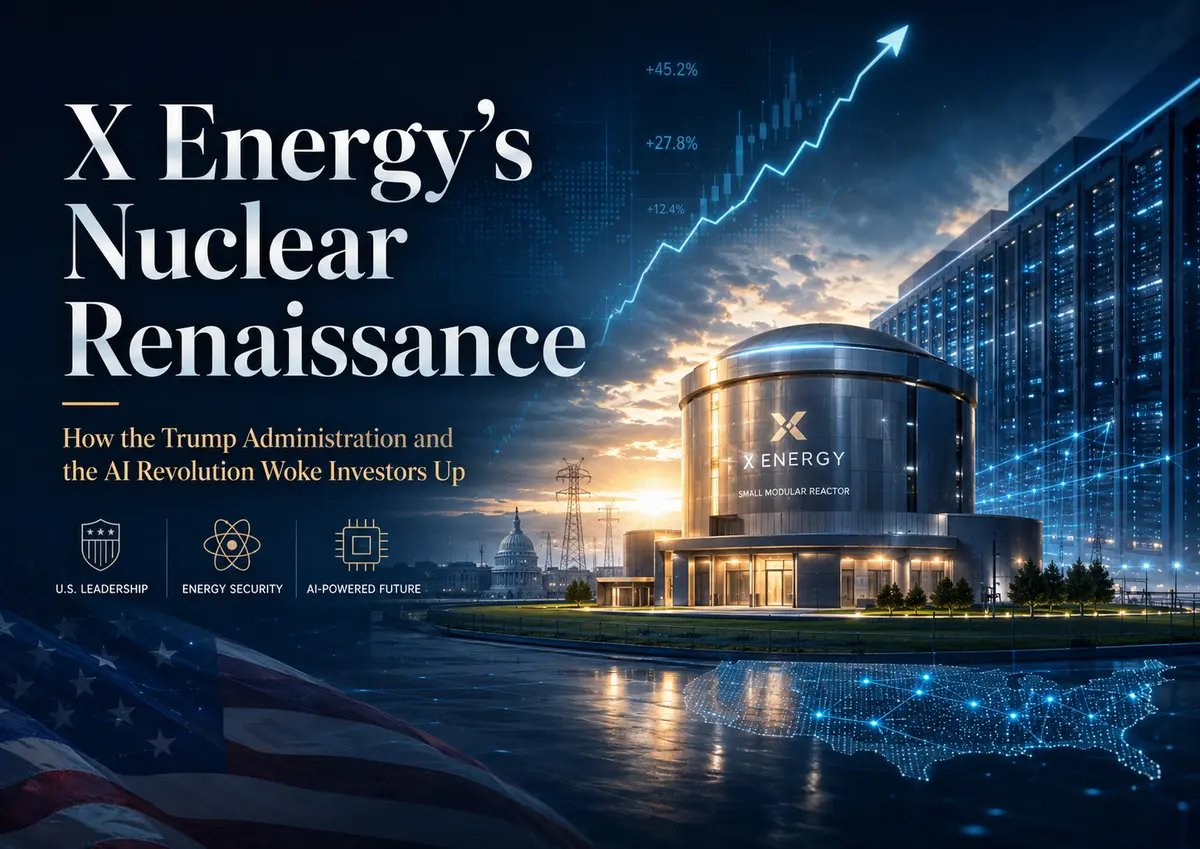
After-Hours Momentum: A 4.8% Gain in Just a Few Hours of Trading
When the closing bell rang on Wall Street on Tuesday evening, most investors had already turned their attention to the next day’s coffee and market charts. For X Energy shareholders, however, the evening marked the beginning of a genuine celebration. The company’s shares surged 4.8% in after-hours trading, and the move was far from a random spike. It was driven by news that could reshape the future not only of the company itself but of the entire US energy industry.
Citing people familiar with the matter, Bloomberg reported that X Energy had become part of a major $200 million federal initiative personally backed by the Trump administration. The program, which the US Department of Energy was preparing to officially unveil, is designed to dramatically accelerate the development of next-generation nuclear reactors.
The purpose of this race is not simply to produce environmentally friendly electricity and satisfy green-energy targets. The reality is both more practical and more ambitious: nuclear reactors are needed to power artificial intelligence data centers, which consume electricity like hungry monsters.
The development came as a complete surprise to many analysts. Although X Energy had long appeared on lists of promising developers of small modular reactors, its shares had not recorded significant growth in recent months. Now, however, the situation has changed dramatically. The government is extending a helping hand, while Microsoft and Nvidia are reportedly among the initiative’s participants.
X Energy is no longer merely an ambitious technology startup. It is becoming a key component of the United States’ national strategy for artificial intelligence and energy security.
Why Artificial Intelligence Needs Nuclear Energy More Than Ever
To understand why the news generated so much excitement, it is necessary to look at the heart of the modern technological revolution.
Artificial intelligence is more than a fashionable phrase. It requires enormous computing capacity and vast amounts of electricity. Every new language model and every neural-network training process can consume as much electricity as a small city. This appetite is growing exponentially every year.
Traditional energy sources—including coal, natural gas and hydroelectric power—are struggling to keep up. Renewable energy, despite all its advantages, remains too inconsistent. The sun does not shine at night, and the wind does not blow on demand.
Data centers, however, must operate continuously, 24 hours a day. A disruption in their electricity supply could result in billions of dollars in lost data, interrupted services and failed contracts.
This is where nuclear power enters the picture.
It is clean, powerful and stable. Most importantly, it can provide uninterrupted baseload electricity around the clock. The small modular reactors being developed by X Energy could offer an ideal solution for powering enormous server farms.
They are compact, can potentially be installed close to data centers and may require less capital for construction and maintenance than conventional nuclear power plants. The US government is now reportedly prepared to invest $200 million in this future.
However, the initiative is about more than money. It sends a clear signal to the market: nuclear energy is returning, and it is becoming a strategic priority.
The Trump administration, known for its pragmatic approach to economic policy, appears to view nuclear reactors as essential to preserving America’s technological leadership. While China expands its data-center infrastructure and develops its artificial intelligence capabilities, the United States cannot afford to fall behind in the energy sector.
X Energy has found itself in the right place at the right time.
The Participants: A Star-Studded Quartet Changing the Rules of the Game
The news became even more significant because of the companies reportedly involved in the initiative.
The program does not include only X Energy and its direct competitor OKLO ... , whose shares also jumped following the news. It also reportedly features two global giants that require no introduction: MSFT ... and NVDA ... .
When companies of this scale support an initiative, it suggests that the project is driven not only by government policy but also by enormous commercial opportunities.
Microsoft, which is already actively investing in nuclear-energy projects for its data centers, views nuclear power as a strategic necessity. The company recently reached an agreement connected to restarting the Three Mile Island nuclear facility and is now supporting a government initiative focused on developing new reactors.
Microsoft understands that without the energy infrastructure of the future, its cloud services and artificial intelligence platforms may be unable to scale effectively.
Nvidia, meanwhile, is the primary beneficiary of the global AI boom. Its graphics processors power a large proportion of the world’s neural networks. The company needs to ensure that the data centers operating these processors have access to sufficient electricity.
Supporting the nuclear initiative is therefore an investment in Nvidia’s own infrastructure security. If energy availability becomes a major constraint, demand for its chips could slow. By investing in nuclear reactors, Nvidia is effectively investing in the long-term growth of its own market.
The remainder of the financing is expected to be directed toward Department of Energy national laboratories and leading academic institutions. This demonstrates the long-term and systematic nature of the initiative.
It is not a one-time subsidy. It is an attempt to create an entire ecosystem in which technologies will be developed, specialists will be trained and critical infrastructure will be built.
Wall Street analysts have already begun revising their estimates. Many have reportedly assigned X Energy shares a Buy rating, with price targets significantly above current levels.
This optimism is not based solely on enthusiasm. It reflects a calculated expectation that government contracts and support from major technology companies could provide X Energy with a stable stream of orders for years to come.

A Market of Contrasts: Why Wall Street Is Not Celebrating
Against the enthusiasm surrounding X Energy and Oklo, the rest of the market appeared relatively weak.
Wall Street index futures declined on Tuesday evening, creating an interesting contrast. Investors were selling shares in major technology and industrial companies while simultaneously buying shares in nuclear-energy startups.
It is a classic example of individual sectors following their own narratives regardless of broader market sentiment.
Why was Wall Street generally pessimistic?
There were several reasons. First, inflation remained elevated, putting pressure on risk assets. Second, geopolitical instability—including conflict in the Middle East and trade tensions with China—was encouraging investors to move into defensive assets.
Third, the corporate earnings season was producing mixed results. Some companies were reporting strong profits, while others were disappointing investors, contributing to increased market uncertainty.
Against this background, nuclear energy appeared to offer an island of relative stability. It is less directly dependent on oil prices, is not exposed to the same supply-chain problems as many other industries and can provide highly secure, locally generated electricity.
It represents a long-term investment in infrastructure that could produce returns for decades. When the US government declares its willingness to spend billions of dollars supporting the industry, investors see a genuine fundamental catalyst rather than another short-lived speculative wave.
Xe-100 Technology: Why This Particular Reactor Matters
It is worth taking a closer look at the X Energy product that has attracted the attention of the White House and investors.
The Xe-100 is a small modular reactor that the company has been developing for several years. Unlike enormous conventional nuclear power plants, which can take decades to build and require extraordinary levels of investment, the Xe-100 is designed to be compact and standardized.
Its components could be manufactured in a factory and then transported to the installation site.
The difference is comparable to moving from constructing a skyscraper to assembling a Lego set.
Each module has a capacity of approximately 80 megawatts, and multiple units can be combined depending on the customer’s requirements. A data center requiring 200 megawatts could install three modules. A smaller industrial facility might need only one.
This flexibility and scalability make the technology particularly suitable for a rapidly changing world.
The Xe-100 also uses fuel made from tristructural isotropic particles, commonly known as TRISO fuel. This fuel is more resistant to extreme temperatures and does not require the same type of complex active cooling system used in many traditional reactors.
These characteristics could make the reactor safer and reduce the risk of serious accidents. For governments and companies considering the installation of reactors near populated areas, safety is a critically important argument.
The main problem is that the technology has not yet been fully commercialized.
X Energy has demonstrated prototypes and conducted tests, but large-scale manufacturing remains some distance away. The government program reported by Bloomberg could provide the push the company needs to complete development and bring a market-ready product into commercial operation.
Competitors and Allies: Who Else Is in the Game?
X Energy was not the only company to benefit from the news. Shares in Oklo, another developer of advanced nuclear reactors, also rose sharply.
Oklo is a startup associated with prominent figures from the technology industry, and it has already attracted investor attention through its ambitious strategy of developing nuclear-powered microgrids.
There is, however, an important technological distinction between X Energy and Oklo.
X Energy is focusing on modular, high-temperature gas-cooled reactors that use graphite, while Oklo is working on fast-neutron reactors with liquid-metal cooling systems. Each approach has its own advantages and disadvantages, and both could eventually achieve commercial success.
The US administration does not appear willing to place all its bets on a single company. By including two reactor developers in the initiative, Washington is creating a form of strategic insurance.
Should one project encounter serious technical or regulatory difficulties, the other may still move forward. This approach also creates healthy competition and encourages further innovation.
Other participants reportedly include national laboratories such as Idaho National Laboratory and Oak Ridge National Laboratory, both of which possess decades of experience in nuclear research.
Their participation could help ensure that the projects meet demanding safety and efficiency standards. Academic institutions, meanwhile, will be responsible for educating a new generation of engineers and scientists, creating a skilled workforce for the entire industry.
What Comes Next: Risks and Opportunities for Investors
Despite the optimism, investors should not ignore the risks.
First, nuclear energy is a heavily regulated industry. Even with support from the Trump administration, the licensing and construction of reactors will take years. The first Xe-100 reactors are unlikely to begin full commercial operation before the 2030s.
This means that the company may still be a long way from generating substantial profits from its reactor technology.
Second, the competition is not standing still. China is actively developing its own small modular reactors. Should Chinese companies bring their technologies to market before their American competitors, the result could significantly affect the global balance of power.
European companies are also continuing to develop their own nuclear technologies.
Third, there is always a risk of a change in political direction. Although President Trump and his administration support nuclear energy, future elections could bring to power politicians who favor other energy sources.
Such a shift could delay the program or result in its cancellation.
Nevertheless, for investors prepared to look five to ten years ahead, X Energy appears to be one of the most promising assets in the emerging nuclear-energy sector.
Government support, technological partnerships with industry leaders and rapidly growing demand for electricity all provide a strong foundation for future expansion. The current after-hours price movement suggests that investors are already willing to pay for exposure to this story.
The market must now wait for an official announcement from the Department of Energy. Should it confirm Bloomberg’s report, X Energy shares could receive another significant boost.
Even without immediate confirmation, however, the discussion itself demonstrates that nuclear energy is experiencing a revival—and X Energy is positioned at the forefront of that renaissance.
Only time will show whether the company can meet the expectations placed upon it. But one thing is already clear: X Energy has moved into the center of investor attention, and that alone is changing the rules of the game.




Comments
No comments yet. Be the first to share your thoughts!
Authentication Required
You must be logged in to post a comment.