

The Collapse of a Sneaker Empire: How Topsports Lost Nike and Half a Billion in Market Value in a Single Day
The Plunge That Shook the Hong Kong Stock Exchange
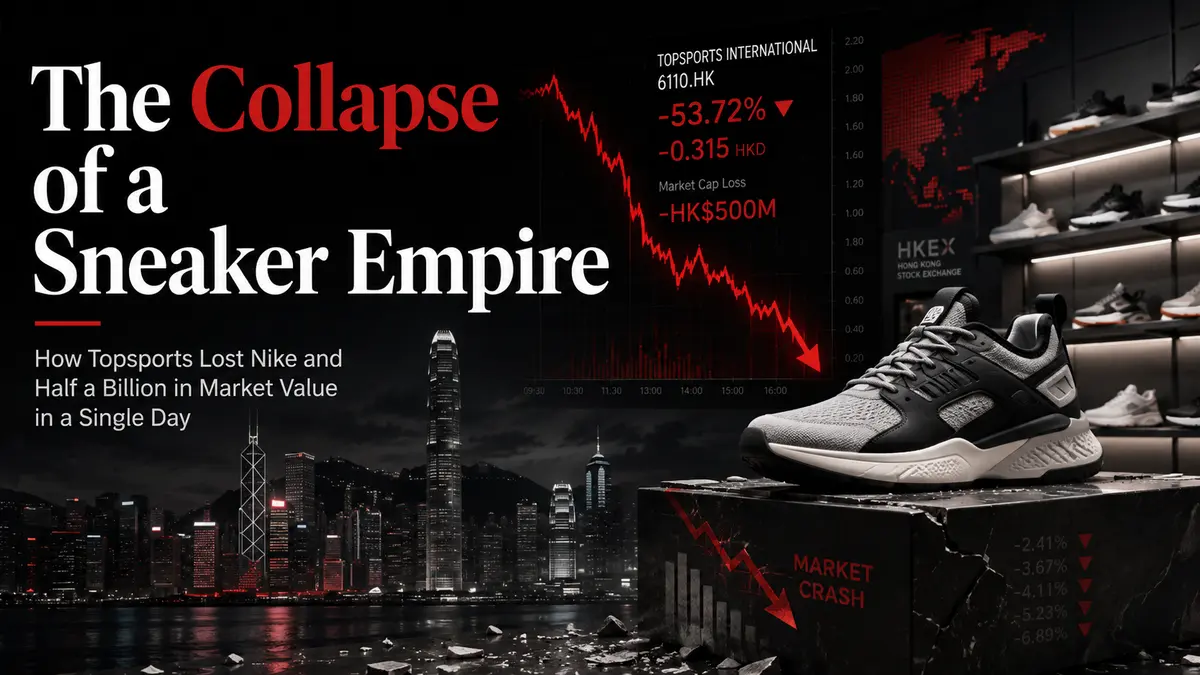
When trading opened in Hong Kong on 22.07.2026 Wednesday morning, no one expected such a nightmare. Shares of TPSRF ... International, one of China’s largest sportswear retailers, plunged 26.2% almost instantly, reaching an all-time low of HKDUSD ... HK$1.41.
This was not merely a market correction. It was a collapse that wiped out nearly a quarter of the company’s market capitalization within minutes. By the time the figures were recorded, the shares had recovered slightly but were still deeply in negative territory, down approximately 23.6% at HK$1.46. Traders stared at their screens in disbelief, repeatedly checking the data and wondering whether what they were seeing was real.
The reason for the collapse was as sudden as a lightning strike and as destructive as a tsunami. The previous evening, after the main trading session had closed, Topsports received an official notice from American sportswear giant NKE ... . Beginning on January 1, 2027, their long-standing partnership covering online sales in mainland China would be terminated completely.
Nike—the iconic Swoosh brand that had supported Topsports’ business for many years—had decided to sever its digital relationship with the retailer. A decision made quietly in corporate offices at Nike’s Oregon headquarters triggered a financial earthquake thousands of miles away in Hong Kong.
To understand the scale of the problem, online sales of Nike products accounted for approximately 22% of Topsports’ total revenue in the financial year that ended on February 28, 2026. This was not a small slice of the pie. It represented almost a quarter of the entire business.
Imagine that your primary supplier, responsible for nearly one in every four of your customers, suddenly tells you: “Starting next year, we will no longer work together in the same way.” News like that can destroy almost any business, and Topsports found itself directly in the path of the impact.
The History of the Partnership: From a Golden Era to a Cold Ending
To understand the full depth of the drama, it is necessary to look back. Topsports and Nike had worked together for many years, and their partnership was one of the most successful relationships in Chinese retail.
When China began opening its doors to global brands in the early 2000s, Nike was among the first companies to recognize the market’s enormous potential. However, local market conditions required a strong domestic partner capable of managing distribution, logistics, and sales.
Topsports became that partner. For nearly two decades, the companies built a sports retail empire around the strength of the Nike brand. Topsports stores in shopping centres across Beijing, Shanghai, and other major cities were filled with the instantly recognizable Swoosh.
Its online stores on Tmall and JD.com, as well as the company’s own website, were packed with Air Max sneakers, Dri-FIT shirts, and Tech Fleece jackets.
But strong relationships, like balloons, can burst at any moment. In recent years, Nike began changing its strategy in China. Instead of relying primarily on distributors, the brand started actively developing its direct-to-consumer operations.
The opening of Nike Direct stores, expansion of the company’s own shopping application, and increased investment in direct marketing all signalled that the manufacturer wanted to eliminate intermediaries and retain more of the profit margin for itself.
Eventually, Nike made its final decision. Beginning in 2027, its entire online sales channel in China would operate directly. Topsports would no longer be allowed to sell Nike sneakers online.
It was as though half of the pipes supplying water to a building had suddenly been shut off. Technically, the remaining pipes could still be used, but no new ones would be available.
The Impact on the Business: What Losing 22% Really Means
The figure of 22% is more than a percentage in a financial report. It represents the lifeblood of the business. It pays the salaries of hundreds of employees, covers warehouse rent, funds logistics operations, and supports marketing and advertising budgets.
Twenty-two per cent of revenue represents an enormous stream of money that is now disappearing from the company’s financial model.
Let us consider the numbers. In the 2026 financial year, Topsports reportedly generated approximately HK$30–35 billion in revenue. If 22% of that amount came from online sales of Nike products, the total involved would be approximately HK$6–7 billion.
That money will now go directly to Nike, which is expanding its own online store and direct-delivery operations. Topsports will be left with nothing from those sales while still carrying substantial operating costs that must somehow be covered.
The most frightening aspect is that the company has no obvious way to fill this hole in the short term. Other brands in the Topsports portfolio—including Adidas, Puma, New Balance, Asics, and others—are unlikely to replace the lost sales volume completely.
Some customers may switch to these brands, but Nike enthusiasts form a distinct and highly loyal group. They are unlikely to buy another brand simply because it is available. Instead, they will purchase directly from Nike or find another retailer that is still authorized to sell Nike products online.
There are many such retailers in the market. Nike may choose to work with other partners or focus exclusively on its direct sales channels. Topsports is therefore facing a situation in which its largest source of revenue is leaving, with no immediate replacement available.
Offline Retail: A Lifeline or False Hope?
In its statement, Topsports rushed to reassure investors that its offline partnership with Nike would continue on a mutually beneficial basis. In other words, the company argued that not everything had been lost and that it would continue selling Nike products through its physical retail stores.
However, it is important to examine what this statement actually means.
Despite efforts to revive physical retail, China’s offline shopping market is no longer what it was ten years ago. Consumers have become accustomed to shopping online. They want to order a pair of sneakers and have them delivered to their homes within hours rather than travelling to a shopping centre, searching for parking, standing in queues, and trying on products in a cramped fitting area.
Even assuming that customer traffic in physical stores remains stable, Topsports faces another problem. Offline stores require substantial investment.
Rent in premium Chinese shopping centres is extremely expensive. Employee salaries, utilities, local advertising, and store maintenance consume a significant portion of the profit margin. Online sales were cheaper and more efficient because they did not require the same level of operating expenditure.
Nike is also actively expanding its own flagship store network. Its stores can now be found throughout Beijing, Shanghai, Guangzhou, and other major cities.
Competing with stores operated directly by the brand is nearly impossible when you are merely an intermediary. The brand will always be able to offer exclusive models, better conditions, lower prices, or special promotions. Topsports is effectively condemned to play a secondary role.
The promise to continue the offline partnership therefore sounds more like an attempt to calm the market than a genuine rescue plan. Investors clearly understood this, which explains the intensity of the share sell-off.
More Than One Brand: What Will Happen to the Other Partners?
The most dangerous question now occupying analysts’ minds is whether other major brands will follow Nike’s example.
Adidas, which has already experienced difficulties in the Chinese market because of past controversies and consumer boycotts, may also decide to reduce its reliance on intermediaries. Puma, New Balance, and Under Armour are all watching Nike move away from distributors and are probably considering similar strategies.
Should Topsports lose not only Nike but also other key partners, the situation would no longer represent a downturn. It would become a catastrophe.
The company could lose the very reason for its existence. Its business model was built around acting as a bridge between Western brands and Chinese consumers. Today, however, Western brands no longer need such a bridge.
They have their own online stores, understand Chinese consumers, and can hire local managers and marketing professionals directly.
The era of local distributors in sports retail is gradually coming to an end. An increasing number of brands are choosing direct sales. This is a global trend, and China is no exception.
Topsports has become a hostage to this transformation, and escaping from the trap will be extremely difficult.
What Happens Next: Bankruptcy or Transformation?
When a company’s shares fall 26% in a single day, investors naturally begin to wonder whether it is time to abandon a sinking ship. Many did exactly that.
Trading volumes were enormous, indicating that large institutional investors were exiting their positions on a massive scale.
However, there are still some optimists. They point out that Topsports retains its offline business, which generates approximately 78% of its revenue. That is not an insignificant amount.
Should the company successfully reposition itself, reduce costs, and reconsider its product range, it may survive. For example, Topsports could strengthen its relationships with other brands that have not yet moved away from the company. It could also begin actively developing private-label products that would not depend on Western suppliers.
Interest in domestic sportswear brands is currently growing in China. Companies such as Li-Ning, Anta, and Xtep are gaining momentum and capturing market share from international giants.
Topsports could become a major platform for these brands by offering access to its logistics infrastructure and retail network. This strategy could give the company a new lease on life.
However, such a transformation would require time, investment, and—most importantly—strategic thinking, which the current management team may or may not possess.
It is much easier to rely on old contracts and collect profits than to rebuild a business for a new market reality. But the old contracts are disappearing, and Topsports has reached a decisive moment: either it changes or it dies.
Market Reaction: Panic, Fear, and Hope
The market was brutal towards Topsports on Wednesday. The shares did not simply fall sharply; they reached an all-time low.
This indicates that investors have little confidence in the company’s ability to recover in the near future. Many analysts have already downgraded the stock from “buy” to “hold” or “sell.”
Notably, the decline affected more than Topsports shares. Other sportswear retailers listed in Hong Kong also experienced modest losses, although their declines were far less dramatic.
This suggests the existence of a broader, systemic fear. Investors are worried that Nike may only be the beginning and that other brands could soon follow its example.
Nevertheless, some traders see an opportunity. Whenever shares fall to historical lows, speculators appear who are prepared to take the risk. They buy during the decline in the hope of a rebound.
Could Topsports recover? A new strategy, the acquisition of another major brand partner, or the announcement of a large-scale cost-cutting programme could provide momentum for a temporary rise.
However, the company’s fundamental problems will not disappear. Losing 22% of revenue is far too serious a blow to be offset by reassuring statements alone.
The market needs real action, real figures, and real contracts. Until they appear, pressure on the shares is likely to continue.
Conclusion: A Lesson for All Retailers
The story of Topsports and Nike is a warning to the entire retail industry. It demonstrates how fragile a business model can become when it depends heavily on a single major brand.
Diversification is not simply a fashionable business term. It is a necessity. When 20% or more of your business depends on a single supplier, you are always operating in a high-risk environment.
This is also a story about the changing world of retail. Direct sales are becoming the norm, while intermediaries are losing their value.
In the internet era, every brand can become its own retailer. All it needs is an efficient logistics system and a well-designed website. Topsports has found itself at the epicentre of this tectonic shift.
The company must now endure a difficult period of transformation. Only time will show whether it succeeds.
What happened on the Hong Kong Stock Exchange on Wednesday was a moment of truth—a moment when the old economy confronted a new reality and lost. It is a lesson that the retail industry will continue studying for many years.



Comments
No comments yet. Be the first to share your thoughts!
Authentication Required
You must be logged in to post a comment.