

Understanding the Role of a Financial Trader
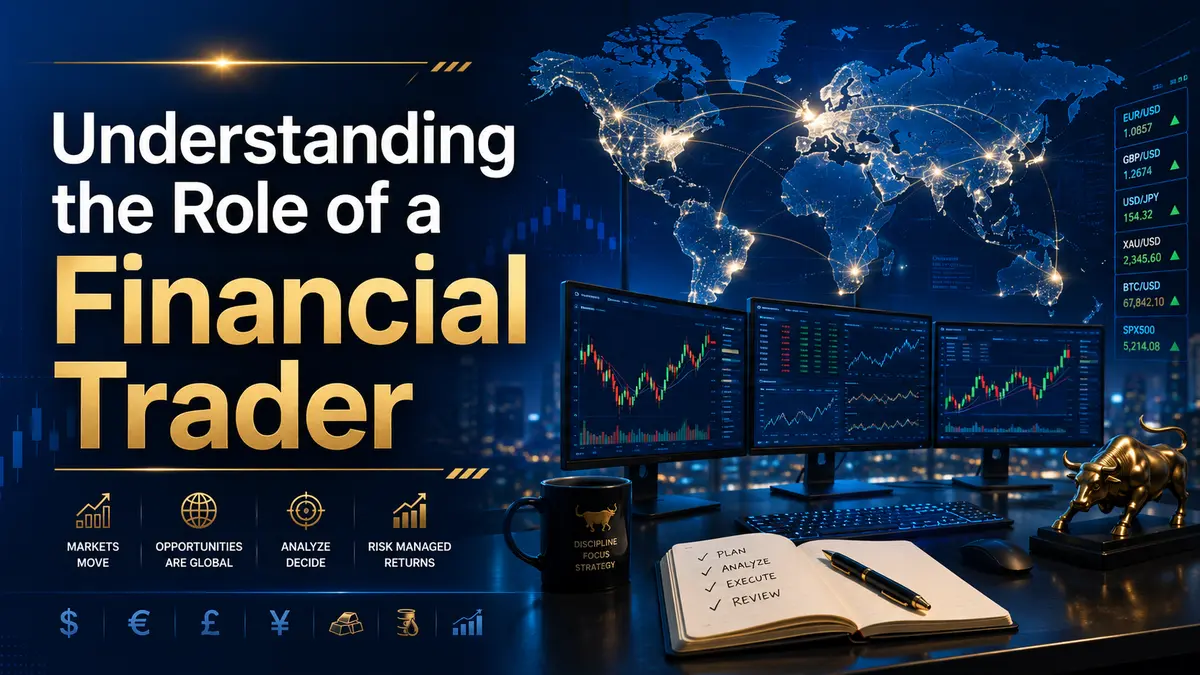
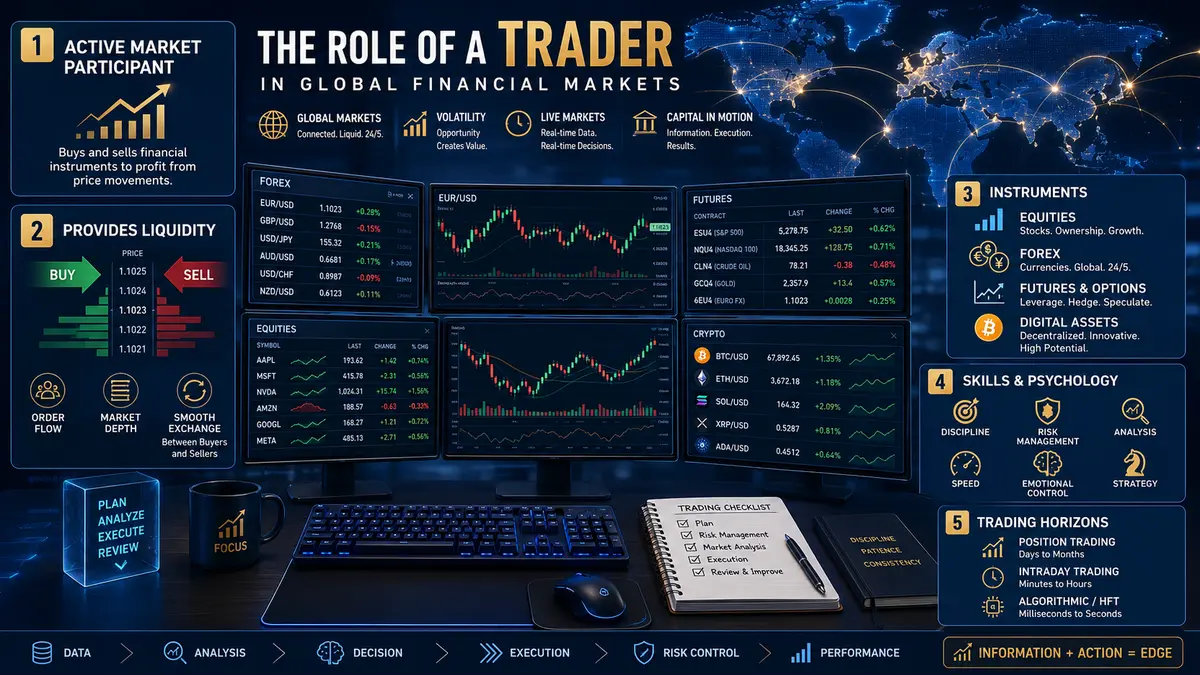
A trader is a highly specialized market participant who actively buys and sells financial instruments within the global financial markets to generate a profit. Unlike passive market participants, traders thrive on movement, capitalizing on the constant price fluctuations that occur every second across international exchanges.
Operating at the very heart of the global economy, traders can work independently from a home office as retail traders, or they can be employed by massive financial institutions — such as Wall Street investment banks (e.g., Goldman Sachs, Morgan Stanley), global hedge funds (like Citadel or Bridgewater Associates), and proprietary trading firms.
By constantly executing buy and sell orders, traders provide the essential liquidity that keeps global markets functioning smoothly. They ensure that when a pension fund wants to offload a massive block of shares, or a multinational corporation needs to hedge its currency exposure, there is someone on the other side of the trade willing to take the risk.
The Arsenal of a Modern Trader: Instruments and Strategies
Traders do not limit themselves to simply buying stocks. The global market offers a vast array of complex financial instruments, allowing traders to profit whether the broader economy is booming or crashing.
-
Equities (Stocks): Trading shares of global powerhouses like Apple AAPL ... , Tesla TSLA ... , or LVMH LVMHF ... , often attempting to capture intraday price movements driven by earnings reports or global news.
-
Derivatives (Options and Futures): These contracts allow traders to speculate on the future price of an asset without owning it. A trader might buy crude oil futures (like the West Texas Intermediate benchmark) or S&P 500 options to leverage their capital and amplify potential returns.
-
Foreign Exchange (Forex): The largest and most liquid market in the world, where traders speculate on currency pairs like the EUR/USD EURUSD ... or GBP/JPY GBPJPY ... , reacting to global interest rate decisions and geopolitical events.
-
Digital Assets: A newer frontier where traders navigate the extreme volatility of cryptocurrencies operating on a 24/7 global cycle.
The Anatomy of a Successful Trader: Skills and Psychology
Surviving in the high-stakes environment of global finance requires much more than just basic economic knowledge. Modern traders need a profound financial education and a deep understanding of macroeconomic mechanics. Furthermore, they must possess absolute mastery over complex trading platforms, such as Bloomberg Terminals or MetaTrader, which stream millions of data points per second.
Perhaps the most critical skill is emotional and psychological discipline. Markets are driven by two primal emotions: fear and greed. A successful trader must maintain a cold, analytical mindset, capable of making split-second decisions during periods of extreme market volatility — such as a sudden interest rate hike by the US Federal Reserve or an unexpected geopolitical crisis. Trading can range from holding a position for several months (position trading) to holding an asset for mere milliseconds using complex algorithms (High-Frequency Trading, or HFT).
The Trader’s Bill of Rights in the Global Market
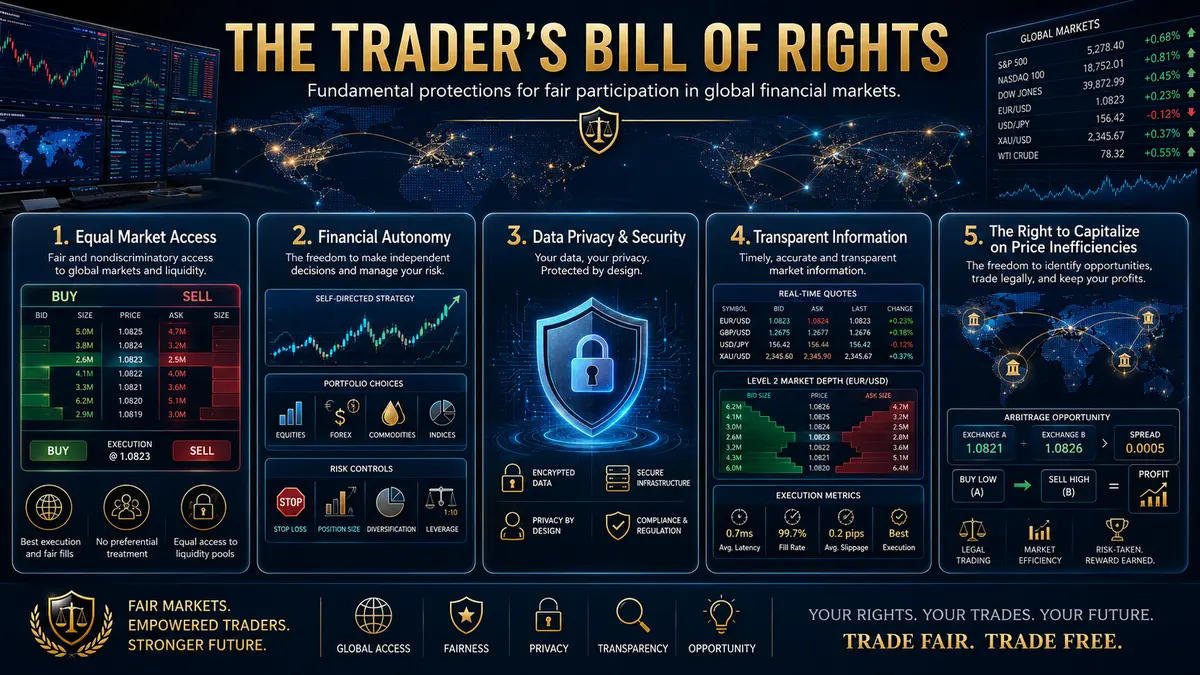
The rights of a trader are heavily dictated by their employment status, their geographical jurisdiction, and the regulatory bodies governing the specific exchanges they use (such as the SEC in the United States or the FCA in the United Kingdom). However, all legitimate traders share a core set of fundamental rights designed to ensure a fair and transparent playing field.
-
The Right to Equal Market Access: Traders have the right to participate in live market auctions on equal footing with other participants, executing buy and sell orders without arbitrary interference.
-
The Right to Financial Autonomy: Independent traders have the absolute right to construct their own financial strategies, choose their asset classes, and manage their own risk limits.
-
The Right to Data Privacy and Security: Whether operating through an online brokerage or an institutional desk, traders have the right to strict confidentiality regarding their personal data, trading history, and proprietary strategies, protected by global standards like the GDPR.
-
The Right to Transparent Information: Traders must be granted access to accurate, unmanipulated market data, real-time price quotes (Level 2 data), and transparent execution metrics to make informed decisions.
-
The Right to Capitalize on Price Inefficiencies: The foundational right of a trader is the legal authorization to capture profits generated from the price differentials of financial instruments, provided the trades are executed legally.
The Strict Obligations and Regulatory Duties
With the ability to move vast amounts of capital comes a heavy burden of responsibility. The financial markets are heavily policed to prevent systemic collapses, and traders must adhere to strict codes of conduct.
-
Mandatory Adherence to Market Rules: Traders are obligated to strictly follow the operational rules, trading hours, and margin requirements dictated by global exchanges (such as the New York Stock Exchange or the Tokyo Stock Exchange).
-
Fiduciary Duty to Clients: For institutional traders managing external capital, their highest legal obligation is to act in the best financial interest of their clients, prioritizing client profits over personal commissions.
-
Rigorous Market Analysis: A professional trader is obligated to base their trades on structured, logical analysis — whether technical, fundamental, or quantitative — rather than reckless gambling, especially when managing institutional risk.
-
Strict Legal Compliance: Traders must navigate and obey complex international financial laws. They are strictly forbidden from engaging in market manipulation, spoofing (placing fake orders to deceive the market), or insider trading (trading on non-public, material information).
-
Comprehensive Record-Keeping: Traders and their firms are required to maintain exhaustive logs of every executed trade, canceled order, and communication. These records must be readily available for audits by financial watchdogs to ensure total transparency.
Ultimately, beyond legal compliance, the primary operational duty of any trader is risk management. The goal is not just to maximize profits, but to construct a portfolio mathematically designed to protect capital and minimize losses during inevitable market downturns.
The Great Divide: Trader vs. Investor
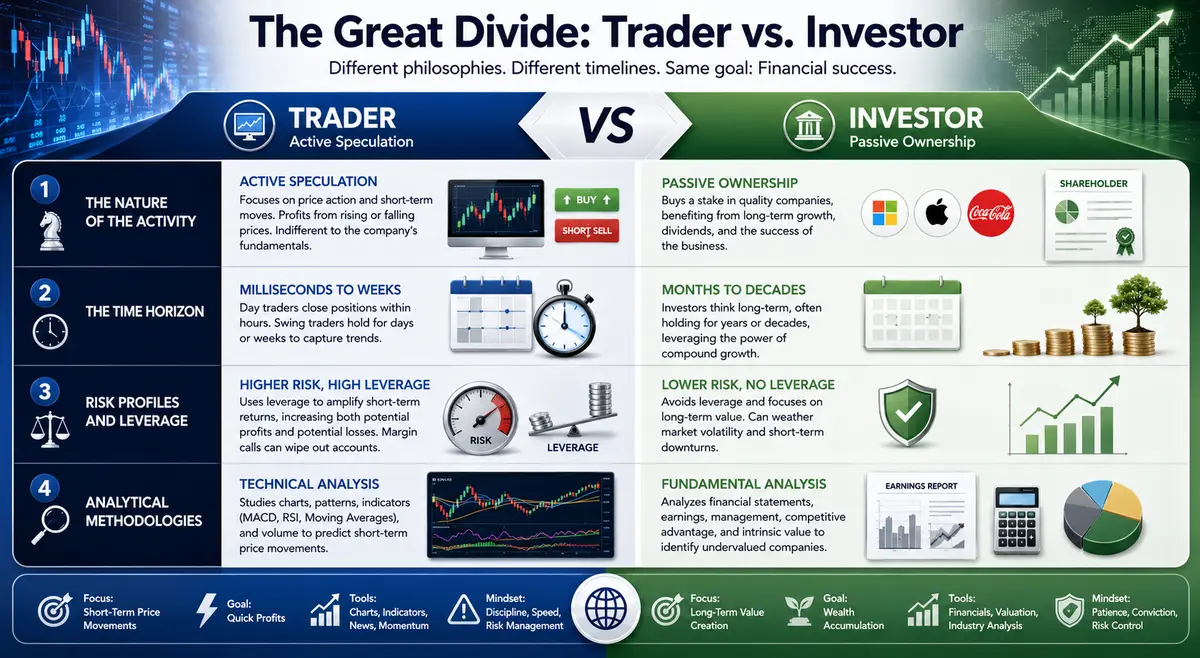
While both traders and investors commit capital to the financial markets to make money, their philosophies, timelines, and daily realities could not be more different.
1. The Nature of the Activity: Active Speculation vs. Passive Ownership
A trader is an active speculator. They do not necessarily care about the underlying health, vision, or products of a company; they care purely about price action. If a stock is crashing, a trader can “short sell” it, making a massive profit from the company’s decline.
An investor, on the other hand, approaches the market as a business owner. When an investor buys shares in a global corporation like Microsoft MSFT ... or Coca-Cola COLA.NE ... , they are purchasing a stake in the company’s future cash flows, product innovations, and global expansion, aiming to benefit from dividend payouts and long-term corporate growth.
2. The Time Horizon: Milliseconds vs. Decades
Time is the most obvious dividing line. Traders operate on drastically compressed schedules. A “day trader” will open and close dozens of positions within a single trading session, ensuring they hold zero assets when the closing bell rings to avoid overnight risk. “Swing traders” might hold positions for a few days or weeks to capture a specific trend.
Conversely, an investor’s favorite holding period is often “forever.” Investors, echoing the philosophy of financial titans like Warren Buffett, are willing to hold onto their assets for years or decades, allowing the mathematical magic of compound interest to multiply their wealth over time.
3. Risk Profiles and Leverage
Because traders seek out short-term price movements, which are often small, they frequently use leverage (borrowed money from a broker) to amplify their returns. This makes trading inherently high-risk. A sudden global news event can trigger a “margin call,” instantly wiping out a trader’s entire account.
Investors generally face lower day-to-day volatility risks. Because they operate on a multi-year timeline, they can simply ignore short-term market crashes, trusting that historically, the broader global market eventually recovers and trends upward.
4. Analytical Methodologies: The Chart vs. The Balance Sheet
Traders rely heavily on Technical Analysis. They study complex price charts, candlestick patterns, trading volumes, and mathematical momentum indicators (like the MACD or the Relative Strength Index) to predict where a price will go in the next hour or day. They believe that all known information is already priced into the chart.
Investors rely primarily on Fundamental Analysis. They spend their time reading quarterly earnings reports, listening to CEO conference calls, analyzing global supply chains, and evaluating a company’s debt-to-equity ratio. They are looking for companies whose true intrinsic value is higher than their current stock price, willing to wait patiently for the market to eventually recognize that value.






Comments
No comments yet. Be the first to share your thoughts!
Authentication Required
You must be logged in to post a comment.