

Understanding the Investor: Roles, Strategies, Rights, and Responsibilities in Global Markets

An investor is an individual or an entity that allocates financial capital with the primary expectation of generating a future financial return. In essence, investors act as the lifeblood of the global capitalist economy. By committing funds to various assets, they provide the necessary liquidity and capital that businesses, startups, and governments need to innovate, scale, and build infrastructure.
The landscape of modern investing spans a massive spectrum of asset classes, from traditional equities and fixed-income securities to global real estate, venture capital, and digital assets. Regardless of their scale, all investors operate under a fundamental economic principle: balancing risk against potential reward.
1. The Spectrum of Investors: From Retail to Institutional Giants
Not all investors are created equal. The global financial markets are shaped by a diverse array of participants, each possessing distinct capital structures, regulatory boundaries, and investment objectives.
Retail Investors: The Power of the Individual
Retail investors are individual, non-professional market participants who invest their personal savings. Historically, retail investors were limited by high brokerage fees and information asymmetry. However, the digital revolution and the rise of zero-commission platforms like Charles Schwab, Robinhood, and eToro have democratized access to Wall Street, London, and Tokyo exchanges.
Retail investors often invest for personal milestones — such as retirement planning through accounts like a 404(b) or an IRA, funding education, or buying property.
While individual retail accounts may be small, their collective power can influence market sentiment and drive significant liquidity into popular consumer brands like Apple AAPL ... , Microsoft MSFT ... , or Nvidia NVDA ... .
Institutional Investors: The Heavyweights of Wall Street
Institutional investors are highly specialized organizations that pool massive amounts of capital from millions of individual clients or taxpayers to invest on a grand scale. Because they execute trades worth hundreds of millions of dollars, their market movements dictate global asset pricing.
-
Pension Funds: Entities like the Japanese Government Pension Investment Fund (GPIF) manage hundreds of billions of dollars to ensure long-term payouts for retirees, prioritizing stable, income-generating assets.
-
Sovereign Wealth Funds: State-owned funds, such as Norway’s Government Pension Fund Global or Singapore’s Temasek, deploy national surplus wealth across global markets to secure the country’s economic future.
-
Asset Management Firms & Mutual Funds: Giants like BlackRock BLK ... and Vanguard VPCCX ... manage trillions of dollars via mutual funds and Exchange-Traded Funds (ETFs), allowing individuals to buy diversified market baskets easily.

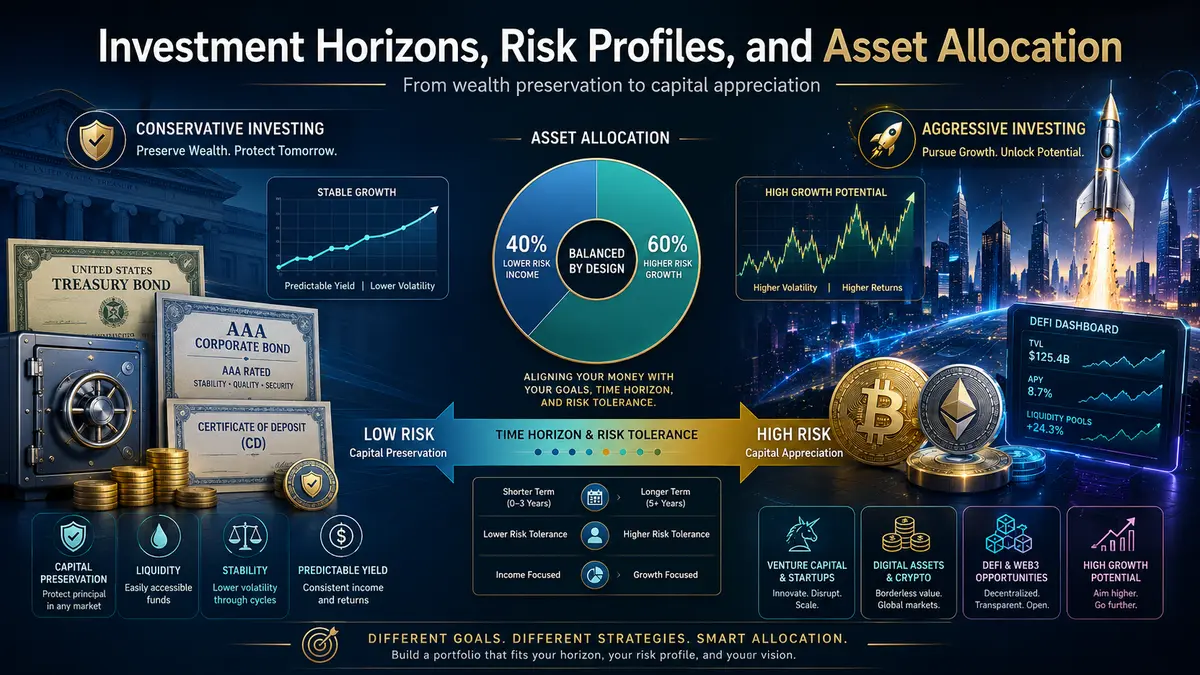
2. Investment Horizons, Risk Profiles, and Asset Allocation
An investor’s behavior is dictated heavily by their timeline (investment horizon) and their psychological and financial capacity to endure losses (risk tolerance).
Low-Risk, Wealth Preservation Strategies
Conservative investors prioritize capital preservation over aggressive growth. They typically target highly stable, liquid instruments. For example, US Treasury Bonds are globally recognized as the benchmark for risk-free assets because they are backed by the full faith and credit of the US government. Other low-risk options include AAA-rated corporate bonds and certificates of deposit (CDs), which provide predictable yield but often fail to beat high inflation over the long term.
High-Risk, Capital Appreciation Strategies
On the opposite end of the spectrum are aggressive investors who embrace high volatility in pursuit of exponential gains.
-
Venture Capital (VC): Firms in tech hubs like Silicon Valley invest millions into early-stage startups. While a vast majority of these startups fail, a single successful investment in an early-stage company (like Uber UBER ... or Airbnb ABNB ... ) can yield astronomical returns.
-
Cryptocurrencies and Digital Assets: Highly speculative and volatile markets centered around Bitcoin BTCUSD ... , Ethereum ETHUSD ... , and decentralized finance (DeFi) attract investors willing to risk significant capital for short-term or exponential growth.
3. Analytical Methodologies and Trading Strategies
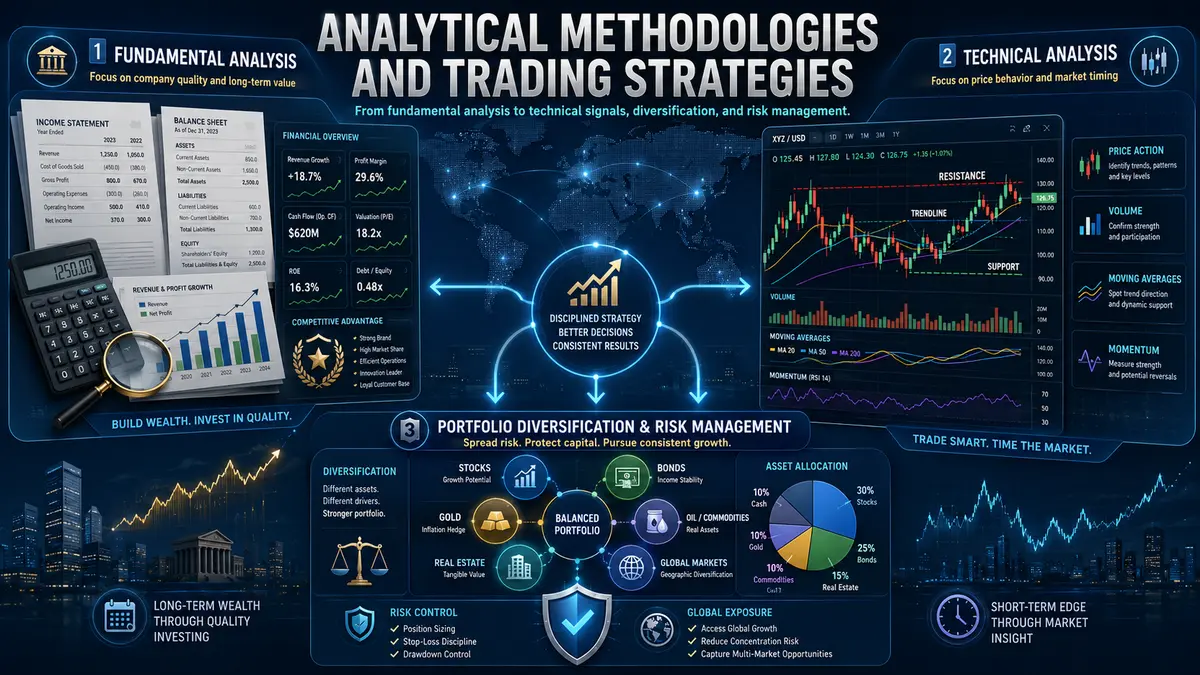
Successful investing is rarely a product of pure luck; it requires disciplined analysis, structured strategies, and an understanding of macroeconomic trends.
Fundamental vs. Technical Analysis
Investors generally split into two analytical camps when evaluating where to place their capital:
-
Fundamental Analysis: Championed by iconic value investors like Warren Buffett, this approach involves studying a company’s financial statements, revenue growth, profit margins, management competency, and competitive advantages. The goal is to find “undervalued” companies to buy and hold for years.
-
Technical Analysis: This methodology focuses entirely on historical market data, price charts, volume trends, and mathematical indicators (such as moving averages). Technical investors seek to exploit short-term supply and demand imbalances rather than judging the intrinsic value of a corporation.
Portfolio Diversification and Risk Management
A cornerstone of modern financial theory is portfolio diversification — the practice of spreading investments across different asset classes, sectors, and geographic regions. The logic is simple: if tech stocks suffer a downturn, an investor’s losses may be offset by gains in commodities (like gold or oil) or real estate investments. Diversification helps minimize unsystematic risk, ensuring that a single corporate bankruptcy does not wipe out an investor’s entire net worth.
4. The Investor’s Bill of Rights
To maintain trust and stability within global financial networks, international regulatory bodies (such as the SEC in the United States or the FCA in the United Kingdom) uphold a strict set of legal rights for investors.
-
Right to Free Disposal of Capital: Investors have the absolute right to allocate their funds, purchase legal financial instruments, and liquidate or withdraw their assets whenever they choose, subject to standard contract terms.
-
Right to Information Transparency: Investors are legally entitled to accurate, timely, and comprehensive data regarding financial products, market conditions, and corporate earnings before risking their money.
-
Right to Privacy and Data Protection: Financial intermediaries must securely protect investors’ personal and financial data against unauthorized access, adhering to global standards like GDPR.
-
Right to Legal Protection: If a broker, fund manager, or corporation violates financial regulations or commits fraud, the investor has the right to state-backed legal protection and restitution.
-
Right to Dispute Appeal: Investors maintain the right to contest decisions made by asset management firms or brokerages through neutral arbitration platforms or financial ombudsmen.
-
Right to Investment Income: Investors have an undisputable legal right to receive dividends, interest payments, or capital gains generated by their underlying assets according to agreed terms.
5. The Investor’s Code of Obligations
Rights do not exist without responsibilities. To ensure market integrity and personal financial safety, investors must adhere to several core obligations.
-
Compliance with Financial Laws: Investors must strictly abide by international tax laws, anti-money laundering (AML) protocols, and the rulebooks of the specific exchanges they trade on.
-
Conducting Due Diligence: It is an investor’s personal duty to carefully audit financial instruments, read prospectuses, and understand the inherent risks of an asset before allocating capital.
-
Making Informed Decisions: Investors must take accountability for their choices, executing trades based on rational research rather than emotional impulses or unverified social media hype.
-
Timely Settlement of Financial Obligations: Investors are obligated to settle transactions promptly, ensuring they have sufficient capital to pay for purchased securities, margin calls, or management fees.
-
Secure Record Keeping: Investors must responsibly maintain records of their transactions, contracts, and statements for tax reporting and auditing purposes.
-
Abstaining from Market Manipulation: Investors are strictly legally prohibited from engaging in predatory practices like insider trading, “pump and dump” schemes, or spoofing orders to artificially manipulate market prices.








Comments
No comments yet. Be the first to share your thoughts!
Authentication Required
You must be logged in to post a comment.