

Gold Under Pressure: How the Oil Shock and Inflation Fears Are Sinking the Precious Metal
Introduction: Monday’s Sell-Off
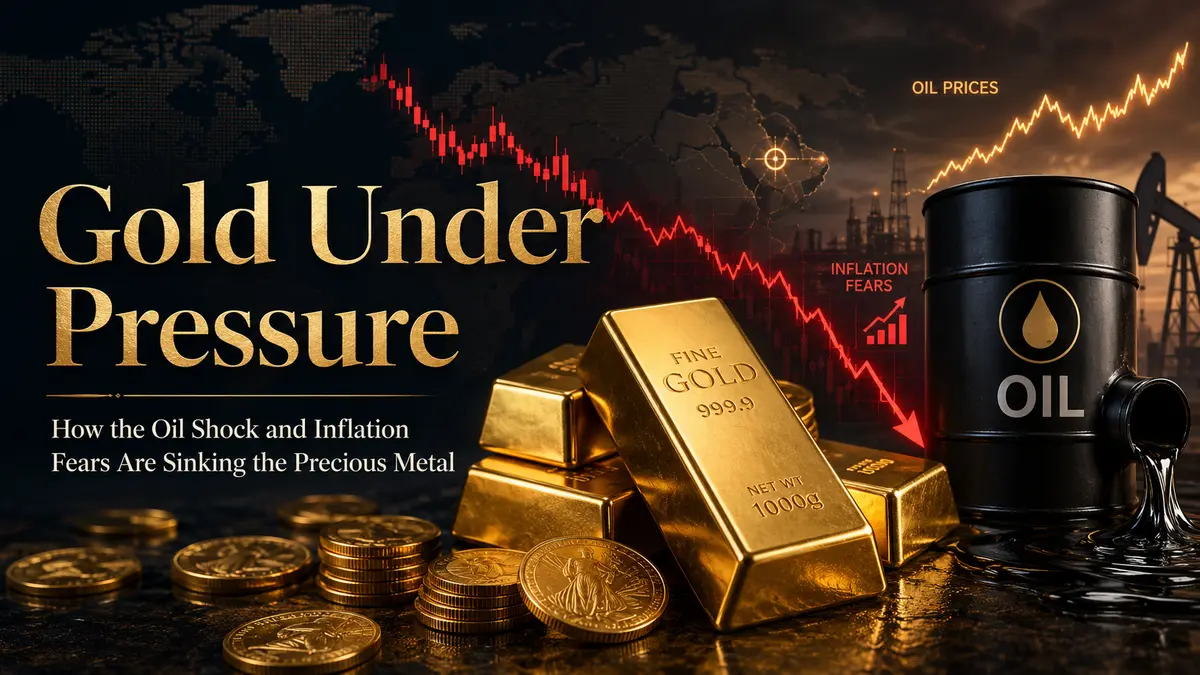
Monday morning brought an unpleasant surprise for gold investors. Precious metal prices continued to decline, and the drop was substantial. XAU/USD fell by 1.5% to $4,057 per ounce, while gold futures lost 1.17%, slipping to $4,065. Silver and platinum suffered even heavier losses: silver plunged by nearly 3%, while platinum fell by 1.6%.
What happened? Why is gold, traditionally considered a safe-haven asset, falling at a time when geopolitical tensions are reaching their peak? As is often the case, the answer lies in a complex combination of factors, with rising oil prices and inflation expectations outweighing demand for safety.
The resumption of hostilities between the United States and Iran, the threat of the Strait of Hormuz being closed, and the surge in oil prices above $78 per barrel have created a perfect storm for the gold market. Investors are not so much afraid of the war itself as they are of its consequences: accelerating inflation and, as a result, tighter monetary policy from the Federal Reserve. For gold, which generates no income, higher interest rates can be a fatal blow.
Geopolitical Shock: Iran, the United States, and the Strait of Hormuz
Escalation of the Conflict: From Words to Action
The weekend marked the point at which diplomatic efforts finally reached a dead end. The United States launched another round of strikes against Iranian targets following an attack on a Cyprus-flagged cargo vessel in the Strait of Hormuz. Tehran responded swiftly by announcing the closure of the key shipping route until further notice.
Although US officials disputed the announcement and emphasized that the waterway remained open under the protection of the US armed forces, markets had already begun pricing in the worst-case scenario. Shipping activity in the region declined sharply, and even if the strait technically remains open, fears of further attacks are forcing shipowners to avoid the route.
Why Markets Fear the Closure of the Strait
The Strait of Hormuz is more than just a geographical point on the map. It is an artery through which approximately one-fifth of the world’s oil supply passes. Any disruption to this channel would mean not merely higher energy prices, but a fundamental shift in the global economy.
For gold, this has two opposing implications. On the one hand, geopolitical instability should increase demand for safe-haven assets. On the other hand, rising oil prices fuel inflation, and inflation forces central banks to tighten monetary policy. At present, the second effect is proving stronger.
Investors are now thinking less about how to protect themselves from war and more about how to survive the coming tightening of monetary policy. In this environment, gold, which produces no yield, finds itself at a disadvantage.
Inflation Fears: How Oil Is Weighing on Gold
The Surge in Energy Prices
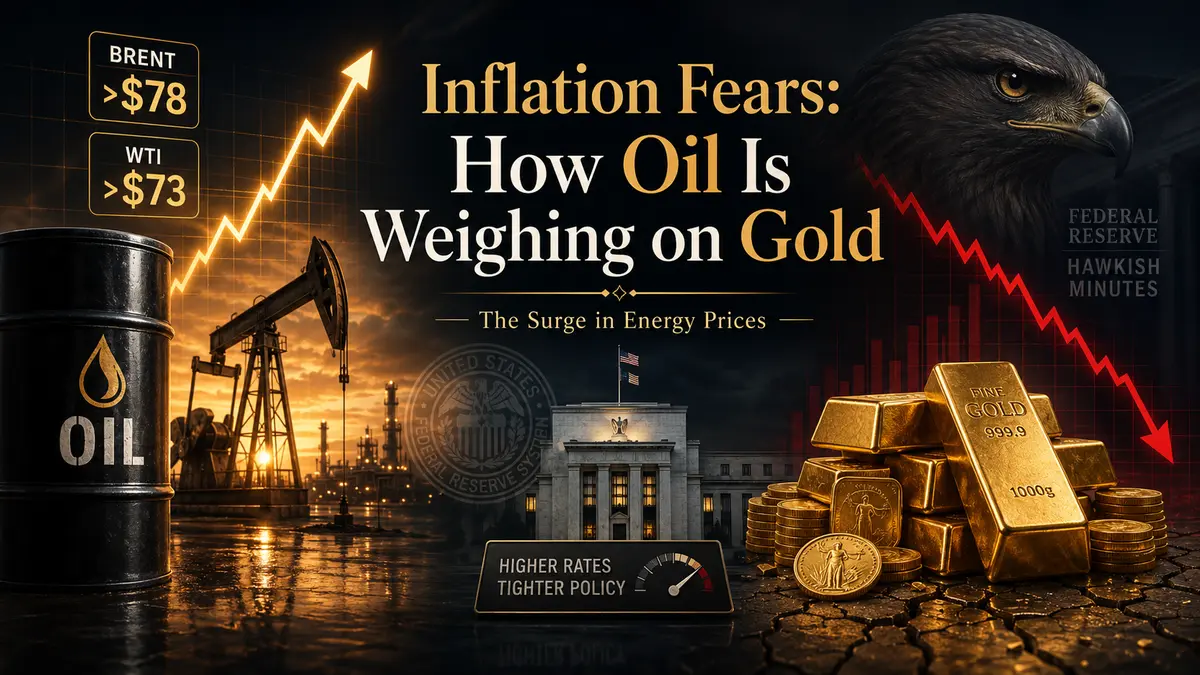
Oil prices rose by approximately 3% following the weekend’s escalation and remain significantly above last week’s levels. Brent crude is trading above $78 per barrel, while WTI is above $73. This is a serious signal for the market.
Rising energy prices provide a direct path toward accelerating inflation. Oil is not merely fuel for vehicles. It is a raw material used in the production of plastics, fertilizers, and synthetic materials. It also provides energy for factories and power plants. Higher oil prices translate into rising costs for virtually all goods and services.
This is precisely what investors fear. A new inflationary shock could force the Federal Reserve to act more aggressively than previously planned. That would mean higher interest rates, a stronger dollar, and consequently lower gold prices.
Fed Minutes: Hawks Circling
The minutes of the Federal Reserve’s June meeting, published last week, already showed that several Committee members believed an increase in interest rates could be justified. Officials generally expressed greater concern about inflationary pressures, even as worries about the labor market eased.
This is an important signal. It means that a group of policymakers within the Federal Reserve is prepared to support further tightening if inflation does not decline quickly enough. Following the surge in oil prices, this group has gained additional arguments in its favor.
The next Federal Reserve meeting is scheduled for July 28–29. If inflation expectations continue to rise by then, the probability of an interest-rate increase will grow significantly. That would place further pressure on gold.
The Dollar as an Additional Source of Pressure
Strengthening of the US Currency
The US Dollar Index rose by 0.3% on Monday. This may appear to be a relatively small move, but it represents a significant source of pressure for gold, which is priced in dollars. The stronger the dollar becomes, the more expensive gold is for holders of other currencies, reducing demand for the metal.
The dollar is strengthening amid expectations of tighter Federal Reserve policy and continued geopolitical uncertainty. Investors are turning to the dollar as a safe-haven asset, which is paradoxically increasing pressure on another traditional safe haven: gold.
This paradox illustrates the complexity of the current situation. During periods of crisis, the dollar and gold would ordinarily rise together. This time, however, the dollar is benefiting from expectations of tighter monetary policy, while gold is suffering. The market is choosing between two forms of protection, and for now, the dollar is winning.
The Correlation Between Interest Rates and the Dollar
The relationship between interest rates and the dollar is direct: the higher rate expectations become, the stronger the dollar tends to be. Investors move capital into dollar-denominated assets because they offer higher returns. This creates additional demand for the currency and pushes its value upward.
For gold, this creates a double blow. A stronger dollar makes the metal more expensive for foreign buyers, while higher interest rates increase the opportunity cost of holding an asset that generates no income. Under these conditions, gold prices inevitably come under pressure.
Inflation Data: The Key Moment of the Week
Tuesday’s CPI Report: What to Expect
Investors are now awaiting the release of the US Consumer Price Index report on Tuesday. The data will be a key factor for the gold market over the coming days. If inflation exceeds expectations, gold could receive another downward impulse. If inflation comes in lower than expected, a corrective rebound may follow.
The market is pricing in several possible scenarios. A stronger-than-expected CPI report could reinforce expectations of another Federal Reserve rate increase before the end of the year and strengthen the dollar, placing additional pressure on gold. Softer inflation data, by contrast, could help gold stabilize after its recent losses.
Warsh’s Congressional Testimony
The second major event of the week will be Federal Reserve Chair Kevin Warsh’s first appearance before Congress. It will be his debut in the new role, and markets will listen carefully to every word.
Warsh may provide signals regarding the future path of interest rates, the Federal Reserve’s response to geopolitical risks, and the inflation outlook. Any reference to the possibility of further monetary tightening will be interpreted as a negative signal for gold.
Traders and analysts will attempt to identify even the smallest nuances in his remarks. A single word could trigger significant market movement. As a result, anticipation ahead of Warsh’s testimony is creating additional nervousness and volatility.
Technical Analysis: Levels to Watch
Support at $4,000
Tony Sycamore, a market analyst at IG, highlighted an important psychological level: last Friday, gold found support near $4,000 per ounce. This level became a temporary floor from which the metal rebounded.
A sustained break below $4,000 could open the way for a further decline, potentially toward the next support zone between $3,800 and $3,900. Such a move would represent a serious setback for gold bulls.
On the other hand, if gold remains above $4,000, this level could provide a foundation for recovery. Many investors regard $4,000 as a psychologically important threshold, and successfully holding it could attract buyers.
Resistance at $4,200
At the same time, gold must overcome resistance at $4,200–$4,220 to begin a meaningful recovery. Sycamore notes that a sustained breakout above this range would strengthen the case for a broader rebound toward the 200-day moving average near $4,491.
For now, however, that target remains distant. The current decline and geopolitical risks are creating powerful bearish pressure that will be difficult to overcome without significant positive signals concerning inflation and Federal Reserve policy.
Silver and Platinum: An Even Deeper Decline
Silver: An Industrial Metal at Risk
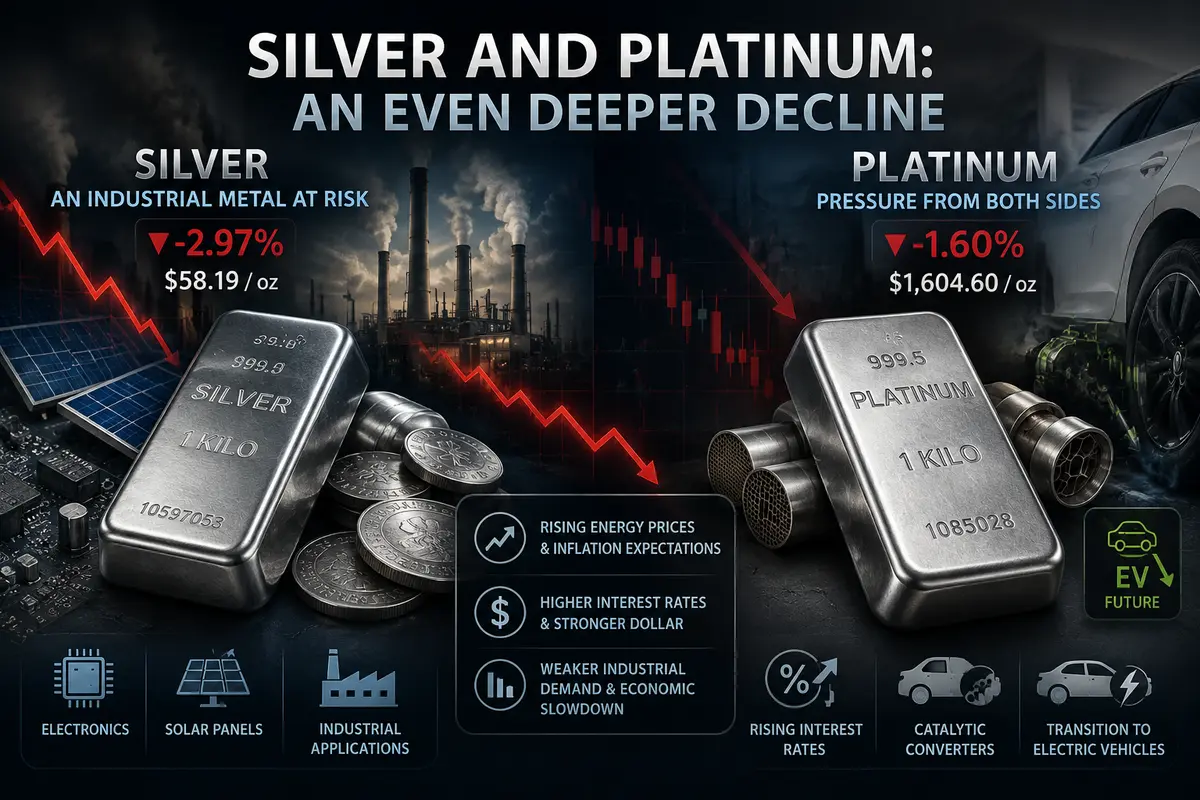
Silver suffered even heavier losses than gold, falling by nearly 3% to $58.19 per ounce. This is not surprising, given the metal’s industrial nature.
As energy prices and inflation expectations rise, the outlook for industrial production deteriorates. This implies weaker demand for silver, which is widely used in electronics, solar panels, and other industrial applications.
Silver is also traditionally more volatile than gold, meaning that it tends to fall more rapidly during market downturns. Investors prefer to sell riskier assets first, and silver is often among the first to be liquidated.
Platinum: Pressure From Both Sides
Platinum also recorded a significant decline, falling by 1.6% to $1,604.60 per ounce. The metal is facing pressure from two directions: as a precious metal, it is suffering from rising interest rates, while as an industrial metal, it is being affected by fears of an economic slowdown.
The situation in the automotive industry is another factor weighing on platinum. The metal is used in catalytic converters, while the transition toward electric vehicles is reducing its long-term demand prospects. During periods of economic uncertainty, these concerns become even more pronounced.
What Comes Next: Possible Scenarios for Gold
The Optimistic Scenario
The most optimistic scenario for gold assumes that Tuesday’s CPI data comes in below expectations and that Warsh’s testimony signals the Federal Reserve’s willingness to move toward a more accommodative policy. In this case, gold could rebound from support at $4,000 and begin a recovery.
Geopolitical uncertainty would remain, but if inflation fears subside, investors could once again begin buying gold as a safe-haven asset. Under this scenario, a move toward resistance at $4,200–$4,220 and potentially higher would be possible.
The Realistic Scenario
A more realistic scenario assumes that uncertainty will remain elevated over the coming weeks. Inflation will stay above the Federal Reserve’s target but will not accelerate sharply. Warsh will provide balanced signals without making any dramatic statements.
In this case, gold is likely to continue trading within the $4,000–$4,200 range, accompanied by elevated volatility. Markets will wait for additional economic data and policy signals before committing to a clear direction.
The Pessimistic Scenario
The worst-case scenario for gold would involve a stronger-than-expected CPI report combined with hawkish signals from Warsh. Under these conditions, expectations of higher interest rates would intensify, the dollar would strengthen, and gold could break below support at $4,000.
The decline could be substantial, potentially extending toward $3,800–$3,900 or even lower. In this situation, investors could begin exiting gold positions on a large scale and reallocating capital toward yield-generating dollar-denominated assets.
Conclusion: Gold Caught Between a Rock and a Hard Place
The current situation in the gold market is a classic example of geopolitics and macroeconomics pulling in opposite directions. The renewed conflict between the United States and Iran and the threat of the Strait of Hormuz being closed should support gold prices because of the metal’s status as a safe-haven asset. However, rising oil prices and inflation expectations are outweighing this effect.
Gold has found itself caught between the hammer of geopolitical uncertainty and the anvil of monetary policy. Investors are more afraid of higher interest rates than they are of war, and this is pushing prices downward.
A crucial week lies ahead, with the release of inflation data and the Federal Reserve Chair’s congressional testimony. These events will determine gold’s future trajectory. If the CPI report disappoints and Warsh adopts a hawkish tone, the decline could continue. If inflation slows and the Federal Reserve’s signals become more accommodative, gold may have an opportunity to recover.
Technical levels will also play an important role. Support at $4,000 and resistance at $4,200 will serve as the key reference points over the coming days. A breakout above or below these levels will determine the market’s next direction.
For now, gold remains in a state of uncertainty. Geopolitical risks have not disappeared, but they have moved into the background as inflation fears have taken center stage. Supported by high oil prices, these concerns continue to weigh on the metal.
The situation may change once the geopolitical shock is fully reflected in market prices or when signs of slowing inflation begin to emerge. For the moment, however, investors remain positioned against gold as they wait for clearer signals.
In the struggle between gold and the dollar, war and inflation, interest rates and asset protection, the more immediate threat is currently winning: high interest rates and a strong dollar. As long as that threat remains real, gold will continue to face pressure, regardless of how alarming the news from the Middle East becomes.

Comments
No comments yet. Be the first to share your thoughts!
Authentication Required
You must be logged in to post a comment.