

Bitcoin Rises Above $63,000 as Fed Concerns Ease

Introduction: A Monday That Started in the Green
Monday, Asian trading session. Traders in Tokyo, Singapore, and Hong Kong open their terminals and see a familiar picture. Bitcoin is back in the green. $63,227.5 — that is the current price of the world’s leading cryptocurrency, gaining 0.8% in the morning and continuing the rally that began last week. This is not just a move — it is a return of confidence after several weeks of chaos, during which Bitcoin fell to a 21-month low below $58,000.
What changed? The main driver is the shift in expectations regarding the Federal Reserve’s policy. Weak U.S. labor market data for June and comments from Fed Chair Kevin Warsh about declining inflation convinced investors that the regulator is unlikely to raise rates this year. This means liquidity will remain high, while risk assets, including cryptocurrencies, will continue to attract demand.
But macroeconomics is not the only factor supporting Bitcoin. The renewed inflow of funds into spot Bitcoin ETFs after several weeks of outflows became another signal that institutional investors are returning to the market. The $221.7 million in inflows recorded last week ended a 10-day streak of outflows and changed market sentiment.
Over the past week, Bitcoin has risen by roughly 5%. This is not an impressive result compared with years when it doubled in a month, but it is important as a change in trend. After a prolonged decline, even a modest recovery is perceived as a victory. But is this growth sustainable? Analysts warn that trading volumes remain relatively low, and further ETF inflows and favorable macroeconomic data will likely be needed to maintain the upward momentum.
Altcoins are also feeling confident. Ethereum rose 0.7% to $1,775.92. XRP gained 0.6% to $1.14. Even meme tokens such as Dogecoin increased by 1.4%. On Monday, the cryptocurrency market is breathing optimism, and investors are beginning to believe that the worst may be over.
But let’s not rush. Bitcoin is still below its all-time highs, and macroeconomic uncertainty remains. This week, the focus will be on the minutes of the Fed’s June meeting, which could provide additional signals about the path of interest rates. If those signals disappoint the market, the recovery could be called into question.
Let’s break down what is really behind this growth, which factors are supporting Bitcoin, and what could stop its recovery.
Macroeconomic Background: Why a Weak Economy Became a Bullish Signal
Employment Data: Unexpected Weakness
The main catalyst for Bitcoin’s growth last week was the U.S. labor market data for June. The figures came in significantly weaker than expected, changing the balance of power across all markets, including crypto.
For several months, markets had been convinced that the Fed would continue tightening because the U.S. economy was showing surprising resilience. The labor market was creating jobs at a pace that exceeded forecasts. Inflation, although declining, remained above the target level. This created hawkish expectations that weighed on Bitcoin.
But the June data showed that the labor market is beginning to cool. This does not mean the economy is collapsing, but it does mean the Fed has fewer reasons to continue tightening. Investors revised their expectations, and the probability of another rate hike this year declined significantly.
For Bitcoin, this is a positive signal. When rates are not rising, liquidity remains high, and risk assets become more attractive. Bitcoin, often called “digital gold,” benefits from this trend because it is perceived as an alternative to traditional assets during periods of macroeconomic uncertainty.
Warsh’s Comments: A Hawk Turned Dove
Another important factor was the comments from Fed Chair Kevin Warsh. In his debut speech in Sintra, he sounded like a hawk ready for further rate hikes. But last week, he softened his rhetoric, saying that inflation continues to decline and confirming that the regulator will be guided by incoming data.
Markets interpreted this statement as a signal that the Fed will not raise rates unless the data shows a need for it. And since employment data was weak while inflation is falling, the probability of a rate hike this year became even lower.
Markets reacted instantly. The CME FedWatch tool recorded a decline in tightening expectations, creating a favorable backdrop for risk assets. Bitcoin, which is especially sensitive to changes in rate expectations, benefited from this shift.
Warsh, who began his Fed career with tough statements, is now forced to acknowledge that reality has changed. He is not talking about rate cuts, but he is making it clear that the pause may be prolonged. For markets, that is almost as good as a rate cut.
ETF Inflows: Institutional Investors Are Returning
Perhaps even more important than the macroeconomic backdrop was the renewed net inflow into spot Bitcoin ETFs. According to SoSoValue, U.S. ETFs recorded inflows of $221.7 million, ending a streak of 10 consecutive sessions of outflows.
This trend reversal became an important psychological signal. Institutional investors, who had been actively exiting Bitcoin in recent weeks, began entering again. And when major players start buying, it creates additional demand and supports prices.
The 10-day outflow streak was one of the longest in recent times. It reflected investor pessimism caused by the Fed’s hawkish rhetoric and the overall deterioration of sentiment in risk markets. Now that outflows have turned into inflows, the market has received a recovery signal.
The current inflow is not a record, but it is a change in trend. If inflows continue to grow in the coming weeks, they could become the foundation for a more sustainable recovery. Analysts warn that further ETF inflows and favorable macroeconomic data will be needed to maintain growth.
Technical Picture: A Rebound From a 21-Month Low
$63,000 — A New Resistance or Support Level?
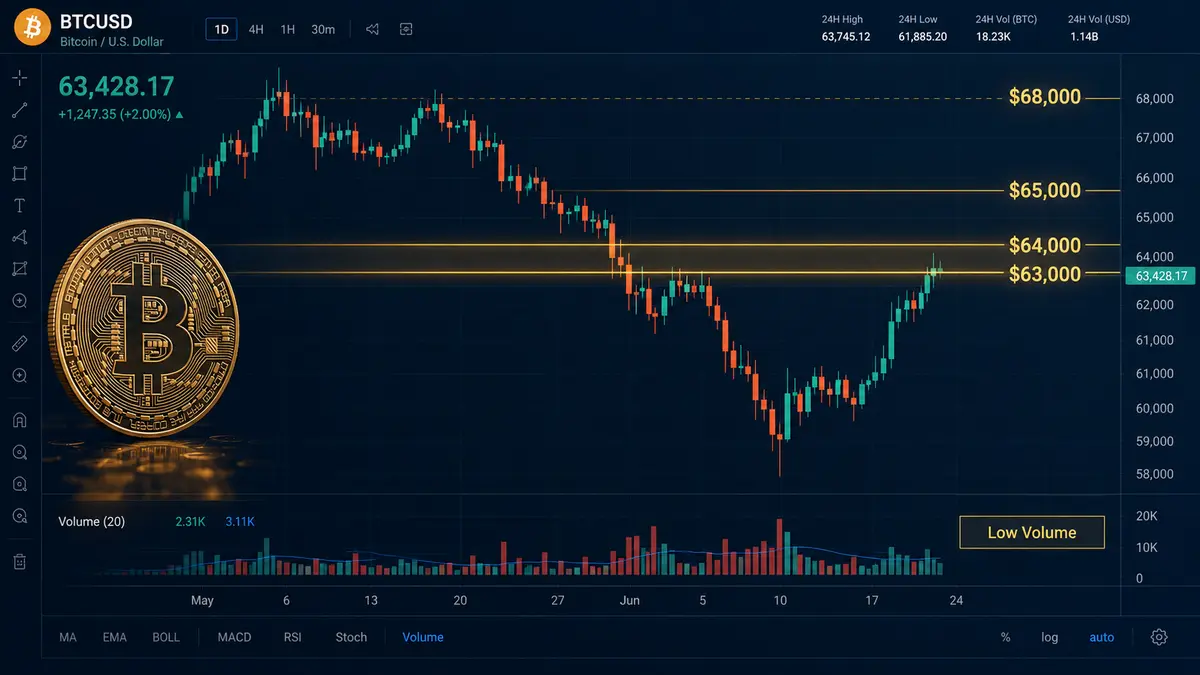
Bitcoin has risen above $63,000, but the question is whether it can hold this level. Technically, $63,000 is an important level that has previously acted as resistance. Now that the price has broken through it, it may become support.
If Bitcoin manages to consolidate above $63,000, it will open the way toward $65,000 and $68,000. If it pulls back below this level, it will signal that the recovery is not yet sustainable.
Traders will closely watch price behavior in the $63,000–$64,000 range. Holding above this range would be a bullish signal, while a return below it would be bearish.
Trading Volumes Remain Low
One factor causing caution is trading volume. Volumes remain relatively low, indicating that many investors are still in wait-and-see mode. Low volumes mean that the rally may be unstable and could easily break down if negative news appears.
Sustainable growth requires not only positive macroeconomic signals but also an increase in trading volumes. Investors need to actively buy Bitcoin, not simply watch prices rise.
If volumes remain low, Bitcoin may be vulnerable to a correction. This is especially important given the ongoing macroeconomic uncertainty.
Altcoins: The Recovery Continues
Ethereum and Other Leaders
Ethereum rose 0.7% to $1,775.92, continuing its recovery after a decline that was especially painful for this cryptocurrency. Ethereum had been particularly vulnerable in recent months due to lower DeFi activity and weak demand for NFTs. But now that Bitcoin has started rising, Ethereum has followed.
Ethereum’s growth may also be linked to expectations of an improved regulatory climate for altcoins. In recent weeks, there have been signs that the SEC may soften its stance toward certain cryptocurrencies.
XRP gained 0.6% to $1.14. Solana and Cardano traded almost unchanged at the start of the trading session. Meme tokens such as Dogecoin rose by 1.4%.
This broad rally suggests that market sentiment is improving. Investors are not only buying Bitcoin — they are buying the entire spectrum of cryptocurrencies. This is a positive signal indicating that the market may be ready for further growth.
Meme Tokens: Dogecoin Leads
Dogecoin, often viewed as an indicator of retail activity, rose by 1.4%. This suggests that retail investors are also beginning to return to the market.
Meme tokens are generally more volatile than major cryptocurrencies, and their growth often points to a rising appetite for risk. If Dogecoin continues to rise, it could signal that the market is ready for a broader recovery.
What Awaits Bitcoin in the Coming Weeks
Fed Minutes: The Next Test
This week, the focus will be on the minutes of the Fed’s June monetary policy meeting. They may provide additional signals about the expected path of interest rates in the United States.
If the minutes confirm that the Fed is ready to maintain a pause, this will be a bullish signal for Bitcoin. If they indicate that the regulator is still considering further tightening, the market may react negatively.
Investors will carefully analyze every word in the minutes, trying to understand what the Fed plans to do in the coming months.
Holding Above $63,000–$64,000
The main question for Bitcoin is whether it can hold above the $63,000–$64,000 range to continue its recovery. If Bitcoin can consolidate at these levels, it will create a foundation for further growth.
If Bitcoin falls below $63,000, however, it may signal that the recovery is temporary. In that case, the market could retest support at $58,000.
Conclusion: Bitcoin on the Path to Recovery
Bitcoin rose above $63,000 on Monday, continuing last week’s rally. Weak U.S. economic data, Kevin Warsh’s comments, and renewed ETF inflows have all created a favorable backdrop for the recovery of the cryptocurrency market.
Over the past week, Bitcoin has risen by roughly 5%, recovering after its fall to a 21-month low below $58,000. This is not an impressive result, but it is a change in trend that gives hope for further growth.
Altcoins are also feeling confident. Ethereum, XRP, Solana, Cardano, and even meme tokens are all showing growth, indicating improved market sentiment.
However, analysts warn that trading volumes remain relatively low, and maintaining growth will likely require continued ETF inflows and favorable macroeconomic data. This week, the focus will be on the minutes of the Fed’s June meeting, which could provide additional signals.
Bitcoin is now at a crossroads. If it can hold above $63,000–$64,000, this will open the way toward $65,000 and $68,000. If it falls below, the recovery may prove temporary.
In any case, the cryptocurrency market is entering a new phase — a phase in which macroeconomic factors continue to play a key role, while institutional investors are gradually returning to the market. And if this trend continues, Bitcoin may extend its recovery in the coming months.

Comments
No comments yet. Be the first to share your thoughts!
Authentication Required
You must be logged in to post a comment.