

The Yen Falls to Its Lowest Level Since 1986: Four Decades of Decline Compressed Into a Few Months
Introduction: The Day the Clock Turned Back
Tuesday began in Asia like any other trading day. Exchanges opened, traders took their seats, and price charts lit up across countless screens. But what happened next made many market participants rub their eyes in disbelief.
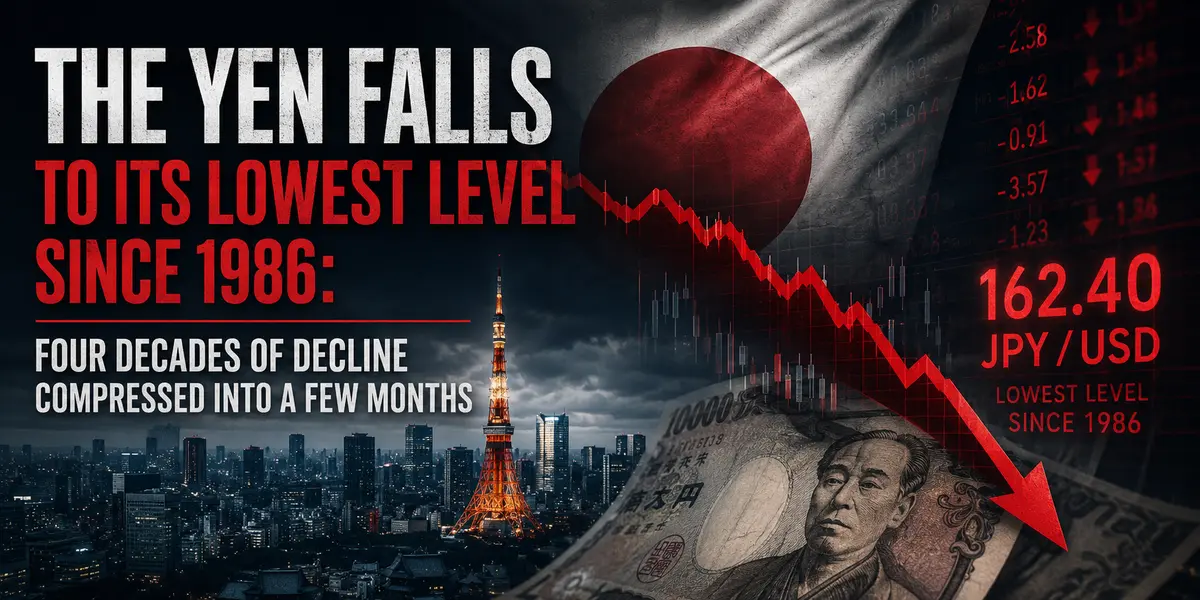
The Japanese yen, the national currency of the world’s third-largest economy, plunged to a level that none of today’s active market participants had ever witnessed. 162.40 yen per U.S. dollar. The last time the exchange rate reached this level was in 1986.
For those born after the fall of the Berlin Wall, 1986 is little more than a line in a history textbook. For currency traders who have spent three decades in the market, however, it marks a moment when every familiar reference point suddenly disappears. Once regarded as a symbol of Japan’s economic strength, the yen has increasingly become a currency investors are eager to sell whenever the opportunity arises.
Chief Cabinet Secretary Minoru Kihara and Finance Minister Satsuki Katayama responded with the government’s familiar verbal warnings. The market barely reacted. Because words are just words. Markets respond to numbers, and the numbers tell a clear story: the Japanese currency has been in freefall for months, and nothing so far has managed to stop it.
Last year, the Japanese government spent a record $72 billion on currency interventions. The Bank of Japan raised its policy rate to 1%, the highest level in three decades. Yet all of those efforts proved to be little more than a drop in the ocean.
Let’s examine why the yen continues to weaken, what this means for Japan’s economy, and whether a reversal of the trend is possible—or even likely.
The Mechanics of the Decline: Why the Yen Can’t Stop Falling
Carry Trade: The Yen’s Biggest Enemy
To understand why the yen continues to weaken, we need to look at the core of global capital flows. There, an incredibly simple—and highly dangerous—game is unfolding.
Investors borrow Japanese yen because borrowing costs in Japan remain exceptionally low. A 1% interest rate is almost laughably cheap compared with what other countries offer. They then invest those borrowed funds in higher-yielding assets—U.S. Treasury securities, Turkish deposits, Mexican peso assets, and other investments offering significantly better returns.
This strategy is known as the carry trade. It is as old as modern financial markets themselves, and it continues to work as long as interest-rate differentials remain wide.
And they do.
The Federal Reserve continues to maintain interest rates at levels that make U.S. assets highly attractive. As long as the American economy remains resilient while Japan’s economy struggles with weak growth, capital will continue flowing in one direction—from the yen into the U.S. dollar.
Every time a trader borrows yen to purchase dollars, additional downward pressure is placed on Japan’s currency. That pressure is multiplied many times over because the carry trade is not an isolated strategy. It is a massive global phenomenon involving hedge funds, commercial banks, insurance companies, and even some central banks.
Verbal intervention cannot stop the carry trade.
It will only slow once interest-rate differentials disappear—or shrink enough that the strategy no longer offers worthwhile returns.
But as long as the Bank of Japan raises rates only cautiously while the Federal Reserve continues to signal a “higher for longer” policy stance, traders will keep doing what they have been doing for months: selling yen and buying assets that generate higher yields.
Interventions That Don’t Work
Tokyo spent ¥11.73 trillion, or roughly $72.4 billion, defending the yen through foreign-exchange interventions.
It was the largest intervention campaign in Japan’s history.
And the result?
The yen still broke through 162.40 per dollar.
The uncomfortable truth is that interventions no longer work—or at least not for very long.
They can produce temporary relief when authorities surprise markets with large-scale purchases of the domestic currency. But once traders know that the government is committed to defending a particular level, speculators simply wait for the intervention to end before resuming even more aggressive selling.
Japan’s government now finds itself trapped in a paradox.
If it intervenes, it may buy a short period of stability while undermining confidence in the currency over the longer term.
If it does nothing, the yen continues to weaken, dealing another political blow to Prime Minister Sanae Takaichi’s government.
It is a choice between a bad option and an even worse one.
Perhaps even more painful is the fact that these interventions have done almost nothing to alter the broader downward trend.
Despite every effort, the yen continues to slide.
That creates a growing sense of helplessness among policymakers while simultaneously strengthening traders’ conviction that the government is ultimately powerless against market forces.
And when markets sense weakness from a regulator, they tend to push even harder.
Political and Social Consequences
Expensive Energy, an Expensive Life
The yen’s decline is not just another number flashing across a Bloomberg terminal. It translates directly into the bills Japanese households have to pay every month.
Japan imports almost all of the oil and natural gas it consumes—and pays for those imports in U.S. dollars. When the yen weakens, the cost of imports rises in the most literal sense: it takes more yen to buy the same barrel of crude oil.
Service producer prices rose 3.3% year over year in May. Ocean freight rates surged 61.8%, while international air transportation costs climbed 17.3%.
The underlying cause is the same across the board: higher fuel costs driven by the weaker yen.
Businesses pass those costs on to consumers.
Electricity becomes more expensive. Groceries become more expensive. Clothing, transportation, and everyday services all cost more.
For Japanese households, the impact is severe.
Japan spent decades living with either deflation or near-zero inflation, and older generations grew accustomed to remarkably stable prices. Today they are watching their savings lose purchasing power while everyday expenses continue climbing.
The result is growing social pressure that the government can no longer ignore.
Prime Minister Sanae Takaichi finds herself caught between two opposing forces.
On one hand, a weaker yen benefits exporters—the backbone of Japan’s economy. Companies such as Toyota, Sony, and Nintendo enjoy windfall profits when the currency depreciates.
On the other hand, ordinary Japanese consumers bear the cost through higher prices.
Balancing corporate interests against household welfare is becoming one of the government’s most politically explosive challenges.
A Record-Breaking Stock Market: The Other Side of a Weak Yen
There is another side to the yen’s decline—one Japanese officials rarely discuss openly.
Japan’s stock market is booming.
The Nikkei index has climbed to record highs, and the weak yen deserves much of the credit.
A cheaper currency makes Japanese exporters significantly more competitive in global markets.
Toyota sells its vehicles in dollars but reports its earnings in yen. When the currency weakens, every dollar of overseas revenue converts into more yen, automatically boosting profits even if sales volumes remain unchanged.
Investors understand this dynamic.
They continue buying shares of Japan’s export-oriented companies, pushing equity markets to new highs.
This creates a striking paradox.
A weak yen.
A booming stock market.
For investors, everything appears to be going well.
For exporters, business has rarely looked better.
For ordinary families shopping at supermarkets, however, life is becoming increasingly expensive.
That widening gap in economic experience is emerging as one of the government’s biggest political problems.
Analysts at Nomura argue that the yen’s continued weakness—even amid falling oil prices and increased flows into safe-haven assets—suggests that structural downward pressure on the currency remains firmly in place.
In other words, the yen’s decline is not an accident.
It is a systemic trend.
And reversing it will require far more than occasional interventions in the foreign-exchange market. It will require fundamental changes in monetary policy.
The Bank of Japan: Too Little, Too Late
One Percent Is a Historic High—and Historically Low
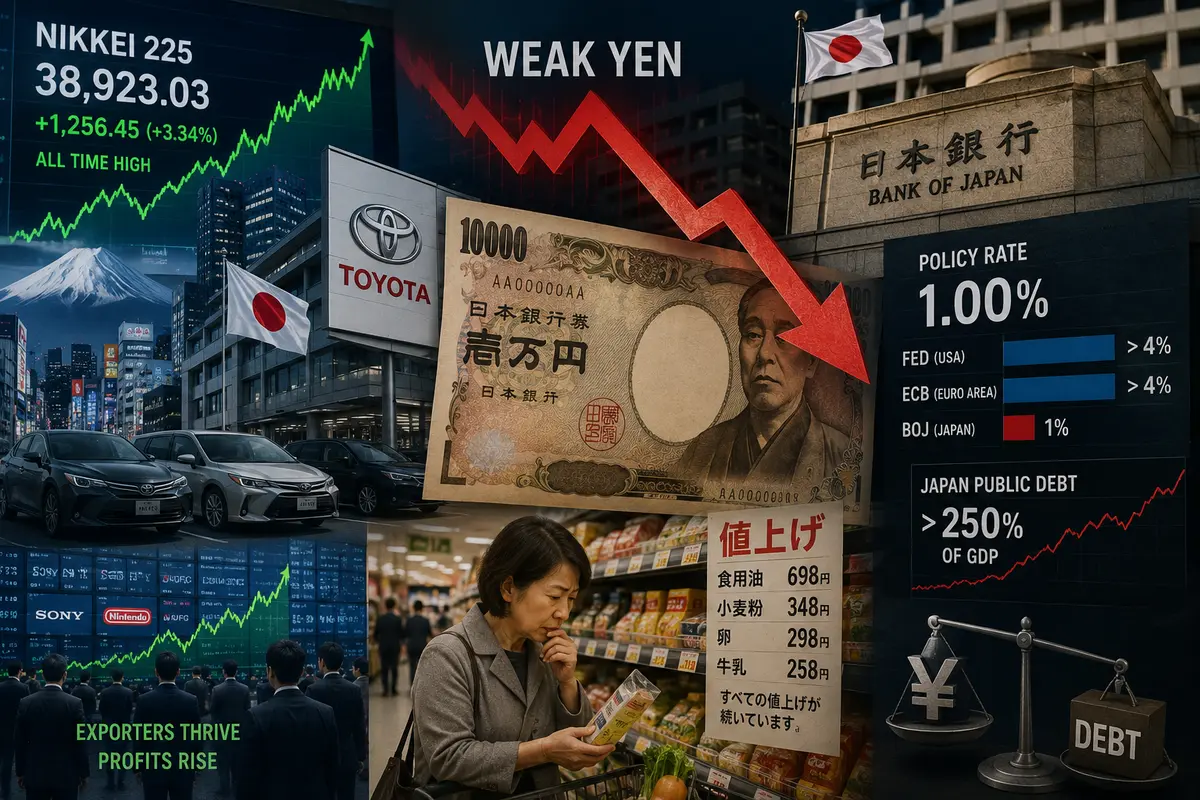
The Bank of Japan has finally raised its benchmark interest rate to 1%.
That sounds significant—until you consider the broader context.
A 1% policy rate is Japan’s highest level in three decades.
But in a world where the Federal Reserve maintains rates above 4%, and the European Central Bank also keeps borrowing costs well above Japan’s, 1% looks almost insignificant.
Comparisons with other major central banks quickly erase any hope that this rate increase alone could halt the yen’s decline.
The interest-rate gap remains enormous.
As a result, traders continue borrowing cheap yen and investing in higher-yielding assets overseas.
Those capital flows remain the single biggest reason for the yen’s weakness.
Could the Bank of Japan raise rates faster?
Yes.
Could it raise them much higher?
Technically, yes.
But it chooses not to.
The reason is simple: policymakers fear pushing the economy into recession.
Japan has spent decades operating under ultra-low interest rates.
A rapid tightening cycle could choke economic growth.
The country also carries one of the largest public debt burdens in the developed world—more than 250% of GDP.
Higher interest rates would dramatically increase the cost of servicing that debt.
As a result, the Bank of Japan is trapped.
If it leaves rates unchanged, the yen continues to weaken.
If it raises rates aggressively, it risks damaging the economy.
For now, policymakers have chosen what they see as the lesser evil: allowing the yen to depreciate.
Because a weaker currency, at least for the moment, appears less dangerous than a recession.
Verbal Intervention: When Words No Longer Matter
Japan’s Chief Cabinet Secretary and Finance Minister continue issuing statements.
They insist the government stands ready to take decisive action.
They warn speculators.
They promise to defend the yen.
The market listens…
Yawns…
And keeps selling.
The problem with verbal intervention is that it only works when markets believe policymakers are willing—and able—to act.
After Tokyo spent more than $72 billion on interventions with little lasting success, that credibility has largely disappeared.
Today, each official warning is increasingly viewed as little more than background noise.
In fact, verbal intervention may now be producing the opposite effect.
When traders see officials attempting to reverse a powerful market trend through rhetoric alone, they conclude that the government has exhausted its effective policy tools.
That only reinforces confidence that the yen will continue to weaken.
It becomes a self-reinforcing cycle—one that grows increasingly difficult to break.
Economic Context: Why the Yen Struggles to Recover
The U.S. Economy: The Yen’s Biggest Obstacle
While Japan’s economy continues to hover between stagnation and modest growth, the United States has maintained remarkable economic resilience.
The labor market remains strong.
Consumer spending continues to expand.
Investment in technology has reached record levels.
That strength allows the Federal Reserve to keep interest rates elevated, and policymakers continue to signal that borrowing costs are likely to remain “higher for longer.”
For the yen, this is a fundamentally bearish environment.
As long as the U.S. economy remains strong and the interest-rate gap between the United States and Japan stays wide, the dollar will continue to attract global capital while the yen remains comparatively unattractive.
No amount of currency intervention or verbal warnings can alter these underlying economic fundamentals.
The only realistic path toward reversing the trend would be either a meaningful slowdown in the U.S. economy or a significant acceleration in Japan’s own growth.
Neither appears likely in the near term.
That means the yen’s decline could continue for quite some time.
Oil and Commodities: External Pressures
Energy prices represent another major source of pressure on the Japanese currency.
Japan imports nearly all of its energy needs, making the country’s trade balance highly sensitive to movements in global commodity prices.
When the yen weakens, energy imports become even more expensive, worsening the trade deficit and creating additional downward pressure on the currency.
Lower oil prices could, in theory, provide some relief.
Yet even when crude prices declined following the agreement involving Iran, the yen continued to weaken.
That suggests the problem extends well beyond energy costs alone.
This is a structural trend rather than a temporary reaction to commodity markets.
What Comes Next? Forecasts and Possible Scenarios
Another Intervention on the Horizon?
Many analysts believe another round of currency intervention is inevitable.
The only question is when—and at what exchange rate—the Japanese authorities will once again enter the market.
The further the yen falls, the harder it becomes to engineer a meaningful recovery.
Interventions launched at relatively stronger exchange-rate levels generally have a better chance of success because they can still surprise market participants.
But as traders become increasingly accustomed to a weak yen, changing market psychology becomes progressively more difficult.
Analysts at Nomura believe the Ministry of Finance is unlikely to launch an aggressive intervention campaign while Prime Minister Takaichi’s administration continues to struggle with its broader economic response.
That suggests intervention may eventually come—but only after the damage has already been done, reducing its effectiveness.
That, perhaps, is the central tragedy of Japan’s current currency policy.
The Long-Term Trend: Where Is the Yen Headed?
Over the longer term, everything depends on how the global balance of economic power evolves.
If the Federal Reserve begins cutting interest rates, yield differentials will narrow, giving the yen an opportunity to recover.
If the Bank of Japan accelerates its own tightening cycle, the effect could be even more significant.
But there is also a far more pessimistic scenario.
If the U.S. economy continues to outperform while Japan remains trapped in sluggish growth, the yen could weaken even further.
Some analysts are already discussing the possibility of 170 yen per dollar.
That no longer seems unthinkable.
For Japan, such a scenario would mean a continued decline in living standards, growing social tensions, and mounting political pressure.
Prime Minister Sanae Takaichi may eventually have to choose between supporting the country’s export sector and protecting household purchasing power.
That decision could ultimately define her political legacy.
Conclusion: Four Decades of Decline
The yen has fallen to its weakest level since 1986.
162.40 per U.S. dollar.
A number that takes us back to an era when Mikhail Gorbachev had only just begun perestroika, oil prices had collapsed to around $10 per barrel, and Japan’s economy seemed unstoppable.
Back then, Japanese corporations were buying American skyscrapers.
Today, the picture could hardly be more different.
The yen’s decline is neither an accident nor a temporary market fluctuation.
It is the consequence of deep structural imbalances that have been building for decades.
Japan has struggled to escape deflation.
It has failed to bring its enormous public debt under control.
And it cannot raise interest rates aggressively without risking severe damage to its own economy.
As long as those structural problems remain unresolved, the yen is likely to stay under pressure.
Traders continue selling.
The government continues talking.
The Bank of Japan continues moving cautiously.
And the yen keeps falling.
No one knows where the bottom lies.
Perhaps intervention at 165 will halt the decline.
Perhaps 170 will mark a turning point.
Or perhaps the market will eventually test 180.
In foreign-exchange markets, certainty is always elusive.
One thing, however, is beyond dispute:
We are living through a historic moment in which Japan’s currency is experiencing one of the longest and deepest declines in its modern history.
The consequences of that decline are likely to shape Japan’s economy, politics, and society for many years to come.

Comments
No comments yet. Be the first to share your thoughts!
Authentication Required
You must be logged in to post a comment.