

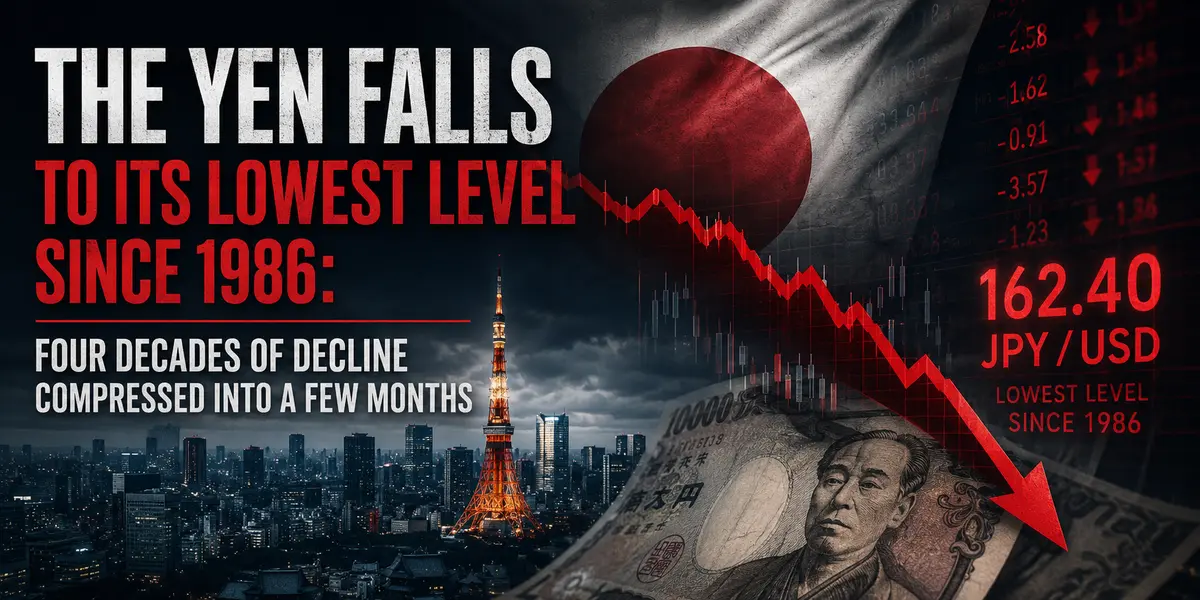
The Yen Falls to Its Lowest Level Since 1986: Four Decades of Decline Compressed Into a Few Months
Introduction: The Day the Clock Turned Back
Tuesday began in Asia like any other trading day. Exchanges opened, traders took their seats, and price charts lit up across countless screens. But what happened next made many market participants rub their eyes in disbelief.
The Japanese yen, the national currency of the world's third-largest economy, plunged to a level that none of today's active market participants had ever witnessed. 162.40 yen per U.S. dollar. The last time the exchange rate reached this level was in 1986.
For those born after the fall of the Berlin Wall, 1986 is little more than a line in a history textbook. For currency traders who have spent three decades in the market, however, it marks a moment when every familiar reference point suddenly disappears. Once regarded as a symbol of Japan's economic strength, the yen has increasingly become a currency investors are eager to sell whenever the opportunity arises.
Chief Cabinet Secretary Minoru Kihara and Finance Minister Satsuki Katayama responded with the government's familiar verbal warnings. The market barely reacted. Because words are just words. Markets respond to numbers, and the numbers tell a clear story: the Japanese currency has been in freefall for months, and nothing so far has managed to stop it.
Last year, the Japanese government spent a record $72 billion on currency interventions. The Bank of Japan raised its policy rate to 1%, the highest level in three decades. Yet all of those efforts proved to be little more than a drop in the ocean.
Let's examine why the yen continues to weaken, what this means for Japan's economy, and whether a reversal of the trend is possible—or even likely.
The Mechanics of the Decline: Why the Yen Can't Stop Falling
Carry Trade: The Yen's Biggest Enemy
To understand...
