

SK Hynix Surpasses Samsung: How a Modest Chipmaker Became South Korea’s Most Valuable Company
Introduction: The Day the Crown Fell
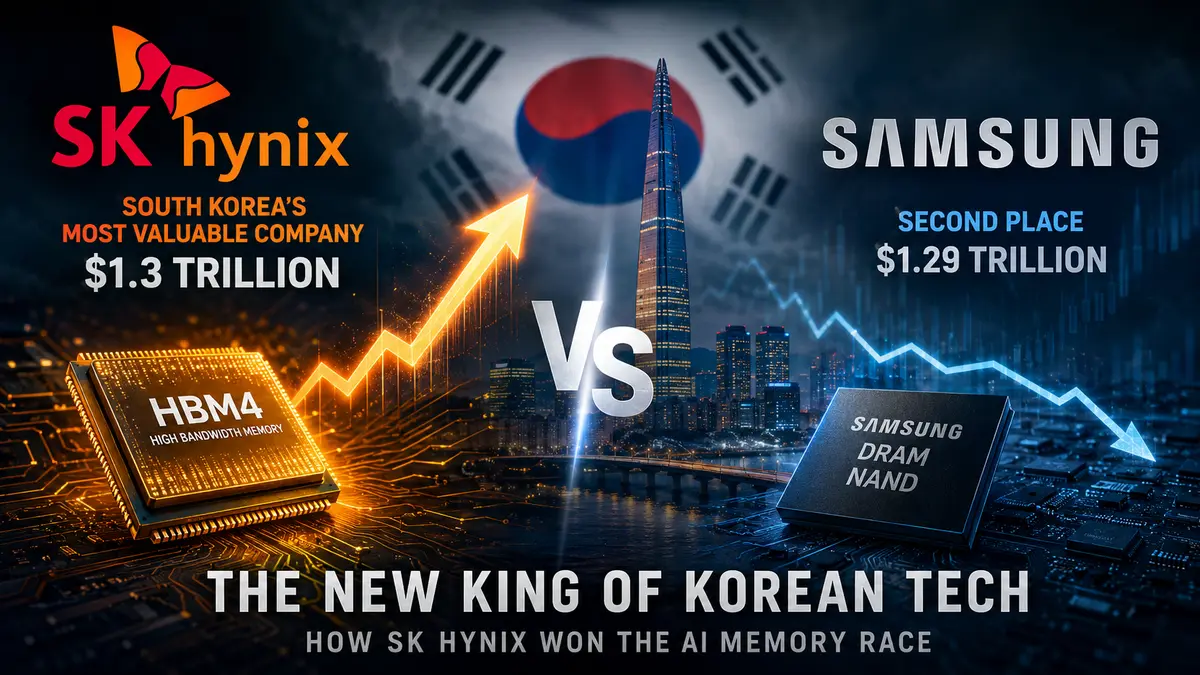
Monday morning in Seoul began like any other—people grabbing coffee, traffic filling the roads, office workers hurrying to work. But on the stock exchange, something historic was unfolding. SK Hynix shares surged 3.7%, reaching 2.8 million won per share. At the moment the stock crossed that threshold, South Korea crowned a new market king.
SK Hynix, a company many had written off two decades ago, became the most valuable company in the country. Its market capitalization reached 2,082 trillion won, or approximately $1.3 trillion. Samsung, the longtime champion that had held the title for so long that many investors could scarcely remember another leader, slipped into second place with a valuation of 2,081 trillion won.
The gap between them is only one trillion won. Yet that trillion is more than just a number. It symbolizes a tectonic shift in the global semiconductor industry. It reflects the reality that artificial intelligence is redrawing the map of the technology world, rewarding those who made the right bets at the right time while leaving others struggling to catch up.
How did SK Hynix—a company that once stood on the brink of bankruptcy and desperately searched for a buyer—manage to overtake Samsung, one of the most powerful and resilient technology giants on the planet? And what does this mean for the semiconductor industry as a whole?
Let’s take a closer look.
The Rise of SK Hynix: From Bankruptcy to a Trillion-Dollar Empire
2005: The Company Nobody Wanted to Buy
To appreciate SK Hynix’s triumph today, we need to go back about twenty years.
In 2005, the company was not merely the second-largest player in the memory market—it was a struggling one. Burdened by debt, saddled with outdated manufacturing facilities, and steadily losing market share, Hynix (as it was then known) appeared headed for extinction.
Management desperately sought a buyer. Negotiations with U.S. memory giant Micron Technology collapsed. Attempts to sell the company to private investors went nowhere. Hynix had become such a toxic asset that nobody wanted to assume its liabilities and obligations.
Then came what business schools now study as a classic corporate turnaround.
The company was acquired by SK Group, a South Korean conglomerate with interests in energy and telecommunications. More importantly, new leadership arrived with a vision others had missed.
They recognized that the memory market was not dying—it was evolving. They believed that focusing on quality rather than volume could pull the company out of crisis. Investments were directed toward advanced technologies, inefficient operations were cut, and premium products became the priority.
The strategy worked.
The AI Era: How HBM Changed Everything
The turning point arrived when artificial intelligence began transforming from a niche technology into a mass-market phenomenon.
This was precisely where SK Hynix found itself in the right place at the right time.
HBM (High Bandwidth Memory) is a specialized type of memory that is critical for modern AI processors. It operates at extremely high speeds, enabling rapid data transfer between chips. Without HBM, training large language models, running generative AI systems, and handling other compute-intensive AI workloads would be virtually impossible.
SK Hynix became one of the few manufacturers capable of producing HBM at scale.
Unlike traditional DRAM, where competition is fierce and margins are thin, HBM is a high-barrier market. Success requires not only advanced manufacturing facilities but also sophisticated engineering expertise and strong customer trust.
Its most important customer became Nvidia.
SK Hynix established a strategic partnership with the GPU giant, becoming a key supplier of memory for Nvidia’s most powerful AI chips. As Nvidia prospered, SK Hynix prospered alongside it. It was the kind of synergy every component manufacturer dreams about.
More recently, the company took another major step forward by announcing that samples of its next-generation HBM4 memory had been delivered to key customers.
This is more than an evolutionary upgrade—it is a leap that could secure SK Hynix’s leadership for years while competitors continue catching up to previous generations.
Samsung: Why the Giant Stumbled
An Empire That Missed a Trend Shift
Samsung is more than a company in South Korea—it is practically a state within a state.
Its influence on the national economy is so extensive that jokes about “Samsung people” often refer not just to employees, but to an entire generation that works for Samsung, buys Samsung products, invests in Samsung, and believes in Samsung.
That is why SK Hynix’s achievement came as such a shock.
Samsung losing the title of South Korea’s most valuable company is not merely a stock market story. It raises deeper questions about the country’s corporate culture and industrial future.
So what went wrong?
The answer lies in the same paradigm that saved SK Hynix.
Samsung remained heavily focused on traditional products—DRAM for computers and smartphones, NAND flash for storage devices. These remain enormous markets with stable revenue streams, but margins have been shrinking while competition from China continues to intensify.
Meanwhile, SK Hynix concentrated on HBM and won Nvidia’s business.
Samsung attempted to remain strong across every segment. That strategy works when markets grow evenly. But during periods of rapid technological disruption, being good at everything can mean being the best at nothing.
Samsung did not lose its manufacturing capabilities. It did not lose its technological expertise. It simply reacted too slowly to the AI memory opportunity.
Today, Samsung is investing heavily in HBM production. However, time is a critical factor. While Samsung builds capacity, SK Hynix is already shipping products to Nvidia and securing long-term contracts.
Preferred Shares: The Hidden Story
Another interesting aspect involves Samsung’s preferred shares.
When reports mention Samsung’s 1.4% decline, they typically refer to common shares. Including preferred shares slightly changes the picture, but not the conclusion: SK Hynix still leads in overall market capitalization.
Samsung’s preferred shares have traditionally been less volatile and are largely held by institutional investors. Their decline was more modest, but the broader story remains unchanged.
The psychological impact of SK Hynix surpassing Samsung is enormous.
It’s comparable to a football underdog defeating a legendary powerhouse 5–0.
Many analysts had anticipated this moment. SK Hynix’s roughly 340% rise since the beginning of the year was not an accident. It reflected disciplined execution, strategic foresight, and, admittedly, a degree of good fortune.
But luck is what happens when preparation meets opportunity.
And SK Hynix made the most of its opportunity.
What a $1.3 Trillion Valuation Means for SK Hynix
Joining the Elite Club
A market capitalization of $1.3 trillion is not merely a symbolic milestone.
It places SK Hynix among the world’s elite technology companies, alongside giants such as TSMC, Broadcom, Nvidia, and other semiconductor heavyweights.
This status brings significant advantages:
-
Easier access to low-cost financing
-
Greater ability to acquire other companies
-
Increased attractiveness to top engineering talent
-
Higher employee wealth through stock-based compensation
For South Korea, the milestone is equally important.
For decades, Samsung was the country’s undisputed national champion. Now South Korea has a second global semiconductor powerhouse capable of competing not only internationally but also domestically.
Competition often drives innovation, improves productivity, and strengthens labor markets.
The Future of SK Hynix: The Next Frontiers
The question investors are asking now is simple:
What’s next?
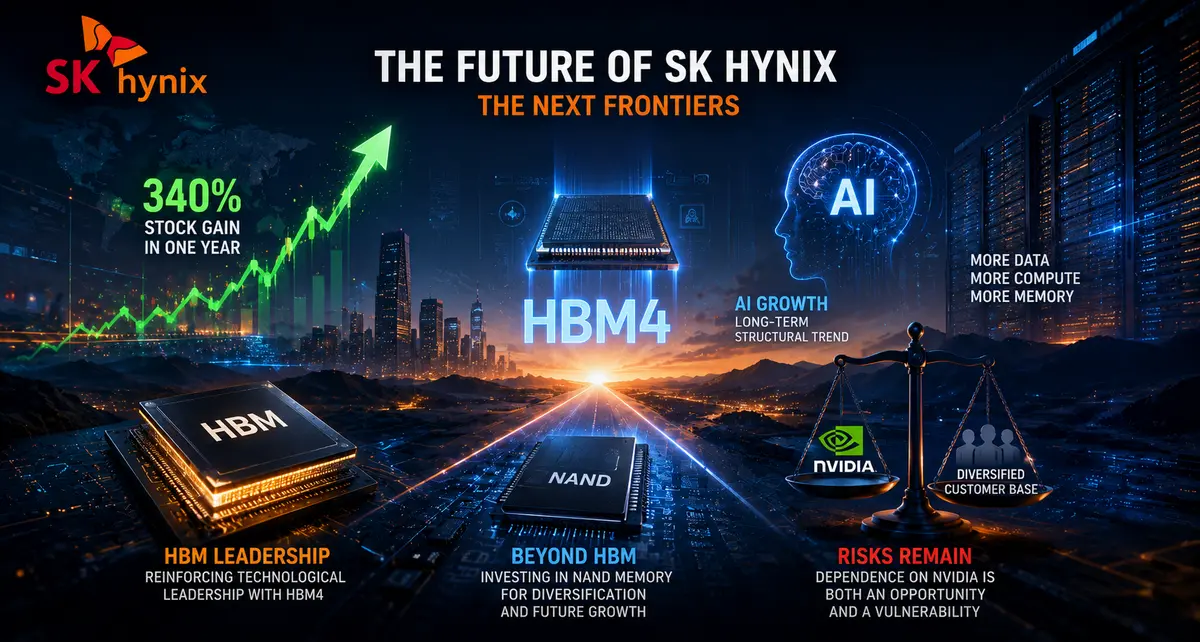
A 340% stock gain in a single year is extraordinary, but it also creates enormous expectations.
Can SK Hynix sustain its momentum?
Can it maintain its dominance in HBM?
Or will another player emerge to challenge its position?
For now, the outlook remains favorable.
The transition to HBM4 should reinforce technological leadership. Meanwhile, the AI market increasingly appears to be a long-term structural trend rather than a speculative bubble.
Large language models continue growing in size and complexity. They require more computing power and more memory. HBM is becoming increasingly indispensable.
SK Hynix is also investing beyond HBM.
The company continues developing NAND memory technologies, creating additional opportunities for innovation and diversification. While these businesses currently generate lower margins than HBM, they help reduce dependence on any single market segment.
Risks remain.
The most obvious is dependence on Nvidia.
Should Nvidia significantly shift toward another supplier, SK Hynix’s stock could fall as rapidly as it rose. The company understands this risk and is actively diversifying its customer base.
Still, Nvidia remains both its greatest engine of growth and its greatest vulnerability.
The South Korean Market and the Global Semiconductor Cycle
What This Shift Says About the Entire Industry
SK Hynix overtaking Samsung is not merely a local event.
It reflects broader changes sweeping through the global semiconductor industry.
Traditional chipmakers that dominated for decades are increasingly being challenged by companies that successfully aligned themselves with AI.
The industry has seen similar transitions before:
-
In the 1990s, Intel and IBM dominated.
-
In the 2000s, Samsung and TSMC rose to prominence.
-
In the 2010s, Nvidia surged thanks to gaming and cryptocurrency mining.
-
In the 2020s, AI is creating an entirely new generation of winners.
SK Hynix perfectly illustrates how a well-timed technological bet can transform competitive dynamics.
The company did not invent AI.
It did not single-handedly create HBM.
But it recognized the opportunity earlier than many rivals and positioned itself accordingly.
For investors, the lesson is clear: even in highly concentrated industries such as memory semiconductors, leadership is never guaranteed.
Samsung is not untouchable.
Companies that identify the right niche and commit to innovation can still challenge even the strongest incumbents.
Short Samsung, Long SK Hynix?
Analysts are rapidly revising their recommendations for both companies.
Many now favor SK Hynix, expecting continued growth driven by demand for HBM.
Others remain cautious on Samsung until the company demonstrates stronger progress in AI-focused memory products.
Yet there is another camp that argues the valuation gap has become excessive.
Samsung remains one of the world’s most powerful technology companies, with vast resources, world-class talent, and enormous manufacturing capabilities.
It possesses everything necessary to catch—and potentially surpass—SK Hynix in HBM.
The question is not capability.
The question is speed.
For now, the market is voting in SK Hynix’s favor.
But semiconductor history teaches one consistent lesson: today’s leader can quickly become tomorrow’s laggard if it misses the next technological wave.
Conclusion: A New King, But the Game Isn’t Over
SK Hynix has surpassed Samsung to become South Korea’s most valuable company.
The achievement will likely be remembered as a defining symbol of the AI era—a time when specialized suppliers of AI-critical components suddenly became more valuable than diversified technology empires.
The rise of SK Hynix is the story of a company that stood at the edge of collapse, reinvented itself, bet on the future, and ultimately found its moment.
It is an inspiring lesson for businesses everywhere: it is never too late to change your destiny if you recognize a trend before others and are willing to take calculated risks.
At the same time, it serves as a warning to Samsung.
Even great empires can stumble when they become too confident in their own dominance.
Samsung will undoubtedly fight to reclaim its crown. It has the resources, talent, and determination to do so.
But the first round belongs to SK Hynix.
For South Korea, the development is both a source of pride and a challenge. The country now boasts two semiconductor giants competing at the highest level. Whether that rivalry strengthens both companies or weakens them remains to be seen.
Investors around the world will continue watching this battle of titans closely.
SK Hynix is climbing.
Samsung is preparing its response.
And in the memory-chip industry, things are rarely boring.
One thing, however, is certain:
SK Hynix earned this moment.
After decades of struggle, restructuring, technological breakthroughs, and persistence, the company that nobody wanted to buy in 2005 is now worth more than Samsung.
If that’s not a success story, what is?

Comments
No comments yet. Be the first to share your thoughts!
Authentication Required
You must be logged in to post a comment.