

Bitcoin Above $64,000: Iran Talks and Bullish Options Push Crypto Higher
A Sunday Morning That Started in the Green
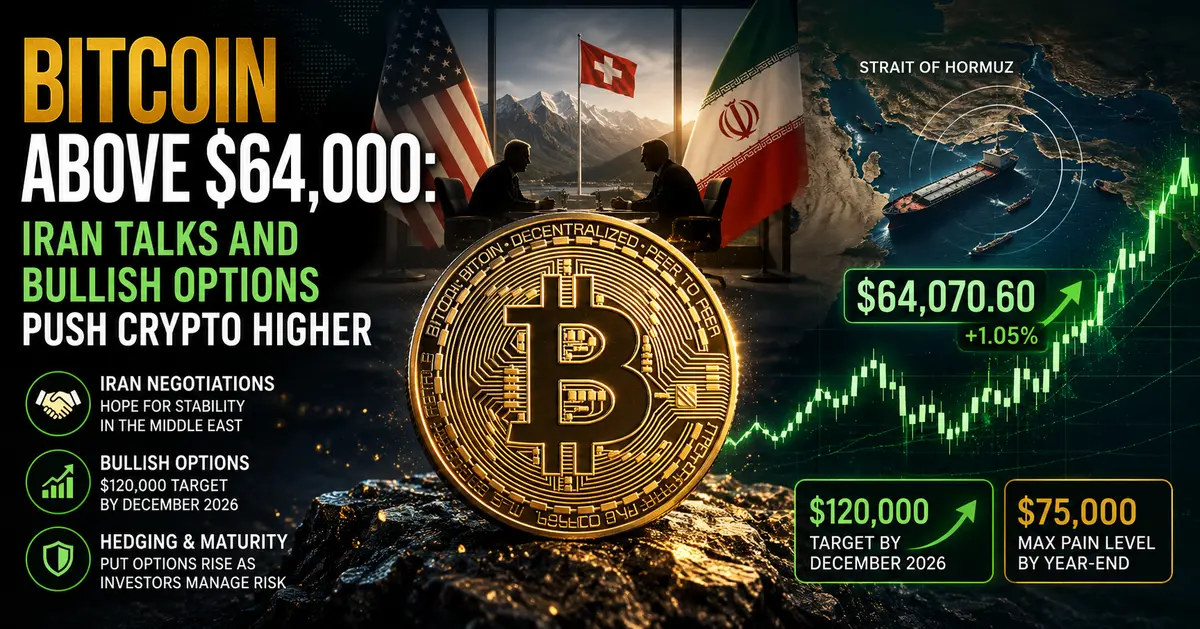
Sunday. Traditional markets are closed, but cryptocurrencies never sleep. While many people are just sipping their morning coffee, Bitcoin has already gained 1.05%, breaking above the $64,000 mark and settling at $64,070.60. After a week that left many investors on edge, seeing green on the chart feels like a breath of fresh air.
So what happened? Why has Bitcoin, which only a few days ago seemed vulnerable to every negative headline, suddenly found the strength to rally?
As has often been the case lately, the answer lies at the intersection of geopolitics and market expectations. On one side are the ongoing U.S.–Iran negotiations in Switzerland, offering the prospect of greater stability in the Middle East. On the other are options markets that continue to paint bullish scenarios, even as short-term volatility encourages traders to hedge their positions.
At the center of it all is Bitcoin, once again proving that it is more than just a digital asset—it is a complex financial instrument that reacts to macroeconomic and geopolitical signals. Let’s take a closer look at what is really driving this recovery and where the price could head next.
The Geopolitical Factor: Iran, Switzerland, and the Strait of Hormuz
Negotiations Keeping Markets on Edge
The peace agreement between the United States and Iran signed last week was met with cautious optimism. But diplomacy is a process, not an event. Now that the initial documents have been signed, the difficult part begins: negotiating the details.
Officials from both countries have met in Switzerland to transform a memorandum of understanding into something more durable and sustainable.
For markets, this is highly significant. The Middle East remains one of the world’s primary sources of geopolitical uncertainty. Any conflict in the region can trigger a surge in oil prices, which would affect the global economy and inflation expectations. Inflation expectations, in turn, are a key factor influencing all asset classes—including Bitcoin.
As negotiations continue, investors are watching every statement, every gesture, and every diplomatic signal. So far, progress itself is being viewed as a positive development. If both sides can reach a lasting ceasefire agreement, geopolitical risk premiums across asset markets could decline, supporting risk assets.
The Strait of Hormuz: An Old Threat in a New Context
Despite sending negotiators to Switzerland, Iran has not stopped reminding the world of its most powerful leverage point: the Strait of Hormuz.
This narrow maritime corridor carries roughly 20% of global oil shipments and remains a potential flashpoint. Iran has once again threatened to close the strait if negotiations do not proceed according to its expectations.
This is a classic element of Iranian diplomacy—keeping pressure on the table even while negotiating. Markets have heard such threats before and have become partially accustomed to them. However, in today’s fragile geopolitical environment, such statements carry added significance.
For Bitcoin, this factor cuts both ways. Greater Middle Eastern stability is generally positive for risk assets, including cryptocurrencies. On the other hand, any disruption to global energy supplies could create turmoil in traditional markets, which historically has not always benefited Bitcoin.
Bitcoin is still not a universal safe-haven asset. During periods of acute market stress, it can decline alongside equities.
As a result, traders remain in wait-and-see mode. They want to see progress in negotiations, but they are also preparing for unexpected developments. This combination of hope and caution is exactly what fuels the volatility that has become a defining feature of crypto markets.
The Options Market: Bullish Positioning Versus Short-Term Fears
Call Options Dominate: A Bet on $120,000 by December 2026
If geopolitics represents the external backdrop, the options market reveals what traders are thinking internally.
And the picture there is considerably more bullish than recent price fluctuations might suggest.
Data from Deribit, one of the largest cryptocurrency options exchanges, shows that call options (bets on rising prices) significantly outweigh put options (bets on falling prices) in terms of open interest.
In other words, investors are committing more capital to upside expectations than downside protection.
The most notable contracts target a Bitcoin price of $120,000 by December 2026.
Yes, $120,000.
This goes beyond simple optimism—it reflects confidence that current price levels represent only the early stages of a longer-term uptrend.
Naturally, long-dated options are not for everyone. They are expensive instruments typically purchased by large institutional investors capable of making long-term strategic bets. Nevertheless, the fact that such contracts exist and attract demand speaks volumes about broader market sentiment.
Major players appear to believe Bitcoin could reach $120,000 within the next eighteen months.
“Max Pain” Levels: $75,000 as the Next Milestone
Another intriguing indicator is the so-called “max pain” level.
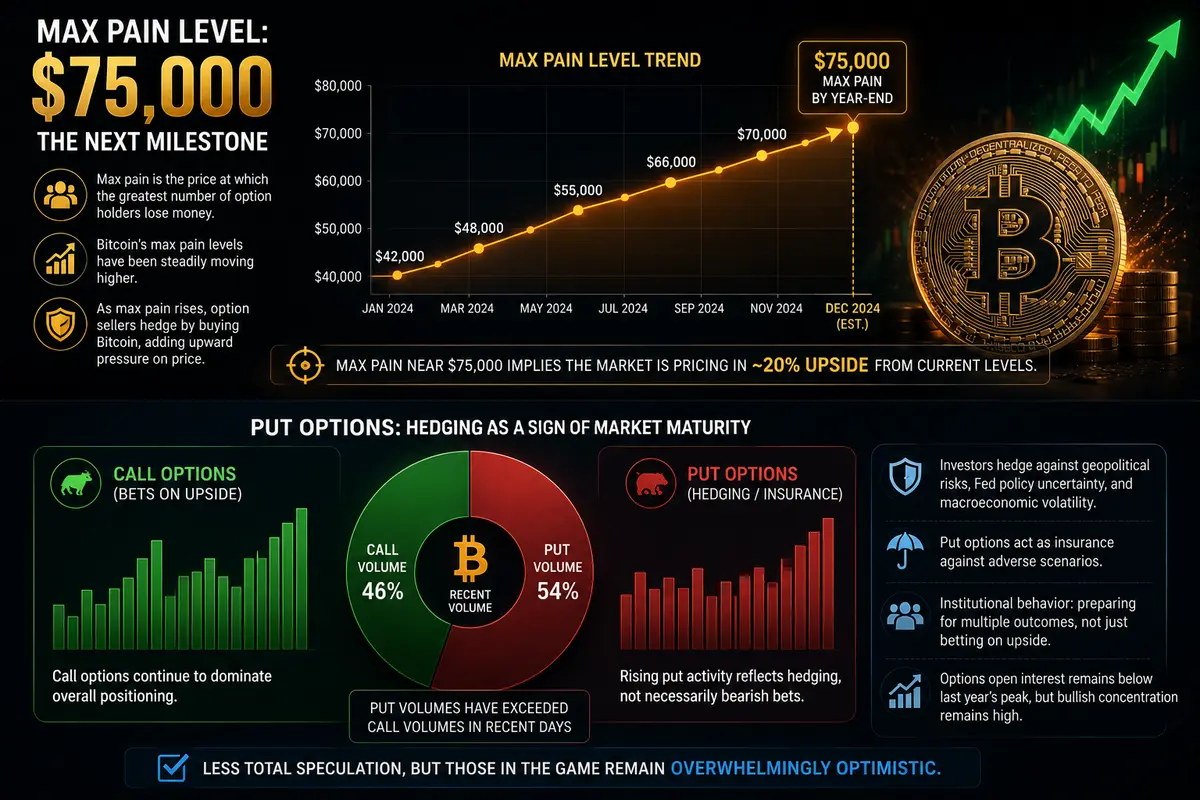
In options theory, max pain refers to the price at which the greatest number of option holders would experience losses. Bitcoin’s max pain levels have been steadily moving higher and now point toward approximately $75,000 by year-end.
In practical terms, this suggests that market participants are pricing in further upside.
If expectations were bearish, max pain levels would likely be lower.
Option sellers—typically market makers and large hedge funds—must account for these dynamics and adjust their hedging strategies accordingly. As max pain levels rise, sellers may need to buy Bitcoin to hedge exposure, creating additional upward pressure on the price.
This is not a direct price forecast, but it is a powerful technical signal.
A max pain level near $75,000 implies that the market is pricing in nearly 20% upside from current levels, even as short-term caution remains elevated.
Put Options: Hedging as a Sign of Market Maturity
The story, however, is not entirely one-sided.
While call options continue to dominate overall positioning, trading volumes in put options have recently increased significantly. In fact, put volumes have exceeded call volumes over the past several days.
At first glance, that might seem bearish.
In reality, it is more likely a sign of market maturity.
Investors are not merely betting on upside—they are actively hedging against adverse scenarios. This is classic institutional behavior. Large investors cannot afford to ignore downside risks, especially in an uncertain environment.
Geopolitical tensions involving Iran, unpredictable Federal Reserve policy, and broader macroeconomic volatility all encourage traders to purchase insurance.
Put options serve precisely that purpose.
The rise in put activity does not necessarily mean the market expects a decline. Rather, it suggests participants are preparing for multiple outcomes.
Interestingly, Bitcoin options open interest remains below last year’s peak levels. This reflects a broader retreat from the most aggressive six-figure price expectations.
Yet bullish concentration remains high.
Put simply, total speculative activity may have decreased, but those still participating are overwhelmingly optimistic.
Recovering From Last Week’s Decline
A Quick Look Back
To understand why Sunday’s 1% gain matters, it is important to remember what came before it.
Last week was challenging for Bitcoin. Prices fell below $62,000, prompting some commentators to declare the end of the bull market.
The reasons were familiar:
-
Hawkish signals from Federal Reserve Chair Kevin Warsh.
-
A stronger U.S. dollar.
-
Rising Treasury yields.
These are classic headwinds for risk assets.
Bitcoin, which still maintains a degree of correlation with technology stocks, remains sensitive to such macroeconomic signals.
Additional crypto-specific concerns also emerged, including declining options open interest, which many interpreted as waning risk appetite. Traders closed positions, either locking in profits or limiting losses.
But markets rarely move in one direction forever.
Every correction creates opportunities for buyers, and this time those buyers returned on Sunday.
The $64,000 level, now reclaimed, may serve as an important psychological support zone. If Bitcoin can maintain levels above it, the foundation for further gains could strengthen.
The Role of Iran Talks in the Recovery
The negotiations in Switzerland acted as the catalyst that brought buyers back into the market.
Hope for a durable agreement reduces geopolitical uncertainty and allows investors to focus on growth opportunities rather than defensive positioning.
Of course, the positive impact could prove temporary. Diplomacy moves slowly, and favorable developments can quickly be offset by new tensions.
Yet on this particular Sunday, markets chose to interpret the news positively—and that was enough to create momentum.
The implications extend beyond geopolitics.
A lasting agreement with Iran could influence global oil prices. Lower energy costs would help ease inflationary pressures, reducing the need for aggressive monetary tightening by central banks.
That environment tends to support risk assets, including Bitcoin.
The Long-Term Picture: The Bull Market May Not Be Over
Institutional Demand Remains Strong
Despite ongoing volatility, Bitcoin’s long-term fundamentals remain constructive.
Institutional participation in the crypto sector continues to grow.
Spot Bitcoin ETFs launched earlier in the year continue attracting capital. Major financial institutions such as BlackRock and Fidelity are not retreating from crypto; they are expanding their involvement.
This creates a stronger foundation for long-term growth.
As discussed earlier, options markets also remain bullish over longer time horizons.
The popularity of $120,000 December 2026 contracts reflects strategic positioning by investors who see substantial upside potential.
Halving, Regulation, and Adoption
Fundamental drivers remain supportive as well.
The 2024 Bitcoin halving has already reduced new supply, but its full price impact may take additional time to materialize. Historically, major bull market peaks have occurred 12–18 months after a halving event, suggesting the possibility of further upside extending into late 2025 and early 2026.
The regulatory environment is also improving.
The United States continues moving toward clearer cryptocurrency regulations, reducing uncertainty for institutional investors. Europe’s MiCA framework provides a unified regulatory structure across the European Union. Meanwhile, financial hubs such as Singapore and Hong Kong are competing to establish themselves as leading crypto centers.
Bitcoin adoption as both a payment method and a store of value is also expanding.
More corporations are adding Bitcoin to their balance sheets, while countries facing currency instability increasingly view it as an alternative to the U.S. dollar.
Conclusion: $64,000 Is Not the Finish Line—It May Be the Starting Point
Bitcoin trading above $64,000 this Sunday is more than a random market move.
It is a sign that investors continue to believe in the long-term growth story despite numerous short-term challenges.
The geopolitical situation surrounding Iran remains delicate, but negotiations in Switzerland provide grounds for optimism. If a durable agreement emerges, it could ease pressure on the global economy and support risk assets.
Meanwhile, options markets suggest that large investors remain positioned for higher prices. Call options dominate, max pain levels continue to rise, and the popularity of $120,000 December 2026 contracts reflects a confident long-term outlook.
The increase in put-option activity should not necessarily be viewed as bearish. Rather, it demonstrates a more mature market where participants actively hedge risks while maintaining bullish exposure.
What happens tomorrow, next week, or next month?
No one knows.
But today, Bitcoin is above $64,000.
And that fact alone suggests that the cryptocurrency market remains resilient. Despite corrections, uncertainty, and macroeconomic headwinds, it continues to find opportunities for growth.
Perhaps that is the most important signal of all.
Bitcoin is not fading into the background. It continues to fight for a larger role within the global financial system.
And as long as major investors continue placing long-term bets on prices as high as $120,000, while buyers remain willing to accumulate during downturns, the possibility of new all-time highs remains very much alive.
For now, all that remains is to watch the negotiations in Switzerland, monitor the options market, and follow the world’s leading cryptocurrency.
And perhaps prepare for the possibility that $64,000 is merely another stop on the road to significantly higher levels.

Comments
No comments yet. Be the first to share your thoughts!
Authentication Required
You must be logged in to post a comment.