

Oil Pulls Back: Middle East Ceasefire Cools the Market, but It’s Too Early to Relax
Tuesday Morning: Black Gold Gets Cheaper, but Doesn’t Fall Off a Cliff
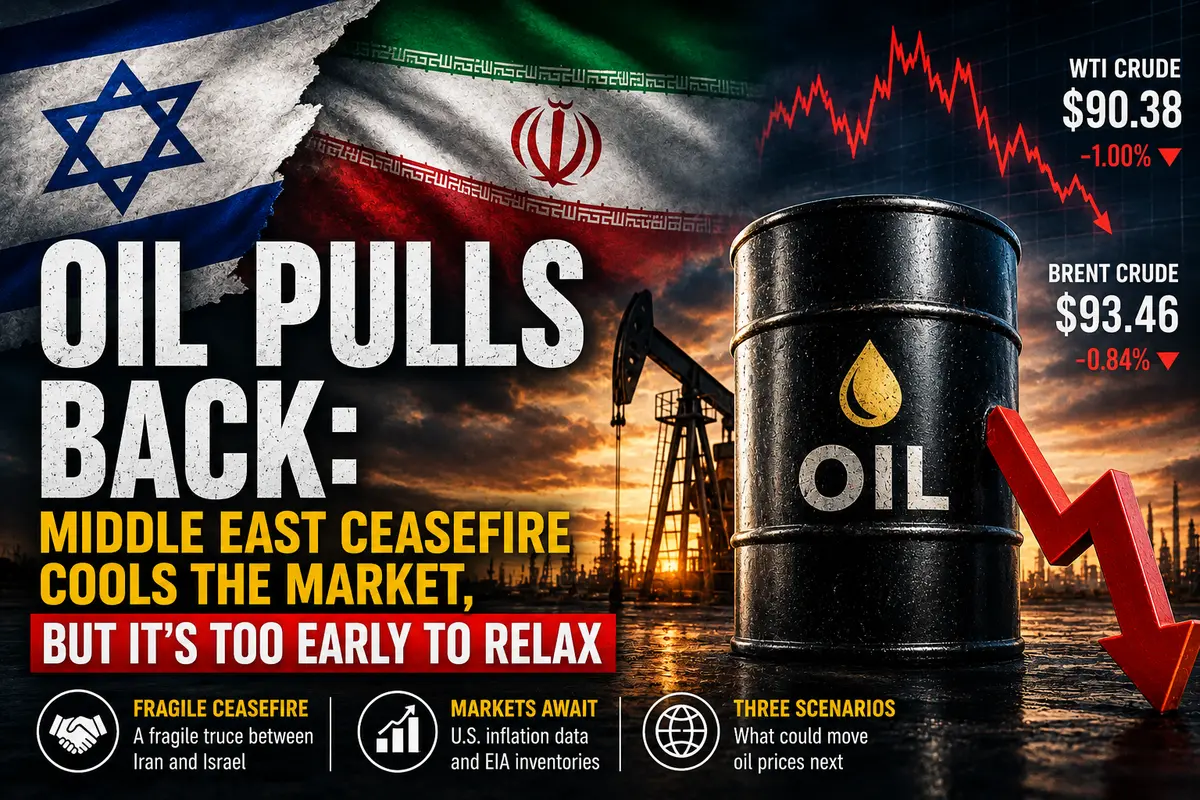
On Tuesday morning, oil traders could finally sip their coffee without their hands shaking. After the wild swings over the weekend, when Iran and Israel exchanged missile strikes and crude prices surged dramatically, a period of relative calm arrived. Futures for WTI crude oil—the benchmark for the U.S. market and beyond—moved lower. At the time of writing, a barrel was trading at $90.38, down 1% from the previous close.
At first glance, a one-percent decline may seem insignificant. But behind that single percentage point lies an entire story: negotiations behind closed doors, diplomatic maneuvering by Donald Trump, a fragile ceasefire between two countries that only yesterday appeared ready to tear each other apart, and, of course, the ever-present fears surrounding the Strait of Hormuz.
On Monday, oil prices soared. WTI climbed above $93, while Brent nearly reached $96. Markets were pricing in the worst-case scenario—a blockade of the Strait of Hormuz, a full-scale regional war, and gasoline prices in the United States rising to $5–6 per gallon. By Monday evening, however, the first signs emerged that catastrophe might be avoided. Then, on Tuesday morning, confirmation arrived: the parties had agreed to halt attacks—at least for now.
Oil markets reacted immediately. WTI slipped to $90.38, while Brent fell to $93.46. The spread between the two benchmarks stood at $3.08 per barrel in favor of Brent—a historically normal range and nothing extraordinary.
Yet beneath the surface calm, many sources of concern remain.
Donald Trump Promises “Total Victory” — But What Does That Mean?
On Monday evening, as Asian markets opened and U.S. markets were still trading, President Donald Trump made a statement that quickly spread across financial media. According to Trump, the United States was close to declaring a “total victory” in the conflict with Iran. He also suggested that oil prices would likely fall sharply afterward.
The phrase “total victory” is, to put it mildly, an exaggeration. In the Middle East, outright victories are rare. Even after the defeat of ISIS, conflicts in the region merely shifted into new phases rather than ending entirely. This is especially true when dealing with a country like Iran—a nation of more than 80 million people with an advanced missile program, a network of regional proxy forces stretching from Lebanon to Yemen, and support from major powers such as Russia and China.
Trump, however, is not known for traditional diplomatic language. He speaks primarily to American voters and financial markets. His message was clear: “Don’t panic. The war is ending. Oil prices will come down.”
With elections approaching and high gasoline prices posing a political risk to any administration, calming markets is an obvious priority.
Did traders believe him? Partially.
Oil prices declined, but not dramatically. Instead of falling 5–10%, they slipped by only one to two percent. Markets understand that political statements are not guarantees of peace. Real agreements, enforcement mechanisms, and, most importantly, time are required. Without time, any ceasefire is merely a pause before the next round of hostilities.
Technical Levels: Support and Resistance
For traders who rely on charts rather than headlines, specific price levels matter.
WTI currently has a key support level at $89.68 per barrel. This was the low reached during Tuesday’s morning session before prices rebounded. If oil breaks below that level, the next downside target could be $87–88.
On the upside, resistance sits at $95.91, Monday’s panic-driven high. Returning to that level would likely require a fresh geopolitical shock, such as a collapse of the ceasefire and renewed attacks.
For now, oil remains trapped between these levels, closer to the lower boundary. Traders are waiting. Investors are waiting. Everyone is waiting—for U.S. inflation data due on Wednesday and for further developments from the Middle East.
Why Did Oil Fall Instead of Rise? Three Reasons
Someone who doesn’t follow markets closely may reasonably ask: “How can oil fall when there’s a war in the Middle East?”
There are three main reasons.
1. The Ceasefire
The most obvious explanation. The parties have agreed to stop attacking each other. The threat of a full-scale war has receded, at least temporarily. The Strait of Hormuz remains open. Tankers continue to move normally. Supply disruptions have not materialized.
2. Profit-Taking
Monday’s rally generated substantial gains for traders.
Anyone who bought oil at $87 on Friday and sold near $93 on Monday earned almost 7% in just two days—an extraordinary return. Many of those traders are now closing positions, locking in profits, and moving into cash. Their selling pressure pushes prices lower.
3. Anticipation of U.S. Inflation Data
This may be the most important medium-term factor.
Consumer inflation data is due Wednesday, followed by producer price data on Thursday. If inflation remains elevated, the Federal Reserve may be forced to keep interest rates higher for longer—or even tighten further.
Higher interest rates generally support a stronger U.S. dollar and weigh on oil prices. Since crude is priced in dollars, a stronger dollar makes oil more expensive for buyers in other countries, reducing demand and pressuring prices lower.
Many investors prefer to stay on the sidelines ahead of such important economic releases.
What’s Happening With Brent?
Brent crude, the benchmark for Europe and much of the global market, also declined, falling 0.84% to $93.46 per barrel.
The drop was slightly smaller than WTI’s because Brent tends to be more sensitive to Middle Eastern geopolitical risks. Although Brent production comes from the North Sea, its pricing remains heavily influenced by developments in the Persian Gulf.
The Brent-WTI spread currently stands at $3.08.
Historically, Brent has traded at a premium of roughly $2–4 per barrel due to quality and logistical factors. A spread of $5–6 often signals fears of supply disruptions from the Gulf region, while a narrowing spread toward $1–2 can indicate abundant U.S. shale production.
Today’s spread suggests a market that is cautious but not panicked.
The Ceasefire: An Agreement Nobody Has Seen
The most important question remains unanswered: what exactly does the ceasefire entail?
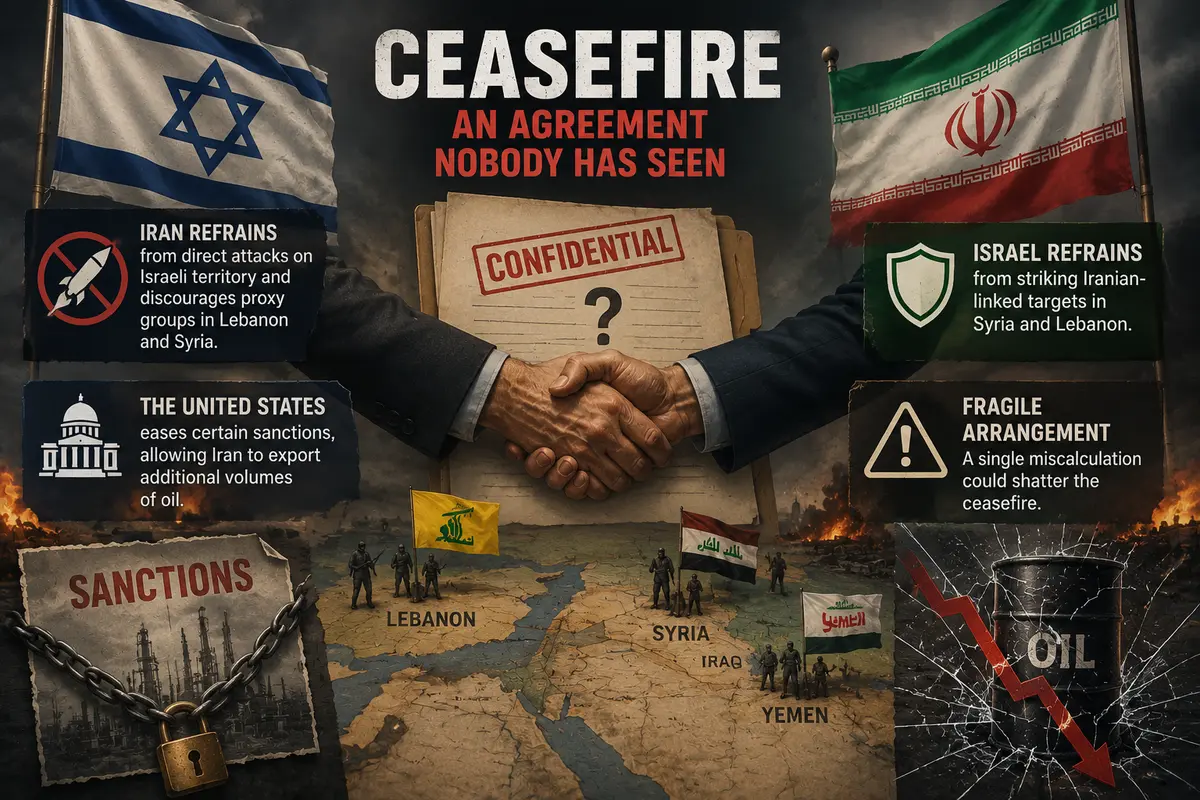
As is often the case with such arrangements, public information is scarce. Israeli officials confirm that attacks have ceased but provide few details. Iranian officials have done the same. Trump speaks of “total victory,” yet what that means in practical terms remains unclear.
According to unofficial reports, the understanding may include several provisions:
-
Iran refrains from direct attacks on Israeli territory and discourages proxy groups in Lebanon and Syria from launching attacks.
-
Israel refrains from striking Iranian-linked targets in Syria and Lebanon.
-
The United States eases certain sanctions, allowing Iran to export additional volumes of oil.
However, these reports remain unconfirmed. No official text has been released, and one may never be published. Agreements of this nature are often negotiated privately to allow all parties to save face domestically.
The biggest risk is the fragility of the arrangement itself.
The Middle East contains numerous actors with an interest in disrupting peace efforts. Hezbollah, the Houthis, and various militia groups in Iraq and Syria do not always respond directly to orders from Tehran. Meanwhile, powerful political and military factions within Israel may oppose concessions.
A single miscalculation could shatter the ceasefire—and the calm in oil markets along with it.
The U.S. Angle: Elections and Gasoline Prices
To understand why Trump has become so deeply involved in Middle Eastern diplomacy, one must look at domestic politics.
Presidential elections are approaching, and gasoline prices remain one of the most visible economic indicators for American voters.
Americans are accustomed to relatively inexpensive fuel. When gasoline rises above $4 per gallon—or $5–6 in places like California and Hawaii—it directly affects household budgets. Consumers drive less, spend less, and economic sentiment weakens.
No president wants to campaign for reelection while facing accusations of allowing fuel prices to surge.
This helps explain why Trump, once known for his hardline approach toward Iran, is now emphasizing peace and stability. Lower oil prices mean lower gasoline prices, and lower gasoline prices are politically valuable.
EIA Inventory Data: The Next Key Report
Alongside inflation data, markets will also receive another important report on Wednesday: the U.S. Energy Information Administration’s weekly petroleum inventory release.
Over the past four weeks, U.S. crude inventories have reportedly declined by roughly 10 million barrels, driven by strong summer gasoline demand and lower imports.
Analysts expect inventories for the week ending June 5 to fall by another 2–3 million barrels.
If the decline proves larger—around 4–5 million barrels—oil prices could rebound. Conversely, an unexpected inventory build would add further downward pressure.
Still, inventory figures may take a back seat to developments in the Persian Gulf and the inflation numbers.
The Dollar: An Underappreciated Factor
The U.S. Dollar Index futures slipped 0.06% on Tuesday morning to 99.97.
A tiny move, but one worth watching.
The dollar strengthened over the previous two weeks on the back of solid economic data and expectations for higher interest rates. Following Friday’s employment report, the index climbed to a two-month high near 100.21.
Since then, news of the ceasefire has reduced demand for the dollar as a safe-haven asset.
When geopolitical risks ease, investors become more willing to diversify into euros, yen, pounds, and emerging-market currencies. As a result, the dollar softens.
A weaker dollar is generally supportive for oil because it makes crude cheaper in local currency terms for buyers in Europe, China, Japan, and India.
The decline so far is modest, but if the trend continues, it could provide additional support for crude prices.
Outlook for the Next Few Days: Three Scenarios
The near-term outlook depends on three variables:
-
The durability of the ceasefire.
-
U.S. inflation data.
-
U.S. oil inventories.
Scenario 1: Bullish for Consumers
-
Ceasefire holds.
-
Inflation comes in below expectations.
-
Oil inventories rise.
In this case, WTI could fall toward $85–87 per barrel over the next two weeks.
Scenario 2: Neutral
-
Ceasefire remains in place.
-
Tensions stay elevated.
-
Inflation matches forecasts.
-
Inventories decline modestly.
WTI trades between $88 and $92.
Scenario 3: Bullish for Oil
-
Ceasefire collapses.
-
Iran and Israel resume attacks.
-
Inflation exceeds expectations.
WTI could quickly move back toward $95, then $98, and potentially $100 per barrel.
For consumers, that would be painful. For oil traders, highly profitable.
The Bottom Line
Oil prices moved lower on Tuesday morning, though not dramatically. The decline was driven by reports of a ceasefire between Iran and Israel and by Trump’s comments about an impending “total victory.”
However, it is far too early to relax.
The ceasefire remains fragile. U.S. inflation data will not be released until Wednesday. Oil inventory figures are also due Wednesday. And the Middle East remains one of the world’s most unpredictable regions.
For now, traders are taking profits after Monday’s rally and waiting for clarity. The dollar has eased slightly. The Brent-WTI spread remains normal. Key technical levels—support at $89.68 and resistance at $95.91—remain intact.
The next 48 hours could prove decisive.
If the ceasefire holds and inflation data comes in benign, oil may continue drifting lower toward $87–88 per barrel. If the truce breaks down, however, prices could quickly return to $95 and beyond, with $100 becoming the next major target.
For now, everyone is waiting.
Even oil.

Comments
No comments yet. Be the first to share your thoughts!
Comments only for logged-in users.