

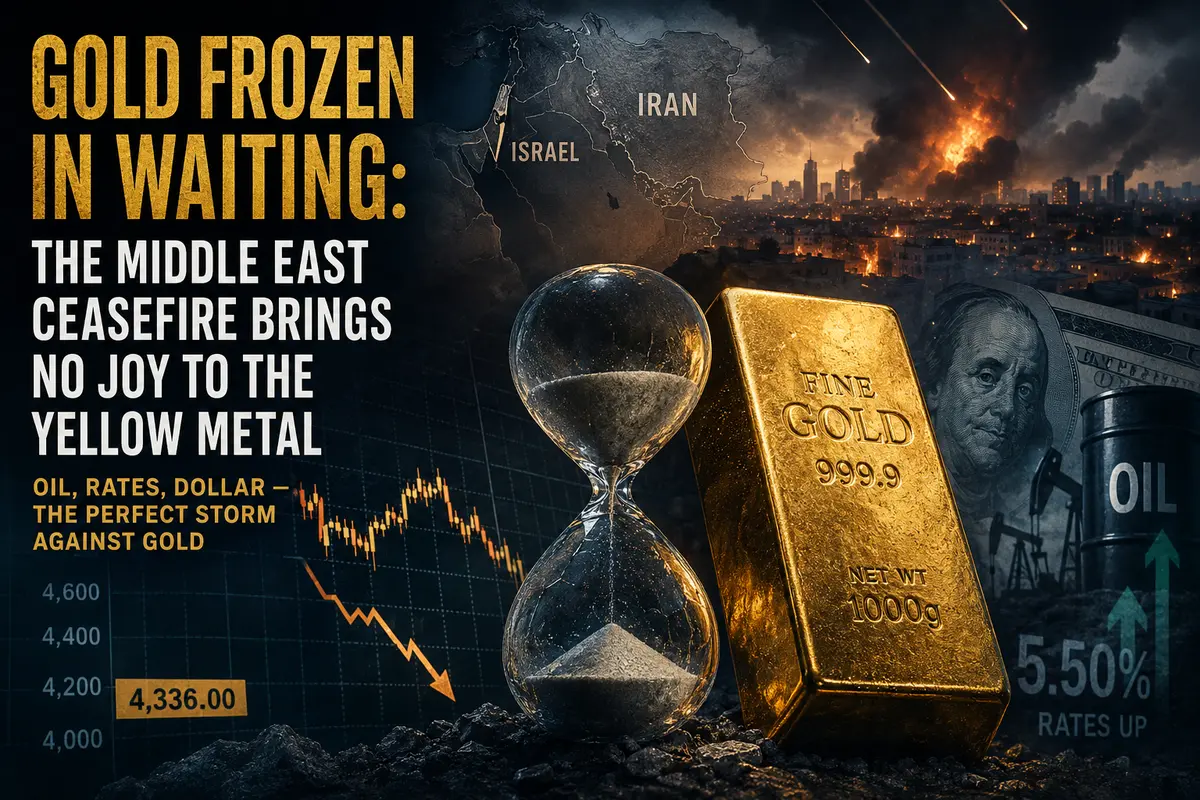
Gold Frozen in Waiting: The Middle East Ceasefire Brings No Joy to the Yellow Metal
A Strange War in Which Gold Is Losing
There is a deeply rooted, almost archetypal belief: when the world is falling apart, when missiles fly, tanks fire, and politicians threaten one another with destruction, you buy gold. The yellow metal has been tested by centuries. It survived the fall of Rome, the plague, world wars, and the hyperinflation of the Weimar Republic. A war in the Middle East? Surely that means rushing to jewelry stores and coin dealers.
Not this time.
Reality has once again proven more complicated than the simplified lessons found in economics textbooks. The conflict between Iran and Israel, which flared up again on Sunday with missile exchanges and airstrikes, has brought gold nothing but another round of pain. On Tuesday morning, gold was trading near an 11-week low. Spot prices stood at $4,336 per ounce, up just 0.2%—not nearly enough to recover Monday’s losses. August futures were at $4,361, virtually unchanged.
What kind of war is this, where the traditional safe-haven asset falls instead of rising? And why has the ceasefire, which should theoretically calm markets and reduce demand for safe-haven assets, left gold almost exactly where it was?
As is often the case, the answer lies in three interconnected factors: oil, interest rates, and the U.S. dollar. Together, they are working against gold almost perfectly.
The Oil Paradox: The Worse It Is for the World, the Worse It Is for Gold
Let’s break it down.
Iran and Israel exchanged strikes. Iran launched missiles into northern Israel. Israel conducted airstrikes on Beirut suburbs where, according to its intelligence, Iranian assets were located. Whenever conflict erupts in the Middle East, markets immediately become nervous about oil.
The Strait of Hormuz, through which roughly one-fifth of global oil exports pass, is within range of Iranian missiles and naval forces. If Iran were to block it, oil prices could easily surge to $150—or even $200—per barrel.
In the old world, a simple chain reaction would follow:
Higher oil → Higher inflation → More demand for gold as a hedge.
Simple and intuitive.
But today, everything has been turned upside down.
Why?
Because gold’s biggest enemy today is not inflation itself—it is the Federal Reserve’s response to inflation.
Higher oil prices mean inflation in the United States will remain elevated. That means the Federal Reserve cannot comfortably cut interest rates. In fact, if oil keeps climbing, the Fed may even need to raise rates further to prevent inflation expectations from becoming entrenched.
And high interest rates are poison for gold.
Gold generates no income. If investors can buy a U.S. Treasury bond yielding 5.5% and sleep peacefully, why would they buy a gold bar that simply sits in a vault waiting for someone to pay more for it later?
Exactly.
This mechanism played out once again. When news of the missile exchanges emerged on Sunday, oil prices surged. Brent crude approached $96 per barrel, while WTI climbed toward $93.
Gold, however, fell.
Traders immediately worked through the chain:
Expensive oil = Higher inflation = Higher rates = Weaker gold.
Trump Promises “Total Victory” Over Iran
Late Monday evening, as Asian markets were already open and U.S. markets were still trading, Donald Trump made a statement that caught investors’ attention.
He said the United States was close to declaring a “total victory” in the conflict with Iran and added that oil prices would likely fall sharply as a result.
The wording was striking.
“Total victory” is not language typically used by diplomats discussing Middle Eastern peace efforts. But Trump has never been known for diplomatic understatement. His style has always been loud, direct, and emphatic.
What exactly did he mean?
Details remain unclear. Judging by the context, he was referring to a U.S.-brokered ceasefire that could evolve into broader agreements aimed at limiting Iranian influence in the region. Perhaps a new nuclear deal. Perhaps diplomatic recognition of Israel by Iran. Perhaps something else entirely that remains behind closed doors.
For oil markets, however, the message was simple: perhaps the worst-case scenario could be avoided.
On Tuesday morning, oil prices edged lower. Not dramatically, not in panic—just enough to ease concerns. That, in turn, slightly reduced pressure on gold because lower oil prices imply lower inflation risks, giving the Federal Reserve somewhat more room to maneuver.
Yet gold did not rally.
It simply froze in place.
Waiting.
U.S. Labor Market Data: The Foundation Supporting Everything
To understand why gold remained stagnant rather than surging after the ceasefire news, we need to revisit Friday’s U.S. employment report.
The U.S. economy added 172,000 jobs in May. Economists had expected only 130,000.
Unemployment remained at 4.3%, while many had anticipated a slight increase.
These weren’t merely good numbers.
They were shockingly strong.
The data showed that the U.S. economy continues to expand despite repeated forecasts of slowing growth. Companies are hiring. People are working. Wages are rising.
The market reaction was dramatic.
Just before the report, traders were pricing in the possibility of Fed rate cuts later this year. After the report, many began pricing in the possibility of further rate hikes.
Current federal funds futures imply roughly a 70% probability of a rate increase by December.
Seventy percent.
That is no longer “maybe.” That is “more likely than not.”
And it changes everything.
Treasury yields jumped. The dollar strengthened to a two-month high. Gold, which offers no yield, suddenly became far less attractive compared to government bonds providing guaranteed income.
The Ceasefire: Fragile but Important
The ceasefire reached on Monday between Iran and Israel is undoubtedly positive news for global stability.
For gold, however, it is neutral at best—and possibly mildly negative.
Any reduction in geopolitical tension reduces demand for safe-haven assets.
But the key issue is not the ceasefire itself.
The key issue is how oil reacted.
Oil moved lower. Not by 5–10%, but enough to matter. That suggests inflationary pressure from energy may be less severe than investors feared on Sunday.
If inflation proves less threatening, the Federal Reserve may not need to tighten policy further. That would eventually ease pressure on gold.
There is one major caveat.
The ceasefire is fragile.
Extremely fragile.
No one can guarantee that Iran will not launch missiles tomorrow or that Israel will not respond with additional strikes. Trump talks about “total victory,” but history suggests that in the Middle East, peace often resembles little more than an intermission between conflicts.
That is why investors are not rushing to sell gold.
They are waiting.
What if the ceasefire collapses? What if oil surges back toward $100? What if diplomatic progress proves illusory?
For now, nobody knows.
U.S. Inflation: The Week’s Defining Event
Ask any gold trader what matters most right now, and they probably will not mention Iran, Israel, or the ceasefire.
They will mention Wednesday.
That is when the U.S. Consumer Price Index (CPI) is released.
On Thursday comes the Producer Price Index (PPI).
Those reports are likely to determine gold’s direction for weeks—perhaps months.
If inflation exceeds expectations, the Fed will have little room to consider rate cuts. Markets may begin pricing even more aggressive tightening. The dollar would strengthen, bond yields would rise, and gold could break below $4,300—perhaps even $4,200.
If inflation comes in below expectations, hope will return. Investors may begin to believe the Fed is done hiking rates and could even start easing sooner than currently expected. In that scenario, the dollar would weaken, yields would decline, and gold could rebound toward $4,400 or even $4,500.
For now, however, there is silence.
Inflation data have not yet arrived.
The ceasefire is holding.
Oil has stabilized.
And gold remains frozen in place.
Like a predator before a leap.
Or before a fall.
No one knows which.
An Unusual Dynamic: Gold and Oil Have Swapped Roles
One of the most fascinating developments in today’s markets is the breakdown of traditional correlations.
Historically, gold and oil often moved in the same direction. Expensive oil implied inflation, and inflation increased demand for gold as a hedge.
Today, that relationship has fractured.
Oil rises, gold falls.
Oil falls, gold stalls.
Why?
Because markets are no longer focused on the first step:
Oil → Inflation
They are focused on the second:
Inflation → Fed Rates
Then the third:
Fed Rates → Dollar
And finally:
Dollar and Rates → Gold
At every stage of that chain, gold currently loses.
Higher oil means higher inflation expectations.
Higher inflation expectations increase the likelihood of Fed tightening.
More tightening means stronger bond yields and a stronger dollar.
And higher yields combined with a stronger dollar are among the most powerful headwinds gold can face.
This creates a remarkable paradox:
A Middle Eastern conflict that should theoretically push gold higher is instead pushing it lower.
And the more serious the conflict becomes, the stronger the downward pressure may be.
Many veteran traders who began their careers in the 1990s or early 2000s are struggling with this reality.
“How can there be war in the Persian Gulf and gold not rally?” they ask.
Because the world has changed.
Central banks have changed.
Markets have changed.
And old playbooks no longer work.
What About Other Precious Metals?
Silver posted a modest gain Tuesday morning, rising 0.1% to $68.24 per ounce.
Platinum was virtually unchanged at $1,760.60.
No enthusiasm.
No panic buying.
Just caution, patience, and all eyes fixed on Wednesday’s inflation report.
Silver differs from gold because it has a substantial industrial component. It is used in solar panels, electronics, and medical applications. Therefore, industrial demand supports silver when economic growth remains strong.
But even that support has not been enough to overcome the pressure created by high interest rates and a strong dollar.
Platinum is even more dependent on industrial demand, particularly from the automotive sector and the transition toward electric vehicles.
Its challenges are largely structural and have persisted for years.
A stagnant platinum price reflects not only current macroeconomic conditions but also longer-term industry trends.
Forecast: What Happens to Gold This Week?
The next two days are critical.
Wednesday: Consumer inflation data.
Thursday: Producer inflation data.
Friday: Markets digest what they have learned.
Three scenarios emerge.
Scenario 1: Bearish for Gold
Inflation comes in above forecasts.
Markets become convinced the Fed will raise rates in December—or perhaps even sooner.
Ten-year Treasury yields climb toward 5% or higher.
The dollar strengthens further.
Gold falls.
First to $4,300.
Then $4,250.
Perhaps eventually $4,200.
At present, this appears to be the most likely scenario.
Scenario 2: Bullish for Gold
Inflation surprises to the downside.
Markets breathe a sigh of relief.
Confidence grows that the Fed may not need to raise rates again.
The dollar weakens.
Bond yields decline.
Gold rebounds.
First toward $4,400.
Then, if Thursday’s producer-price data are also soft, perhaps toward $4,450–$4,500.
A favorable outcome—but currently a less probable one.
Scenario 3: Neutral
Inflation matches expectations almost exactly.
Markets shrug.
Nothing changes.
Gold remains trapped between roughly $4,320 and $4,380, waiting for the next catalyst.
A boring scenario.
But for gold holders, boring is often preferable to falling.
Final Thoughts
Looking at the resilience of the U.S. economy, the strength of the labor market, and still-elevated oil prices despite recent pullbacks, I currently lean toward the bearish scenario.
Gold may face more pain ahead.
Possibly a lot more.
The current 11-week low may not represent the bottom.
It may simply be another stop on the way down.
But markets have a habit of humbling certainty.
Geopolitics remains unpredictable.
One careless statement.
One miscalculated missile.
And the fragile balance holding everything together could disappear overnight.
If that happens, the gold that investors are ignoring today could suddenly become the asset everyone wants tomorrow.
And if that day comes, few people will be eager to sell it anywhere near an 11-week low.
That is the market.
You never truly know where the truth lies, where the illusion begins—or where the bottom really is.

Comments
No comments yet. Be the first to share your thoughts!
Comments only for logged-in users.