

Yen Tests the 160-per-Dollar Level Amid Intervention Threats
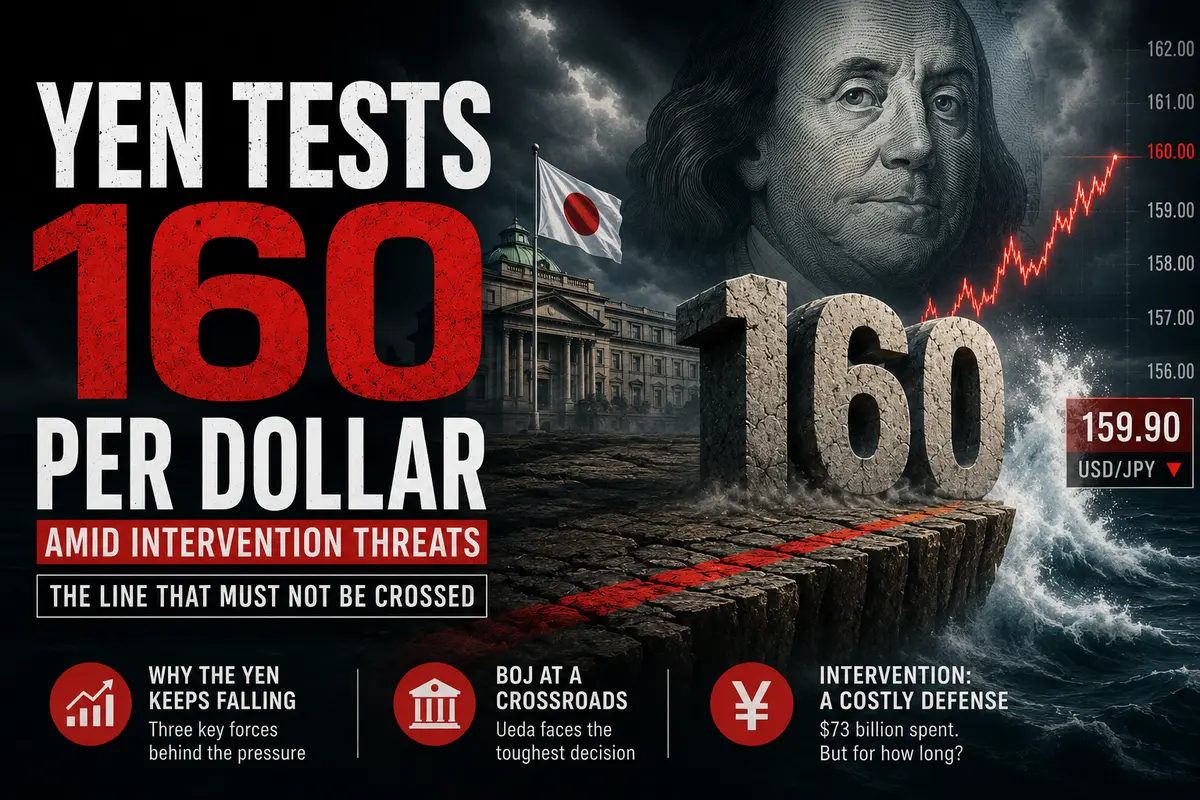
The line that must not be crossed
The silence during Wednesday’s Asian trading session was tense. Not the kind of silence where nothing happens, but the kind where everyone holds their breath and stares at a single number on their screens: 160. Three digits that, for the Japanese yen, matter more than any economic forecast or government report.
The dollar-yen exchange rate hovered around 159.9. It was like standing at the edge of a cliff and looking down. One step forward, and you’re at 160 — precisely the level Japanese authorities deemed unacceptable back in April.
Four months ago, Japan’s Ministry of Finance woke up to a yen trading at 160 and launched a currency intervention on a scale the country had not seen in decades. Officials spent a record ¥11.5 trillion — nearly $73 billion — defending the currency. It was the largest single-round intervention in modern Japanese history.
But markets are notoriously stubborn. The impact proved short-lived. As soon as Japanese officials breathed a sigh of relief and congratulated themselves, the dollar resumed its slow, relentless advance. And today, the 160 level was briefly touched again. Only for a few minutes — but those few minutes were enough to make thousands of traders around the world forget about their coffee and everything else.
Why the Yen Is Falling Again: Three Pillars of Weakness
There are several explanations, rooted not in emotion but in the hard realities of global finance.
1. U.S. Interest Rates
The most obvious factor is U.S. monetary policy. The Federal Reserve has made it clear that it is in no rush to cut interest rates. Contrary to gloomy predictions, the U.S. economy continues to show remarkable resilience.
Labor market data surprised analysts with stronger-than-expected job openings, while consumer spending has softened only modestly — not enough to alarm the Fed.
For global investors, the choice is simple: where can money earn a better return?
In Japan, interest rates remain near zero. The Bank of Japan, the most conservative central bank in the developed world, has only recently begun hinting at further tightening. But moving rates from zero to 0.1% is hardly enough to change the calculations of major hedge funds.
Meanwhile, U.S. Treasury bonds can still offer around 5% annually. The interest-rate gap between the two countries is enormous. As a result, capital naturally flows from yen into dollars, just as water flows downhill.
2. Rising Oil Prices
Japan imports nearly all of its energy.
Oil, gas, coal — virtually everything is purchased abroad and paid for in dollars. When oil prices rise, as they have amid tensions in the Persian Gulf, Japan needs more dollars to pay for the same amount of imports.
With U.S. forces striking Iranian targets and Tehran threatening to disrupt traffic through the Strait of Hormuz, energy markets remain on edge.
The result is straightforward: demand for dollars rises while demand for yen does not. Japanese companies sell yen and buy dollars, putting further downward pressure on the currency.
3. Domestic Inflation
For years, Japan struggled with deflation. Now it faces inflation.
Not the gentle 2% inflation rate the Bank of Japan spent two decades hoping to achieve, but inflation that is squeezing household budgets.
Food prices have risen. Utility bills have increased. Imported goods — from clothing to electronics — have become noticeably more expensive.
In theory, this gives the Bank of Japan room to raise rates and contain inflation. In practice, it’s not so simple.
Higher rates would hurt an economy that has grown accustomed to ultra-cheap money. They could trigger slower growth or even recession. That is why Governor Kazuo Ueda and his colleagues have been moving cautiously. They continue to delay aggressive action while the yen continues to weaken.
Why 160 Matters So Much
Why 160 and not 159 or 161?
The answer lies in psychology and politics.
Foreign-exchange markets have symbolic levels: 100 yen per dollar, 150, 160. When a currency pair crosses a major round number, it makes headlines worldwide. It becomes a political issue.
For Japan, 160 has become a threshold of embarrassment.
When the level was breached in April, panic spread through Tokyo. Ministry of Finance officials held emergency meetings over the weekend. Public statements from policymakers became increasingly forceful. And when intervention finally came, the world learned that Japanese authorities were serious.
But intervention is expensive.
Spending $73 billion in a single campaign is significant even for the world’s third-largest economy. And as experience has shown, the effect is temporary.
Markets know Japan cannot spend that kind of money indefinitely. Eventually, the ammunition runs out. And when it does, market forces reassert themselves.
Today, traders are testing that reality.
Carefully, incrementally, they are pushing USD/JPY toward 160. Not aggressively. Not in a panic. Just probing the authorities’ resolve.
Will Finance Minister Satsuki Katayama issue another warning? Will the Bank of Japan make calls to major banks asking what is happening in the market? Or will there be a quiet intervention through trusted institutions, as is often the case?
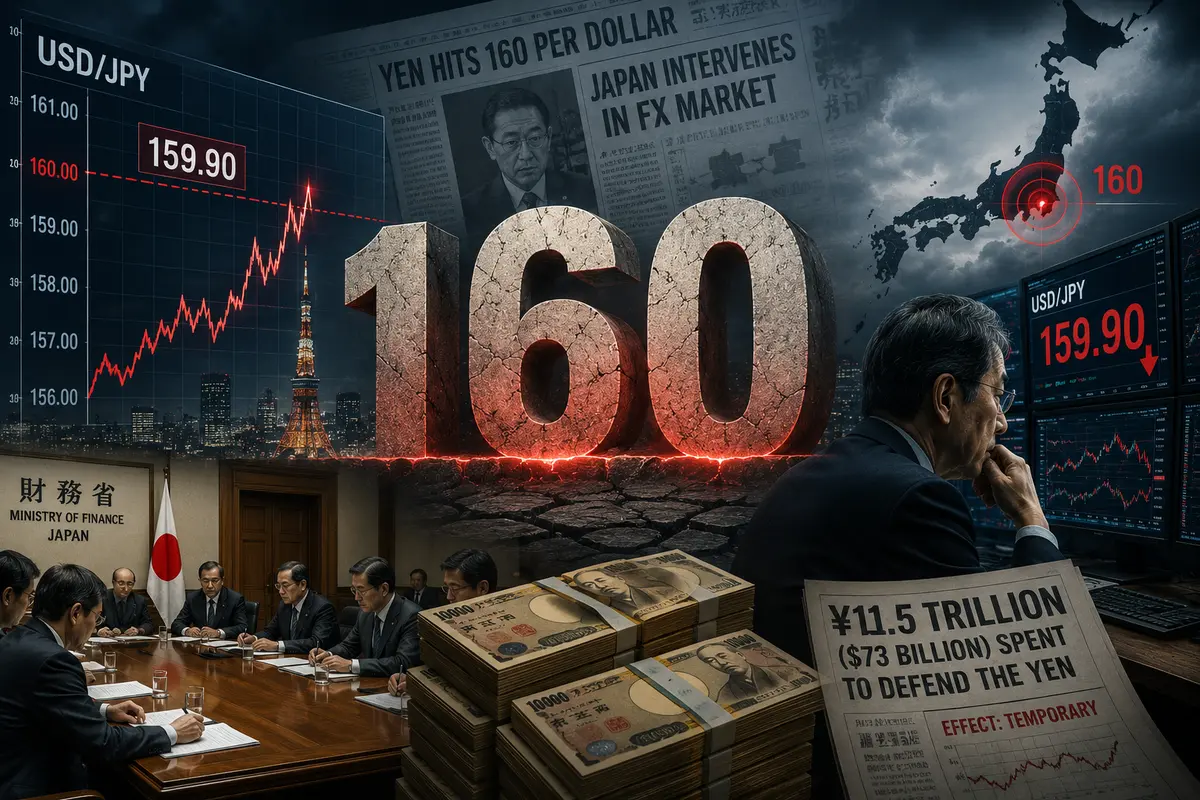
Katayama Enters the Game
Japan’s finance minister did not take long to respond.
On Wednesday morning, after the exchange rate briefly touched 160, Katayama issued a statement. The language was familiar but important precisely because it was familiar.
Authorities, she said, are prepared to take appropriate measures against excessive market volatility and speculative currency moves.
This is what traders call verbal intervention.
No money has been spent. No yen have been bought.
But the market heard the message.
Traders considering new short positions against the yen paused for a moment.
What if the authorities really are prepared to intervene? What if officials are watching every move right now?
Verbal intervention is not a new weapon, but it can be effective. Sometimes it works. Sometimes it does not.
Its success depends entirely on whether markets believe policymakers are willing to back up words with action.
In April, they did.
And because that intervention actually happened, the warning still carries weight today.
After Katayama’s comments, USD/JPY retreated from 160 back toward 159.9. Not a panic. Not a trend reversal. Just a pause while everyone waits for the next move.
The Bank of Japan Takes Center Stage
If verbal intervention belongs to the Ministry of Finance, genuine stabilization of the yen falls to the Bank of Japan.
And that is where things become complicated.
Governor Kazuo Ueda inherited a difficult situation. He took office after Japan’s long era of negative interest rates had already run its course.
He began the process of normalization cautiously — raising rates for the first time in seventeen years.
It was a symbolic move.
Markets want more.
Analysts at major institutions such as MUFG argue that the Bank of Japan must move decisively. Interest rates need to rise enough to narrow the gap with the United States. Only then can the trend in USD/JPY begin to change.
Otherwise, the yen could continue weakening toward 170, 180, or beyond.
But Ueda has good reasons to be cautious.
Higher rates would hurt millions of Japanese borrowers. Mortgages, business loans, and regional banking systems are all built around near-zero rates.
Raise rates too quickly, and bankruptcies could rise, consumer spending could weaken, and the economy could slip back into recession or even deflation — the very problem Japan spent three decades fighting.
There is another issue.
Japan remains the world’s largest creditor nation. Pension funds and insurance companies hold trillions of dollars in foreign assets.
If the yen strengthens sharply, the value of those assets in yen terms falls.
Pension returns decline. Insurers take losses.
Politically, that is a dangerous outcome.
So Ueda waits.
He watches inflation. He watches the yen. He watches the United States.
And perhaps he hopes the Federal Reserve will begin cutting rates before he is forced to act.
Based on recent U.S. data, however, that hope appears increasingly fragile.
What to Expect at the June Meeting
The Bank of Japan’s June policy meeting is shaping up to be the key event of the month for anyone following USD/JPY.
Markets have already begun pricing in another rate hike.
Not because Ueda has promised one, but because alternatives are becoming scarce.
If the Bank of Japan does nothing — leaves rates unchanged and continues emphasizing “careful monitoring” — markets may interpret that as a green light for further yen weakness.
The exchange rate could break above 160 and remain there.
Then 165 becomes the next target.
After that, perhaps 170.
And Japan’s Ministry of Finance may once again be forced into the market, spending tens of billions of dollars on another intervention that may prove temporary.
On the other hand, if the Bank of Japan raises rates — even by just 0.25 percentage points — it would send a powerful signal.
A signal that Tokyo is finally taking the weak-yen problem seriously.
The currency could strengthen, perhaps substantially.
But would the move last?
The fundamental issue remains: a massive interest-rate gap.
Japan cannot raise rates to U.S. levels without damaging its own economy.
Which means the structural pressure on the yen would remain.
Life on the Edge
For now, traders are living in launch-wait mode.
Some remain short the yen, betting on further weakness.
Others are buying the currency, anticipating another intervention and hoping to profit from a sudden rebound.
Nobody is entirely comfortable.
The 160 level is no longer just a psychological marker.
It has become a front line.
On one side stands the market, convinced of the strength of the U.S. economy and the logic of Federal Reserve policy.
On the other stands the Japanese government, willing to spend tens of billions of dollars defending its currency.
The battle unfolds every day, every hour, every minute.
There are no heroes and no villains.
Only numbers on screens.
The yen at 159.9.
The dollar at 160.
The wind has gone quiet.
But the silence before a storm is always deceptive.
Everyone is waiting to see who blinks first:
The market — or Tokyo.
The answer may come this week.
Or next week.
Or perhaps just a few minutes from now.
In the foreign-exchange market, things are never boring.
Especially when everything comes down to three digits:
160.

Comments
No comments yet. Be the first to share your thoughts!
Authentication Required
You must be logged in to post a comment.