
A Century-Old Index Reshuffle: Why FedEx Is Replacing American Airlines in the Transportation Barometer
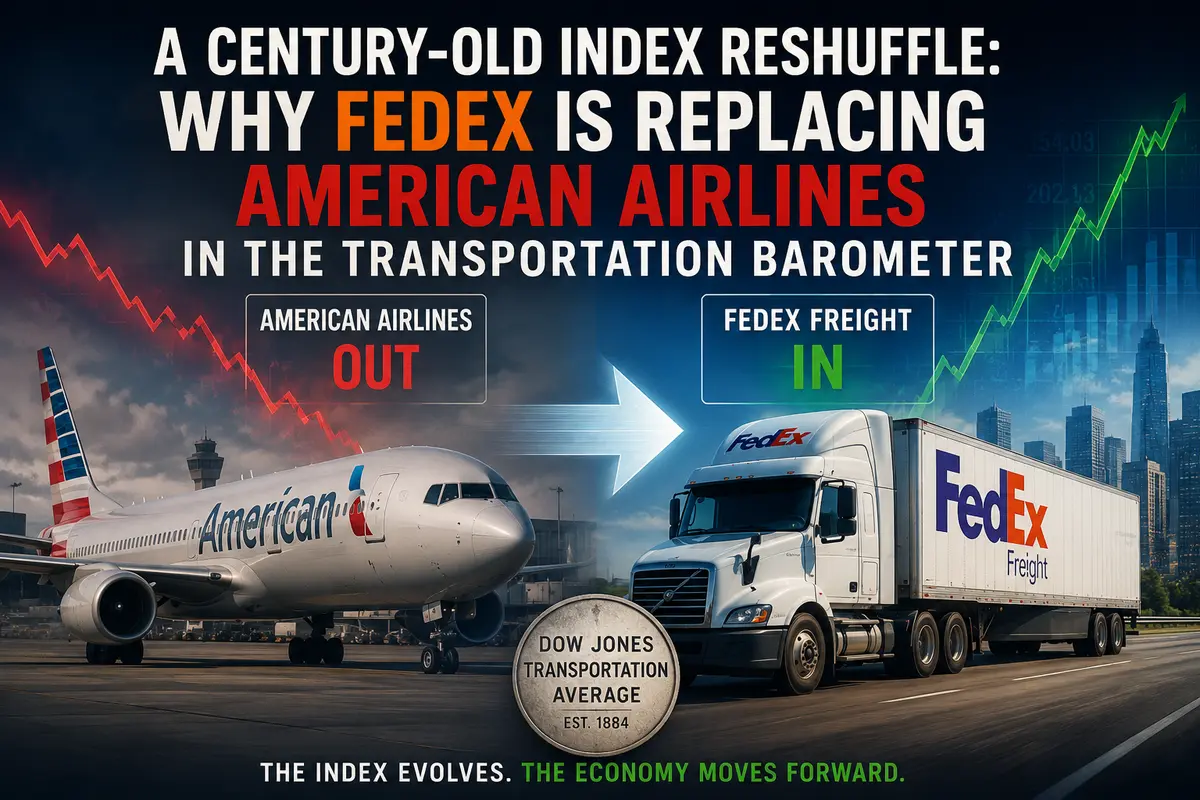
In the world of financial indices, some changes go unnoticed, while others make you stop and think. The replacement of American Airlines with FedEx Freight in the Dow Jones Transportation Average belongs firmly to the latter category. This is not merely a technical reshuffle or another bureaucratic note on the S&P Dow Jones Indices calendar. It is an event that reshapes America’s oldest transportation index and tells the story of how the freight industry has evolved over recent decades.
An Index with History: What Is the Dow Jones Transportation Average?
Before diving into the details of the replacement, it is worth understanding the index itself. The Dow Jones Transportation Average is more than just a basket of stocks. It is the oldest sector index in the world, created by Charles Dow in 1884 alongside the original Dow Jones Industrial Average. Initially, it consisted of nine railroad companies and reflected the state of America’s primary transportation artery in the nineteenth century.
Over time, the index evolved. Railroads gradually gave way to airlines, trucking companies, and logistics corporations. Yet its essence remained unchanged: the Transportation Average serves as a barometer of economic activity. If goods are moving, if trucks are on the road, if planes are in the air, the economy is alive and breathing. That is why the index is closely watched not only by traders, but also by macroeconomists.
American Airlines: The Exit of a Giant for Technical Reasons
Why is American Airlines leaving the index? The answer is surprisingly simple and entirely lacking in drama: its share price is too low. The airline’s stock trades at just $14.92 per share. Its market capitalization is slightly below $10 billion. Its weight in the index is less than half a percentage point.
The Dow Jones Transportation Average, like its industrial counterpart, is price-weighted. This is an archaic methodology invented by Charles Dow in an era before computers, when stock quotes were transmitted by telegraph. Simply add up the stock prices and divide by the number of companies — what could be easier? But the method has a side effect: low-priced stocks exert only microscopic influence on the index, even if the company itself is enormous.
With its $14 stock price, American Airlines became such a microscopic component. When the S&P Dow Jones Indices committee made its decision, it followed straightforward logic: why keep a company in the index if its influence on the benchmark is approaching zero? Better to replace it with a company whose higher share price gives it a more meaningful impact.
FedEx Freight: New Blood
That is where FedEx Freight Holding Company enters the stage. But there is an important nuance that is easy to miss. FedEx Freight is not the FedEx everyone already knows. It is a division being spun off from FedEx Corp. into a separate publicly traded company. The spinoff will be completed on June 1, 2025, and on the very same day the new company will take its place in the index.
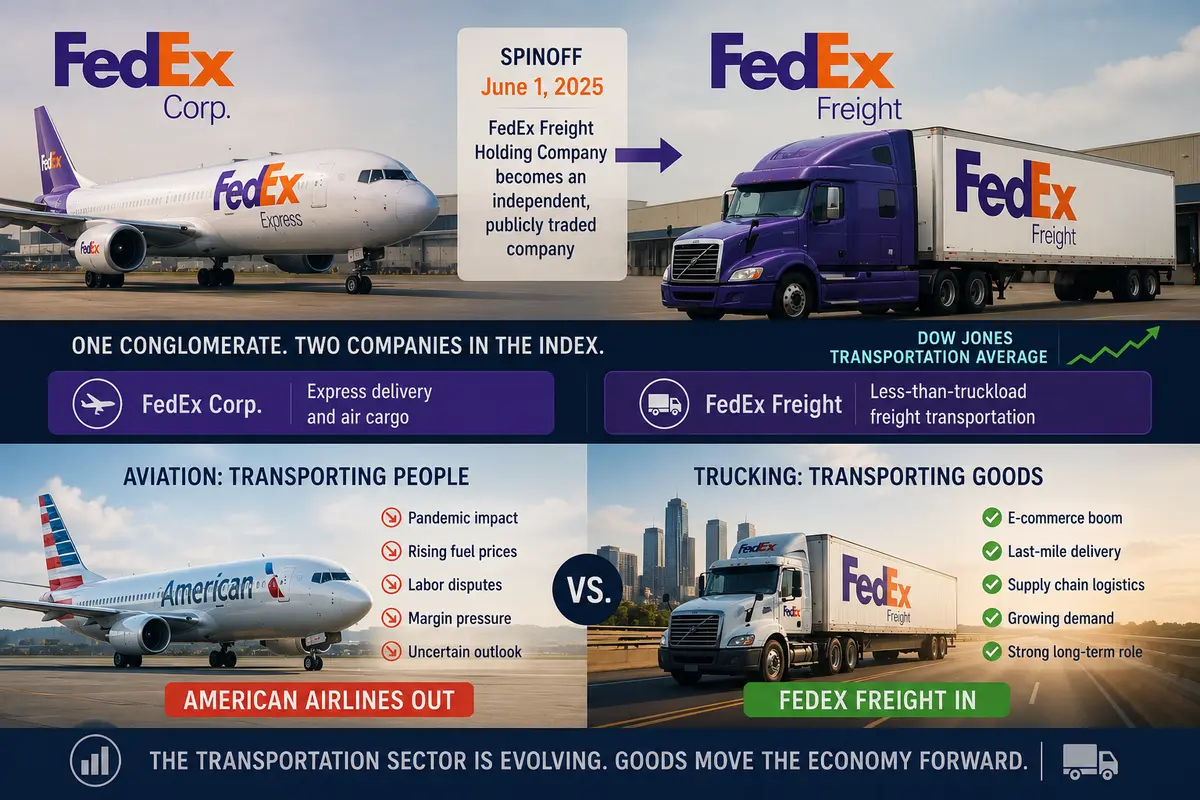
At the same time, FedEx Corp., the parent company, will remain part of the Dow Jones Transportation Average. As a result, after the restructuring, the index will include two FedEx-related companies: FedEx Corp., focused on express delivery and air cargo, and FedEx Freight, specializing in less-than-truckload freight transportation.
This is an unprecedented situation for the index. In effect, one conglomerate gains double representation in America’s transportation barometer. It reflects reality: FedEx has become so deeply embedded in the country’s transportation infrastructure that even after the breakup, its separate components remain significant enough to deserve individual spots in the index.
Trucking Versus Aviation: A Changing of the Guard
Behind this replacement lies a deeper structural shift. A passenger airline is leaving the index, while a freight trucking company is entering. This is not merely a swap of names — it reflects how the structure of the American economy has changed.
American Airlines transports people. FedEx Freight transports goods. The fact that the index committee deemed freight trucking more representative of the transportation sector than passenger aviation speaks volumes. E-commerce, last-mile delivery, and supply-chain logistics are now the driving forces behind transportation. People still fly, but goods move more often and in greater volumes.
Moreover, the airline industry has struggled in recent years. The pandemic devastated passenger traffic, rising fuel prices linked to tensions involving Iran continue to pressure margins, and labor disputes have shaken major carriers. American Airlines, despite its history and scale, now finds itself with a depressed stock price and uncertain prospects.
FedEx Freight, by contrast, sits at the center of the e-commerce and logistics boom. FedEx trucks are part of the circulatory system of the American economy, and their importance is only expected to grow.
The Technical Mechanics: The Divisor That Keeps Everything Aligned
Replacing an index component is not as simple as crossing out one name and inserting another. It is a mathematical operation that requires adjusting the divisor. The divisor is the number by which the sum of all stock prices in the index is divided to calculate the final index value. When component prices change because of a replacement, the divisor must be adjusted so the index does not experience an artificial jump.
S&P Dow Jones Indices will implement this adjustment before the market opens on June 1. The new divisor value will become available through the company’s FTP site beginning Friday, May 29. This is a routine procedure for index providers, but it is critically important for preserving continuity and historical comparability. An index should reflect market changes, not technical distortions.
What This Means for Investors
For holders of index funds tracking the Dow Jones Transportation Average, the replacement means automatic rebalancing. Funds following the index will be forced to sell shares of American Airlines and purchase shares of FedEx Freight. This will create additional demand for the new component and additional selling pressure for the old one.
For American Airlines, removal from the index is a blow to prestige, though hardly a catastrophe. Funds tied specifically to the Transportation Average are not large enough to trigger a collapse in the airline’s stock. Nevertheless, the psychological impact could be meaningful: exclusion from a major index is often perceived by the market as a sign of weakness.
For FedEx Freight, inclusion is a moment of triumph. A company that has not even fully completed its spinoff is already gaining a place in the world’s oldest transportation index. It is a signal to the market that FedEx Freight is a serious player worthy of institutional investors’ attention.
June 1 will mark a change in the composition of one of the oldest indices in the world. American Airlines will depart, FedEx Freight will arrive, the divisor will be adjusted, and the market will continue operating as usual. But behind this technical procedure lies a broader story about how the economy evolves, how some industries give way to others, and how even the most venerable institutions must adapt to a new reality.
Trucks have beaten airplanes. Delivering goods has become more important than transporting passengers. And the index born in the age of railroads continues to tell the story of the American economy — only now, it has different heroes.
Comments
No comments yet. Be the first to share your thoughts!
Comments only for logged-in users.