

Word Against the Market: How the RBI Governor Challenged the Bearish Assault on the Rupee
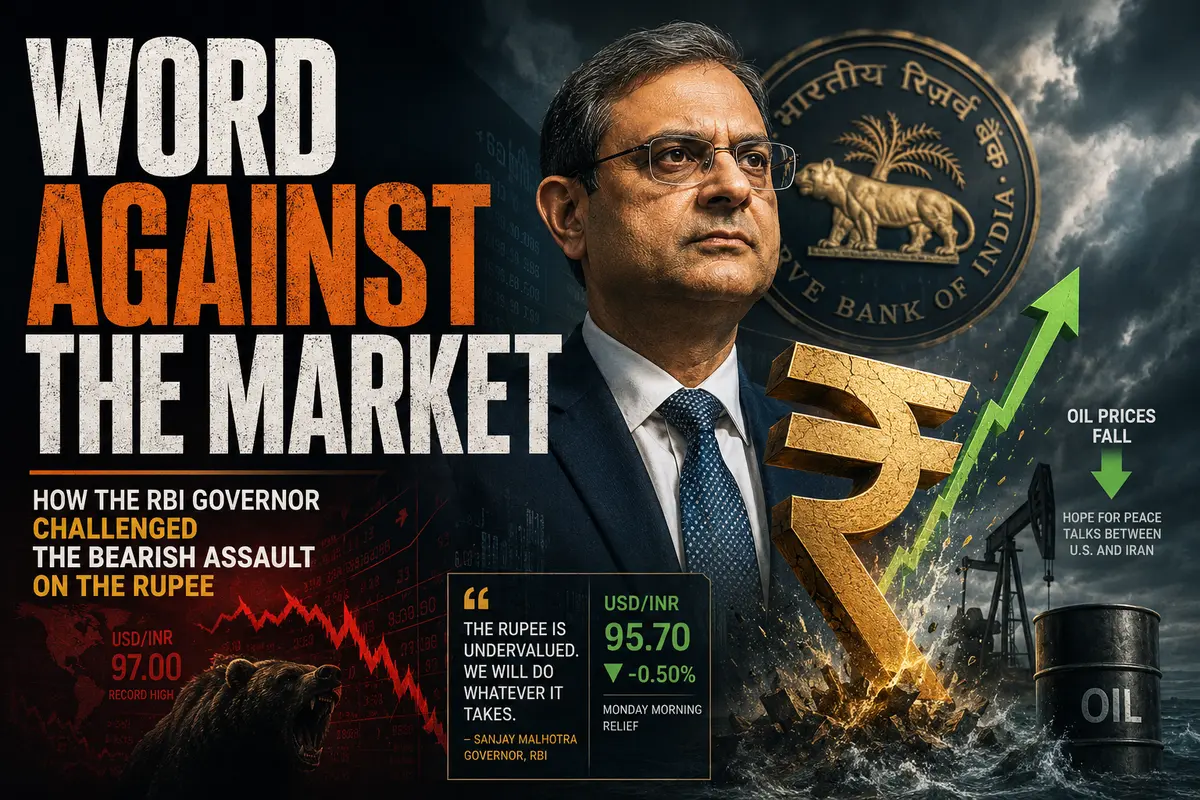
Monday morning on India’s currency market began with the very thing everyone — from oil importers to owners of street stalls selling imported goods — had been desperately waiting for. The rupee, which only on Friday had been staring into the abyss near the 97-per-dollar mark, suddenly reversed course and began to climb. The USD/INR pair fell by half a percent to 95.70 — a move that may seem modest after weeks of relentless decline, yet one whose psychological significance can be compared to the first breath of air for a drowning man. And the reason for this reversal was neither market forces nor global macroeconomic shifts. The reason was a man. One man who uttered a few sentences in an interview with the newspaper Mint.
Malhotra Steps Into the Ring: “The Rupee Is Undervalued, and We Will Do Whatever It Takes”
Sanjay Malhotra, governor of the Reserve Bank of India, is not known for making blunt public statements. Central bankers usually speak in shades, hints, and carefully crafted phrases whose interpretation has become a profession of its own. But this time, Malhotra seemed to cast diplomacy aside. His statement rang out like a gong: the rupee is undervalued. The RBI will do whatever is necessary to prevent further weakening of the currency.
“Whatever is necessary” is not a phrase central bankers throw around lightly. It is a signal that traders call a verbal intervention. And when it comes from the man controlling the foreign exchange reserves of the world’s seventh-largest economy, the market has no choice but to listen. Because words may be followed by action. And judging by recent developments, they already have been — last week the RBI actively intervened, steering USD/INR away from record highs. Malhotra made it clear these interventions were not a one-off operation, but the beginning of a campaign.
Traders who had spent recent weeks happily shorting the rupee suddenly realized that on the other side of the trade stood a central bank armed with hundreds of billions of dollars in reserves. That has a sobering effect — even on the most aggressive speculators. It is one thing to pressure a currency when the central bank stays silent and merely smooths volatility. It is something entirely different when the head of the regulator personally steps forward and declares that the current exchange rate is unacceptable and that he intends to fight.
Undervaluation as a Diagnosis: What the RBI Sees
Malhotra’s assertion that the rupee is undervalued deserves closer examination. Exchange rates are always the equilibrium of many forces: trade balances, capital flows, interest rate differentials, inflation expectations, geopolitical risks. When a currency falls six percent in a matter of months, the question arises: is the market correcting an overvalued currency, or is panic overshooting reality?
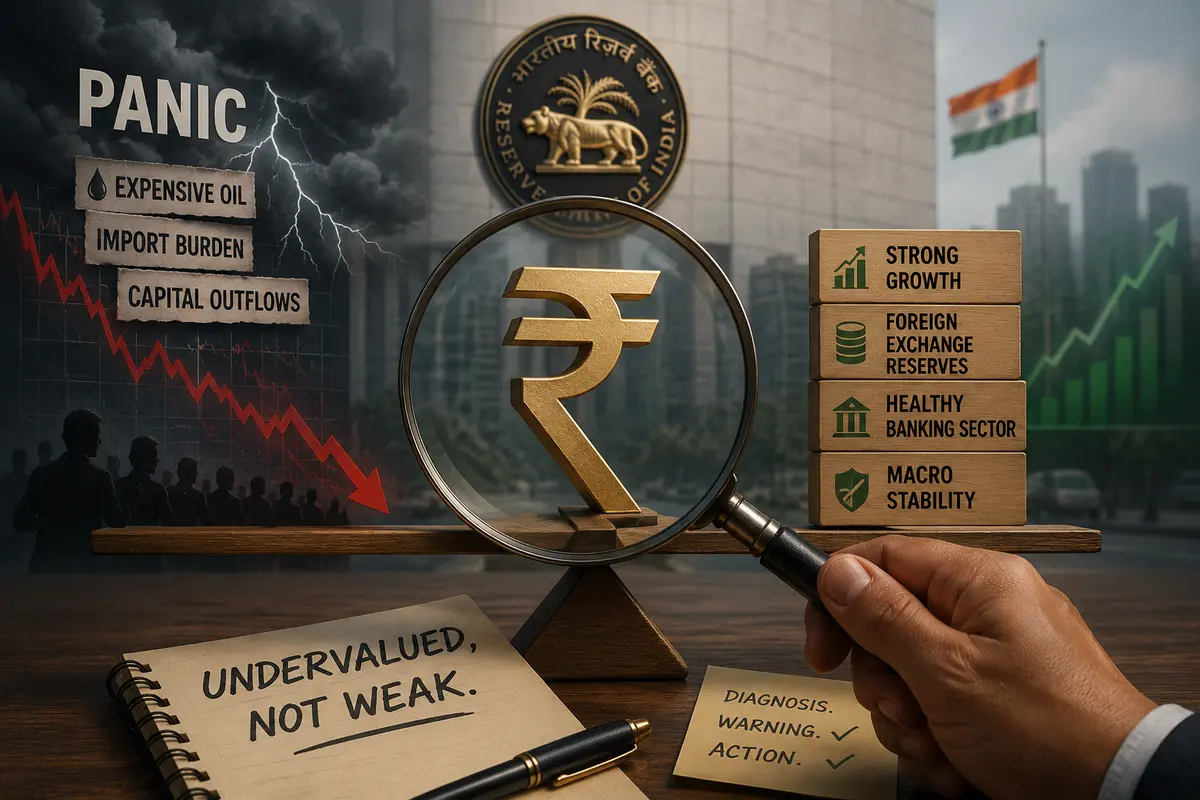
Judging by the governor’s remarks, the RBI believes panic has gone too far. Yes, oil is expensive. Yes, the import burden is heavy. Yes, foreign investors are pulling capital out. But the fundamentals of the Indian economy — growth rates, reserves, the health of the banking sector — do not justify a six-percent depreciation. This is not a balance-of-payments crisis like 2013. It is not a situation where the country cannot pay its bills. It is a market pricing in the worst-case scenario, and the central bank’s task is to remind everyone that reality has limits.
Calling the rupee undervalued is both a diagnosis and a warning. A diagnosis for those selling the rupee: you have gone too far. A warning for those considering joining the selloff: think twice. The central bank sees something you do not, and it is prepared to act.
Oil Pulls Back — The Rupee Breathes Again
Malhotra’s verbal intervention coincided with another event that may have given the rupee even more support than the central bank itself. Over the weekend, reports emerged of some progress in peace negotiations between the United States and Iran. Oil prices immediately moved sharply lower.
For the rupee, this was like a shot of oxygen. The relationship between oil and India’s currency is so direct and unforgiving that their charts sometimes look like mirror images. India imports more than eighty percent of the crude oil it consumes. When oil prices rise, importers need more dollars, they sell rupees, and the rupee falls. When oil prices decline, the mechanism works in reverse. The drop in oil prices triggered by hopes of progress in the Iran talks instantly eased pressure on the Indian currency.
The coincidence of RBI intervention and falling oil prices created a perfect storm in favor of the rupee. Speculators betting on further weakness suddenly found themselves trapped from both sides. On one side stood the central bank buying rupees and selling dollars. On the other stood a genuine improvement in the oil outlook, reducing future demand for dollars from importers. Under such conditions, holding short rupee positions becomes both unprofitable and dangerous. And judging by Monday’s move in USD/INR, many traders began unwinding those positions.
Six Percent of Weakness: Anatomy of the Decline
To understand the scale of the reversal, one must remember how far the rupee had fallen. Since late February, when the war with Iran began, the Indian currency had lost around six percent, making it one of the world’s weakest currencies over that period. Six percent may not sound catastrophic compared to the collapses of the Turkish lira or Argentine peso. But for India — a country with relatively stable macroeconomic policy and substantial reserves — it is significant. It is the kind of depreciation that begins to create real problems: imported inflation, rising costs of servicing foreign debt, and capital flight.
For several months the rupee ranked among the weakest major currencies in the world. Seven consecutive record lows became a scar the RBI was clearly tired of carrying. Each new all-time low generated another wave of panicked headlines in Indian newspapers, another surge of anxiety among importers, another wave of speculative attacks. And the central bank, it seems, decided enough was enough.
No Rate Hikes — But Not So Fast
One of the most intriguing parts of Malhotra’s interview was his statement that the RBI rules out raising interest rates. This was a major signal that ran contrary to market whispers. Persistent rupee weakness had fueled speculation that the central bank might resort to an emergency rate hike to defend the currency — the classic textbook response to a currency crisis. Higher rates make assets denominated in the national currency more attractive, drawing in capital and supporting the exchange rate.
But Malhotra shut down those rumors. There will be no rate hikes. Why? Because the RBI is looking at the broader picture. Raising rates at a moment when the economy is still recovering from the pandemic, when inflation is largely imported rather than driven by overheating domestic demand, when business lending needs to expand rather than contract — that could prove a cure worse than the disease. Yes, higher rates theoretically support the currency. But they also choke economic growth, raise the cost of servicing government debt, and hit the stock market. The RBI is choosing another path — intervention rather than monetary tightening.
This distinction matters. The central bank is telling the market: we will not raise rates; we will spend reserves. It is a choice in favor of economic growth and against currency speculators. And it is a choice that requires confidence that reserves are sufficient. Judging by Malhotra’s tone, he has that confidence.
The Morning After the Storm
Monday became the morning after a long and dark night for the rupee. A half-percent rebound is not victory in the war, but it may be a signal of a temporary truce. Malhotra’s verbal intervention, reinforced by real RBI actions in the market and perfectly timed with falling oil prices, has created a new reality for traders — one in which shorting the rupee is no longer a risk-free trade.
But it is far too early to relax. The Iran conflict is far from resolved. Oil prices, even after the pullback, remain historically elevated. Foreign investors continue pulling money out of emerging markets. And the RBI’s reserves, however impressive, are not infinite. The central bank has won one round, but the fight continues. Malhotra has challenged the market, and the question now is whether the bears will accept that challenge or retreat to regroup. Monday morning suggested the retreat has begun. But whether it turns into a rout or merely the calm before another assault will depend on oil, on Iran, and on global risk appetite. The rupee has managed to take a breath — but the waters around it are still deep.

Comments
No comments yet. Be the first to share your thoughts!
Authentication Required
You must be logged in to post a comment.