

Silent Expansion: How Google Is Turning Missouri Cornfields into a Digital Empire
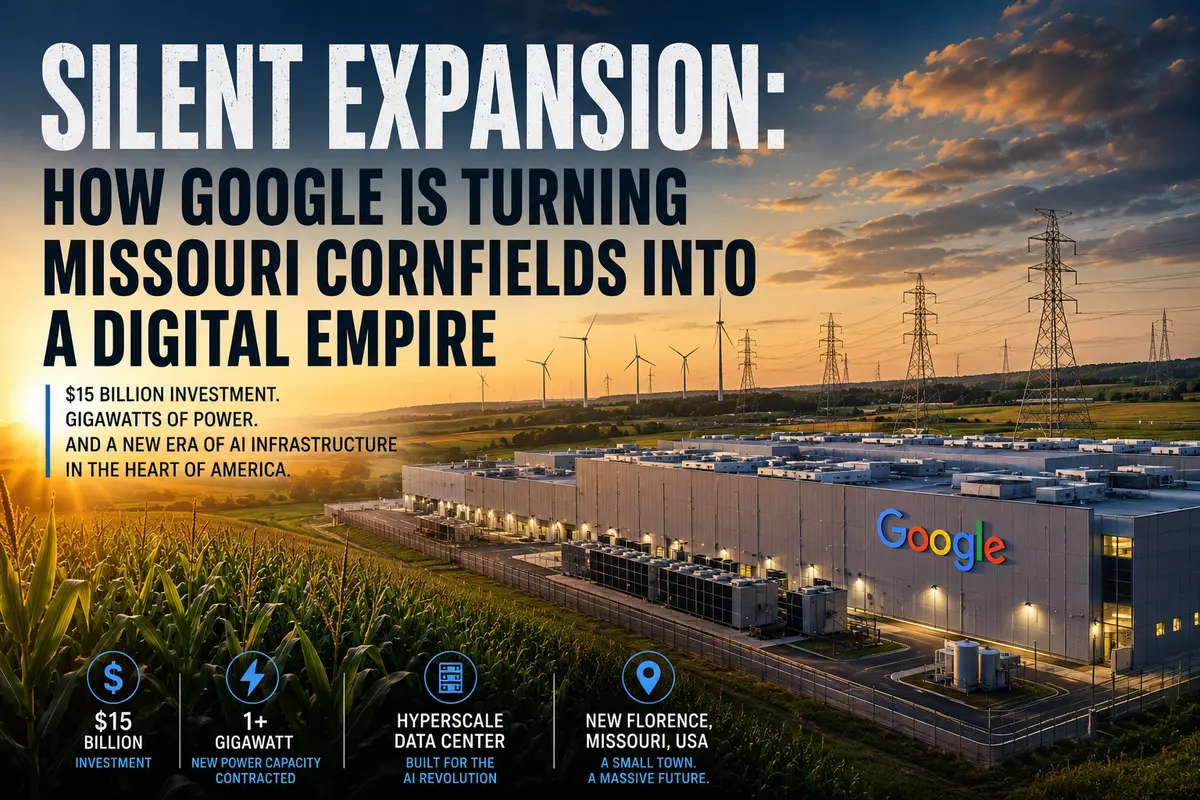
Fifteen billion dollars. A sum large enough to build several skyscrapers in New York, finance the space program of a small nation, or reshape the transportation system of an entire metropolis. But Google has chosen to spend that money differently. On Wednesday, the company announced it would invest the funds into land, concrete, steel frameworks, and miles of fiber-optic infrastructure in the state of Missouri.
At first glance, the news about a new data center in the small town of New Florence, tucked away among the fields of Montgomery County, looks like just another line in a corporate press release. In reality, however, the project fundamentally changes how we think about the direction of the digital economy — and who its next beneficiaries will be.
Cornfields Become the New Silicon Valley
Missouri is not the first place that comes to mind when people hear the phrase “technology hub.” Known for its ranches, beer breweries, and the blues clubs of St. Louis, the state has never seriously competed with California or Texas. Yet this is precisely where Google has chosen to place one of its largest infrastructure projects — and the decision is far from accidental.
A modern data center is not simply an office building filled with servers. It is an industrial facility comparable in scale to a steel plant, except instead of consuming coking coal, it consumes electricity. Gigawatts of electricity.
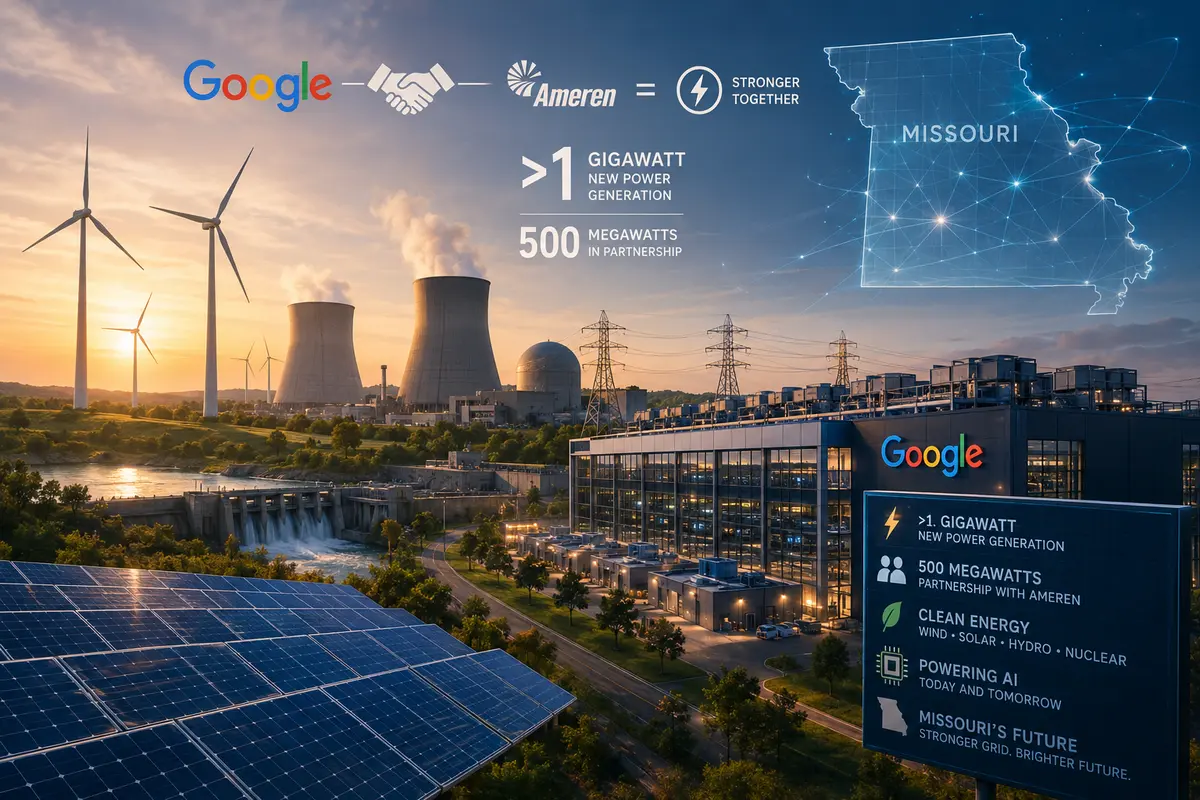
The fact that Google has already contracted more than one gigawatt of new power generation capacity in Missouri speaks volumes about the scale of its appetite. One gigawatt is roughly equivalent to the output of a large nuclear power plant or two million solar panels. And this is only the beginning. The company’s partnership with local utility provider Ameren includes the development of an additional 500 megawatts of capacity.
To put that into perspective: a data center consuming 1.5 gigawatts could power a small city of half a million people. The difference is that here the electricity will not illuminate streets or run refrigerators — it will cool server racks and process trillions of operations per second, supporting search queries, neural networks, and cloud services.
Why Missouri: The Hidden Logic Behind the Location
Choosing a site for a hyperscale data center is a complex equation with many variables. Land must be cheap and abundant. High-capacity transmission lines must be nearby. Water resources for cooling systems must be accessible. The climate should be moderate to reduce air-conditioning costs. And perhaps most importantly, local authorities must be willing to offer tax incentives and accelerated permitting procedures.
Missouri checks every box.
Land in Montgomery County is dramatically cheaper than in Northern Virginia, where a large portion of the world’s data centers are concentrated. The state’s energy grid, operated by Ameren, has sufficient reserve capacity to support massive industrial consumers. And Governor Mike Kehoe, judging by his public statements, appears ready to roll out the red carpet for tech giants.
“Missouri’s growing role as a center for technology and innovation” is not merely a politician’s talking point. It is a signal to other corporations that the state is open for business and ready to compete for investment.
But there is an even deeper shift underway. Technology giants are gradually moving away from traditional hubs. Silicon Valley, Northern Virginia, Dublin — these locations are overheating. Land prices have soared, power grids are strained, and local communities increasingly resist the construction of ever more data centers that generate noise, consume water, and create relatively few permanent jobs compared to manufacturing facilities.
Missouri, Iowa, Ohio, Wyoming — these are the new frontiers of digital expansion. States that spent decades losing population and jobs as traditional industries declined are suddenly discovering that their cheap land and underutilized power infrastructure have become strategic assets in the age of artificial intelligence.
Gigawatts, Megawatts, and the Energy Question
The energy dimension of the deal deserves special attention.
Google is not merely building a data center and hoping the local grid can handle the load. The company is actively participating in the creation of new generating capacity. Contracts for more than one gigawatt of new power generation represent commitments that will reshape Missouri’s energy landscape. The partnership with Ameren to develop another 500 megawatts effectively turns Google into a co-investor in the state’s energy infrastructure.
This is part of a broader strategy among technology giants. Artificial intelligence requires enormous computational resources. Every training run for a large language model, every neural-network query, every cloud operation consumes electricity — and demand is growing exponentially.
At the same time, companies like Google have pledged carbon neutrality. They need not just electricity, but clean electricity: solar, wind, hydroelectric, and in some cases nuclear energy.
Missouri, with its combination of wind potential, solar exposure, and existing grid infrastructure, becomes an ideal testing ground for such a hybrid energy system. Ameren gains its largest customer yet — one willing to help finance modernization. The state receives major energy investment that might otherwise have required taxpayer funding. And Google secures guaranteed access to energy for decades to come.
New Florence: A Town That Will Never Be the Same
For New Florence, a small town in Montgomery County, Google’s arrival will be an event comparable to the discovery of a gold deposit.
Fifteen billion dollars invested in infrastructure will transform the local economy. Building a data center of this scale means years of work for local contractors, construction-material suppliers, and transportation companies. Governor Kehoe was not exaggerating when he spoke about new jobs and support for local businesses.
But permanent operations create fewer jobs than many might expect. A modern hyperscale data center is run by a relatively small team of highly skilled engineers and technicians. Hundreds of construction jobs will eventually give way to dozens of operational positions.
This is not an automobile factory capable of employing thousands for generations. Yet for New Florence and Montgomery County, even several dozen high-paying technical jobs will provide a meaningful boost to the local economy — not to mention the tax revenues the facility will generate for decades.
There is also a downside. Data centers consume large quantities of water for cooling. They create noise pollution from ventilation systems and backup diesel generators. They alter the landscape — fields replaced by anonymous concrete structures surrounded by fences and barbed wire.
Not every local resident will welcome such a transformation. And Google, having learned from conflicts in other regions, has already begun outreach efforts with local communities, promising to be a “good neighbor.”
The Bigger Picture: The Infrastructure Race
Google’s investment in Missouri cannot be viewed in isolation. It is part of a global race among technology giants to build the physical infrastructure required for artificial intelligence.
Microsoft is constructing data centers around the world at the same pace as Google. Amazon Web Services continues expanding its availability zones. Meta is pouring billions into server farms to train its AI models. Even Apple, traditionally more cautious with cloud investments, is increasing capacity.
Competition in the AI sector is shifting away from algorithms and software toward physical capital. The winner will not necessarily be the company that invents the best neural network, but the one with enough electricity and server capacity to train and deploy it at industrial scale.
In that sense, fifteen billion dollars in Missouri is not merely a data center investment. It is a strategic bet in a contest where the prize is dominance in the artificial intelligence market of the next decade.
And Missouri, perhaps unexpectedly, has found itself on the front lines of that battle.
A state long associated with agriculture and a fading industrial era is becoming one of the key nodes of the digital economy. Google is transforming cornfields into machine halls, while transmission lines originally built for factories are finding a new purpose: powering servers that process search queries, generate images, and train the next generation of artificial intelligence.
The quiet expansion is well underway — and New Florence may become one of those places on the map where the future grows directly through the soil of the past.

Comments
No comments yet. Be the first to share your thoughts!
Authentication Required
You must be logged in to post a comment.