

Gold at a Crossroads: Peace With Iran Beckons, but War Still Lingers
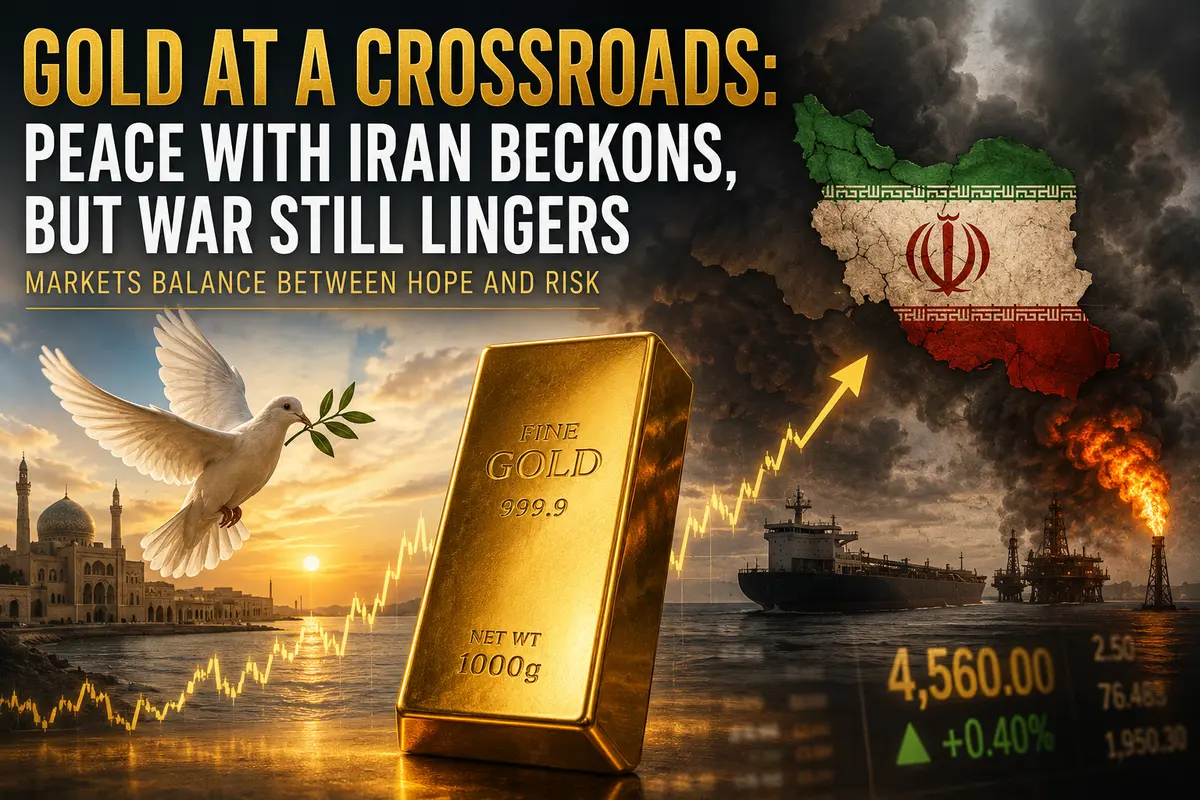
Gold is climbing again. During Thursday’s Asian trading session, prices turned green, extending a rally that seemed to begin against all logic. Spot gold rose to $4,560 per ounce, while futures reached $4,562. A gain of four-tenths of a percent for the session marked a confident recovery after recent losses. But the real mystery behind this move lies not in the numbers — it’s in what caused it. Gold, which for weeks had been suffocating under the pressure of rising rates and a strong dollar, suddenly found support where few expected it: in hopes for peace with Iran. And that paradox reflects the complex, multilayered logic of a market that no longer reacts to headlines in a straightforward way.
Peace as a Catalyst: An Unexpected Twist
At first glance, everything should have played out differently. Gold is the classic safe-haven asset. It rises when the world descends into chaos — when guns fire and diplomats throw up their hands. A war with Iran, a blocked Strait of Hormuz, oil prices soaring into the stratosphere — all of that should have sent gold flying higher. Instead, the yellow metal hovered near recent lows, unable to break resistance. And now, just as Trump speaks of the conflict entering its “final stage” and negotiations progressing successfully, gold suddenly comes alive. How can that be explained?
The answer lies in the transmission mechanism — the invisible conduit linking geopolitics to monetary policy. The conflict with Iran created an inflationary shock. Disruptions to oil supplies drove energy prices sharply higher, which in turn fueled inflation worldwide. Central banks, especially the Federal Reserve, responded with more hawkish rhetoric and threats of higher rates. High interest rates are gold’s deadliest enemy because they increase the opportunity cost of holding a non-yielding asset. That mechanism has been choking gold for weeks. Investors looked at the war and thought not about safety, but about the Fed tightening the screws again.
Now, however, with hopes for peace emerging on the horizon, the chain reaction is beginning to reverse. Peace means the restoration of oil supplies. Restored supplies mean lower energy prices. Lower energy prices mean easing inflationary pressure. Lower inflation means the Fed may not need to raise rates further. And the absence of additional rate hikes is a green light for gold. That is how hopes for peace have transformed into a bullish factor for the precious metal. The market is no longer focused on the conflict itself, but on its monetary consequences — and it is voting accordingly.
Bond Yields Retreat, Gold Breathes Again
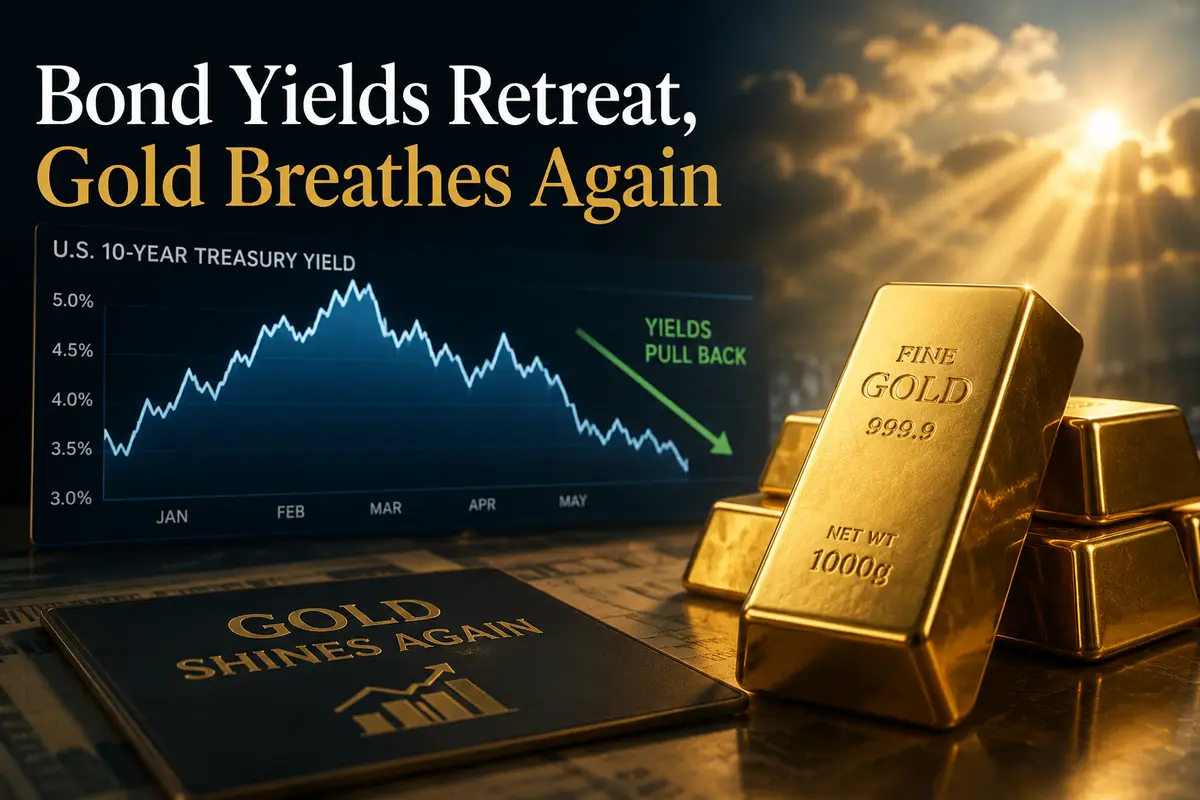
Another factor supporting gold on Thursday was stabilization in the bond market. Debt markets, which had suffered a major selloff in recent weeks, finally paused for breath. U.S. Treasury yields, which had surged to multi-year highs, pulled back slightly. And for gold, that pullback felt like a breath of fresh air.
The relationship between yields and gold is one of the most fundamental in finance. When bonds offer attractive returns, gold loses appeal: why hold a bar of metal that generates no income when Treasuries can provide guaranteed dollar cash flow? But when yields fall, the equation changes. Gold becomes competitive again, especially if inflation remains above nominal yields, creating negative real rates. That is exactly what happened. Investors, seeing the bond selloff lose momentum, began returning to gold, particularly as recent declines made prices look attractive for dip-buying.
Trump Between Peace and War: The Pendulum Keeping Markets on Edge
Donald Trump is staying true to form. On one hand, he speaks about the war entering its “final stage” and about successful negotiations. On the other, he immediately warns that the United States could resort to further military action if Iran refuses to accept the terms. It is classic Trump negotiating strategy — one he honed for decades in business before bringing it into the White House: keep the opponent under pressure by alternating between carrot and stick. But for financial markets, this duality creates an atmosphere of chronic uncertainty.
In this environment, gold occupies a unique position. On one side, hopes for peace push it higher through the monetary-policy channel. On the other, the threat of renewed conflict preserves gold’s traditional role as a safe-haven asset. The result is a kind of win-win setup: if peace is achieved, gold rises on expectations of easier monetary policy. If war continues, gold rises on geopolitical risk premiums. Of course, reality is more complicated, and short-term volatility remains inevitable. But fundamentally, gold now stands at a point where both scenarios work in its favor.
There is one important nuance: the Strait of Hormuz remains largely closed. Despite all the talk of peace, physical oil supplies are still disrupted. Oil prices, while down from their peaks, remain relatively elevated. That means inflationary pressure has not disappeared — it has simply stopped accelerating. And stable but elevated inflation is itself positive for gold, which for centuries has served as protection against the erosion of money’s value.
Platinum and Silver: The Younger Brothers Catch Up
Other precious metals also took advantage of the moment. Spot silver gained six-tenths of a percent, climbing to nearly $76.50 per ounce. Platinum added a modest one-tenth of a percent, holding above $1,950. These moves were smaller than gold’s, but they confirmed the broader picture: the precious metals sector is emerging from its recent losing streak.
Silver, as always, occupies a dual role. On one hand, it is a precious metal that tends to follow gold. On the other, it is an industrial metal whose demand depends heavily on the health of the global economy. Here, hopes for peace with Iran cut both ways. Peace is positive for industrial demand: uncertainty declines, supply chains recover, and energy costs fall. But peace also weakens inflation fears, reducing silver’s appeal as a defensive asset. For now, the market appears to be betting that industrial optimism will outweigh those concerns.
On Thursday, gold showed that it is once again beginning to play by its own rules. After weeks of swinging between fears of higher rates and hopes for de-escalation, the market seems to have found a new balance. Peace with Iran is no longer viewed as an unambiguously negative factor for precious metals. On the contrary, it opens the door to easier monetary policy — something gold desperately needs. Yet Trump’s unpredictability, along with the still-restricted Strait of Hormuz, prevents complacency. Gold is balancing between two realities: a peace that feels almost within reach, and a war that is not yet over. And within that balance, it is finding strength to rise.

Comments
No comments yet. Be the first to share your thoughts!
Authentication Required
You must be logged in to post a comment.