

Italy’s Inflation Revision Caught Markets Off Guard
Why One-Tenth of a Percentage Point Became Important for All of Europe
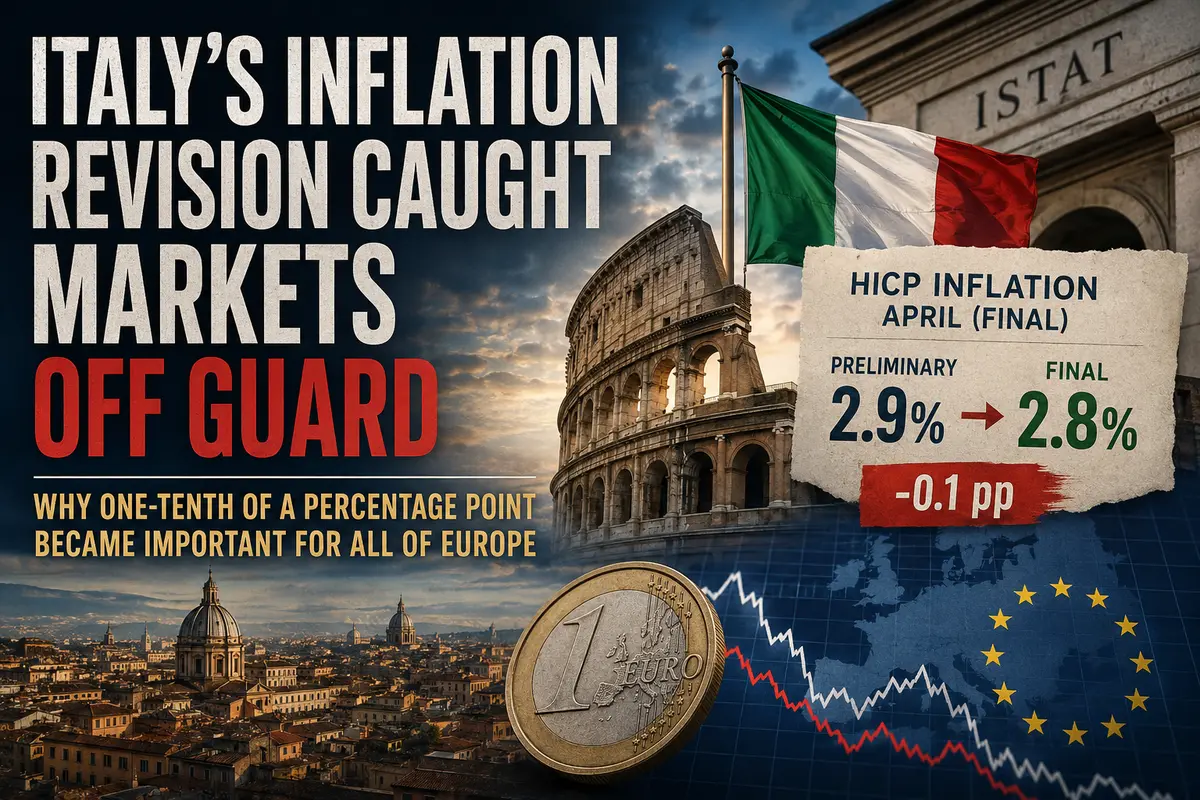
When Italy’s national statistics agency ISTAT released revised inflation data for April on Friday, nothing dramatic seemed to happen at first glance. The preliminary estimate for annual inflation under the harmonized HICP index stood at 2.9 percent, while the final figure came in at 2.8 percent. The difference was just one-tenth of a percentage point. To someone far removed from financial markets, that may look like an accounting detail nobody should care about. But today, it is precisely these “small details” that move bond markets, reshape investor expectations, and force central bankers to study statistical reports line by line.
The modern financial system operates in a state of extreme sensitivity. When the economy is balancing between slowing growth and the threat of a new inflation wave, any deviation from forecasts becomes a signal. Sometimes a single number is enough to sharply alter expectations for interest rates, government bond yields, or the euro exchange rate. That is why the revision of Italy’s inflation data turned out to be far more significant than it initially appeared.
April’s Inflation Surge Looked Too Sharp
The dynamics of April itself look troubling. As recently as March, Italy’s HICP inflation stood at 1.6 percent year-over-year. One month later, it had jumped to 2.8 percent. An increase of 1.2 percentage points in such a short period is not a normal fluctuation — it is a sharp acceleration. And the issue goes beyond the numbers themselves. For Italy, inflation is almost a painful topic because the country’s economy is especially vulnerable to external shocks.
Italy has been living in a state of chronic economic fatigue for years. Formally, it is the eurozone’s third-largest economy, a country with a powerful industrial base, famous global brands, a massive tourism sector, and strong exports. But behind that façade are years of weak growth, stagnant labor productivity, and a massive public debt burden that has long exceeded 140 percent of GDP. Any acceleration in inflation immediately creates problems for Rome on multiple fronts.
Why Energy Became the Main Problem Again
The primary driver behind April’s inflation spike was energy. Europe remains heavily dependent on global oil and gas prices, and Italy is one of the countries most exposed to this vulnerability. The country lacks significant domestic energy resources, meaning any disruption in global markets is felt almost immediately throughout the economy.
April unfolded under the shadow of rising tensions in the Middle East. Markets feared supply disruptions through the Strait of Hormuz, shipping insurance costs increased, oil prices climbed, and alongside them came higher fuel prices, more expensive logistics, and rising industrial costs. The Italian economy felt the impact almost instantly. Manufacturers began paying more to transport goods, utility costs rose, and supermarket prices soon followed.
For ordinary Italians, inflation is not an abstract figure in a statistical report. It is the price of gasoline at the pump, the heating bill, the cost of coffee at the neighborhood café, and groceries at the supermarket. The problem is that wages in Italy are growing far more slowly than prices. As a result, household purchasing power continues to erode.
Core Inflation Gave Markets a Chance to Breathe
Yet the report also contained one important detail that calmed investors somewhat. Core inflation — the measure excluding food and energy prices — slowed from 1.8 percent to 1.6 percent.
This is the indicator the European Central Bank watches most closely. The reason is simple: the ECB cannot control global oil and gas prices. It cannot stop geopolitical conflicts or influence developments in the Middle East. What it can influence is domestic demand through interest rates.
When core inflation rises, it suggests that price increases are spreading throughout the broader economy. Companies begin raising prices across the board, workers demand higher wages, and an inflationary spiral starts to emerge. So far, Italy has not reached that stage.
Yes, fuel has become more expensive. Yes, utility bills have risen. But businesses have not yet started passing higher energy costs onto the full range of goods and services. For markets, this is an extremely important signal. It suggests that April’s inflation surge may prove temporary rather than the beginning of a new sustained inflationary wave.
Why the ECB Is Watching Italy So Closely
The European Central Bank now finds itself in a very difficult position. Over the past two years, the regulator aggressively raised interest rates in an effort to contain the inflation crisis that swept across Europe after the energy shock. But high interest rates also cool the economy.
And the eurozone economy already looks weak. Germany is hovering near recession, industrial production is slowing, and consumer demand remains sluggish. Against this backdrop, any renewed acceleration in inflation becomes a serious threat.
Italy plays a particularly important role here. It is the eurozone’s third-largest economy, and problems inside the country quickly become problems for the entire currency bloc. If inflation remains low in Germany while accelerating in Italy and Spain, maintaining a unified monetary policy becomes far more complicated.
That is why even a revision from 2.9 to 2.8 percent is being interpreted as a positive sign. It does not mean inflation has been defeated. But it is at least a hint that the situation is not spiraling out of control.
High Inflation Is Especially Dangerous for Italy
For Italy, inflation is a much more sensitive issue than for many other European countries. The reason is its enormous public debt. The higher interest rates rise in the eurozone, the more expensive it becomes for Rome to service its obligations.
For Germany, high rates are an inconvenience. For Italy, they represent a potential threat to financial stability. The government is forced to spend increasing amounts of money servicing debt instead of investing in the economy.
The government of Giorgia Meloni now finds itself caught between two pressures. On the one hand, inflation actually benefits the budget because higher prices generate larger tax revenues. On the other hand, social pressure is rising rapidly. Labor unions demand wage increases, pensioners expect indexed payments, and businesses complain about mounting costs.
And all of this is happening in a country where economic growth has remained weak for many years.
May Data Could Change Market Sentiment
Investor attention is now gradually shifting toward May inflation data. Those numbers will determine whether April’s surge was merely a temporary energy-driven episode or the beginning of a more persistent inflation trend.
If inflation slows again, markets will likely conclude that the earlier panic was premature. Expectations for ECB rate cuts in the second half of the year would strengthen once more.
But if prices continue rising, the situation will become far more complicated. The European Central Bank would face a choice between two unpleasant scenarios. Either keep interest rates elevated for longer, risking further damage to eurozone economic growth, or tolerate inflation above target levels while hoping it gradually fades on its own.
Why Markets Remain Nervous
For now, investors have only received a brief moment of relief. One-tenth of a percentage point was enough to slightly reduce tension in bond and currency markets.
But the underlying problem has not disappeared. Italy remains one of Europe’s most vulnerable economies when it comes to energy shocks and rising borrowing costs. Any new acceleration in inflation could once again shake investor confidence.
That is why ISTAT’s reports are now read carefully not only in Rome, but also in Frankfurt, Brussels, London, and New York. Because inflation давно ceased to be just a statistical measure. Behind every percentage point stand real household expenses, the stability of public finances, and the ability of millions of people to plan their lives even a few months ahead.

Comments
No comments yet. Be the first to share your thoughts!
Authentication Required
You must be logged in to post a comment.