

The Pentagon’s Quiet Forge: How IBM Continues to Build the Digital Foundation of the U.S. Air Force
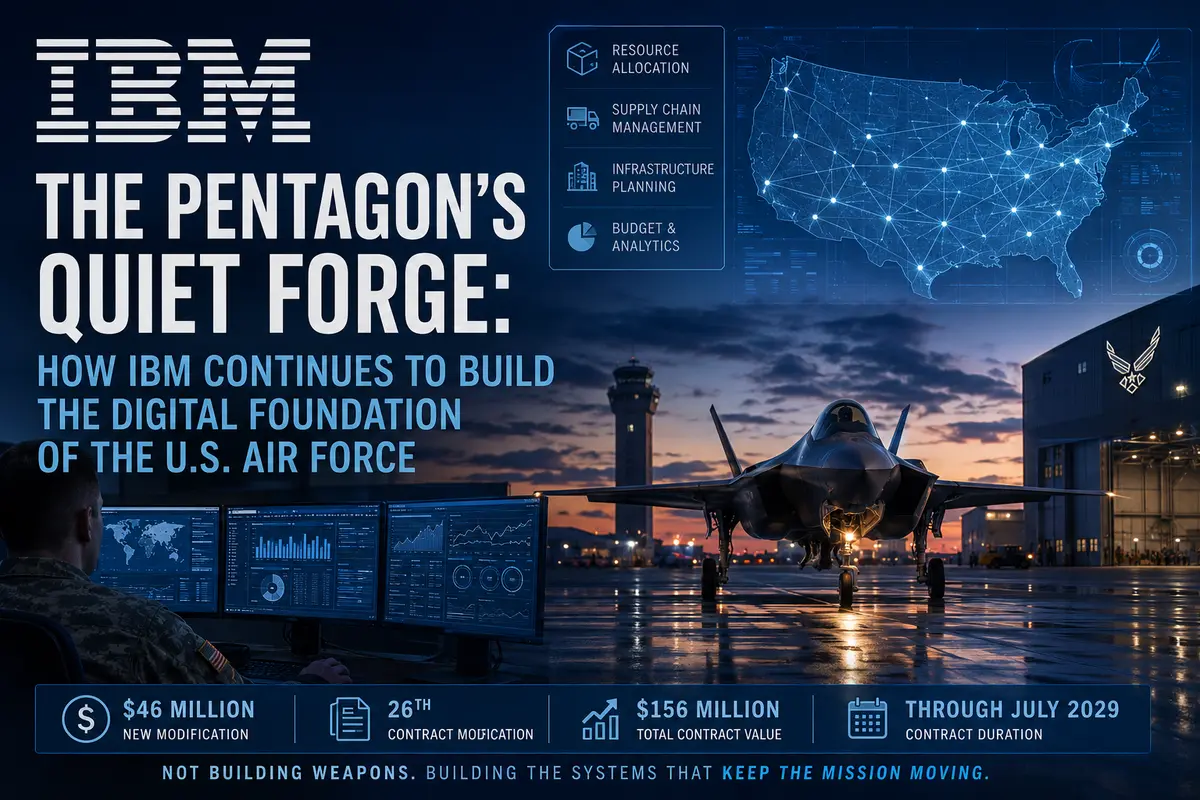
Forty-six million dollars. In the context of the United States defense budget, measured in the hundreds of billions, it is almost an invisible amount. Contracts like this rarely make headlines, spark heated debates in Congress, or ignite storms on social media. Yet it is precisely these quiet, routine contract modifications — signed somewhere deep within the Contracting Directorate of the Air Force District of Washington — that form the very foundation on which the military machine of a superpower rests. IBM has received another contract modification for advisory and support services related to resource distribution and civil engineering programs. It sounds dry and bureaucratic. But behind those words lies work without which no fighter jet would take off, no runway would be repaired, and no budget would be allocated correctly.
What IBM Actually Does for the Air Force
The phrase “advisory and support services for resource distribution and civil engineering programs” is a classic example of how the Pentagon describes things that cannot be explained in detail for security reasons. But if we break it down piece by piece, the picture becomes clearer.
Resource distribution programs are the heart of military logistics. The U.S. Air Force operates thousands of aircraft, hundreds of bases, and tens of thousands of pieces of ground equipment. Spare parts, fuel, ammunition, food, medical supplies — all of it must be delivered to the right place at the right time. A mistake in resource allocation could mean a fighter squadron left without fuel or a military hospital without medicine. IBM helps configure and maintain the systems that manage all of this. This is not simply IT support in the conventional sense. It involves databases, forecasting algorithms, and decision-making systems. It means advising military logisticians on supply chain optimization.
Civil engineering in the Air Force context is not about laying city roads or building residential neighborhoods. It refers to base infrastructure: runways, hangars, command centers, fuel storage facilities, barracks. All of it requires planning, budgeting, and execution oversight. Judging by the contract, IBM assists the Air Force in managing these programs — likely through specialized software, data analytics, and consulting services.
The Twenty-Sixth Modification: A Contract That Keeps Growing
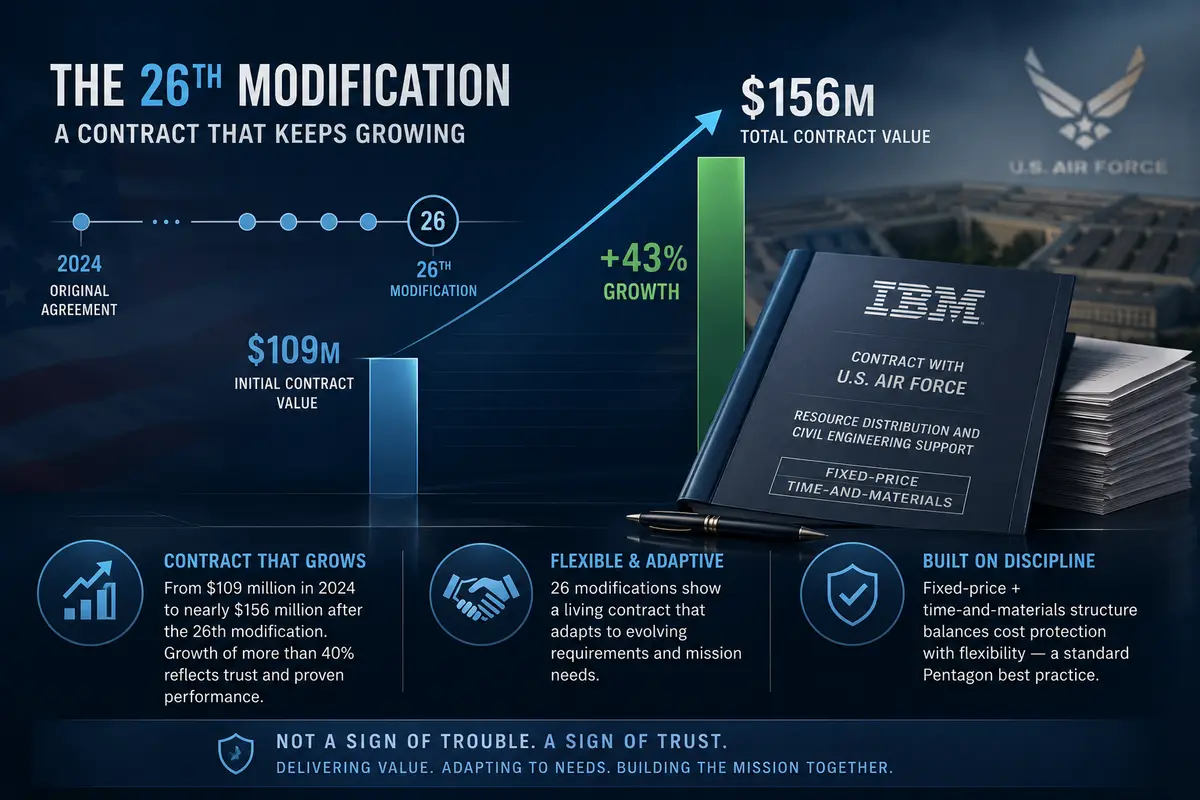
The history of this contract is notable in itself. The original agreement was signed in 2024. The current modification is already the twenty-sixth. This is not a sign of trouble — it is a sign that the contract is alive, flexible, and adapting to the customer’s changing needs.
The initial contract value was approximately $109 million. Now, after the twenty-sixth modification, the total cumulative value has reached nearly $156 million. Growth of more than forty percent over the life of the agreement suggests that the Air Force is satisfied with IBM’s work and willing to expand the partnership. If the contractor were underperforming, the contract would not be modified — it would be terminated and reassigned.
The contract structure — fixed-price combined with time-and-materials payments — gives IBM some protection against cost overruns, while simultaneously requiring the company to strictly adhere to deadlines and deliverables. This is standard Pentagon practice, especially after several multibillion-dollar procurement failures in previous decades made defense agencies far more
cautious in contract design.
Funding and Timeline: 2029 on the Horizon
Of the total $46 million added through this modification, nearly $37.5 million is being obligated immediately as fiscal year 2026 operations and maintenance funding. The remainder will likely be distributed as work progresses.
The contract is scheduled to run through July 2029. That gives IBM several more years of guaranteed work with the Air Force. For a company that has spent recent years restructuring its business around cloud technologies, artificial intelligence, and consulting, long-term government contracts like this are anchors of stability. They provide predictable cash flow and enable long-term investment planning in personnel and technology.
Context: IBM and the Defense Sector
IBM has never been a pure defense contractor in the way that Lockheed Martin or Raytheon are. It does not manufacture weapons, build aircraft, or launch missiles. But it does something without which none of those things function: it creates the digital nervous system that connects the fragmented elements of the military machine into a unified whole.
This legacy stretches back decades. IBM has worked with the U.S. government since its founding. During World War II, the company produced small arms and tabulating machines used for artillery calculations. During the Cold War, its mainframes processed data for NORAD and other early warning systems. Today, its cloud platforms and AI solutions help the military analyze intelligence, manage logistics, and plan operations.
The Air Force contract for resource distribution and civil engineering support is a continuation of that same trajectory. IBM does not make loud public statements about its role in the defense sector, but its presence there is deep and systemic. It is contracts like these — not one-off headline-grabbing deals — that form the backbone of long-term relationships between technology giants and the U.S. government.
What This Means for IBM and for the Market
For IBM, this contract is more than just another line item in an earnings report. It is confirmation that the company’s strategic pivot, chosen several years ago, is working. IBM exited low-margin hardware manufacturing, sold off parts of its legacy business, and focused on high-margin services: cloud computing, artificial intelligence, and consulting. Government contracts, especially defense-related ones, are among the most stable revenue sources in that segment. Governments do not abandon critical services during crises or slash budgets at the first signs of recession. They pay consistently and predictably.
For the market as a whole, this contract is another reminder that technology companies are deeply integrated into defense infrastructure. That is not always obvious because IBM does not sell weapons or participate in military parades. But when the Air Force needs to optimize resource allocation or plan construction of a new runway, it does not call Lockheed Martin. It calls IBM. And that call is worth forty-six million dollars — so far, just for one contract modification.

Comments
No comments yet. Be the first to share your thoughts!
Authentication Required
You must be logged in to post a comment.