

The Canadian Dollar Catches Its Breath: Peace with Iran and Falling Oil Give the Loonie a Chance
Monday: A Day of Hope for the Loonie
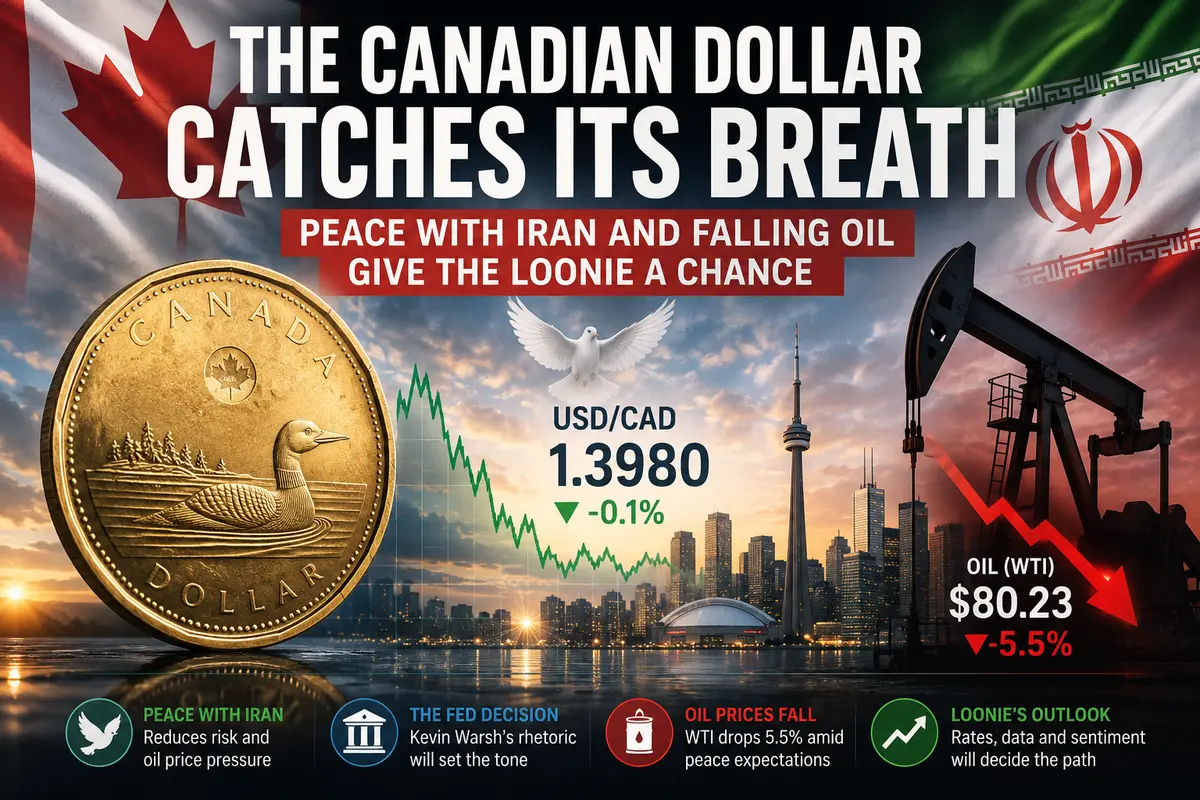
On Monday morning, the Canadian dollar—affectionately known as the “loonie” because of the loon depicted on the one-dollar coin—finally showed some strength. The USD/CAD exchange rate fell 0.1% to 1.3980, meaning the Canadian currency gained ground. A small move? Yes. Symbolically important? Perhaps. But it came after the loonie hit a seven-month low of 1.4023 last Thursday. In other words, the Canadian dollar bounced off the bottom and managed to climb higher.
What happened? A preliminary peace agreement between the United States and Iran. The news acted as a catalyst, improving global investor sentiment. Markets breathed a sigh of relief. Equity and bond markets around the world rallied. The Canadian dollar, however, advanced cautiously, as investors remained focused on the week’s main event: the upcoming U.S. Federal Reserve meeting.
Then there’s oil. Canada is a major oil exporter, and its currency is closely tied to crude prices. On Monday, oil prices plunged 5.5% to $80.23 per barrel amid expectations of peace in the Middle East and the reopening of the Strait of Hormuz.
Here’s the paradox: the Canadian dollar strengthened even as oil collapsed. How is that possible? The answer lies in the complex relationship between interest rates, inflation, and risk sentiment.
Let’s break it down.
Peace with Iran: Why It’s Good for Canada (and the Loonie)
Canada is not the United States, but its economy is deeply integrated with its southern neighbor. Roughly 70–80% of Canadian exports go to the U.S. Therefore, what benefits the U.S. economy often benefits Canada as well.
Peace with Iran is positive news for the global economy in general, but especially for oil-importing nations. Canada, however, is a net exporter of oil thanks to Alberta’s oil sands. Higher oil prices are usually beneficial for Canada’s economy—but there is a catch.
High oil prices fuel inflation. Inflation leads to higher interest rates. Higher interest rates support a stronger U.S. dollar. And a stronger U.S. dollar often translates into a weaker Canadian dollar.
It’s a long chain, but a direct one. When oil rises because of geopolitical tensions—as it did during April and May—the Canadian dollar doesn’t necessarily strengthen as one might expect from a commodity currency. Instead, it can weaken because investors anticipate tighter Federal Reserve policy, boosting the U.S. dollar.
Now the chain has reversed:
Peace with Iran → Lower oil prices → Lower inflation → A more dovish Fed → A weaker U.S. dollar → A stronger Canadian dollar.
That’s why the loonie strengthened despite oil’s 5.5% decline.
Another factor is global risk sentiment. Peace with Iran improved investors’ appetite for risk. They sold safe-haven assets like the U.S. dollar and bought currencies that tend to benefit from global growth, including the Canadian dollar. Canada is more than just oil—it exports lumber, wheat, fertilizers, and industrial equipment, all of which tend to perform well in an expanding global economy.
The Fed This Week: The Main Event for Everyone
Despite Monday’s optimism, the Canadian dollar remains on edge. The Federal Reserve’s June 16–17 meeting is looming large. Monday marks the start of a two-day marathon that will culminate in a rate decision and, perhaps more importantly, guidance from new Fed Chair Kevin Warsh.
Warsh, appointed by Donald Trump after Jerome Powell completed his term in early 2026, is a controversial figure. He served on the Fed’s Board of Governors during the 2008 financial crisis and worked in the White House under President George W. Bush. He is generally considered a hawk on inflation, but his views on current economic conditions remain somewhat unclear.
Markets expect the Fed to leave interest rates unchanged this month. However, investors are paying close attention to the updated economic projections—the so-called “dot plot”—and to Warsh’s remarks. If he signals that further rate hikes in 2026 are unlikely, the U.S. dollar could weaken, providing another boost to the Canadian dollar. If he adopts a hawkish tone, as many expect given his reputation, the loonie could quickly come under pressure again.
As of Monday, markets were pricing in a 49% probability of another Fed rate hike, down sharply from 69% a week earlier. That 20-percentage-point decline represents a significant shift driven by softer inflation data and the prospect of peace with Iran reducing energy-related inflation risks.
If Warsh validates this shift, the dollar could fall. If he pushes back against it, the dollar could rally.
For the Canadian dollar, the implications are significant. A dovish Fed could send USD/CAD toward 1.39 or even 1.38 by the end of the week. A hawkish Fed could push the pair back above 1.40.
Oil: It Fell, but Didn’t Sink the Loonie
Oil deserves special attention. WTI crude plunged 5.5% on Monday to $80.23 per barrel, its lowest level since March 10. The decline was driven by expectations that the Strait of Hormuz would reopen and that Iranian oil exports could return to global markets.
Normally, a 5% drop in oil prices would be devastating for the Canadian dollar. This time, it wasn’t.
Why?
First, much of the move had already been anticipated. Markets began pricing in lower oil prices on Friday when rumors of a peace deal first surfaced. By Monday, a portion of the negative impact had already been absorbed.
Second, the Canadian dollar is currently more sensitive to interest-rate differentials than to oil prices. The gap between U.S. and Canadian rates could shift in Canada’s favor if the Bank of Canada proves more hawkish than the Federal Reserve.
The Bank of Canada left its policy rate unchanged at 5.5% in April and signaled that another hike remains possible if inflation fails to slow. Canada’s latest inflation reading came in at 3.8% year-over-year—still well above the central bank’s 2% target. As a result, another rate increase in July remains on the table.
The Fed, meanwhile, may choose to pause. If Canadian rates remain higher than U.S. rates—or if the gap narrows—the Canadian dollar could strengthen further.
Thus, even in a lower-oil environment, the loonie may perform well if interest-rate differentials move in its favor.
CFTC Data: Speculators Are Betting Against the Loonie
There is, however, a warning sign.
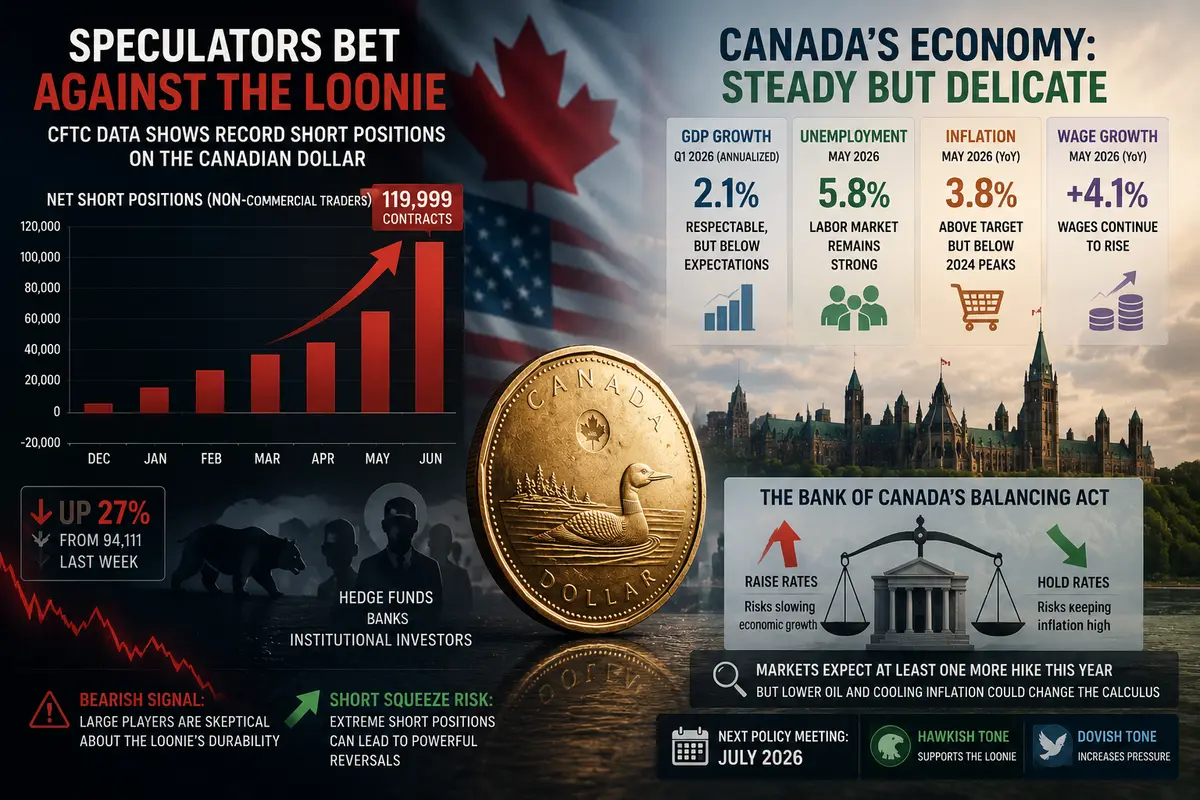
Data released Friday by the U.S. Commodity Futures Trading Commission (CFTC) showed that speculators increased their short positions in the Canadian dollar to the highest level since December.
In other words, hedge funds, banks, and institutional investors are betting on further weakness in the Canadian currency. Net short positions among non-commercial traders climbed to 119,999 contracts, up from 94,111 the previous week—a 27% increase.
That is a bearish signal. Large speculative players clearly remain skeptical about the loonie’s durability.
But they could be wrong.
Historically, when short positioning has reached extreme levels, the Canadian dollar has often staged powerful reversals. Too many traders on one side of the market can create the conditions for a short squeeze, forcing bears to buy back their positions.
This is another reason the loonie could strengthen even if some fundamental factors remain unfavorable.
Domestic Factors: Canada’s Economy
Canada’s domestic backdrop should not be overlooked.
The economy continues to expand, albeit at a modest pace. GDP grew at an annualized rate of 2.1% in the first quarter of 2026—respectable, but below expectations. The labor market remains relatively strong, with unemployment at 5.8% and wages continuing to rise.
Inflation stands at 3.8%, still above target but down significantly from the peaks seen in 2024, when it approached 5%.
The Bank of Canada faces a difficult balancing act. Raising rates further could slow economic growth. Failing to do so could allow inflation to remain elevated. Markets currently expect at least one more hike this year, but if oil prices continue falling and inflation cools accordingly, policymakers may reconsider.
For the Canadian dollar, that means every signal from the Bank of Canada matters. The next policy meeting is scheduled for July. A hawkish tone would support the loonie; a dovish one would increase pressure.
Technical Analysis: Levels to Watch
From a technical perspective, the Canadian dollar is approaching several key levels.
-
Current USD/CAD: 1.3980
-
Resistance: 1.4023 (last week’s seven-month high)
-
Support: 1.3950, followed by 1.3900
If USD/CAD breaks above 1.4023 (meaning the Canadian dollar weakens), the next target could be 1.4100 and beyond.
If the pair falls below 1.3950 (meaning the Canadian dollar strengthens), the next objective would be around 1.3880.
The Relative Strength Index (RSI) currently sits near 45, a neutral reading that suggests neither overbought nor oversold conditions. There is room for movement in either direction.
Outlook: Three Scenarios for the Loonie
Scenario 1: Bullish for the Loonie
The Fed leaves rates unchanged and delivers dovish guidance. The Bank of Canada remains hawkish despite lower oil prices. Peace with Iran holds, and oil stabilizes between $75 and $80 per barrel. The U.S. dollar weakens, and USD/CAD falls toward 1.38–1.39 by the end of the week.
Scenario 2: Bearish for the Loonie
The Fed adopts a hawkish tone and hints at a possible rate hike later in the year. The Bank of Canada unexpectedly softens its stance due to weaker economic growth. Oil falls further toward $70–75 per barrel. The U.S. dollar strengthens, and USD/CAD climbs to 1.40–1.41.
Scenario 3: Neutral
The Fed maintains its current stance without sending strong signals. The Bank of Canada remains on hold. Oil consolidates between $78 and $82 per barrel. USD/CAD fluctuates in the 1.39–1.40 range without establishing a clear trend.
My view leans toward the first scenario. Peace with Iran is a powerful positive catalyst for global markets. The Fed is likely to remain cautious, while the Bank of Canada remains too concerned about inflation to pivot dovishly. As a result, the loonie may continue strengthening over the coming weeks.
That said, risks remain. If Warsh embraces a strongly hawkish stance, the outlook could change quickly.
Conclusion: The Loonie at a Crossroads
The Canadian dollar strengthened on Monday following news of a peace agreement with Iran. Despite a 5.5% drop in oil prices, the loonie gained 0.1% and rebounded from a seven-month low.
The drivers were expectations of a more accommodative Federal Reserve, improving global risk appetite, and hopes that interest-rate differentials could shift in Canada’s favor.
Speculators remain skeptical, however. Short positions in the loonie have reached their highest level since December, signaling either continued pessimism or the potential for a powerful short squeeze.
The key event this week will be the Federal Reserve meeting on June 16–17. The rhetoric of new Fed Chair Kevin Warsh is likely to determine the Canadian dollar’s near-term direction.
For now, cautious optimism prevails. The loonie has held its ground despite falling oil prices and has even managed to strengthen. What happens next will depend on decisions made in Washington—and on how quickly the ships of peace begin moving through the Strait of Hormuz once again.

Comments
No comments yet. Be the first to share your thoughts!
Authentication Required
You must be logged in to post a comment.