

Teaching you about forex spread, with basic English.
Understanding Spread in Forex Trading
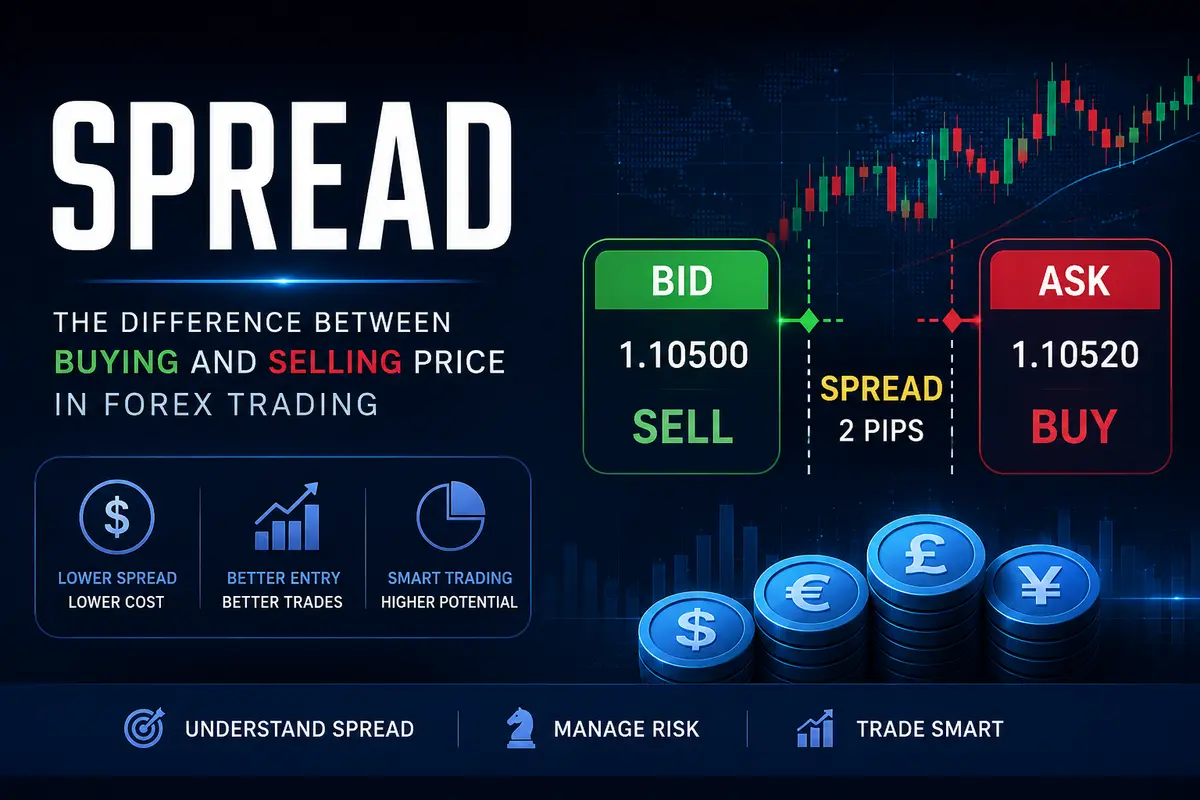
Spread is one of the most important concepts every forex trader should understand. It is the difference between the buying price (Ask price) and the selling price (Bid price) of a currency pair. In simple terms, spread is the cost a trader pays to enter a trade.
For example, if EUR/USD has a Bid price of 1.1700 and an Ask price of 1.1702, the difference is 0.0002, which equals 2 pips. This means the spread is 2 pips.
The Bid price is the price at which the market or broker is willing to buy a currency pair from you, while the Ask price is the price at which you can buy the currency pair. Since the Ask price is always higher than the Bid price, there is always a small gap between the two prices, and this gap is called the spread.
Spreads are very important because they directly affect trading costs. A lower spread means traders pay less to open positions, while a higher spread increases the cost of trading. This is why many traders prefer brokers that offer low spreads, especially scalpers and day traders who open many trades each day.
There are two main types of spreads in forex trading: fixed spreads and variable spreads. Fixed spreads remain the same regardless of market conditions, while variable spreads change depending on market volatility and liquidity. During major economic news releases or periods of low market activity, variable spreads can widen significantly.
Several factors influence spread in the forex market. One factor is liquidity. Popular currency pairs such as EUR/USD, GBP/USD, and USD/JPY usually have lower spreads because they are traded in large volumes. Less popular pairs, known as exotic pairs, often have wider spreads.
Market volatility is another factor. When important economic events occur, such as central bank announcements, inflation reports, or employment data releases, price movements become more intense and spreads may increase. Brokers widen spreads during these periods to manage risk.
Broker type also affects spread. Some brokers make money mainly through spreads, while others charge commissions in addition to lower spreads. Traders should understand their broker’s pricing structure before opening an account.
Spread can be measured in pips. A pip is the smallest standard movement in a currency pair. For most currency pairs, one pip equals 0.0001. If the spread on EUR/USD is 1 pip and a trader opens a standard lot trade, the spread cost is approximately $10. Understanding this helps traders calculate their expenses and manage risk properly.
For successful trading, it is important to monitor spreads, trade during periods of high liquidity, and avoid entering trades when spreads are unusually high. The London and New York trading sessions often offer tighter spreads because of increased market activity.
In conclusion, spread is a fundamental part of forex trading. It represents the difference between buying and selling prices and serves as a trading cost. By understanding how spreads work, traders can make better decisions, reduce costs, and improve their overal trading performance

Comments
No comments yet. Be the first to share your thoughts!
Authentication Required
You must be logged in to post a comment.