Bar Pipa
We pay for a post of 10$

Shareholders

A Swimming Lesson in Troubled Waters: How Leslie’s Bankruptcy Crisis Sank Its Stock in a Single Evening

A Swimming Lesson in Troubled Waters: How Leslie’s Bankruptcy Crisis Sank Its Stock in a Single Evening

A 50% Collapse: When News Destroys Market Capitalization Faster Than Water Dissolves Salt

The evening of July 22, 2025, became a dark moment in the history of LESL ... Leslie’s, a company that had supplied Americans with chlorine, filters, and other chemicals used to keep their backyard swimming pools crystal clear for decades. When news agencies reported that the retailer was actively considering filing for Chapter 11 bankruptcy protection, investors did not wait for official confirmation. During premarket trading, the stock plunged by nearly 49.8%, and the decline swept away billions of dollars in market capitalization within hours, like a financial tsunami.

The share price collapsed to $0.87, the lower boundary of its 52-week trading range, beyond which lay the threat of complete devaluation. Shares that had recently traded at levels that gave investors hope for a recovery suddenly became distressed securities that everyone who had failed to exit earlier was now desperate to sell.

What happened? Officially, the company stated that it was holding “confidential discussions with creditors” regarding the restructuring of its debt obligations. Behind this diplomatic language, however, lies a brutal reality: Leslie’s, a giant in the swimming pool supplies retail industry, is sinking, and the lifeline it is trying to throw itself may be too small.

Such news is certainly not uncommon in the world of corporate finance. However, the scale of Leslie’s decline shocked even seasoned Wall Street veterans. A drop of almost 50% in a single day is not merely a correction. It is a devastating blow that can erase investor confidence in a company for years.

There are relatively few examples in the history of publicly traded companies in which a single news report caused such immediate and comprehensive destruction of market capitalization. Every such case becomes a subject of study for analysts, investors,...


Continue reading...
0
0

Steadfast Group Confirms $5.34 Billion Takeover Bid

Steadfast Group Confirms $5.34 Billion Takeover Bid

Introduction: Thursday, When the Australian Insurance Giant Came Under the Spotlight

Thursday. Sydney, Steadfast Group headquarters. News that could change the future of one of Australia’s largest insurance companies has just become official. A consortium comprising U.S. insurance distributor Amwins Group and investment firm Dragoneer Investment Group has confirmed its intention to proceed with a takeover proposal for Steadfast worth A$7.7 billion ($5.34 billion). The offer price is A$6.00 per share.

This is not just a deal. It is an attempt by one of the world’s largest insurance distributors to enter the Australian market by acquiring a local leader. It is also a signal that the global insurance industry continues to consolidate, and cross-border deals are becoming the new norm.

What is behind this proposal? Why are Amwins Group and Dragoneer Investment Group interested specifically in Steadfast? And what does this mean for the company’s shareholders?

The consortium is conducting due diligence as part of a non-binding proposal to acquire all outstanding Steadfast shares through a scheme of arrangement. The offer price of A$6.00 per share may be reduced by the amount of any dividends or distributions declared or paid by Steadfast after June 5.

The renewed confirmation extends the exclusivity period by four weeks in accordance with the terms of the process agreement signed on June 10. The consortium was required to confirm its intention to continue pursuing the proposal in order to preserve its exclusive negotiation rights with Steadfast.

Steadfast’s board of directors noted that there is no guarantee that a binding agreement with the consortium will be reached, nor any certainty that the proposal will result in a completed transaction. This is a standard caveat that gives the company room to maneuver.

Let’s take a closer look at what is really happening in Australia’s insurance sector, why...

Continue reading...
0
0
Lin Brings

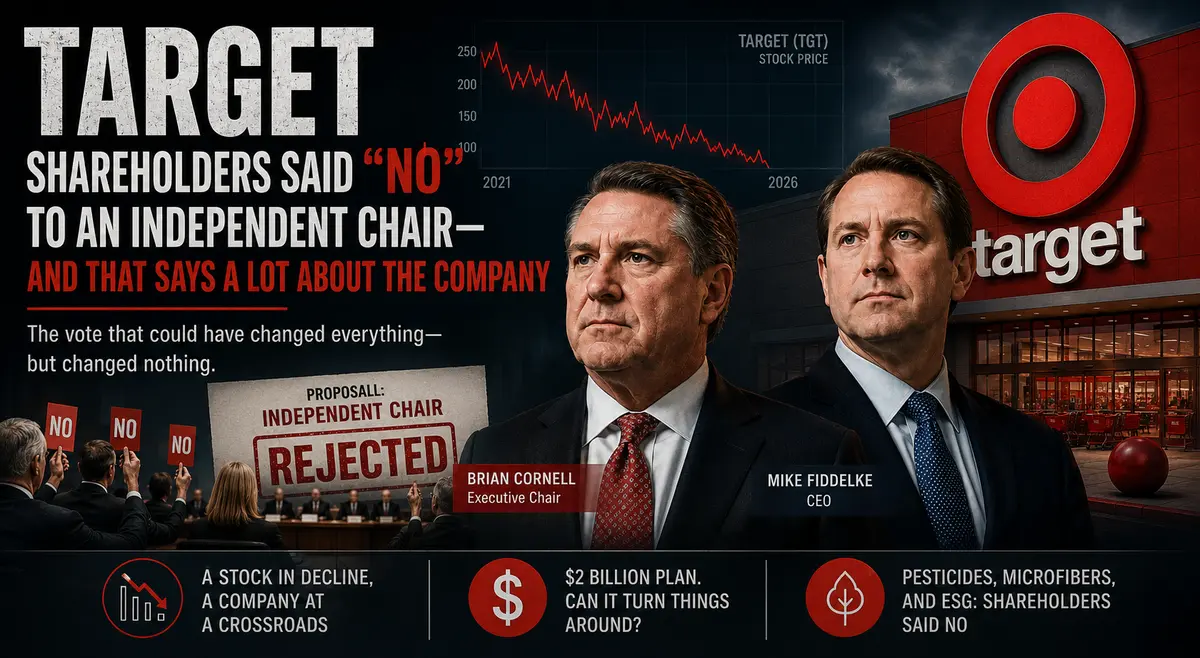
Target Shareholders Said “No” to an Independent Chair — and That Says a Lot About the Company

Target Shareholders Said “No” to an Independent Chair — and That Says a Lot About the Company

A Vote That Could Have Changed Everything — But Changed Nothing

Wednesday, June 10, 2026. The annual shareholder meeting of Target Corporation. One of America’s largest retailers, a chain known to families from Maine to California. Three proposals were on the agenda. One of them was a bombshell: a proposal to separate the roles of board chair and executive leadership. In simple terms, it would have removed Brian Cornell from the position of executive chair, leaving him on the board but without operational authority.

Some investors, particularly institutional shareholders, had been pushing for this change for years. Their argument was straightforward: “Cornell served as CEO for 11 years. He led the company through a period of success, but that success eventually faded. The stock has fallen by roughly half since 2021. Walmart and Costco have pulled ahead. It’s time for new leadership, and for the old leader to step aside without continuing to influence day-to-day operations.”

But shareholders saw things differently. According to Reuters, the proposal for an independent chair was rejected. Two other shareholder proposals—one calling for greater disclosure about pesticide use in private-label products and another addressing microfiber emissions—were also voted down. All board nominees were elected.

Cornell stays.

He will continue overseeing his successor, Mike Fiddelke, who became CEO in February 2026. Fiddelke has already pledged to invest $2 billion this year to improve inventory management and sharpen Target’s pricing strategy.

Yet one question remains: why did shareholders who have watched the stock struggle over recent years decide not to change the company’s leadership structure? And what does that say about Target’s future?

Brian Cornell: Architect of the Rise and Witness to the Decline

For those who do not closely follow the American retail industry, Brian Cornell is a legendary figure. He joined Target in 2014 when...

Continue reading...
0
0
Navigation menu
instaforex banner