

Rumors That Crushed a Giant: How One Unconfirmed Story Wiped Billions Off Meituan’s Market Value
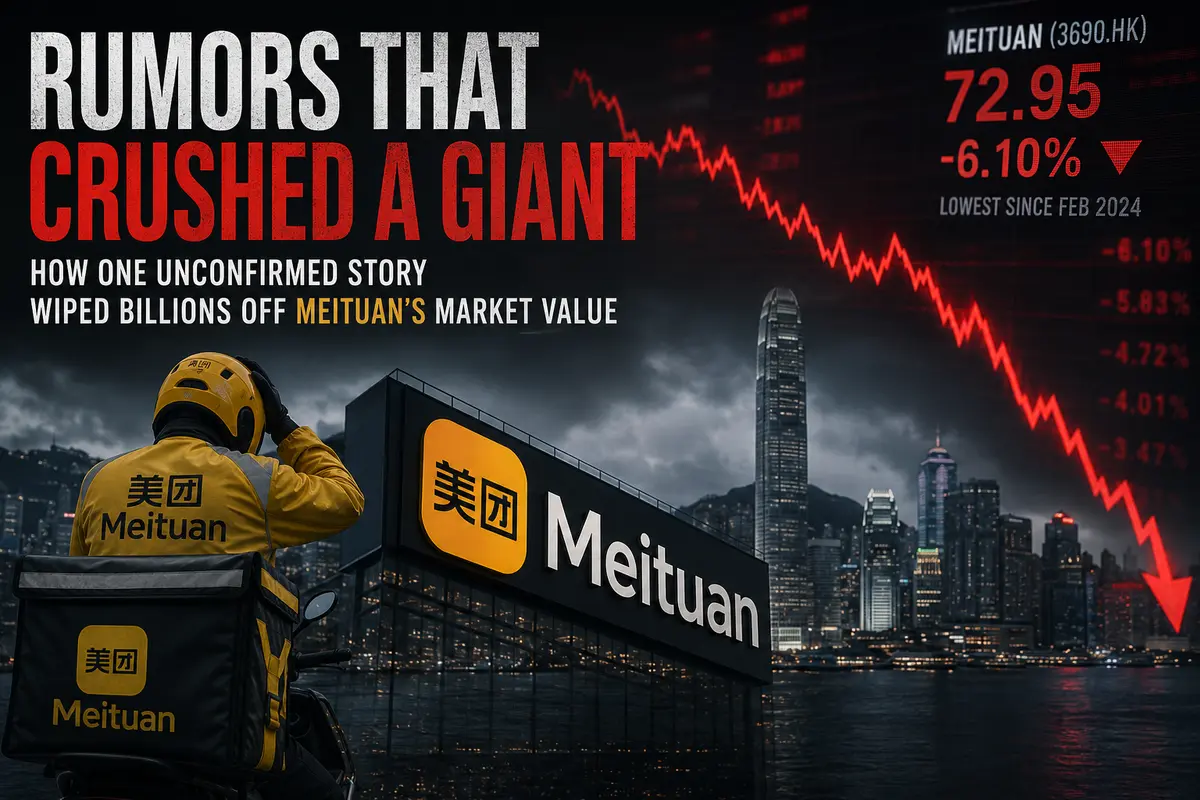
Hong Kong’s stock market witnessed a classic example on Thursday of how fear and uncertainty can outweigh fundamentals. Shares of Meituan, the Chinese food delivery giant, plunged 6.1%, falling to HK$72.95 — the company’s lowest level since February 2024. A business once considered one of the pillars of China’s tech sector lost billions of dollars in market capitalization in a single trading session. And all because of rumors. Rumors that were officially denied, yet still caused damage comparable to a real corporate crisis.
Anatomy of the Panic: What Happened
On Thursday morning, reports began circulating across Chinese social media and among market participants claiming that Meituan was planning massive layoffs. According to the rumors, up to 50% of employees in certain product-related positions could be cut. For a company aggressively expanding its grocery delivery operations and competing with giants like JD.com and Alibaba, the news hit the market like a bolt from the blue.
Meituan employees quickly denied the reports. They called the information false and pointed out that the company’s 2026 campus recruitment program was continuing as planned. Moreover, the company is still actively hiring specialists in technology, product development, and operations. In theory, the denial should have calmed investors. It did not. The stock continued to slide.
Why? Because in today’s atmosphere surrounding China’s tech sector, investors prefer to sell first and ask questions later. Over the past few years, they have repeatedly been burned by sudden regulatory crackdowns, abrupt strategy shifts, and real layoffs that initially appeared as “just rumors.” The market has developed a defensive reflex: if there are reports of trouble, dump the stock immediately before it’s too late.
Competition Is Suffocating the Industry
Still, it would be unfair to blame Meituan’s decline entirely on rumors. The rumors were merely the spark; the powder keg had been building for a long time. China’s food delivery and instant retail market is experiencing brutal competition. Meituan, long the dominant player in the sector, is now fighting battles on multiple fronts.
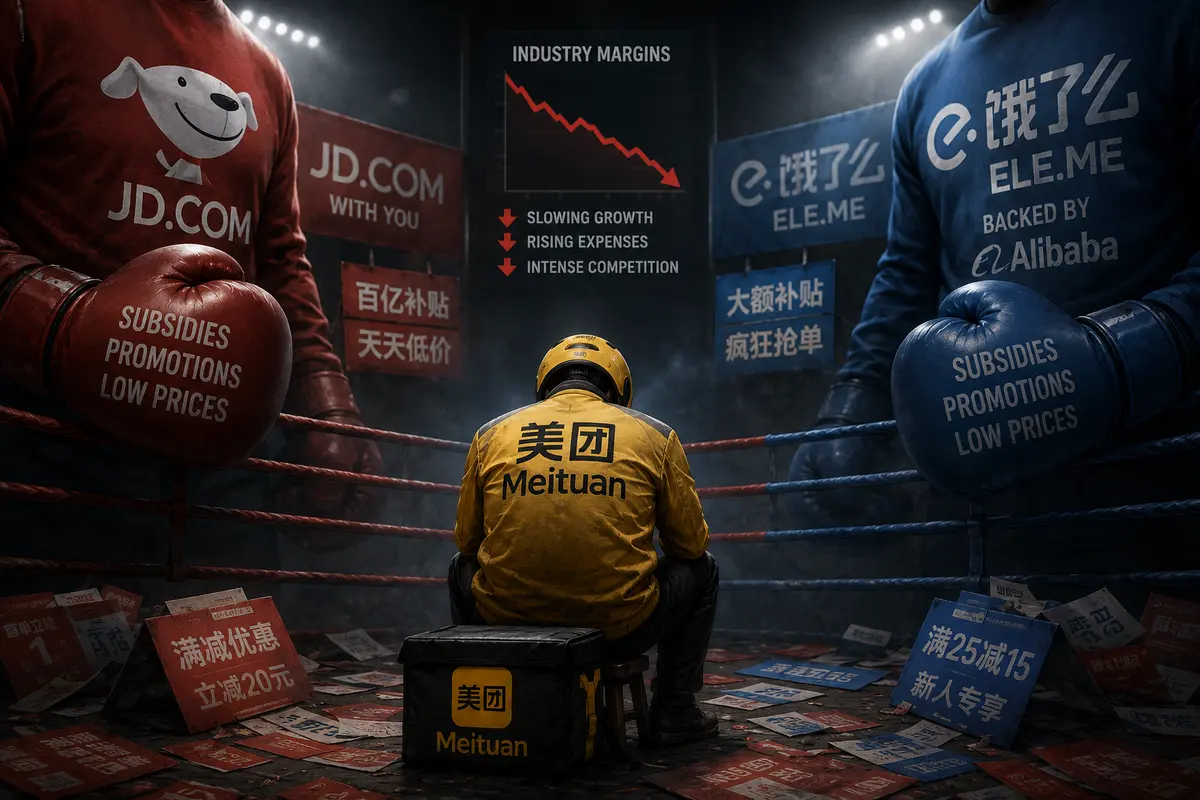
On one side stands JD.com, the e-commerce giant aggressively increasing subsidies and promotions to capture market share. JD.com has enormous financial resources and a highly developed logistics infrastructure, allowing it to undercut rivals and attract customers with lower prices.
On the other side is Ele.me, the delivery platform backed by Alibaba. Despite Alibaba’s own challenges, it remains one of the world’s largest technology conglomerates and still has the capacity to pour billions into a price war.
Meituan is effectively squeezed between two giants. To defend its market share, it must spend heavily on subsidies, marketing, and courier retention. That pressure is weighing on margins. Investors see slowing growth, rising expenses, and competitors with no intention of backing down. In that environment, any rumors about layoffs are interpreted not as optimization, but as a sign of desperation. If the company is cutting jobs, investors assume the situation may be worse than it appears.
The Shadow of Slowdown: Chinese Consumers Are Spending Less
There is also a broader backdrop making Meituan especially vulnerable. China’s economy is going through a difficult period. The property crisis that began several years ago remains unresolved. Consumer demand is weak. People are saving more, delaying major purchases, and cutting back on food delivery and impulse spending. For Meituan, whose business depends directly on consumer activity, this represents a serious threat.
Slowing consumer demand means the pie being fought over by Meituan, JD.com, and Ele.me is no longer expanding. And when the pie stops growing, competition for market share becomes especially ruthless. Companies are forced to spend increasingly large sums to attract the same customers — customers who are also ordering less frequently and spending less overall.
This is the classic trap of a mature market: competition intensifies, margins shrink, and growth prospects become increasingly uncertain.
The Denial That Failed
From a crisis communications standpoint, Meituan did everything right. It issued a rapid denial, emphasized that hiring continues, and stressed that the company is still investing in technology and growth. But the market did not believe it.
Why?
First, because in China the line between rumors and reality is often blurred. Many companies initially deny reports of layoffs, only to announce “restructuring” or “optimization” several months later. Investors remember these cases and prefer to protect themselves.
Second, because even if these specific rumors were false, the broader picture remains troubling. Meituan really is under pressure. Competition really is intensifying. Consumer demand really is slowing. Layoffs may not be happening today, but they could become inevitable in the future if current trends continue.
Markets do not price in today’s headlines — they price in future risks. And this time, that repricing was ruthless.
What Comes Next for Meituan
Meituan now faces a difficult choice. It can continue the price war with JD.com and Ele.me, spending billions on subsidies to defend market share. That would preserve its position but continue hurting profitability.
It could instead cut costs, streamline operations, and prioritize profits over growth. That would improve financial performance but might lead to market share losses.
Or the company could search for new growth drivers, such as international expansion or autonomous delivery technologies. But those strategies require both time and investment.
Whichever path Meituan chooses, investors will closely scrutinize every move. Thursday’s 6% decline is not a death sentence, but it is a warning. Markets are no longer willing to grant Chinese technology companies the benefit of the doubt automatically.
Every decision, every denial, and every earnings report will now face intense examination. Meituan must prove that it can not only survive in an environment of brutal competition, but continue growing. Until investors see convincing evidence of that, the stock is likely to remain under pressure.
The rumors were only the trigger. The real problem runs much deeper — and solving it will require real results, not just denials.

Comments
No comments yet. Be the first to share your thoughts!
Authentication Required
You must be logged in to post a comment.