

Peace as a Currency Driver: Why a Single Word from Trump Turned Asian Markets Upside Down
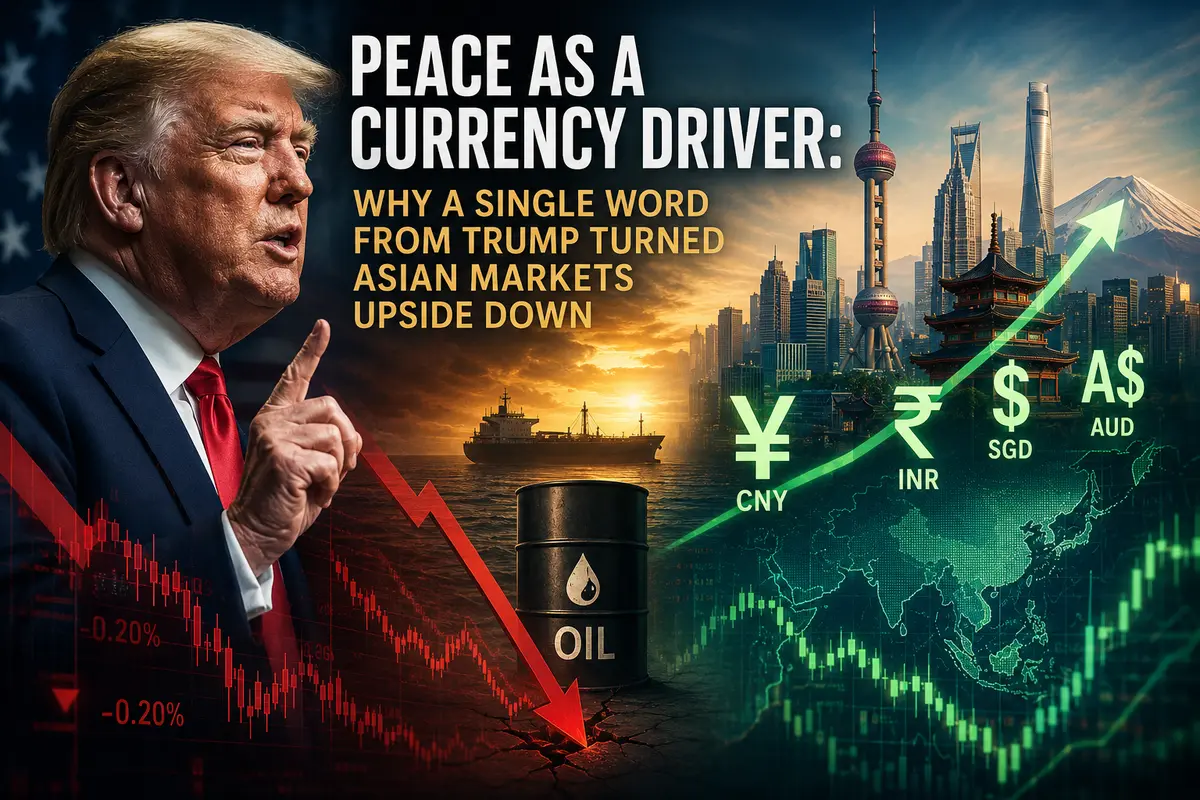
Monday on Asian currency markets began with a sight rarely seen in recent weeks — the dollar was retreating while currencies from Tokyo to Mumbai moved higher in unison. The U.S. dollar index slipped by two-tenths of a percent, and futures on the index fell by roughly the same amount. The move was modest, barely noticeable on the charts, but behind it stood a tectonic shift in sentiment. The reason was a few words spoken by Donald Trump over the weekend. Words that may have marked the beginning of the end of this year’s most destructive geopolitical crisis. And Asian currencies, being among the most sensitive barometers of global risk appetite, reacted instantly.
Trump the Peacemaker: “Largely Agreed”
Over the weekend, the U.S. president made a statement markets had been waiting months to hear. The United States and Iran had “largely agreed” on a framework deal to resolve the conflict. The key point was the resumption of shipping through the Strait of Hormuz — the very artery whose blockade had sent oil prices soaring and triggered a global chain reaction of inflation. Separate sources added further detail: Iranian and Pakistani mediators also reported progress. The picture looked almost idyllic.
But Trump would not be Trump without adding a note of uncertainty to the optimism. Almost immediately after the encouraging statement, he clarified that he was in no hurry to finalize a deal. Iran, for its part, largely rejected U.S. demands regarding the transfer of enriched uranium stockpiles — one of the most contentious points in the negotiations. Contradictory signals, mixed messages, swings between hope and skepticism. Classic Trump diplomacy, in which no one knows until the very last moment whether an agreement will be signed or another escalation will follow.
Still, markets exhausted by months of uncertainty chose to focus on the brighter side. The mere possibility that the conflict was moving toward resolution proved to be a powerful enough catalyst. Oil prices plunged. And in their wake, the dollar began to weaken.
The Oil Echo: Why Falling Crude Hurts the Dollar
The connection between oil prices and the dollar in the current environment is a complex mechanism driven by inflation expectations. The war with Iran disrupted shipments through the Strait of Hormuz, sending oil above $110 per barrel and accelerating inflation in the United States and worldwide. Rising inflation forced the Federal Reserve to discuss the possibility of further rate hikes. Expectations of higher rates, in turn, pushed the dollar upward. A chain reaction emerged: war → oil → inflation → hawkish Fed → stronger dollar.
Now that chain is beginning to unwind in reverse.
Hopes for peace mean hopes for the restoration of normal oil supplies. Hopes for normalized supply mean falling oil prices. Falling oil prices mean easing inflationary pressure. Lower inflation means the Fed may no longer need to raise rates. And the absence of further rate hikes removes one of the dollar’s key pillars of support. This is not a collapse of the U.S. currency, but it is a clear shift in the balance of forces.
Market participants are lowering their expectations for prolonged inflation driven by energy prices. And together with those expectations, the appeal of the dollar is fading. Why hold U.S. currency if the rate differential may no longer widen as aggressively as it seemed just a week ago? Investors are beginning to look for alternatives, and Asian currencies are among the main beneficiaries of that search.
Thin Markets: Holidays Amplify the Move
An important nuance on Monday was the low trading volume. The United States was on holiday, and Hong Kong and South Korea were also closed. A thin market is one where any move is amplified simply because there are fewer counterparties on the other side of the trade. When a large player decides to sell dollars on a normal day, the order is absorbed by a broad range of bids. On a holiday, that same order can move prices much more sharply.
This means Monday’s move should be interpreted with caution. The strengthening of Asian currencies was partly amplified by technical factors. When American traders return on Tuesday, some of the move may be corrected. But the direction has been set. Thin markets may exaggerate the scale of change, but they rarely change its sign. If the dollar weakened on low volumes, it means the underlying sentiment has shifted in favor of risk-sensitive currencies.
The Rupee: A Double Blow to the Bears
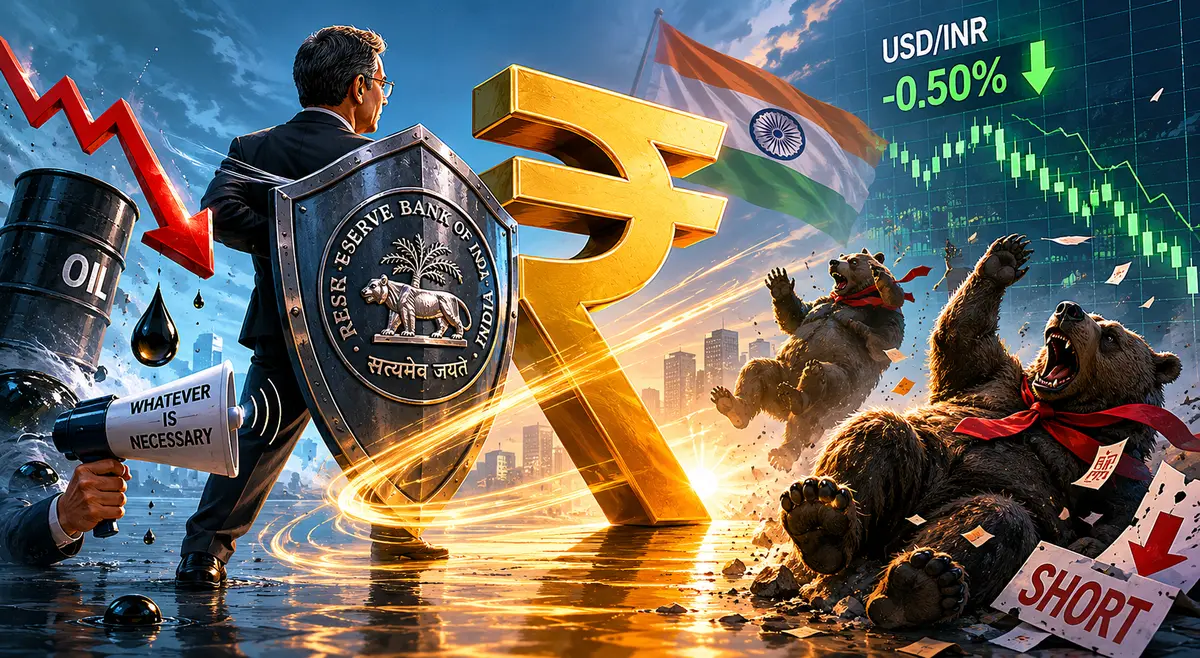
India’s rupee was one of the standout performers on Monday, posting one of the strongest gains among Asian currencies. USD/INR fell by half a percent, sharply retreating from record highs. Two powerful forces converged here — one global and one local.
The global factor was the drop in oil prices. India imports more than 80% of the crude oil it consumes, meaning every move in oil prices directly affects the rupee. When oil becomes cheaper, Indian importers need fewer dollars to pay for shipments, pressure on the rupee eases, and the currency gains room to strengthen. The fall in oil prices on news of progress in Iranian negotiations came as a breath of fresh air for the rupee.
The local factor was a statement by Reserve Bank of India Governor Sanjay Malhotra in an interview with Mint. Malhotra said something the market did not expect to hear so bluntly: the rupee is undervalued, and the RBI will do “whatever is necessary” to stabilize the currency market. It was a classic verbal intervention backed by real action — in May, the central bank had already sold tens of billions of dollars to slow the rupee’s decline. But until now, those interventions had achieved only limited success. Bearish sentiment was too strong, oil was too expensive, and capital outflows too intense.
Now, however, Malhotra’s verbal intervention coincided with a fundamental improvement in the external backdrop. And the effect became cumulative. Speculators who had happily shorted the rupee on Friday began covering positions on Monday. It is one thing to pressure a currency when oil is rising and the central bank is merely smoothing the decline. It is another when oil is falling and the head of the regulator personally promises to do “whatever is necessary.” Under such conditions, staying short suddenly becomes dangerous.
Yen, Yuan, and Singapore Dollar: A Broad Rally
The Japanese yen strengthened by two-tenths of a percent, with USD/JPY moving lower. For the yen, which had long suffered under the massive rate differential between the Bank of Japan and the Federal Reserve, any weakening of the dollar offered a chance to breathe.
The Chinese yuan also gained two-tenths of a percent, continuing the cautious appreciation seen over recent sessions.
The Australian dollar climbed half a percent, partially recovering losses from last week, when weak employment data had hammered the currency. The Aussie, often viewed as a proxy for global risk appetite, reacts sharply to any sign of geopolitical improvement. If peace with Iran is indeed achieved, the Australian dollar could become one of the biggest beneficiaries.
The Singapore dollar also deserves special mention. USD/SGD declined by two-tenths of a percent, but the bigger news for Singapore was first-quarter GDP data that came in far stronger than expected. The small city-state, whose economy serves as a barometer of global trade, demonstrated resilience the market had not anticipated. That gave the Singapore dollar an additional layer of support beyond the broader weakness in the U.S. currency.
Cautious Optimism: The War Is Not Over Yet
Despite all the positive signals markets received on Monday, it would be a mistake to declare the crisis over. Trump spoke of progress, but he also said he was in no rush. Iran rejected U.S. demands on uranium, one of the cornerstones of any agreement. Negotiations could drag on for weeks or months. They could collapse at any moment. And if that happens, oil will surge again, the dollar will strengthen again, and Asian currencies will once more come under pressure.
Moreover, even if a peace agreement is signed, questions remain. How quickly will shipping through the Strait of Hormuz resume? How long will it take to restore damaged infrastructure? When will oil prices return to pre-conflict levels? The path from a framework agreement to normalized supply could take months. And throughout that period, markets will continue operating in a state of heightened uncertainty, reacting sharply to every new headline.
Monday gave Asian currencies a reprieve. The dollar retreated, oil fell, and risk appetite returned. But this is not victory — only the first round in a long and exhausting struggle between hope and fear.
For now, markets have chosen hope.
Now the diplomats must speak. And what they say in the coming days will determine whether the rally in Asian currencies continues — or proves to be nothing more than a brief pause on the road to new lows.

Comments
No comments yet. Be the first to share your thoughts!
Authentication Required
You must be logged in to post a comment.