

Gold Rises in Asian Trading: Why the Precious Metal Is Ignoring a Strong Dollar
Introduction: A Quiet Morning on Asian Markets
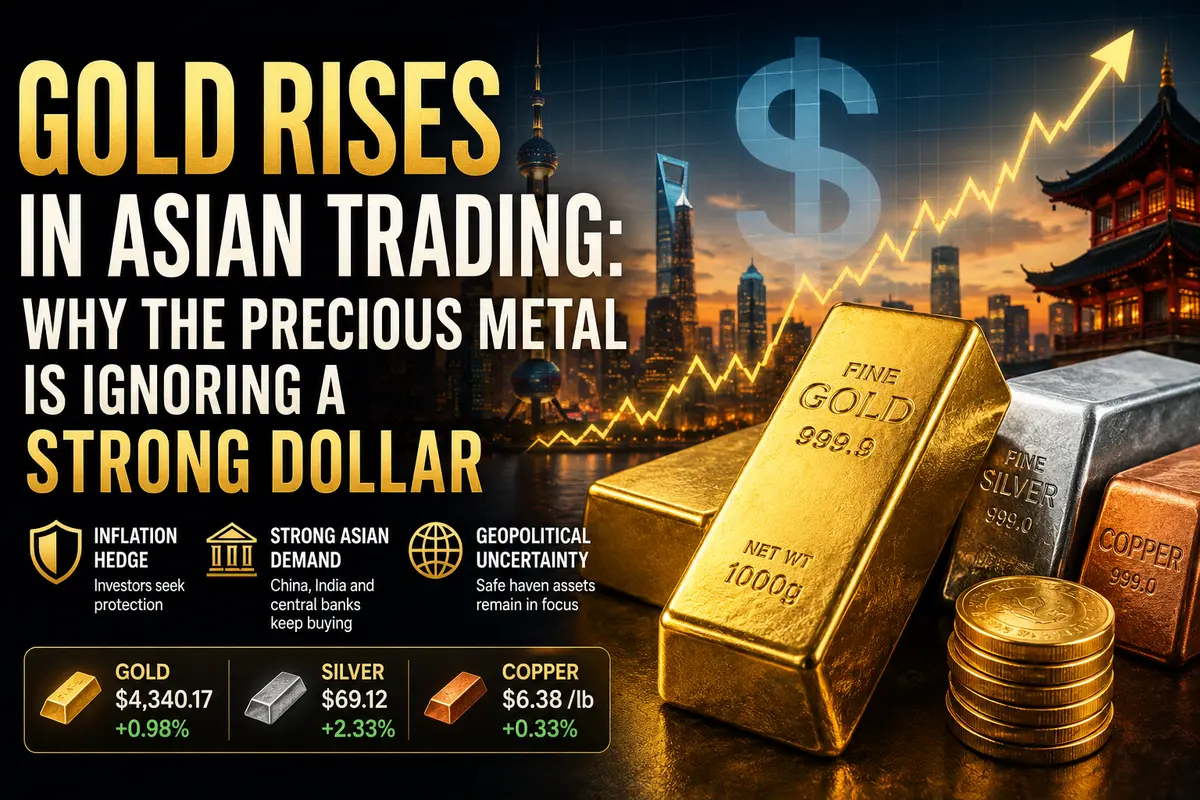
Four o’clock in the morning GMT. Asian markets are waking up, traders in Tokyo, Shanghai, and Singapore are taking their seats in front of their screens, and the first sip of coffee coincides with the first glance at market quotes. Gold is rising. Not dramatically, not explosively, but steadily—up nearly 1% during the morning session. August gold futures have climbed to $4,340.17 per ounce, reaching new local highs and prompting investors around the world to ask: what is happening?
At first glance, the backdrop does not appear particularly favorable for gold. The U.S. dollar remains near two-month highs following hawkish signals from the new Federal Reserve chairman. Treasury yields are rising, making alternative assets less attractive. Under normal circumstances, both factors would put pressure on the yellow metal. Yet gold is not only holding its ground—it is advancing.
Silver, gold’s faithful companion, has surged 2.33% to $69.12 per ounce. Even copper, which suffered a sharp decline the previous day due to the Fed’s rhetoric, managed to gain 0.33% to $6.38 per pound on Thursday. It appears that Asian trading is being driven by a sentiment that cannot be explained by economic logic alone.
What is behind this rally? Why is gold ignoring a strong dollar and a hawkish Federal Reserve? And what should investors expect from the precious metal in the coming weeks? Let’s take a closer look.
Gold’s Paradox: Rising Against the Odds
A Hawkish Fed and a Strong Dollar—Gold’s Traditional Enemies
If you are even somewhat familiar with financial markets, you know the golden rule (pun intended): gold and the U.S. dollar typically move in opposite directions. When the dollar strengthens, gold tends to decline. When the dollar weakens, gold usually rises. It is a correlation that has held for decades.
But on Thursday, that relationship broke down. The U.S. Dollar Index (DXY) was trading around 100.04, near its two-month highs. The greenback strengthened following remarks from Kevin Warsh, who indicated that the Federal Reserve remains prepared to raise interest rates further. A stronger dollar should have weighed heavily on gold. Instead, gold moved higher.
Moreover, rising Treasury yields—another consequence of hawkish monetary policy—typically work against gold. Bonds provide a guaranteed yield, making them a direct competitor to a non-yielding asset such as gold. Yet even this factor failed to halt the rally.
Clearly, other forces are at work in the market—forces powerful enough to outweigh these traditional bearish drivers. And those forces appear to be far stronger than a simple reaction to monetary policy.
Inflation Fears Have Not Disappeared
One of the key drivers of gold is fear of inflation. Gold has long been viewed as a hedge against the erosion of purchasing power. Although the Federal Reserve has spent years fighting inflation, markets remain unconvinced that the battle has been fully won.
Kevin Warsh reaffirmed his commitment to controlling inflation, but words alone are not enough. Markets want proof. As long as inflation remains above target and the cost of goods and services continues to rise, investors will continue buying gold as insurance against further currency debasement.
Silver’s performance is particularly revealing. The metal rose even more than gold, climbing 2.33%. Silver is not only a precious metal but also an industrial one. Its strength suggests that investors are not merely hedging against inflation—they are also anticipating stronger industrial demand. Rather than contradicting gold’s rally, silver reinforces the broader narrative of confidence in hard assets.
Yes, the Fed may raise rates again. Yes, the dollar may remain strong. But if inflation proves persistent, gold can continue to rise because it offers something neither bonds nor bank deposits can provide: protection against the gradual erosion of purchasing power.
The Asian Factor: Why Eastern Markets Are Driving the Trend
China and India: An Insatiable Appetite for Gold
When discussing gold’s rise during Asian trading hours, it is impossible to ignore the region’s fundamental demand dynamics. China and India—the world’s two largest consumers of gold—continue to increase their purchases, creating physical demand support that can sometimes outweigh macroeconomic signals.
In China, gold remains a preferred store of value amid ongoing difficulties in the real estate sector and instability in equity markets. Chinese investors have traditionally trusted gold more than bank deposits or stocks, particularly during periods of uncertainty—and uncertainty remains abundant in China’s economy today.
India, the second-largest gold market, is experiencing a seasonal surge in demand linked to festivals and the wedding season. Indians buy gold not only as an investment but also as a deeply rooted cultural tradition. At certain times of the year, Indian demand becomes strong enough to influence global prices.
Central banks are also contributing to demand. Many countries, especially across Asia, continue diversifying their reserves by increasing gold holdings while reducing exposure to dollar-denominated assets. This is more than a temporary trend—it is a structural shift that could support gold prices for years to come.
Technical Picture: Support and Resistance Levels
Technical factors should not be overlooked. Gold found support around $4,237.40 per ounce and successfully rebounded from that level. It now serves as an important psychological support zone for traders. As long as prices remain above it, many technical indicators remain bullish.
Resistance is located near $4,403.60. A breakout above that level could open the door to new all-time highs. Judging by the confident upward momentum seen during Asian trading hours, many market participants appear to be positioning for exactly that scenario.
Interestingly, August gold futures are trading at a premium to spot prices, suggesting expectations of continued gains over the medium term. Investors are willing to pay more for future delivery because they anticipate that the rally will continue.
Silver, which rose 2.33%, arguably looks even stronger from a technical perspective. The gold-to-silver ratio—a commonly used indicator of relative valuation—is declining. This may suggest that investors are rotating from gold into silver in anticipation of stronger gains in the latter.
What Is Driving Gold Right Now? Three Key Catalysts
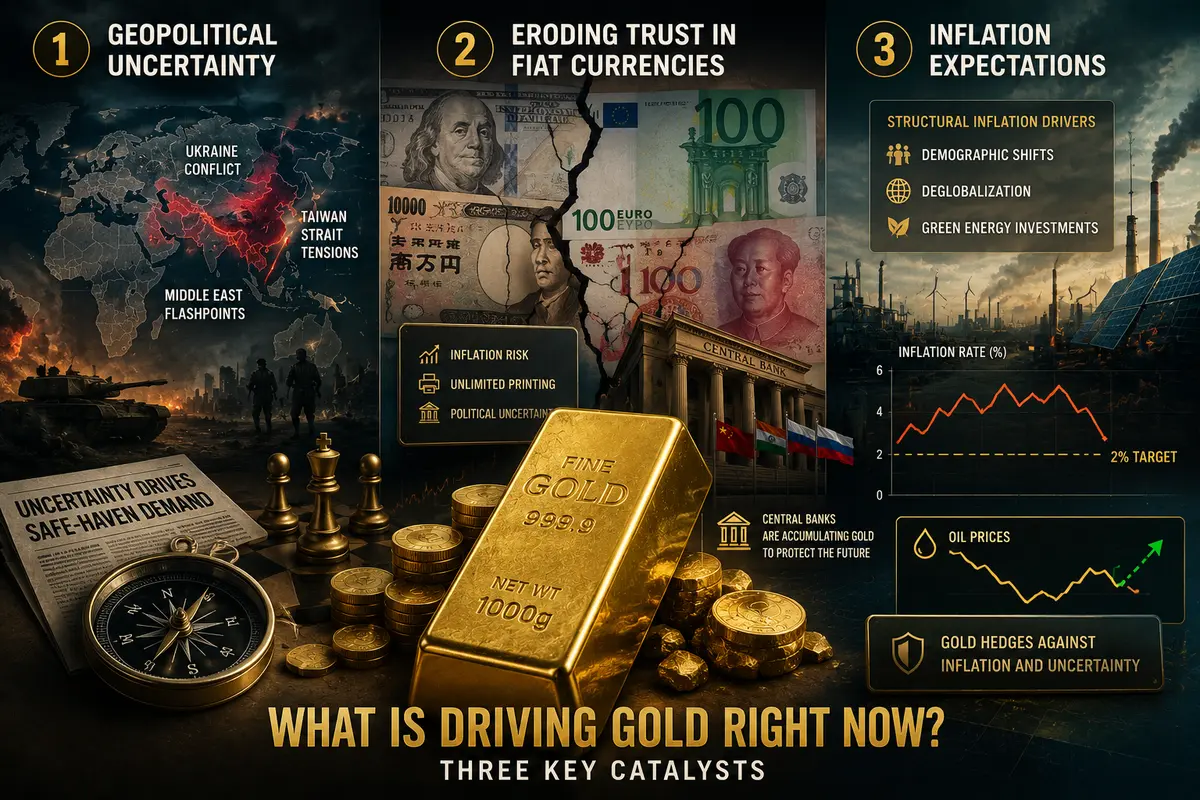
1. Geopolitical Uncertainty
Despite a peace agreement between the United States and Iran, geopolitical tensions remain elevated. The conflict in Ukraine continues, tensions in the Taiwan Strait persist, and numerous regional flashpoints continue to emerge around the world.
Gold remains the classic safe-haven asset during periods of geopolitical turbulence. Investors buy it when they are uncertain about the future and fear that unforeseen events could disrupt financial markets.
An additional layer of uncertainty comes from Kevin Warsh’s recent appointment. Markets have yet to see how he would respond to a major crisis. His first press conference conveyed a hawkish stance, but there is little clarity about how the Federal Reserve would handle unexpected external shocks. Such uncertainty creates fertile ground for gold.
2. Eroding Trust in Fiat Currencies
A second, often overlooked factor is declining confidence in fiat currencies. The dollar, euro, yen, and yuan are all vulnerable to inflation, all can be expanded through monetary policy, and all depend on political decisions that are inherently unpredictable.
Gold, by contrast, cannot be printed by any central bank. Its supply is limited, and its value cannot be diluted at the push of a button. In a world where sovereign debt has reached unprecedented levels, gold is becoming increasingly attractive as a store of wealth.
This trend is particularly evident among central banks. China, India, Russia, and many other nations continue expanding their gold reserves. Their actions reflect concerns about the long-term purchasing power of fiat currencies and reinforce the strategic role of gold.
3. Inflation Expectations
Returning to inflation, markets appear skeptical that inflation will quickly return to the Fed’s 2% target. Too many structural forces are working against that outcome: demographic shifts, deglobalization, and massive investments in green energy infrastructure—all of which can exert inflationary pressure.
Even another Fed rate hike may not solve the problem of structural inflation. Gold remains one of the most effective hedges against this risk, and as long as investors expect prices to rise over time, demand for the metal is likely to remain strong.
Moreover, the recent decline in oil prices following the Iran agreement may prove temporary. Should oil prices rebound, inflation expectations could rise again. Gold is already pricing in that possibility, which helps explain its resilience even amid lower energy prices.
Context: Copper and Silver as Sentiment Indicators
Copper: A Modest Recovery After the Sell-Off
Copper, which fell about 1% the previous day due to Warsh’s hawkish comments, recovered modestly on Thursday, gaining 0.33% to $6.38 per pound. While the move was small, it was meaningful.
Investors may have reassessed the sell-off and concluded that it was excessive. Fundamentally, copper markets remain tight, and long-term demand prospects linked to electrification and green energy remain positive. The previous decline appears more like a reaction to short-term headlines than a shift in underlying fundamentals.
Copper’s recovery helps reinforce the broader bullish tone across the metals complex. If copper can stabilize, it suggests that investors are not panicking—they are waiting for clarity. And that clarity may ultimately prove favorable for the entire sector, including gold.
Silver: Gold’s Bullish Companion
Silver’s 2.33% gain significantly outpaced gold’s advance. This relationship matters because silver often acts as a higher-beta version of gold during strong bull markets.
Silver benefits from a unique combination of factors. Like gold, it serves as a precious metal and inflation hedge. Unlike gold, it is also a critical industrial metal used in electronics, solar panels, and other advanced technologies.
When silver outperforms gold, it often signals that investors are becoming more confident and willing to assume greater risk. While gold may represent safety, silver reflects optimism—and right now, both forces appear to be supporting precious metals simultaneously.
Conclusion: Gold Continues Its Climb
Gold futures rose during Thursday’s Asian trading session despite a strong dollar and hawkish Federal Reserve rhetoric. This is not merely a statistical anomaly. It is a reminder that the gold market often follows its own rules—rules that do not always align with traditional financial models.
Investors continue to seek protection against inflation. Central banks continue accumulating gold reserves. Asian demand remains robust, particularly from China and India. Geopolitical uncertainty persists. And while the Federal Reserve may raise rates again, that is unlikely to alter the fundamental drivers supporting gold.
The next key target for bulls lies at $4,403.60. A successful breakout above that level could pave the way for new all-time highs. With August futures already trading at $4,340.17, the market is less than $60, or roughly 1.5%, away from testing that resistance.
Perhaps most interestingly, gold is rising alongside the U.S. dollar. This is unusual, but not unprecedented. Such periods typically occur during times of extreme uncertainty, when investors seek safety wherever they can find it. Both gold and the dollar become beneficiaries of risk aversion.
Silver and copper are reinforcing the bullish narrative. Silver is outperforming, while copper is recovering from its recent decline. Across the metals complex, momentum is pointing in the same direction—upward.
What happens tomorrow? No one knows. Markets will remain volatile. Investors will scrutinize every word from Kevin Warsh. Geopolitical developments will continue shaping sentiment. But for now, on this Thursday morning, gold is rising.
And that may be the most important signal of all.

Comments
No comments yet. Be the first to share your thoughts!
Authentication Required
You must be logged in to post a comment.