

EUROPEAN SESSION · WEDNESDAY 17 JUNE 2026 BMW Just Blew a 7% Hole in the DAX. And Europe Still Has to Trade Through Warsh Tonight
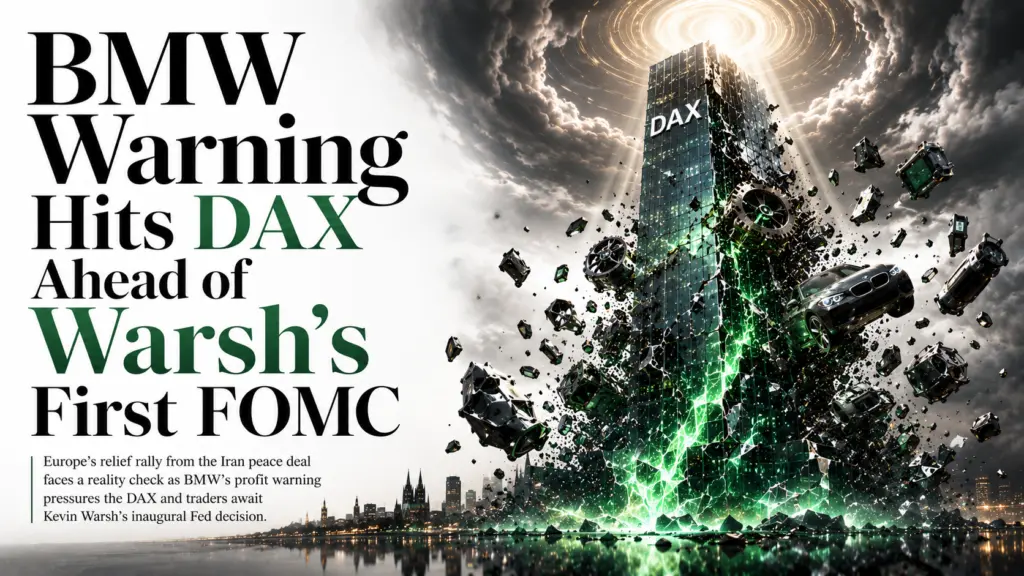
Europe opens with an Iran peace rally on one hand and a BMW profit warning that has dragged the entire German auto sector lower on the other. The DAX is down. Silver is retreating. BP is being crushed by $78 Brent. And at 20:30 GMT tonight, Kevin Warsh speaks for the first time as Fed Chair — and every position in today’s session either gets validated or reversed in that press conference.
There is a particular kind of session that European traders know well — one where the domestic news is telling you one thing and the global macro is telling you something different, and your job is to figure out which one dominates by close. Wednesday 17 June is that session in its most concentrated form. On the domestic side: BMW issued a 2026 profit warning overnight flagging weaker deliveries and margin pressure from EV transition costs. Shares fell nearly 7%, dragging Mercedes-Benz down 3.2% and Volkswagen down 2.4%. The German auto sector — which carries disproportionate weight in the DAX — is having one of its worst single sessions since the EV cycle began.
On the global macro side: the Iran peace deal has ended the conflict, WTI is near $76, Brent near $78, and the structural backdrop for European equities has materially improved. Lower oil means lower energy costs for German manufacturers, lower Eurozone inflation, and less pressure on the ECB to follow Thursday’s hold with another hike. These are genuine tailwinds. They just are not visible today because BMW’s profit warning is dominating the headlines and the session’s positioning is cautious ahead of Warsh at 20:30 GMT. Every rate-sensitive instrument in today’s session is in a holding pattern until that press conference.
BMW dropped 7% in a session that was supposed to be about the Iran peace dividend. That is European equity trading in one sentence.
The BMW Shock: What the Profit Warning Actually Says
BMW’s 2026 profit warning is not a surprise to anyone who has been following the structural pressures on German auto OEMs over the past two years, but the timing — arriving in the middle of a relief rally when the market wanted to price recovery — makes it more painful than the number itself warrants. The company flagged weaker delivery volumes for 2026, driven by softening demand in China (still their largest single market), and margin pressure from the accelerating EV transition, which requires simultaneous investment in new platforms while legacy ICE volumes decline.
The read-across matters beyond BMW itself. Mercedes-Benz at minus 3.2% and Volkswagen at minus 2.4% are symptomatic: the entire German premium auto sector is being repriced for a structural transition that is proving more expensive and slower than the market’s prior earnings models assumed. The DAX at 24,915 is absorbing this selectively — insurers, defence names, and financials remain firm, reflecting the Iran peace deal’s genuine positive impact on those sectors. The auto drag is sector-specific, not a broader signal about German economic health. But it is a reminder that the DAX’s path to its January record of 25,508 runs through a sector that is having a structurally difficult year.
EUR/USD at 1.1611: The ECB-Fed Trade Still Has Legs
EUR/USD at 1.1611 has been remarkably stable through the BMW shock — which is itself informative. The currency’s fundamental driver is the ECB-Fed rate differential, and that differential is improving for the euro: the ECB hiked to 2.25% on 11 June while the Fed holds at 3.50 to 3.75% tonight. What matters now is the pace of convergence. If Warsh is dovish tonight — acknowledging that the Iran peace deal’s disinflationary impulse changes the near-term inflation calculus — the ECB-Fed gap starts closing from the wrong side for EUR bulls, as the market prices earlier Fed cuts. If Warsh is hawkish, the gap stays wide, which is structurally EUR-supportive but caps the near-term move.
The pair’s 2026 range sits between 1.1435 and 1.2019. At 1.1611 it is in the middle third — neither stretched on the upside nor presenting an obvious dip-buy entry. The clean trade remains a pullback to 1.1520 to 1.1570 after tonight’s Warsh press conference has resolved the near-term uncertainty. The BoE decision tomorrow adds a second layer: a hold with a dovish tilt from Bailey would widen EUR/GBP and provide a secondary EUR/USD support.
Silver at $69.51: Two Forces, One Direction for Now
Silver at $69.51 is retreating from last week’s $71 highs in a dynamic that is structurally identical to what happened when the Iran deal was first announced: the geopolitical safe-haven premium deflates. The metal ran from $35 to over $121 during the conflict’s peak on the combination of war-premium speculation and genuine concerns about supply chains for solar and EV batteries. As the war ends, the speculative war premium unwinds — and it has further to go before it reaches the genuine industrial demand floor.
That floor is real and it is not going away. Solar installation capacity globally has been accelerating — 2026 is on track to be a record year for new capacity additions — and each gigawatt of solar panels requires meaningful silver for photovoltaic contacts. AI data centre power consumption is creating a secondary industrial demand wave. The question for silver is where the war premium ends and where the structural industrial bid begins. The answer, based on CSFX’s analysis, is somewhere in the $63 to $67 range — which means the current $69.51 still has a deflation leg before the structural buyers become aggressive. Sell bounces toward $71 to $72 while the war premium continues to unwind.
BP at 510p: The Worst of Both Worlds
BP at 510p is one of the session’s most analytically uncomfortable positions. The stock rose sharply during the Iran conflict as oil prices spiked and the energy sector’s earnings projections improved. It is now giving back those gains as Brent near $78 removes the war premium — but the company’s underlying restructuring story, which involves divesting assets, cutting costs, and reorienting toward lower-carbon energy, has not fundamentally changed. The question is whether 510p represents a value opportunity — the stock’s consensus Buy rating and 633p analyst target implies 24% upside — or whether there is more downside before oil finds a new equilibrium.
The answer depends on what oil does over the next four to six weeks. With the Hormuz reopening and the formal ceasefire signing on 19 June, there is still residual war premium to deflate — perhaps $5 to $8 per barrel. That gets Brent toward $70 to $73, which is the range where BP’s restructured business model starts to look more fully valued at current levels. The 525p to 535p zone is the accumulation entry — it represents a discount to both the analyst consensus and the pre-conflict trading range, and it provides defined risk against the $495 stop below structural support.
BNB at $601 and USDT at $0.999: The Pre-FOMC Caution Signal
BNB at $601.02 slipping while broader crypto consolidates is the pre-FOMC caution signal in its purest form. When BNB underperforms Bitcoin in a broadly stable crypto session, it typically indicates that the more speculative, exchange-linked layer of the market is de-risking ahead of a macro binary. The same logic applies to USDT trading marginally below its $1.00 peg at $0.999 — not a stablecoin crisis, but a marginal preference for holding slightly more dollar-equivalent liquidity than usual before a pivotal Fed decision.
The read for tonight: if Warsh is dovish, BNB recovers quickly above $620 and USDT returns to par as risk appetite resumes. If Warsh is hawkish, BNB tests $580 and the broader crypto complex sees a positioning flush that is more violent than the pre-FOMC decline suggested. Warsh’s press conference tone is the single most important variable for crypto tonight — more so than for equities or currencies, because crypto’s lack of intrinsic yield makes it the most rate-sensitive major asset class in practical terms.
Natural Gas at $3.24 and EU 20Y at 3.55%: The Quieter Stories
Natural gas at $3.24 per MMBtu is being pushed lower by two forces that are reinforcing each other: US storage inventories sitting 6% above the five-year average, and the Hormuz reopening reducing LNG freight anxiety in Asia-Pacific markets that had been competing with Europe for cargoes. This is a range-bound instrument until either the storage surplus narrows meaningfully or a weather event creates an unexpected demand spike. The EIA report Thursday is the next data gate.
EU 20-year yields easing toward 3.55% tell you the fixed-income market is cautiously pricing in a scenario where the Iran peace deal reduces energy inflation fast enough to soften the ECB’s tightening path. That is the mirror image of the yield spike that followed the June 11 hike. The direction of EU long-end yields tonight will be set by Warsh: a dovish Fed reduces global yield pressure and pulls EU long yields lower; a hawkish Fed reasserts the ‘rates are higher for longer everywhere’ narrative and pushes EU long yields back toward 3.65% to 3.70%.
The Session’s Conclusion: Hold What Works, Size Down What Doesn’t
The BMW shock is a sector-specific event in a session where the macro backdrop is constructive. The Iran peace deal, lower oil, and the ECB’s established hiking cycle are all genuine positives for European markets. The DAX’s reaction today is the auto sector having a bad day — not Germany having a bad quarter. EUR/USD at 1.1611 is where it should be given the rate differential. Silver is on its way to a structural floor rather than a structural breakdown. BP is being repriced by oil, not by a change in its business.
The one variable that overrides all of this is Warsh at 20:30 GMT. Every position in today’s session needs a defined plan for both the dovish and hawkish outcomes before that press conference starts. The positions that survive tonight are the ones where the stop was in place before Warsh spoke — not the ones where the trader was watching the screen and reacting.
─
Live trade levels and FOMC reaction analysis for EUR/USD, DAX, Silver, BP, BNB, Natural Gas, and EU 20Y published at capitalstreetfx.com.
Read Full Report: capitalstreetfx.com/market-analysis/daily-market-analysis/

Comments
No comments yet. Be the first to share your thoughts!
Authentication Required
You must be logged in to post a comment.