

Eurobond Yields Rise amid Hawkish Rhetoric in Sintra

Introduction: The Portuguese Coast Where Hopes Break Apart
The coast of Sintra, with its fairy-tale palaces and sweeping ocean views, has always seemed like a place for inspiration and romance. But these days, the Portuguese city has turned into the epicenter of a harsh financial reality. The European Central Bank’s annual forum, which brings together the world’s leading central bankers, has this year become not merely a platform for exchanging views, but a battlefield for investors’ expectations.
The outcome of the two-day debate came as a surprise to those accustomed to soft wording and cautious signals. The hawkish rhetoric voiced by Federal Reserve Chair Kevin Warsh and ECB President Christine Lagarde immediately reverberated across sovereign debt markets. The yield on benchmark 10-year German bonds, which had recently been falling toward multi-month lows, reversed course and began climbing toward 2.95%.
All of this is happening at a time when inflation risks appeared to be receding. Oil has fallen to levels not seen since before the start of geopolitical turmoil, global supply chains are normalizing, and the eurozone economy is sending mixed signals. But the central bankers gathered on the Atlantic coast made one thing clear: the party is over. Inflation has not yet been defeated, and rate cuts are not a matter for the coming months.
Investors who had already begun pricing in imminent policy easing found themselves confused. Their expectations crashed against the firm statements made in Sintra just as Atlantic waves crash against the cliffs of Cabo da Roca. Bond markets are now undergoing a painful repricing.
What did Warsh and Lagarde actually say? Why have Eurobonds, which had protected capital during periods of uncertainty, begun to lose ground? And how will this shift affect the eurozone economy in the coming months? Let’s take a closer look.
Sintra 2026: When the Hawks Drowned Out the Doves
Kevin Warsh: Nothing Personal, Just Inflation
Kevin Warsh, who has held the position of Federal Reserve Chair for only a few months, has quickly gained a reputation as someone unafraid to say hard things. His debut press conference, which had already managed to send metals markets tumbling, was merely a warm-up. In Sintra, he went further.
Warsh stated clearly and unequivocally that market participants expecting a rapid pivot toward looser monetary policy are likely to be disappointed. He confirmed that the Fed intends to keep interest rates high for an extended period, and that the current level of rates is not a temporary measure, but a deliberate strategic stance.
For those who have followed the rhetoric of the U.S. central bank in recent years, these words were not a complete surprise. The phrase “higher for longer” has already become a mantra for traders on both sides of the Atlantic. But the way Warsh said it, and the emphasis with which he delivered the message, forced markets to reassess their expectations. If before the forum the probability of rate cuts this year was still non-zero, after Sintra it moved close to zero.
It is important to note that Warsh spoke not only about inflation, but also about the risks associated with premature easing. He stressed that the Fed had already made this mistake in the past: loosening policy too early, only for inflation to return and force policymakers to start all over again. He does not intend to repeat that historical lesson. In his interpretation, hawkishness is not dogma, but necessity.
Christine Lagarde: European Calm with Sharp Edges
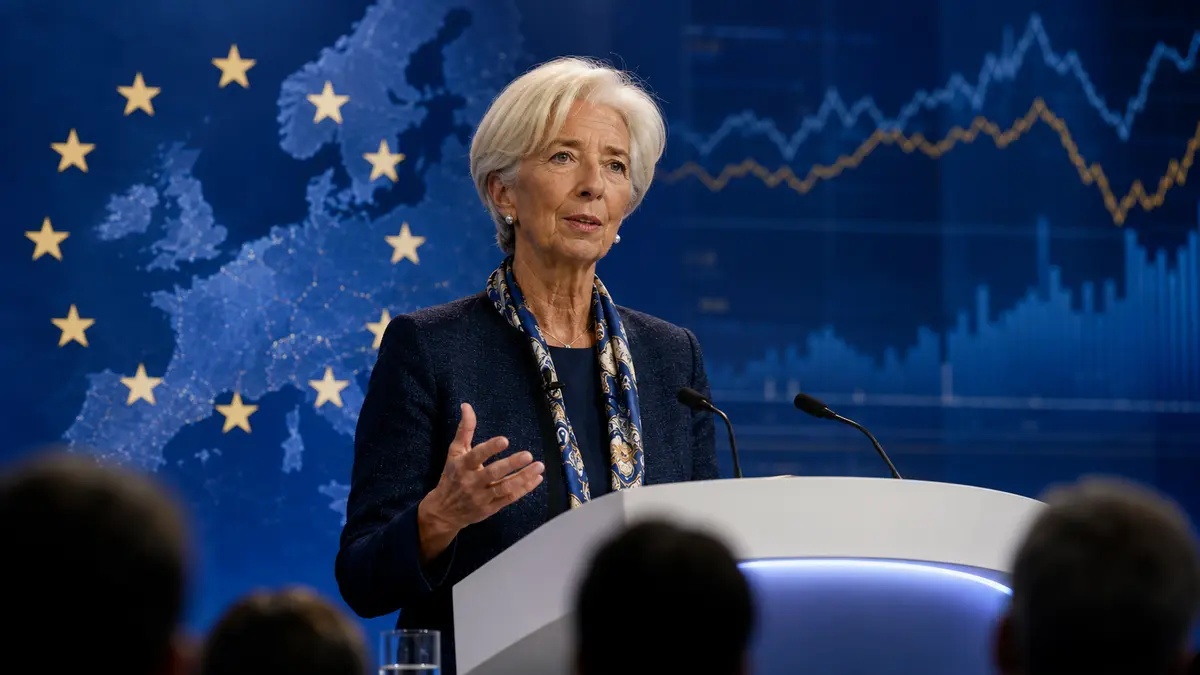
While Warsh was openly hawkish, Christine Lagarde chose a more restrained but no less firm tone. The ECB President confirmed that inflation risks are becoming more balanced, but added a crucial caveat: the central bank is not yet ready to declare final victory over inflation.
Lagarde skillfully used diplomatic language, but the essence of her message was clear. The ECB is closely watching the data and is ready to act if inflation fails to retreat. She did not rule out the possibility of further rate increases, although she acknowledged that, for now, a pause appears justified. Markets heard this as: “Do not expect easing any time soon.”
For the eurozone, this is an especially sensitive signal. The currency bloc’s economy is recovering more slowly than the U.S. economy, and many analysts had predicted that the ECB could move to cut rates before the Fed in order to support growth. Lagarde effectively pushed back against those expectations. She made it clear that price stability matters more to her than short-term economic stimulus.
Interestingly, Lagarde and Warsh, representing different central banks and different economic realities, sounded in unison. This was not a pre-agreed position, but it showed markets that the world’s leading central banks are determined. Coordination, even if informal, only amplified the effect of their statements.
Other Voices: A Chorus of Central Bankers
The Sintra forum was not only about Warsh and Lagarde. Over the course of two days, dozens of central bank representatives spoke, and all of them sounded the same note. Inflation remains the number one priority, and rate cuts are not the baseline scenario.
The remarks from representatives of the Bank of England and the Swiss National Bank were particularly telling. They also confirmed that they see no grounds for easing policy in the coming quarters. The British economy, facing the same inflationary challenges as the eurozone, found itself in a similar position.
The chorus of voices in Sintra was so unified that investors simply could not ignore it. Markets that had hoped for softer signals received the exact opposite. And this was immediately reflected in bond prices.
The Mechanics of the Move: Why Eurobonds React This Way
Yield and Price: The Inverse Relationship in Action
For those who are not immersed in the intricacies of the bond market, let us recall a simple rule: bond yields move in the opposite direction to bond prices. When demand for bonds rises, their price increases and yields fall. When demand declines, prices fall and yields rise.
On Thursday, we observed the second scenario. The yield on 10-year German Bunds rose to 2.95%, while the yield on two-year bonds climbed to 2.53%. This means investors were selling bonds, believing that their yields were not high enough to compensate for the risks. And in the market’s view, those risks increased after Sintra.
Why does hawkish central bank rhetoric lead to higher yields? Because it changes expectations about future interest rates. If a central bank says rates will remain high for a long time, bonds with low fixed yields become less attractive. Investors prefer to sell them and shift into higher-yielding assets, or simply hold cash while waiting for better conditions.
In addition, hawkish rhetoric is usually accompanied by currency strengthening. A strong dollar and a strong euro are additional factors that can put pressure on bonds, especially those denominated in the local currency. Investors may sell bonds in order to convert the proceeds into currencies they expect to rise further.
Rotation from Bonds into Risk Assets
Paradoxically, one of the factors behind rising yields was not only the tightening of rhetoric, but also its flipside. The decline in inflation risks, mentioned by many forum participants, led to an increase in risk appetite. Investors began shifting out of defensive government bonds and into higher-yielding, but also riskier, assets: equities, corporate bonds, and emerging-market currencies.
This rotation began to show even before the start of the Sintra summit. Investors saw that oil was falling, supply chains were recovering, and geopolitical risks were easing. The logical move was to reduce positions in Bunds and shift into equities. Central bankers’ statements only strengthened this trend by confirming that inflation is no longer the main threat to the global economy.
But there is an important nuance here. Rotation out of bonds and into risk assets works as long as investors are confident in the strength of the economy. If central banks had signaled imminent rate cuts, that would have been perceived as a sign of weakness. Instead, they spoke of strength and readiness to keep rates high. This reinforced confidence in the economy, while simultaneously reducing the appeal of bonds as defensive assets.
As a result, Eurobonds suffered a double blow. On the one hand, they lost their “safe haven” status due to lower systemic risks. On the other, they became less attractive as a source of income because of expectations that rates would remain high. Yields began to climb, and so far this move has not been stopped.
The Currency Factor: Why Pressure on the Euro Persists
Interest Rate Differentials Weigh on the Euro
One Lloyds Bank strategist, Karim Khenid, pointed out an important detail: as long as the Fed maintains a hawkish stance, there is a chance that interest rate differentials will continue to put pressure on the euro throughout the summer. This statement deserves special attention.
The gap between interest rates in the United States and the eurozone remains significant. The Fed is keeping rates at levels above those in Europe and is signaling readiness to keep them elevated. The ECB, despite all the firmness of its rhetoric in Sintra, is still in a less aggressive position than the U.S. central bank.
This differential creates opportunities for carry trades: investors borrow in euros, where rates are lower, and invest in dollar-denominated assets. This increases the supply of euros in the market and weakens the currency. A weaker euro, in turn, can become an inflationary factor for the eurozone because imports become more expensive. This forces the ECB to keep rates high, closing the loop.
Thus, the Fed’s hawkish rhetoric in Sintra puts double pressure on European markets. It directly affects rate expectations, indirectly affects the euro exchange rate, and through it, inflation expectations. This effect will be felt in the coming months, no matter how hard Lagarde tries to calm the markets.
The Decline in Eurozone Business Activity
There is another factor that many analysts associate with the euro’s decline, although it was mentioned only briefly in Sintra. The eurozone economy is showing signs of slowing. Business activity is falling, industrial orders are declining, and consumer confidence remains fragile.
The high rates that the ECB does not want to cut are making the situation worse. Expensive credit slows investment, while a weak euro makes imports more costly, reducing household purchasing power. This is a classic vicious cycle that is difficult to escape.
If we add to this the declining appeal of bonds as a defensive asset, it becomes clear why investors are increasingly moving away from European debt instruments. They prefer more reliable and higher-yielding assets in other regions, especially in the United States.
So the rise in Eurobond yields is not merely a reaction to central bank rhetoric. It is a complex reflection of the structural problems of the European economy, which are becoming increasingly evident against the backdrop of a strong dollar and hawkish Fed policy.
What Comes Next: Scenarios and Strategies
The Coming Months: Prepare for Volatility
The coming weeks and months are likely to be a period of high volatility in Eurobond markets. Central banks will continue sending signals, markets will continue reacting to them, and investors will continue revising their positions.
The next ECB and Fed meetings will be key points. If central banks confirm their hawkish stance, yields may continue rising. If signs emerge that policymakers are questioning the need to keep rates high, markets may reverse.
It will be especially important to watch inflation data. If inflation continues to decline, central banks will have more grounds to soften their rhetoric. But for now, they see no such need, and markets will have to take that into account.
Long-Term Strategy: What Investors Should Do
For long-term investors, the current situation offers both risks and opportunities. Rising Eurobond yields make them more attractive for purchase, especially on corrections. Those willing to hold bonds to maturity can lock in a solid yield.
On the other hand, high volatility creates risks for short-term speculators. Those trading bonds over short horizons should be prepared for sharp moves and closely monitor signals from central banks.
There is also a diversification strategy. In the current environment, it is reasonable to hold a portfolio of bonds from different countries, with different maturities and different issuers. This reduces risks linked to volatility in any single market.
Conclusion: Sintra, Where Optimism Ended
The Sintra forum has ended, its participants have returned to their capitals, and markets have been left to digest what they heard. And they did not like what they digested. Eurobond yields are rising, investors are leaving defensive assets, and the euro remains under pressure.
Christine Lagarde and Kevin Warsh sent a clear signal: the era of easy money is not coming back any time soon. Inflation, although declining, is still too high for central banks to declare victory. Rates will remain high, even if that comes at the cost of economic growth.
For investors, this means that a strategy based on expectations of imminent easing no longer works. It is time to reassess approaches, look for new sources of income, and prepare for continued volatility.
The Portuguese coast where the forum took place became not just a picturesque backdrop, but a metaphor for the current state of the markets: just as beautiful, just as unsettled, and just as unpredictable. And as long as central banks maintain their hawkish stance, this uncertainty will remain the main theme for all participants in financial markets.

Comments
No comments yet. Be the first to share your thoughts!
Authentication Required
You must be logged in to post a comment.