Bar Pipa
We pay for a post of 10$

Uncategorized

BCR

Daily Analysis 22 July 2026 | Dollar Strengthens While Gold Tests Key $4,000 Support

Daily Analysis 22 July 2026 | Dollar Strengthens While Gold Tests Key $4,000 Support

Currency & Commodity Analysis:


US Dollar Index


The US dollar index rose to 101.18 on Tuesday, its highest level in nearly a week, as investors continued to assess developments in the Middle East and the renewed rise in oil prices. Inflation concerns resurfaced due to escalating tensions between the US and Iran, with the two countries attacking each other for the tenth consecutive day. Regarding monetary policy, Federal Reserve Chairman Warsh has repeatedly emphasized that inflation remains a key concern for the central bank, a message echoed by several other Fed officials in recent weeks. Policymakers are now in their usual quiet period, preparing for next week's Federal Open Market Committee (FOMC) meeting, with the market widely expecting the central bank to maintain the federal funds rate. However, traders' expectations for further tightening after July remain high, with a roughly 68% probability of a rate hike at the September meeting.


The escalating conflict between the US and Iran has driven the dollar index higher for three consecutive days, trading around 100.90, driven by geopolitical safe-haven demand. Meanwhile, rising oil prices have exacerbated inflation concerns, and the market continues to bet on a possible Fed rate hike, supporting the dollar. Overall, the dollar is likely to maintain a high level of fluctuation in the short term. The daily chart of the dollar index shows that it rebounded after finding support near the 100 level and has now climbed back above the 101.00 area, indicating a short-term bullish structure. The first resistance level to watch is around 101.33 (the high of July 13th). A break above this level could lead to a further test of the psychological level of 102.00. On the downside, the first support level to watch is the 100.50 area, a key support level for the...

Continue reading...
0
0
joy

NZD/CAD: The Market Is Building a Strong Base, but the Next Resistance Level Holds the Key

NZD/CAD has quietly become one of the more technically attractive cross pairs in recent sessions. While many traders have focused on highly volatile instruments, this pair has been developing a structured recovery that deserves attention. The movement has been steady, supported by disciplined price action rather than emotional buying, which often creates stronger trends over time.

Looking at the current market structure, I believe buyers are gradually taking back control.

The pair has stopped making lower lows and has started producing a sequence of higher lows, showing that demand is beginning to outweigh supply. This doesn't guarantee that the trend has completely changed, but it does suggest the market is becoming healthier than it was just a few weeks ago.

One of the strongest signs supporting this view is the behaviour around support.

Every recent correction has found buyers before breaking the previous swing low. Instead of panicking during pullbacks, market participants have continued treating lower prices as buying opportunities. That behaviour is usually associated with growing confidence rather than temporary speculation.

Strong trends often begin quietly.

They rarely start with huge candles that everyone immediately notices.

Instead, they develop through repeated evidence that buyers are willing to defend increasingly higher prices.

NZD/CAD appears to be following that pattern.

However, buyers are now approaching their biggest challenge.

The next resistance zone has already rejected previous rallies and remains the most important technical level on the chart. As price approaches this area, traders who bought much lower may decide to lock in profits, while sellers become more active, expecting another rejection.

That creates a natural increase in selling pressure.

Whether buyers can absorb that pressure will determine the next phase of the trend.

Looking beyond technical analysis, both currencies respond to commodity markets, but they are influenced by different economic drivers.

...

Continue reading...
0
0
joy

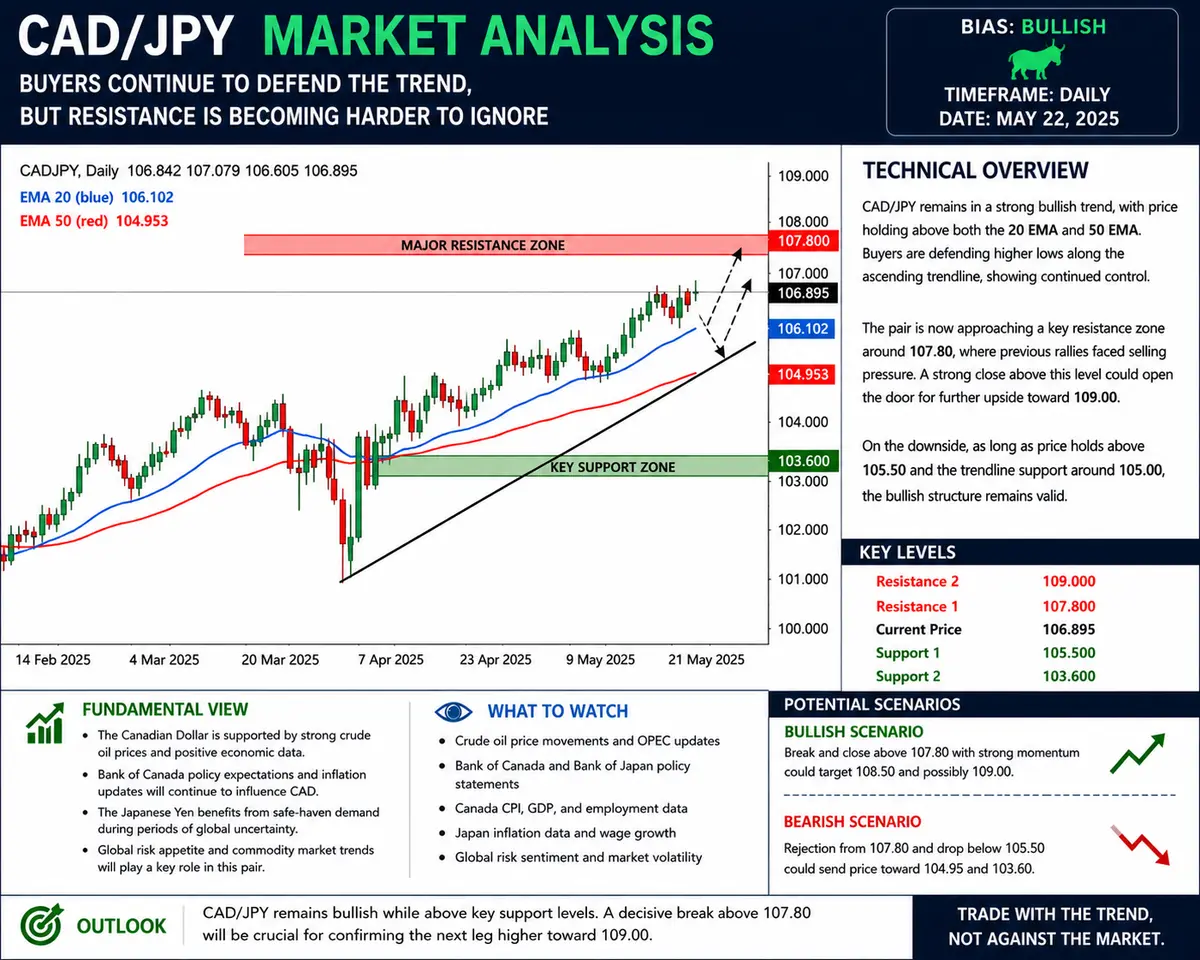
CAD/JPY: Buyers Continue to Defend the Trend, but Resistance Is Becoming Harder to Ignore

CAD/JPY: Buyers Continue to Defend the Trend, but Resistance Is Becoming Harder to Ignore

CAD/JPY has quietly maintained one of the healthiest bullish structures among the yen crosses over the past several trading sessions. While other currency pairs have experienced sharp swings and unpredictable reversals, this pair has advanced with discipline, respecting technical levels and giving traders a clear picture of where buyers continue to show confidence.

Looking at the current market structure, I still believe the buyers have the advantage. The sequence of higher highs and higher lows remains intact, recent pullbacks have been relatively shallow, and sellers have repeatedly failed to generate enough momentum to completely change the direction of the trend.

However, there is one important detail that cannot be ignored.

The market is now approaching a resistance zone that has previously slowed bullish momentum. Every strong trend eventually reaches an area where buyers begin questioning whether current prices still offer good value, while sellers become increasingly willing to challenge the rally. That is exactly where CAD/JPY appears to be trading today.

One aspect I find encouraging is how buyers have reacted during recent corrections. Every dip has attracted fresh demand before breaking the previous swing low. This tells me institutional buyers are still comfortable accumulating positions instead of waiting for significantly cheaper prices.

Healthy trends often reveal themselves through this type of behaviour.

The market doesn't need explosive rallies every day.

Instead, it consistently refuses to break down.

That has been one of the defining characteristics of CAD/JPY throughout the recent advance.

Resistance, though, introduces a different challenge.

Traders who entered near the beginning of the rally are now sitting on attractive profits. As price approaches previous highs, some of those traders naturally begin reducing exposure. At the same time, traders searching for reversal opportunities often become active around resistance because the potential reward appears more attractive.

This creates temporary...

Continue reading...
0
0
joy

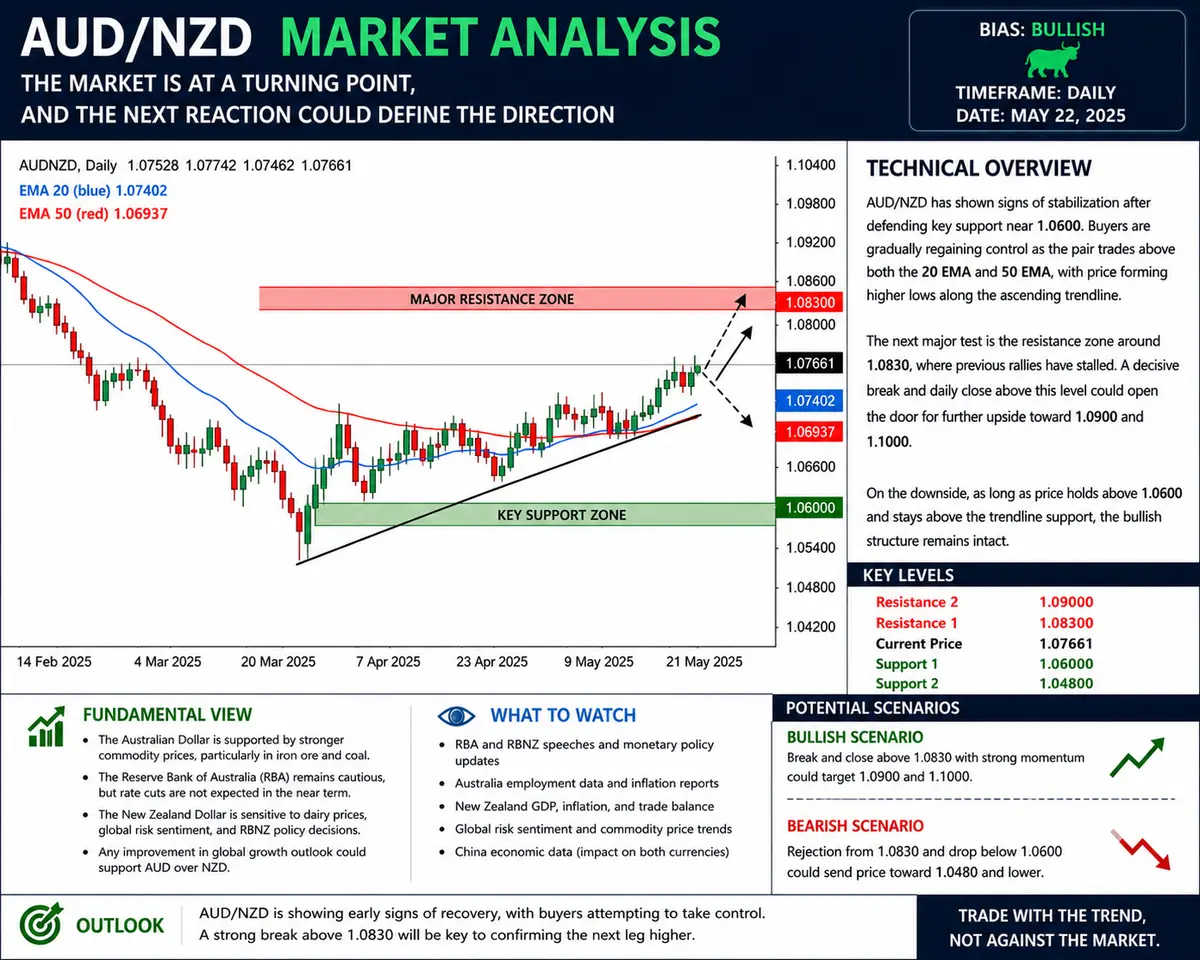
AUD/NZD: The Market Has Reached a Turning Point Where Patience Could Be More Valuable Than Speed

AUD/NZD: The Market Has Reached a Turning Point Where Patience Could Be More Valuable Than Speed

AUD/NZD has spent the last several trading sessions moving inside a structure that deserves close attention. Unlike highly volatile pairs that make dramatic moves every day, this market has been developing gradually, allowing traders enough time to study the relationship between buyers and sellers. Looking at the current chart, I believe the pair is approaching one of those important moments where the next reaction could shape the direction for the rest of the week.

The recent price action tells an interesting story.

After spending time under selling pressure, the market has started showing signs of stabilization. Sellers who previously controlled every rally are no longer pushing the pair lower with the same confidence. At the same time, buyers have not yet produced the type of aggressive breakout that would confirm complete control.

That leaves the market in balance.

And balance often comes before a major move.

One of the first things that caught my attention was the way support has behaved during the latest pullbacks. Instead of allowing price to create fresh lows, buyers have repeatedly stepped into the market at nearly the same technical area. That usually tells me larger participants believe the current price represents reasonable value.

Healthy reversals rarely begin with massive bullish candles.

More often, they begin with repeated failures from sellers to continue the previous trend.

That appears to be happening on AUD/NZD.

Another encouraging feature is that bearish momentum has clearly slowed. Earlier in the decline, every recovery was quickly rejected, and sellers controlled nearly every session. More recently, however, candles have become smaller, volatility has reduced and buyers are beginning to challenge bearish momentum more consistently.

This doesn't guarantee a new uptrend.

It simply tells me the previous bearish trend is losing some of its strength.

Resistance now becomes the market's biggest challenge.

...

Continue reading...
0
0
joy

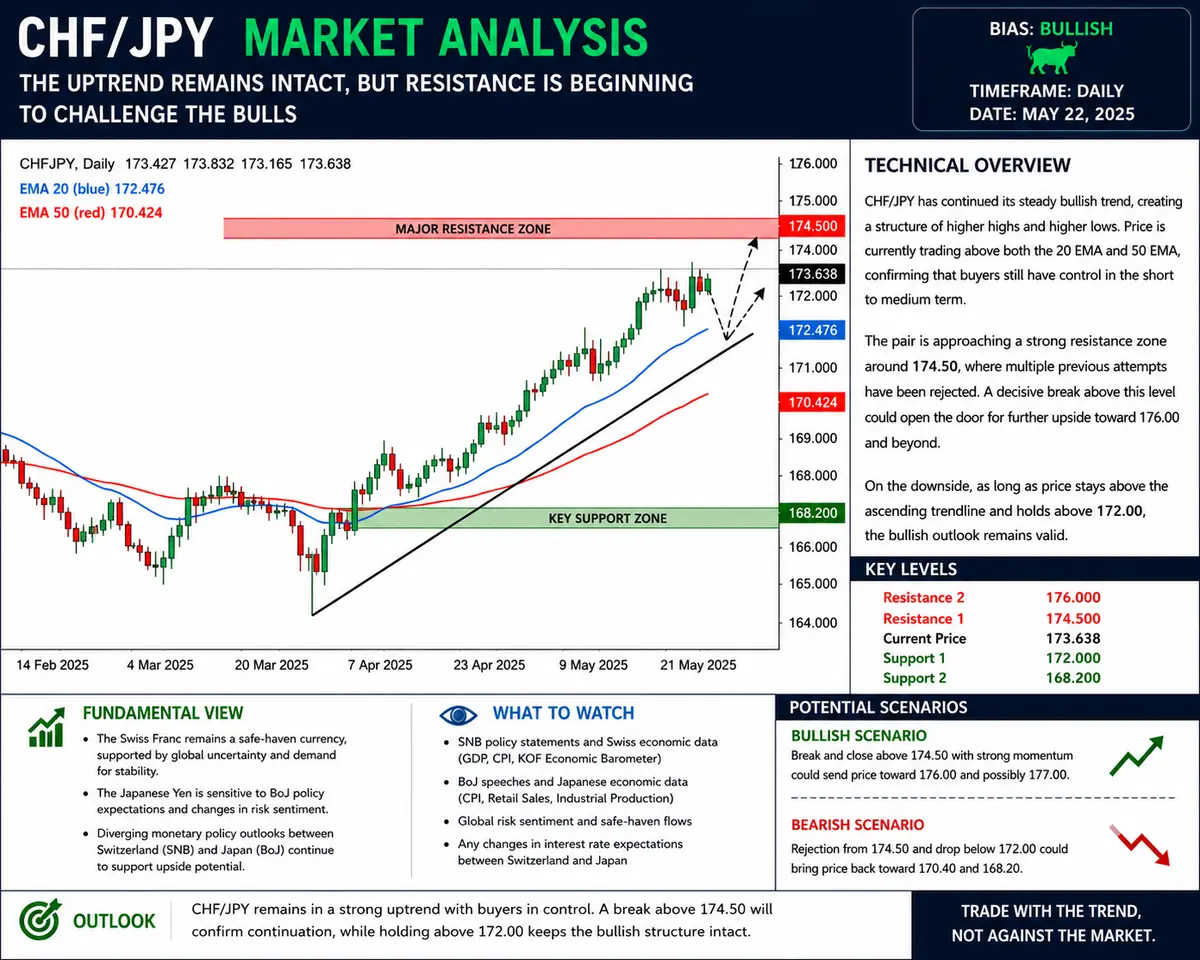
CHF/JPY: The Uptrend Is Still Healthy, but Resistance Is Beginning to Challenge the Bulls

CHF/JPY: The Uptrend Is Still Healthy, but Resistance Is Beginning to Challenge the Bulls

CHF/JPY has quietly become one of the strongest-performing yen crosses over the last several trading sessions. While many traders have focused on more volatile pairs, this market has continued building a disciplined bullish structure through a steady series of higher highs and higher lows. Instead of relying on explosive momentum, the pair has climbed with consistency, and that often creates trends that last much longer than emotional rallies.

Looking at the current chart, I still believe buyers have the advantage.

However, I also believe the market is approaching a stage where maintaining that advantage will become increasingly difficult.

The reason is simple.

The pair is now trading close to an important resistance area where previous buying momentum has slowed several times before. These levels naturally attract attention because traders who entered much lower begin thinking about protecting profits, while sellers become more willing to challenge the existing trend.

That creates a temporary balance between supply and demand.

One detail that immediately caught my attention is how well buyers have defended every recent pullback. Rather than allowing price to break below previous swing lows, they have consistently stepped into the market early, preventing sellers from changing the overall structure.

That behaviour tells me confidence remains healthy.

Healthy trends rarely avoid pullbacks.

Instead, they recover from them quickly.

CHF/JPY has continued showing exactly that characteristic.

Even though momentum has slowed slightly near resistance, buyers continue refusing to surrender meaningful ground. Every correction has remained relatively shallow, allowing the broader bullish structure to remain intact.

That is an encouraging sign.

Resistance, however, deserves respect.

Markets often become most unpredictable after extended rallies because optimism reaches its highest level precisely when profit-taking begins increasing. Traders who have enjoyed strong gains naturally become more cautious as price approaches previous highs.

This doesn't mean the trend...

Continue reading...
0
0
joy

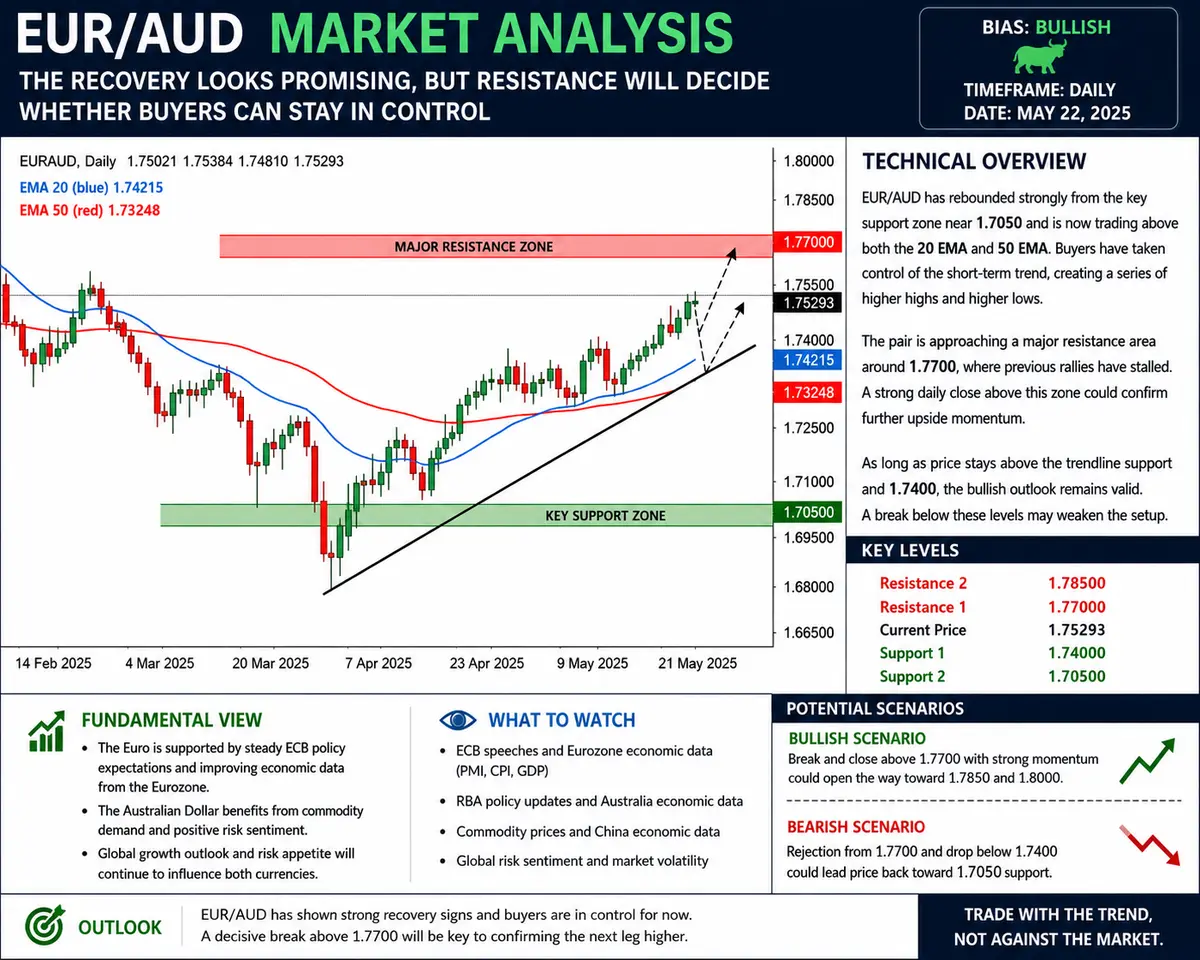
EUR/AUD: The Recovery Looks Promising, but Resistance Will Decide Whether Buyers Can Stay in Control

EUR/AUD: The Recovery Looks Promising, but Resistance Will Decide Whether Buyers Can Stay in Control

EUR/AUD has gradually transformed from a market dominated by uncertainty into one that is beginning to attract renewed buying interest. The recent price action has been noticeably different from what traders experienced during the previous decline. Instead of producing lower lows with strong bearish momentum, the pair has started building a more balanced structure, suggesting that sellers are no longer enjoying the same level of control.

That doesn't automatically mean the market has become bullish.

It simply means the balance between buyers and sellers is changing.

For traders, those transition periods are often the most interesting because they reveal whether a genuine trend reversal is developing or whether the recent recovery is simply another temporary correction before the larger trend resumes.

Looking at the chart, one feature immediately stands out.

Every recent pullback has become shallower than the one before it. Buyers are stepping into the market earlier, refusing to allow sellers to drive price back toward previous lows. That behaviour usually reflects growing confidence rather than emotional buying.

Healthy recoveries rarely happen overnight.

They are normally built through repeated higher lows, improving momentum and increasing willingness from buyers to defend important support levels.

EUR/AUD appears to be following that pattern.

The current support zone has already demonstrated its importance several times. Whenever price has drifted lower, buying pressure has returned before the market structure could be damaged. Institutions often pay close attention to these areas because they represent attractive locations to build positions without chasing higher prices.

As long as support continues holding, buyers remain in a relatively comfortable position.

Resistance, however, is becoming the next major obstacle.

The market is approaching an area where previous rallies have struggled to continue. This naturally creates hesitation because traders who bought near recent lows begin protecting profits, while sellers attempt to...

Continue reading...
0
0
GFATHER

USDCAD: The Selling Has Been Relentless, but Is Support Finally Ready to Fight Back?

USDCAD ... USDCAD: The Selling Has Been Relentless, but Is Support Finally Ready to Fight Back?

There comes a point in almost every trend where the chart starts asking a different question. At first, the only thing that matters is direction. Then, after days of steady movement, the focus shifts from "Where is the market going?" to "Has this move gone far enough?" That is exactly where I think USDCAD finds itself at the moment.

For several sessions, sellers have controlled the pace. Every recovery has struggled to build momentum, and every attempt by buyers has been met with fresh selling. Looking only at the recent candles, it's easy to understand why many traders remain bearish. The path of least resistance has clearly been lower.

But markets have a habit of changing character when most people become comfortable with the current trend.

The reason I'm paying close attention now is because price has finally reached a support area that has mattered before. This isn't just another random level on the chart. It's a zone where buyers previously found enough confidence to slow the decline and push the pair higher. Whether that happens again is impossible to know in advance, but I don't think it's a level that should be ignored.

One mistake traders often make after a prolonged sell-off is assuming the next candle has to follow the same direction. Trends can be powerful, but they don't move forever without stopping. Even the strongest bearish markets need periods of rest. Those pauses can last a few hours, a few days or even longer before the next meaningful move begins.

What interests me most isn't simply the support level itself. It's how the market behaves after reaching it.

If sellers were still completely in control, I would expect price to break through...

Continue reading...
0
0
GFATHER

GBP/JPY: After Three Failed Sell-Offs, Are Buyers Finally Ready to Take Control This Week?

GBP/JPY: After Three Failed Sell-Offs, Are Buyers Finally Ready to Take Control This Week?

GBPJPY ... GBP/JPY: After Three Failed Sell-Offs, Are Buyers Finally Ready to Take Control This Week?

Every chart tells a story, but GBP/JPY has been writing one of the more interesting stories over the past several weeks. At first glance, someone looking only at the previous weekly candles might assume the pair was preparing for a deeper correction. Sellers had managed to push the market lower on several occasions, and bearish momentum appeared convincing. Yet each time the market looked ready to break down, something changed.

Buyers returned, the selling pressure faded, and what initially looked like the beginning of a larger decline became another rejection from lower prices.

That's the pattern that keeps catching my attention.

This isn't just one bounce. It's a series of failed attempts by sellers to keep control of the market. Every rejection from lower levels tells us the same thing: there is still demand waiting underneath the market. Whether that demand is strong enough to drive another strong rally is the question traders are trying to answer this week.

Looking at the recent structure, the market has started creating a rhythm. Price falls, buyers respond, resistance slows the recovery, another pullback develops, and then buyers step back in again. When this happens repeatedly, it often suggests that larger participants are still interested in accumulating positions instead of abandoning them. Markets rarely move in a straight line, and healthy trends often include exactly this kind of back-and-forth movement.

One thing I find encouraging is that each rejection from the downside has happened before sellers could establish complete control. If bears were truly dominating, we would expect to see strong follow-through after each bearish candle. Instead, many of those moves have been erased surprisingly quickly. That tells me selling pressure has not been consistent enough to change...

Continue reading...
0
0
GFATHER

USD/JPY Weekly Market Analysis: Dollar and Yen Battle as Traders Focus on Central Bank Expectations

USD/JPY Weekly Market Analysis: Dollar Strength Faces Yen Resilience Ahead of a Critical Trading Week

The past trading week proved to be another highly active period for USD/JPY as traders navigated a complex mix of economic data, central bank expectations, Treasury yield movements, and shifting global risk sentiment. As one of the most closely watched currency pairs in the forex market, USD/JPY continued to react sharply to every major economic release from both the United States and Japan. While the U.S. dollar retained support from relatively strong economic fundamentals, the Japanese yen remained resilient whenever investors sought the safety of lower-risk assets. This ongoing battle between the two currencies resulted in increased volatility and several significant price swings throughout the week.

Trading began with buyers attempting to extend the previous week's bullish momentum after encouraging U.S. economic reports reinforced expectations that the Federal Reserve may maintain a restrictive monetary policy for longer than previously anticipated. Strong employment figures, resilient consumer spending, and steady inflation expectations continued to support the U.S. dollar. Higher Treasury yields also increased the attractiveness of dollar-denominated assets, encouraging institutional investors to maintain long positions against lower-yielding currencies such as the Japanese yen.

However, the market was far from one-sided. Throughout the week, periods of uncertainty across global financial markets increased demand for traditional safe-haven assets, including the Japanese yen. Whenever investor confidence weakened due to geopolitical developments or concerns surrounding global economic growth, USD/JPY experienced sharp intraday pullbacks as traders temporarily shifted capital into the yen. These alternating waves of optimism and caution created a balanced yet highly volatile trading environment.

From a fundamental perspective, traders continued to monitor developments surrounding the Federal Reserve and the Bank of Japan. While the Federal Reserve remains focused on controlling inflation and maintaining price stability, market participants are also...

Continue reading...
0
0
GFATHER

GBP/USD Weekly Market Analysis: Sterling Holds Firm as Traders Await Fresh Market Catalysts

As always, traders should combine technical analysis with fundamental developments and disciplined risk management rather than relying solely on predictions.

GBP/USD Weekly Market Analysis: Sterling Holds Firm as Traders Await Fresh Market Catalysts

The past trading week was another dynamic period for GBP/USD as traders responded to economic data releases, central bank expectations, and shifts in global market sentiment. The currency pair experienced periods of heightened volatility as investors weighed the outlook for the Bank of England against expectations surrounding future Federal Reserve policy. While the British pound demonstrated resilience throughout the week, the strength of the U.S. dollar continued to create resistance against sustained bullish momentum.

The week began with GBP/USD trading within a relatively balanced range as buyers and sellers searched for direction. Positive economic indicators from the United Kingdom provided intermittent support for sterling, while stronger U.S. economic data and firm Treasury yields boosted demand for the U.S. dollar. This tug-of-war between the two currencies resulted in several sharp intraday price swings but no decisive breakout.

As the week progressed, traders closely monitored inflation figures, employment reports, retail sales data, and comments from policymakers on both sides of the Atlantic. Every major economic release influenced expectations for future interest rate decisions, creating temporary surges in volatility. Despite these fluctuations, buyers continued to defend important support levels, preventing a broader bearish reversal and keeping the pair within a constructive trading structure.

From a technical perspective, GBP/USD remains in an important consolidation phase. The broader market structure shows signs of stability, although momentum indicators suggest that buying pressure has moderated. Price action is approaching key technical levels where either buyers could regain control and extend the trend higher or sellers could trigger a deeper correction.

Looking ahead to next week, traders should prepare for another week of elevated volatility....

Continue reading...
0
0
Navigation menu
instaforex banner