

CAD/JPY: Buyers Continue to Defend the Trend, but Resistance Is Becoming Harder to Ignore
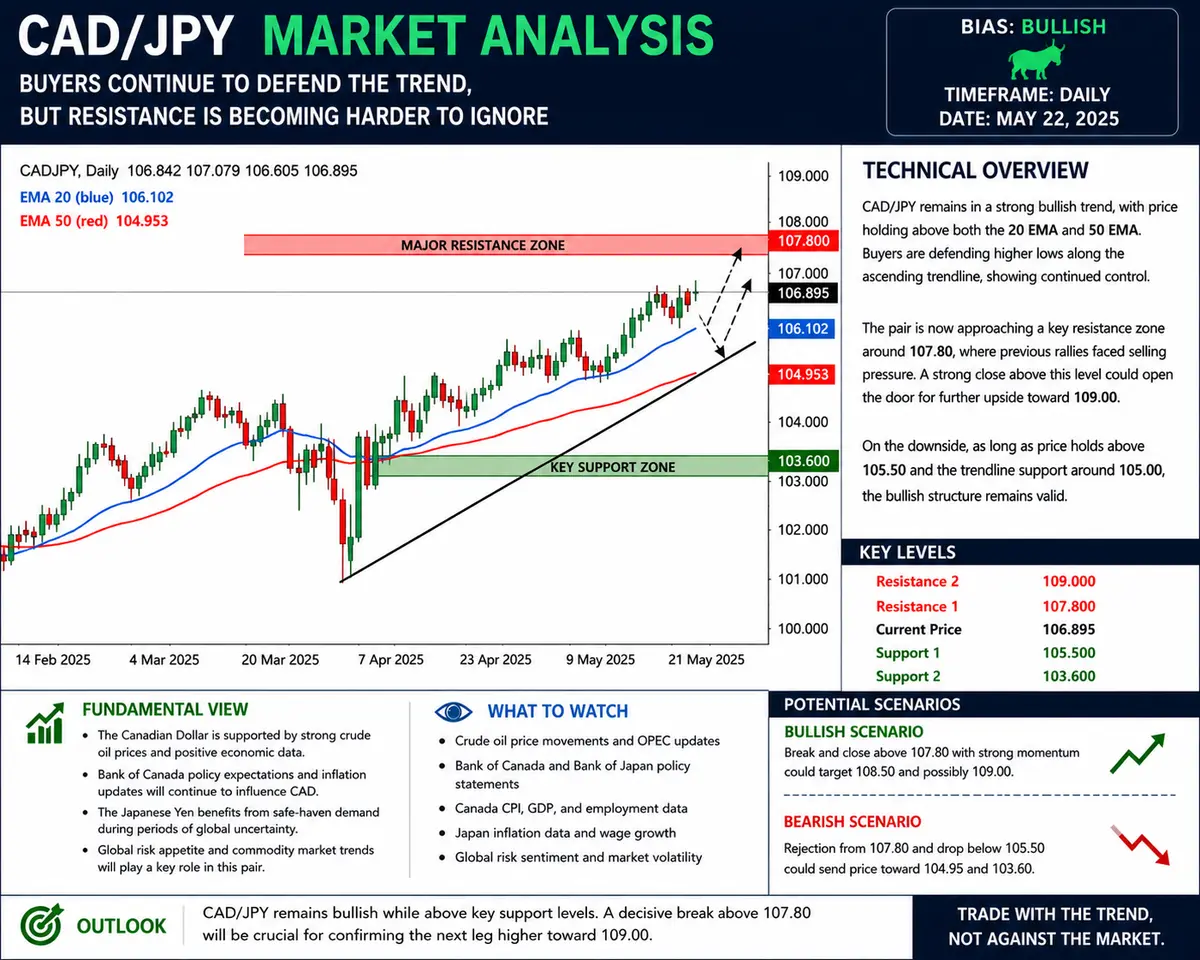
CAD/JPY has quietly maintained one of the healthiest bullish structures among the yen crosses over the past several trading sessions. While other currency pairs have experienced sharp swings and unpredictable reversals, this pair has advanced with discipline, respecting technical levels and giving traders a clear picture of where buyers continue to show confidence.
Looking at the current market structure, I still believe the buyers have the advantage. The sequence of higher highs and higher lows remains intact, recent pullbacks have been relatively shallow, and sellers have repeatedly failed to generate enough momentum to completely change the direction of the trend.
However, there is one important detail that cannot be ignored.
The market is now approaching a resistance zone that has previously slowed bullish momentum. Every strong trend eventually reaches an area where buyers begin questioning whether current prices still offer good value, while sellers become increasingly willing to challenge the rally. That is exactly where CAD/JPY appears to be trading today.
One aspect I find encouraging is how buyers have reacted during recent corrections. Every dip has attracted fresh demand before breaking the previous swing low. This tells me institutional buyers are still comfortable accumulating positions instead of waiting for significantly cheaper prices.
Healthy trends often reveal themselves through this type of behaviour.
The market doesn’t need explosive rallies every day.
Instead, it consistently refuses to break down.
That has been one of the defining characteristics of CAD/JPY throughout the recent advance.
Resistance, though, introduces a different challenge.
Traders who entered near the beginning of the rally are now sitting on attractive profits. As price approaches previous highs, some of those traders naturally begin reducing exposure. At the same time, traders searching for reversal opportunities often become active around resistance because the potential reward appears more attractive.
This creates temporary selling pressure.
That pressure doesn’t automatically signal a reversal.
It simply forces buyers to prove that fresh demand still exists.
Looking beyond technical analysis, both currencies continue responding to different economic forces.
The Canadian dollar remains closely linked to crude oil prices because energy exports play an important role in Canada’s economy. When oil prices strengthen, the Canadian dollar often receives additional support. Strong domestic economic data and Bank of Canada policy expectations can also influence the currency’s performance.
The Japanese yen follows a very different path.
As one of the world’s traditional safe-haven currencies, the yen often strengthens during periods of market uncertainty. Whenever investors become defensive, demand for the yen frequently increases, creating pressure on many JPY crosses.
That relationship makes CADJPY ... particularly sensitive to global market sentiment.
If investor confidence remains strong and commodity markets stay supported, the Canadian dollar may continue outperforming the yen.
If risk appetite weakens, demand for the yen could increase, slowing the current bullish trend.
From a technical standpoint, I also notice that recent candles continue closing above important support despite the slower momentum. Buyers have not surrendered meaningful territory, suggesting confidence remains relatively healthy.
Momentum has cooled slightly.
But slowing momentum after a prolonged rally should not automatically be interpreted as weakness.
Financial markets often consolidate before attempting another breakout.
Without these periods of rest, strong trends frequently become unstable and vulnerable to deeper corrections.
Volume could become the deciding factor over the next few sessions.
If buyers successfully push above resistance while trading activity increases, confidence in the breakout would improve significantly because stronger participation often reflects institutional buying.
If price breaks higher without meaningful volume, I would remain cautious because weak breakouts frequently fail after attracting late buyers.
Psychology also plays an important role.
Many traders now expect every pullback to become another buying opportunity because that strategy has worked repeatedly throughout the recent trend. While that expectation remains understandable, markets have a habit of testing confidence before rewarding it again.
The current resistance zone may become exactly that test.
My View
Based on the present market structure, I continue leaning toward the bullish side. Buyers remain in control of the broader trend, higher lows continue holding, and sellers have not yet produced convincing evidence that a long-term reversal has begun.
That said, I believe patience is becoming increasingly important.
The market has reached a technical area where confirmation matters much more than prediction.
If buyers produce strong daily closes above resistance while maintaining healthy momentum and increasing participation, I believe CAD/JPY has room to continue extending its broader uptrend over the coming sessions.
If resistance rejects price once again and lower highs begin developing before nearby support eventually breaks, I would expect a deeper correction before buyers attempt another sustained advance.
For now, my outlook remains cautiously bullish. The trend still favours the buyers, but successful trends are not measured by how quickly they rise—they are measured by how well they defend themselves when challenged. CAD/JPY is approaching one of those defining moments, and the market’s reaction around current resistance will likely determine whether the next chapter brings another breakout or a healthy period of consolidation before the trend resumes.

Comments
No comments yet. Be the first to share your thoughts!
Authentication Required
You must be logged in to post a comment.