

Buy and Sell: Two Buttons That Control the World (and My Nerves)

Hi, this is NorthRay.
Remember how in my first post I was afraid to press “New Order”?
I sat there staring at the terminal thinking:
“Should I buy or sell? What if I click the wrong thing? What if I choose incorrectly and get arrested?”
Spoiler: you won’t get arrested.
But back then, those two buttons — Buy and Sell — felt like magic to me. I didn’t understand what they did. I was just clicking randomly.
Then I figured it out.
And now I’ll explain it so simply that even my grandma would understand (she still doesn’t get why I stare at charts all day, but at least now she knows what the buttons mean).
What Buy Means in Simple Terms
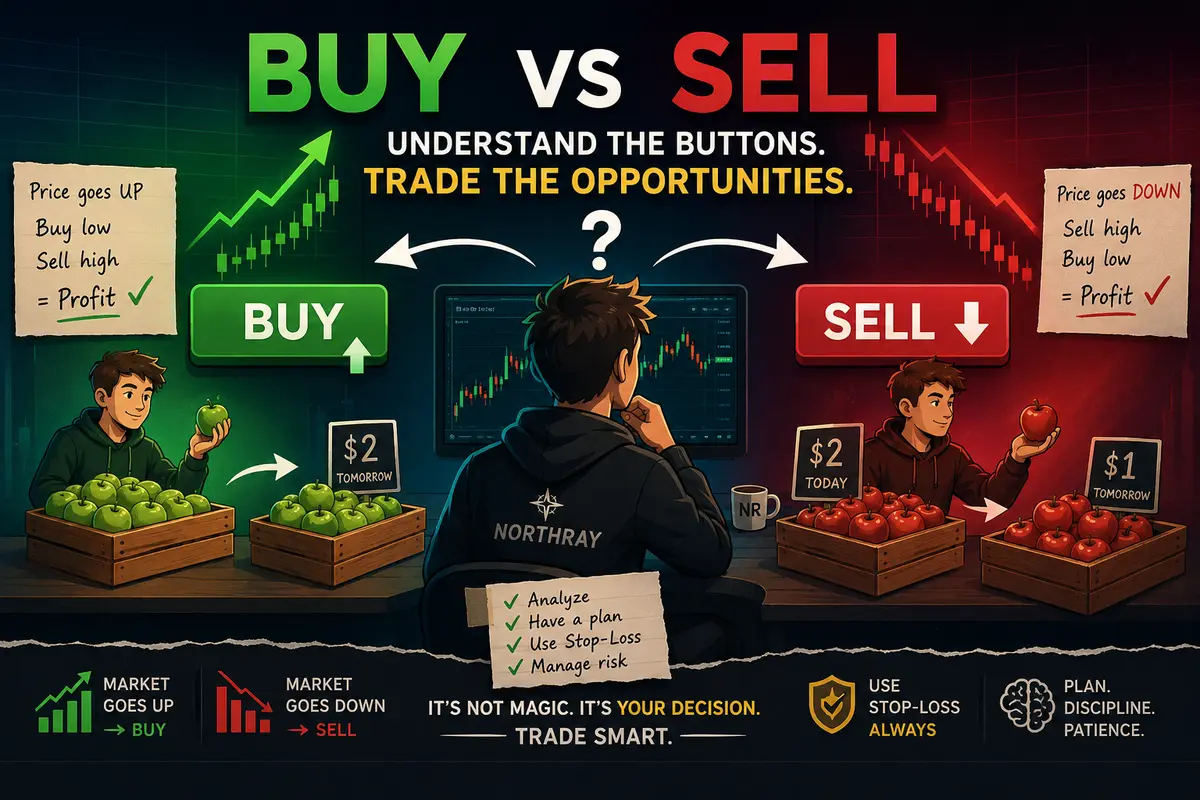
Buy means buying. You’re betting that the price will go UP.
Simple example:
Imagine you’re at an apple market.
Today, an apple costs $1.
You think:
“Tomorrow apples will cost $2.”
So you buy an apple now for $1.
Tomorrow the price becomes $2.
You sell the apple. Your profit is $1.
That’s Buy.
You bought cheap and sold expensive.
Trading works the same way:
— You open a Buy trade.
— The price goes up.
— You close the trade and keep the difference.
When to press Buy:
When you think the price will rise.
What Sell Means in Simple Terms
Sell means selling. But not the usual kind. Here, you sell something you don’t actually own yet.
Sounds weird? Let me explain.
Simple example:
You’re at the same apple market.
Today, an apple costs $2.
You think:
“Tomorrow apples will drop to $1.”
You don’t have any apples. But the broker says:
“I’ll lend you an apple. Sell it now for $2. Tomorrow, buy a cheaper apple for $1 and return it to me.”
So you sell the borrowed apple for $2.
Tomorrow the price falls to $1.
You buy the apple for $1 and return it to the broker.
Your profit is $1.
That’s Sell.
You sold high and bought low.
Trading works the same way:
— You open a Sell trade.
— The price falls.
— You close the trade and keep the difference.
When to press Sell:
When you think the price will fall.
The Main Magic: You Can Make Money Both on Rising and Falling Markets
In normal life, you usually buy something only if you think it will become more expensive.
In trading, you can profit in either direction:
— Price goes up → open Buy → make money.
— Price goes down → open Sell → make money.
The market doesn’t care which direction it moves. And honestly, neither should you. The important thing is guessing the direction correctly.
Example from my own trading:
Last week I was watching EUR/USD. It looked too high to me, and I thought it would drop soon.
I opened a Sell trade.
The price dropped 20 pips.
I closed the trade. Profit was mine.
If I had been wrong and the price went up instead, I would’ve taken a loss. But that’s the whole point: you never know for sure. You make an assumption. And you use a stop-loss in case you’re wrong.
How to Open Buy and Sell Trades (Step by Step)
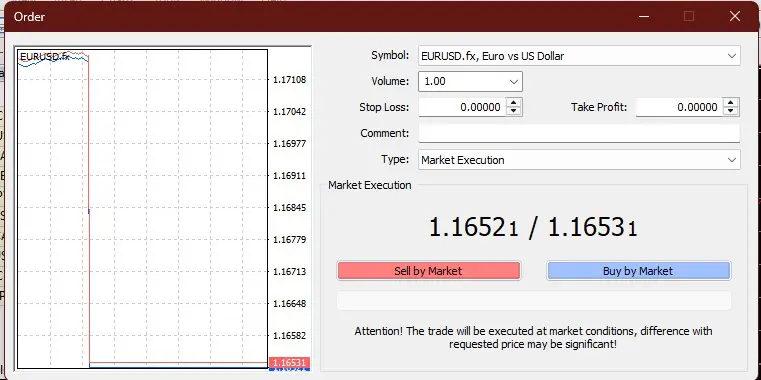
In MetaTrader 4 (and most other platforms), everything is basically the same.
To Open a Buy Trade:
-
Right-click on the chart.
-
Select “Trading” → “New Order.”
-
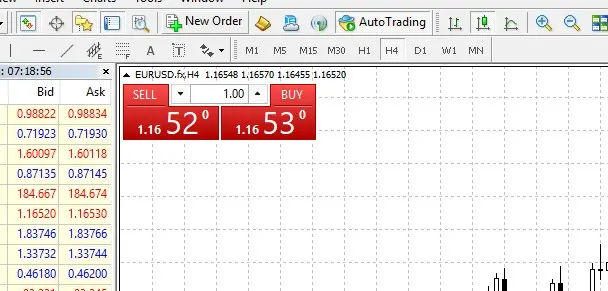
In the “Type” field, choose Buy (or just click the green Buy button on the toolbar).
-
Choose your trade size (lot). I started with 0.01.
-
(Optional) Set a stop-loss and take-profit.
-
Click “Place Order.”
That’s it. You bought. You’re hoping for the price to rise.
To Open a Sell Trade:
-
Same process, but choose Sell (usually the red button).
-
Everything else stays the same.
That’s it. You sold. You’re hoping for the price to fall.
What I See on My Screen After Opening a Trade
When I open a trade, a line appears in the terminal showing:
— Volume: 0.50 (how many lots).
— Open price: the price where I entered.
— Current price: the live market price.
— Profit: a green number if I’m winning, red if I’m losing.
If the trade is green — I’m doing great (for now).
If it’s red — the market is against me. Or I was wrong.
And most importantly: nobody is going to arrest me for choosing the wrong button.
My Dumbest Buy/Sell Mistake
When I first started, I thought:
“If I open Buy, the price will definitely go up. If I open Sell, it’ll definitely go down. Makes sense, right?”
The logic made sense.
But the market doesn’t have to follow my logic.
One time I was sure EUR/USD would rise. I opened a Buy trade. The price dropped. I didn’t set a stop-loss because I thought:
“It’ll turn around any minute now.”
It didn’t.
I lost 200 virtual dollars on my demo account.
That’s when I realized:
Buy and Sell are not magic buttons. They’re just your opinion. And the market has every right to disagree with you.
That’s exactly why stop-losses matter. And why you should never bet everything on one trade.
When I Open Buy and When I Open Sell — Nowadays
I still don’t have some magical super-strategy. But I’ve developed a few simple rules:
— Buy: When the price reaches a support level (the lower boundary) and bounces upward. Or when there’s a clear uptrend.
— Sell: When the price reaches a resistance level (the upper boundary) and bounces downward. Or when there’s a clear downtrend.
I don’t open trades randomly anymore.
I watch the chart. I wait for a clear signal. Only then do I press the button.
Sometimes I’m wrong. Sometimes I’m right.
But every trade teaches me something.
The Main Takeaway
Buy = you’re betting on growth.
Sell = you’re betting on decline.
Both are valid. The only question is where the market goes next.
You do not need to be right in 100% of your trades. Nobody is right all the time.
But you do need to understand:
which button you’re pressing — and why.
If you open a Buy because you “feel like it,” that’s gambling.
If you open a Buy because your strategy gave you a signal, that’s trading.
I’m still at the beginning of my journey. I still make mistakes. But now I understand the difference between these two buttons. And I’m no longer afraid to press them.
What’s Next
— Continuing to test trades with 1.0 lot (I promised a report — it’s coming soon).
— Learning to read Buy and Sell signals better.
— Posting here when things go well — and when they don’t.
If you were also afraid of those two buttons — don’t be anymore. They don’t bite.
Just remember:
Want the market to go up? → Buy.
Want the market to go down? → Sell.
But always use a stop-loss.
Because the market loves jokes.
— Your NorthRay
(who opened a Sell trade today because the price looked too high — let’s see who wins)

Comments
No comments yet. Be the first to share your thoughts!
Authentication Required
You must be logged in to post a comment.