

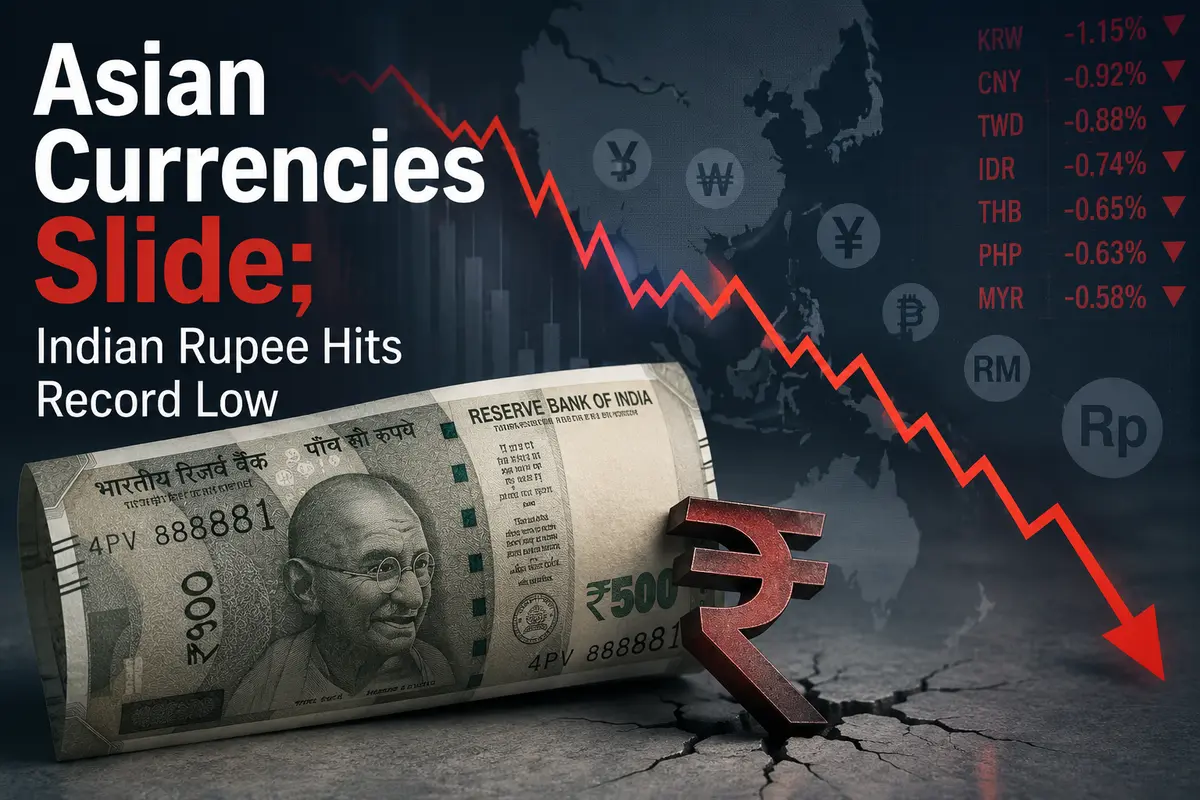
Asian Currencies Slide; Indian Rupee Hits Record Low

Asian currencies head for weekly losses
Asian currencies once again came under heavy pressure, and the current situation can no longer be described as an ordinary short-term correction. The market environment is developing in such a way that the U.S. dollar is receiving support from several directions at once: strong economic data from the United States, rising Treasury yields, expectations of a hawkish Federal Reserve stance, and growing nervousness across global markets. Against this backdrop, emerging Asian currencies are losing stability, while some — such as the Indian rupee — are falling to historic lows.
The rupee is especially symbolic in this situation. For India, an exchange rate approaching 96 rupees per dollar is not just an unpleasant figure on a currency screen. It reflects several deep structural problems at once: expensive oil, dependence on foreign capital, and growing pressure on the country’s trade balance. India imports enormous volumes of energy resources, and when oil prices surge, the economy begins burning through foreign exchange reserves much faster than usual. The higher oil climbs, the more dollars are needed for imports. And if foreign investors simultaneously begin pulling money out of Indian markets, pressure on the national currency intensifies dramatically.
That is exactly the combination now unfolding. Rising tensions in the Middle East have increased fears of disruptions in the Strait of Hormuz — one of the world’s most important energy transit routes. Any threat to supply immediately pushes oil prices higher. For exporting nations this can be beneficial, but for major importers such as India, South Korea, and Japan, it becomes a serious economic burden.
However, oil is only part of the story. The main driver behind the dollar’s strength is still the United States. The American economy continues to show remarkable resilience despite years of elevated interest rates. Markets had expected gradual cooling in economic activity and eventual preparation for monetary easing by the Federal Reserve. Instead, recent data shattered those expectations.
Retail sales in the U.S. continue to rise, the labor market remains solid, and inflation is once again showing signs of acceleration. This matters enormously because only a few months ago investors were convinced that the Fed would begin cutting rates this year. Now the situation has changed almost completely. Some market participants are even discussing the possibility of another rate hike rather than cuts.
For currency markets, this shift is critical. High U.S. interest rates make American assets far more attractive to global investors. Capital naturally flows toward U.S. bonds offering strong yields with relatively low risk. As a result, money is moving out of developing economies and back into dollar-denominated assets. That is why Asian currencies, along with many currencies in Latin America and other emerging regions, are weakening.
The U.S. Dollar Index has now risen for five consecutive sessions, and such sustained momentum almost always creates problems for weaker currencies — especially for countries with trade deficits or heavy dependence on foreign financing. India appears particularly vulnerable in this environment.
The situation is becoming even more complicated because Asian central banks are now trapped in an uncomfortable position. On one hand, they need to support economic growth, which has been slowing across the region. On the other hand, excessively loose monetary policy could accelerate currency depreciation. Raising rates might strengthen local currencies, but it would also hurt lending, investment, and domestic demand.
Japan represents a separate but equally important case. The yen remains under constant pressure because of the enormous interest rate gap between the United States and Japan. While the Federal Reserve keeps rates elevated, the Bank of Japan is only cautiously moving away from decades of ultra-loose policy. As a result, the dollar continues to offer significantly better returns than the yen, pushing USD/JPY higher once again.
At the same time, Japanese authorities are increasingly hinting at possible currency intervention. For Tokyo, an excessively weak yen is becoming a political problem. Exporters benefit from depreciation, but households face rising prices for imports, fuel, and food. Real incomes are declining, and inflation has become a painful issue for a society that lived with near-zero price growth for decades.
The South Korean won is also under significant pressure. South Korea depends heavily on global trade and remains extremely sensitive to changes in worldwide demand for electronics and industrial goods. Whenever uncertainty rises globally, investors tend to move away from riskier assets, causing currencies such as the won to weaken rapidly.
The Australian dollar has also fallen despite Australia’s relatively stable economy. The reason lies in the country’s strong dependence on China. Any doubts surrounding Chinese economic growth automatically weigh on the Australian currency because China remains Australia’s largest trading partner.
Trump-Xi talks in focus as Asian currencies remain under pressure
Against this backdrop, global attention is fixed on talks between Donald Trump and Xi Jinping in Beijing. Investors are trying to determine whether the two sides can at least partially reduce tensions between the world’s two largest economies. So far, the signals remain mixed.
On one hand, both sides continue speaking about progress in negotiations and maintaining dialogue. China is demonstrating interest in stable relations, while the United States wants to preserve trade flows and maintain control over inflation. At the same time, highly sensitive issues remain unresolved — Taiwan, technological rivalry, restrictions on semiconductor exports, and the broader struggle for influence across Asia.
Xi Jinping’s warning that the Taiwan issue could push bilateral relations into a “dangerous place” highlights the reality that strategic rivalry between Washington and Beijing has not disappeared. Markets understand that even if the two sides reach agreements on certain trade matters, the broader geopolitical competition between the U.S. and China will remain.
Additional anxiety has been fueled by Trump’s rhetoric toward Iran. Tough statements regarding the Middle East immediately increase fears of new conflicts and disruptions in oil supplies. That, in turn, further supports the dollar while increasing pressure on Asian currencies.
Interestingly, the Chinese yuan has appeared somewhat more stable than several other regional currencies. The reason is that investors still hope for at least some progress in U.S.-China relations. Nevertheless, even the yuan cannot fully resist the broader strength of the dollar.
Indian rupee hits historic low near 96 per dollar
Overall, the current situation demonstrates how deeply the global financial system still depends on the United States and Federal Reserve policy. Despite ongoing discussions about de-dollarization, China’s growing influence, and the transition toward a multipolar economic system, it is still the U.S. interest rate and the American dollar that determine the direction of global markets.
For Asia, this signals a difficult period ahead. If inflation in the United States remains elevated, the Federal Reserve maintains its hawkish stance, and oil prices continue rising, pressure on regional currencies could intensify further. Countries with high energy import dependence and reliance on foreign capital are likely to face the greatest challenges.
In this context, the Indian rupee has become a symbol of the broader problem. Its decline is not an isolated event, but rather a reflection of deeper global forces: expensive dollar funding, geopolitical instability, competition over global supply chains, and investor anxiety that traditionally drives capital into the U.S. dollar as the world’s primary safe-haven asset during periods of uncertainty.

Comments
No comments yet. Be the first to share your thoughts!
Authentication Required
You must be logged in to post a comment.