

USD/MXN – Nearshoring Capital Capex, Inelastic Remittance Anchor, and Banxico Carry Mechanics
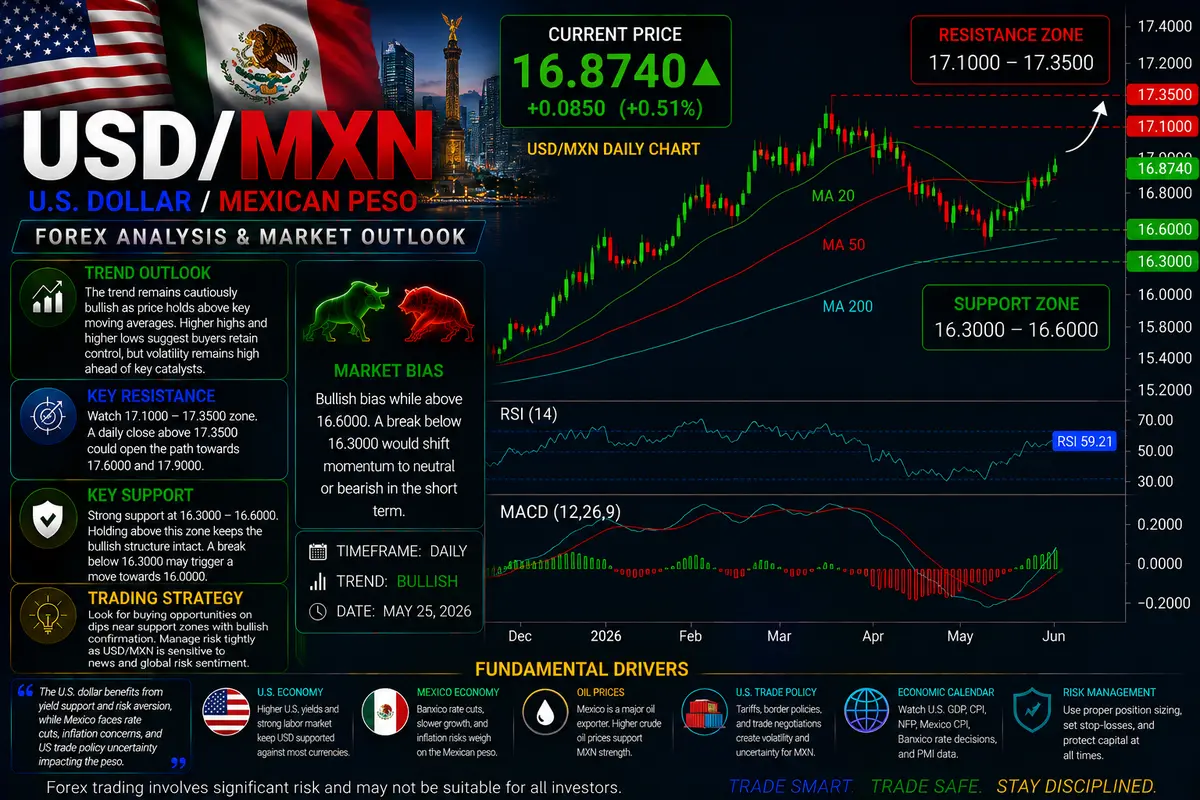
If you ask anyone running an emerging market FX desk where the real institutional volume is in Latin America, they will point you straight to the Mexican Peso. USD/MXN isn’t just another regional cross. It’s the most liquid currency pair in the Americas outside of the USD and CAD, serving as both a benchmark for global risk sentiment and a primary vehicle for yield-seeking capital.
What makes the Peso fascinating to trade right now is the tug-of-war between structural real-money inflows and short-term speculative carry positioning. To understand where this pair is heading over any meaningful horizon, you have to look past basic chart patterns and break down three specific economic forces: the industrial footprint of nearshoring, the constant buffer of family remittances, and the rate mechanics driving Banxico’s yield curve.
The Nearshoring Shift: Real Capital, Not Just Headlines
For decades, North American supply chains relied on long ocean routes from East Asia. But recent global trade frictions and logistics bottlenecks forced a massive structural pivot. Global manufacturing has been aggressively relocating capacity directly into northern and central Mexico—a trend widely known as nearshoring.
From an FX order book perspective, nearshoring translates into persistent, multi-year selling of US Dollars against the Peso:
-
Long-Term Capex Flows: When a international automaker, electronics manufacturer, or industrial firm builds a new facility in hubs like Monterrey, Saltillo, or Querétaro, they bring hard currency in Dollars. To pay for land acquisition, municipal permits, local construction contractors, and ongoing factory payroll, those corporate treasuries have to convert USD into MXN on spot desks.
-
Sticky Money: Unlike hot-money portfolio flows that enter and exit through liquid bond markets overnight, foreign direct investment in physical plants and equipment is illiquid and long-term. This ongoing conversion stream creates a structural floor beneath the Peso, dampening long-term upward spikes in USDMXN ... .
Remittances: The Unconditional Dollar Inflow
While corporate capital expenditure drives the industrial side of the balance sheet, family remittances provide an incredible structural cushion for the Mexican economy.
Mexican workers living in the United States remit upwards of $60 billion back home every year. For macro traders, the critical detail about remittance flow is its complete lack of price sensitivity:
-
Counter-Cyclical Stabilizer: Remittances represent survival capital for households. When global markets panic and USD/MXN surges higher, the purchasing power of the Dollar expands in local currency terms. Rather than slowing down, remittance transfers often increase during currency sell-offs as workers take advantage of favorable conversion rates to send money back home.
-
Constant Spot Conversions: These funds flow through digital money transfer networks and retail bank channels, where liquidity providers continuously convert high volumes of small-ticket Dollar transactions into Pesos every single business day.
This steady, non-discretionary flow provides a baseline supply of Dollars that continuously absorbs local Peso selling, preventing USD/MXN from staying oversold for long periods without a massive fundamental catalyst.
Banxico Mechanics and the Yield Arbitrage
While nearshoring and remittances establish the long-term structural trend, interest rate spreads determine where the pair trades week-to-week.
Banco de México (Banxico) has historically maintained a staunchly hawkish reputation. To keep domestic inflation in check and protect international credibility, Banxico routinely holds its policy rate significantly higher than the US Federal Reserve.
This wide interest rate gap creates the classic FX carry trade:
-
Collecting Swap Points: Global hedge funds and institutional asset managers borrow Dollars at lower interest rates, sell USD/MXN on the spot market, and park the proceeds in high-yielding Mexican government bills (Cetes). Because forward rates reflect this interest differential, traders holding short USD/MXN positions collect positive overnight rollover points every day the position stays open.
-
The Asymmetric Trap: Because carry trade positioning builds up over months of calm, low-volatility price action, the order book becomes heavily lopsided with short USD exposure. When a global risk-off event hits or equity markets slide, carry traders rush to cover their positions simultaneously. This produces the classic USD/MXN price signature: a slow, grinding drift lower punctuated by violent, vertical spikes upward.
Practical Desk Rules for USD/MXN
-
Respect the London/New York Overlap: Peak spot liquidity occurs between 12:00 and 17:00 UTC, when European, Latin American, and US dealing desks are all active. Execution during this window delivers the tightest bid-ask spreads.
-
Track Banxico vs. Fed Forward Guidance: Pay close attention to policy statements from both central banks. A narrowing rate gap usually signals that carry traders will start trimming exposure, removing the tailwind behind Peso strength.
-
Use Volatility Spikes for Re-Entry: Because structural nearshoring conversions and remittance flows provide a long-term buffer, chasing sudden upward spikes driven by short-term market panic often offers high-probability opportunities to position for a mean-reversion move back down.

Comments
No comments yet. Be the first to share your thoughts!
Authentication Required
You must be logged in to post a comment.