

USD/TRY – Emerging Market Volatility, Hyperinflation Mechanics, and Unconventional Policy Traps
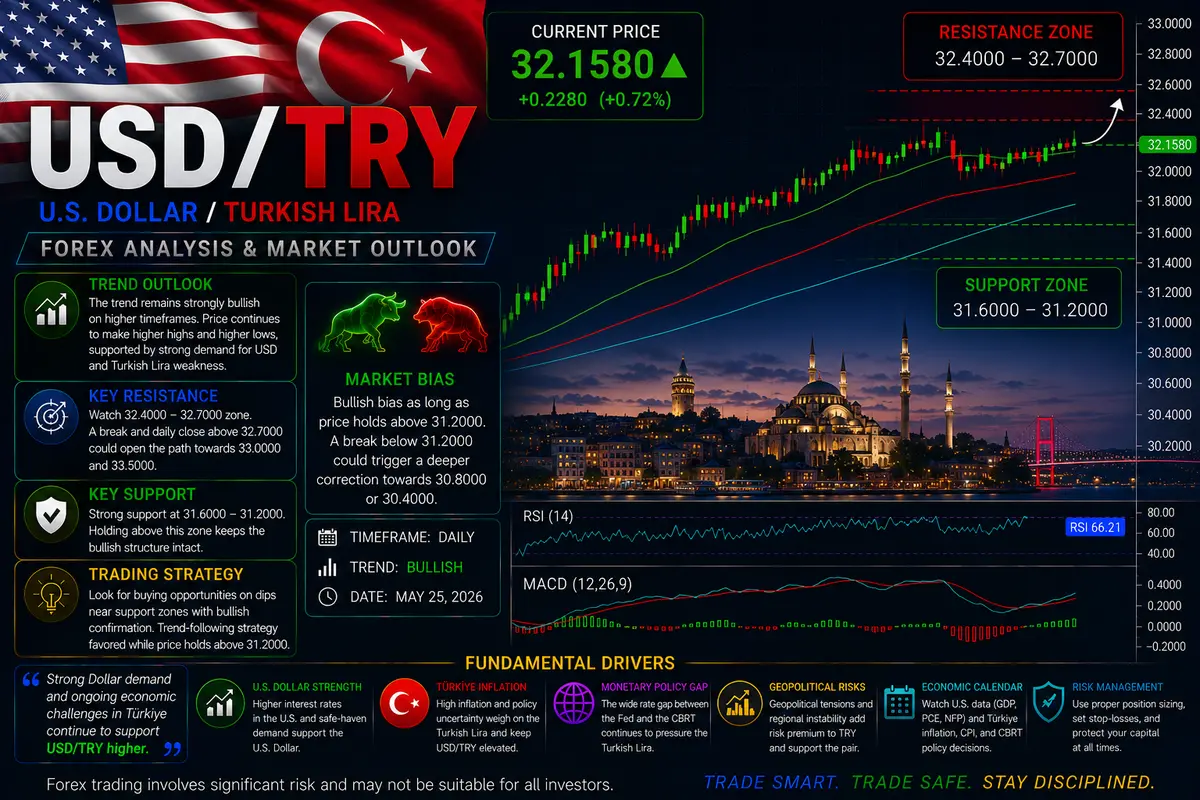
Ask any institutional desk operator about the single most dangerous chart on their monitor, and USDTRY ... will almost certainly come up within thirty seconds. The Lira doesn’t behave like standard G10 major currencies, nor does it follow the predictable mean-reverting rhythms of European cross-rates. Over the past decade, it morphed from a relatively stable regional trading vehicle into a classic example of what happens when a central bank abandons conventional monetary policy while domestic inflation runs rampant.
If you bring standard technical analysis patterns or major-pair leverage models to this chart, the order book will eat you alive. Navigating the Turkish Lira requires throw-away assumptions about clean support levels and mastering the raw mechanics of negative real yields, reserve depletion, and overnight liquidity freezes.
The Core Problem: Negative Real Yields and the Flight to Hard Currency
The foundational driver behind the long-term slide of the Turkish Lira comes down to a straightforward concept that every domestic saver in Istanbul understands intuitively: real interest rates. When the rate of inflation in an economy far outpaces the benchmark interest rate set by the central bank, anyone holding cash in local currency is watching their purchasing power evaporate month after month.
For years, the Central Bank of the Republic of Turkey (CBRT) attempted an unorthodox experiment, cutting interest rates repeatedly even as annual inflation spiked past fifty percent. The logic on the street was simple. If your local bank account pays you twenty percent interest while the price of groceries, fuel, and housing rises by sixty percent, sitting on Lira is a guaranteed way to lose wealth.
Domestic citizens and corporate treasuries responded exactly as economic theory predicts. They took their Lira paychecks and immediately converted them into US Dollars, Euros, and physical gold. This continuous, structural demand for foreign currency created an endless underlying bid on USD/TRY. Every time the exchange rate tried to stabilize, domestic dollarization stepped in to lift the pair higher again.
Central Bank Interventions and the Mirage of Stability
To keep the exchange rate from spiraling into complete freefall without raising official benchmark interest rates, monetary authorities relied on aggressive, behind-the-scenes FX interventions. State-backed lenders and the central bank routinely flooded the order book with foreign currency reserves to absorb Lira selling pressure, creating artificial floors and holding the exchange rate inside extremely narrow horizontal bands for weeks at a time.
Traders who aren’t paying attention often look at these quiet consolidation zones and mistake them for real price stability. In reality, those flat ranges represent a massive burn rate of foreign exchange reserves. Institutional macro funds closely monitor the central bank’s net foreign assets and swap-adjusted reserve levels. The moment those reserve balances dip deep into negative territory, the central bank loses its fire-power to defend the currency. When the intervention breaks, the dam bursts, and USD/TRY launches into a multi-figure upward explosion in a matter of days.
The Swap Rate Trap and Asymmetric Risk
Many traders look at the persistent upward trajectory of USD/TRY and assume the easiest play on the board is to open a leveraged long position and sit on it for months. That’s where the cost-of-carry trap springs shut.
Because of the vast inflation and interest rate differential between the Federal Reserve and the CBRT, holding a long USD/TRY position incurs severe negative overnight swap fees. Over time, those daily rollover charges act like a slow bleed on your account balance. If the spot price goes sideways while state banks defend a level, your net equity steadily shrinks from swap deductions alone.
Going short presents an even more hazardous calculus. On paper, shorting USD/TRY pays positive carry because you’re theoretically earning the higher Turkish yield. But shorting a hyper-inflating currency is an exercise in extreme asymmetric risk. If the central bank delivers an emergency policy shift or introduces new regulatory capital controls—like foreign-exchange-indexed deposit schemes—USD/TRY can drop twenty percent in a single afternoon. If you are caught short with retail leverage when that happens, the gap will wipe out your account before your stop-loss order can even process.
Survival Guidelines for Execution and Session Timing
Timing your entries on USD/TRY requires absolute respect for market depth, which shifts dramatically depending on the clock:
-
Stick exclusively to the European morning: The safest liquidity window occurs between 06:00 and 14:00 UTC, when Istanbul commercial desks and London institutional liquidity providers are fully active. Spreads are at their narrowest, and major economic data releases—like Turkish CPI and CBRT interest rate statements—hit the wires during this window.
-
Stay clear of the New York close: Between 21:00 and 22:00 UTC, global liquidity evaporates as US desks close and Asian markets have yet to open. On exotic pairs like USD/TRY, spreads can instantly widen by hundreds of pips during daily broker rollover, triggering stop-loss orders on perfectly good trades.
-
Radically scale down position sizing: Never apply major-pair leverage (like 1:30 or 1:100) here. Position sizes should be dialed back by seventy to eighty percent compared to your usual EUR/USD allocation to survive sudden five-percent intraday swings.
-
Expect weekend gap risk: Headlines regarding sudden cabinet resignations, central bank governor swaps, or emergency regulatory bans frequently drop over the weekend. Sunday afternoon opens regularly feature massive price gaps that skip right past resting stop orders.

Comments
No comments yet. Be the first to share your thoughts!
Authentication Required
You must be logged in to post a comment.