

A Swimming Lesson in Troubled Waters: How Leslie’s Bankruptcy Crisis Sank Its Stock in a Single Evening
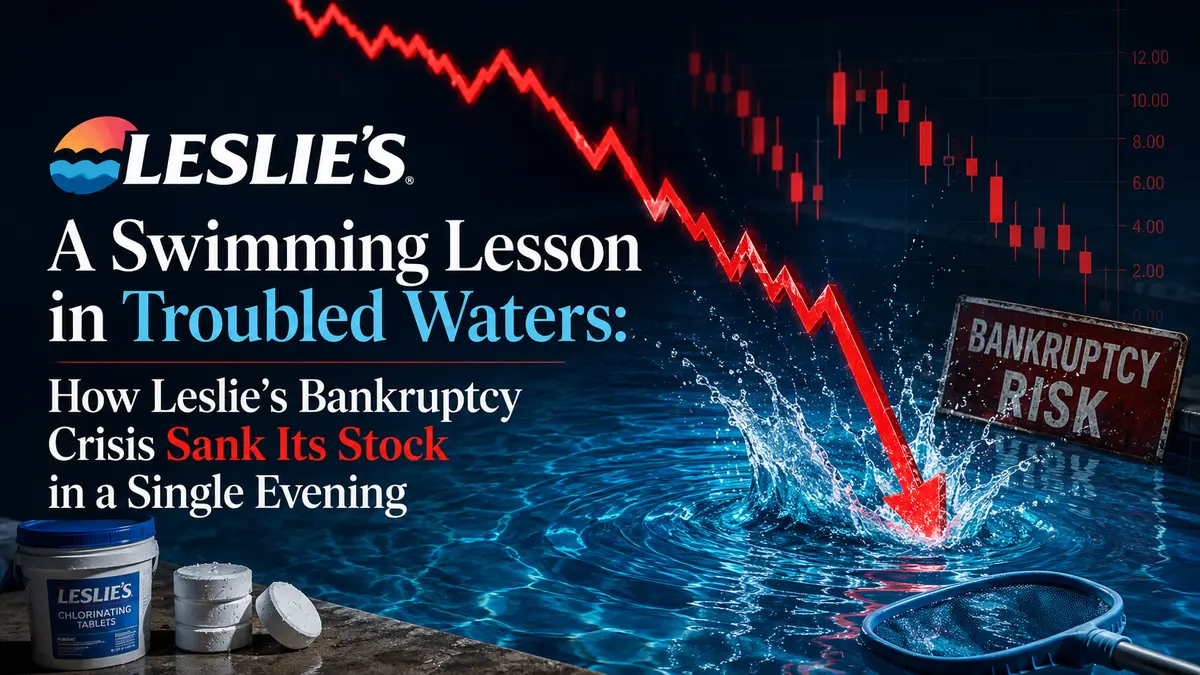
A 50% Collapse: When News Destroys Market Capitalization Faster Than Water Dissolves Salt
The evening of July 22, 2025, became a dark moment in the history of LESL ... Leslie’s, a company that had supplied Americans with chlorine, filters, and other chemicals used to keep their backyard swimming pools crystal clear for decades. When news agencies reported that the retailer was actively considering filing for Chapter 11 bankruptcy protection, investors did not wait for official confirmation. During premarket trading, the stock plunged by nearly 49.8%, and the decline swept away billions of dollars in market capitalization within hours, like a financial tsunami.
The share price collapsed to $0.87, the lower boundary of its 52-week trading range, beyond which lay the threat of complete devaluation. Shares that had recently traded at levels that gave investors hope for a recovery suddenly became distressed securities that everyone who had failed to exit earlier was now desperate to sell.
What happened? Officially, the company stated that it was holding “confidential discussions with creditors” regarding the restructuring of its debt obligations. Behind this diplomatic language, however, lies a brutal reality: Leslie’s, a giant in the swimming pool supplies retail industry, is sinking, and the lifeline it is trying to throw itself may be too small.
Such news is certainly not uncommon in the world of corporate finance. However, the scale of Leslie’s decline shocked even seasoned Wall Street veterans. A drop of almost 50% in a single day is not merely a correction. It is a devastating blow that can erase investor confidence in a company for years.
There are relatively few examples in the history of publicly traded companies in which a single news report caused such immediate and comprehensive destruction of market capitalization. Every such case becomes a subject of study for analysts, investors, and business school students.
Chapter 11: What It Means and Why It Is Terrible for Shareholders
To understand the depth of the panic, it is necessary to examine what Chapter 11 bankruptcy means and why investors fear this scenario so much. Under U.S. law, Chapter 11 is a form of reorganization that allows a company to continue operating under court supervision while developing a plan to repay or restructure its debts. It may not sound particularly frightening, but for shareholders, it is almost always a catastrophe.
When a company enters Chapter 11 bankruptcy proceedings, its shares usually become virtually worthless. During the restructuring process, existing shareholders may receive either a negligible stake in the reorganized company or nothing at all.
The company’s assets are distributed to creditors first, while shareholders, as residual owners of the business, stand at the very end of the line. When the debt burden is too large, the value of their ownership simply disappears.
This is precisely the possibility that Leslie’s investors began pricing into the stock. Even if the company does not immediately file for bankruptcy, the fact that it is negotiating a restructuring indicates that its debt burden has reached a critical level. The company’s financial performance only reinforces this grim diagnosis.
The Numbers That Destroy Hope: Losses, Store Closures, and Rising Debt
Behind the attractive image of a brand associated with summer, sunshine, and relaxing days beside the pool lies a disturbing reality. In the first quarter of fiscal 2026, Leslie’s reported a net loss of $83 million. This was not an isolated failure but a systemic crisis that had been developing for several years.
The company had already closed 80 unprofitable stores as part of its transformation program. This represented a significant reduction in its retail network and was intended to lower costs and improve operating efficiency. However, the results show that these measures were insufficient. Store closures did not solve the problems of declining demand, shrinking margins, and growing competition.
The transformation program, which included revisions to the company’s pricing strategy and further cost reductions, continues to place pressure on short-term results. Leslie’s has found itself trapped in a vicious circle: it must cut expenses to become profitable, but cost-cutting often reduces the quality of customer service, which can lead to further declines in sales.
Wall Street analysts had been sounding the alarm for some time. They identified the company’s debt burden and limited earnings visibility as major risks. At least one large investment firm had downgraded the stock and significantly reduced its price target during the preceding months. Even the most pessimistic forecasts, however, did not anticipate such a rapid collapse.
Why Leslie’s Problem Is Not an Industry-Wide Problem
Interestingly, Leslie’s competitors have not experienced comparable difficulties. Pool Corporation, for example, continues to maintain a relatively stable position in the market. This suggests that Leslie’s problems are primarily internal and related to debt management rather than a broader decline in the swimming pool and spa supplies industry.
The pool products market has undoubtedly experienced a correction following the pandemic-era boom, when large numbers of consumers installed swimming pools in their backyards. However, this slowdown has not been fatal for the entire industry.
Companies that successfully adapted to the new environment, optimized their supply chains, and offered customers competitive prices have continued to perform reasonably well.
Leslie’s, by contrast, became a victim of its own strategy. The company may have expanded too aggressively in previous years, taking on additional debt to open new stores and purchase inventory. When demand began to weaken and interest rates increased, this strategy turned into a ticking time bomb.

The Macroeconomic Environment: An Aggravating Factor, but Not the Root Cause
The broader U.S. stock market was also under pressure on the day Leslie’s shares collapsed. The S&P 500 and the Dow Jones Industrial Average each declined by 0.4%, while the Nasdaq lost 0.5%.
Investors were concerned about inflation, high borrowing costs, and the possibility of a recession. Nevertheless, this macroeconomic pessimism was only a secondary factor compared with the company-specific news.
Had Leslie’s reported strong financial results or announced a convincing new growth strategy, the market might have ignored the broader decline. However, reports of a possible bankruptcy outweighed every external factor.
The company’s shares fell so dramatically that their performance contrasted sharply with that of competitors, which were barely affected by the news.
This highlights an important lesson for investors: even the strongest macroeconomic support cannot always save a company with a weak balance sheet. While the broader market may recover, companies with heavy debt burdens and poor profitability will remain vulnerable.
What Lies Ahead for Leslie’s: Possible Scenarios
Leslie’s now faces several possible paths, none of which looks particularly encouraging.
The first option is a Chapter 11 bankruptcy filing. Under this scenario, shareholders would most likely lose their entire investment. Creditors would gain control of the company, which could continue operating in a significantly reduced form, possibly with fewer stores and more modest ambitions.
The second option is a successful out-of-court debt restructuring. The company could negotiate with creditors to reduce interest rates, extend repayment deadlines, or convert part of its debt into equity.
This could allow Leslie’s to avoid a formal bankruptcy process, but it would probably result in substantial dilution for existing shareholders.
The third option is the sale of the company, or part of its business, to a larger industry player. Pool Corporation or another competitor could acquire Leslie’s at a deeply discounted price, gain control of its assets and customer base, and implement its own restructuring program.
In this scenario, shareholders might receive some compensation, but it would likely be significantly lower than the value of their original investments.
Regardless of which option is selected, one thing is clear: Leslie’s will never be the same company again. A brand that was once associated with summer relaxation has become a symbol of financial instability.
Investors who purchased the company’s shares in the hope of long-term growth have encountered the harsh reality of seeing their profit expectations shattered against the rocks of corporate debt.
Lessons for Investors: What This Story Can Teach Us
The collapse of Leslie’s is more than an isolated incident. It provides an important lesson for everyone who participates in the stock market.
Companies with heavy debt burdens are always vulnerable, particularly during periods of rising interest rates. Even when a business appears stable, as a decades-old retailer of swimming pool products might, external shocks can quickly transform a seemingly reliable company into a bankruptcy candidate.
The second lesson is the importance of diversification. Investors who held large positions in Leslie’s shares lost nearly half of their capital in a single day. Those who spread their investments across different sectors and companies suffered significantly smaller losses.
The third lesson is not to ignore warning signs. Analysts had been warning investors about Leslie’s debt burden for many months. Those who closely monitored these signals could have exited their positions earlier and minimized their losses.
Finally, the fourth lesson is that the market is not always rational, but it is often highly efficient in the short term. News of a possible bankruptcy led to an immediate reassessment of the company’s value, and that reassessment was entirely understandable.
Investors recalculated the risks, and the market found a new equilibrium, even though that equilibrium was approximately 50% below the previous price level.
Conclusion: The End of One Era and the Beginning of Another
The Leslie’s story is not over yet. The company may survive by restructuring its debts, or it may find a buyer capable of giving the business a second life. For shareholders, however, the battle may already be lost.
A nearly 50% decline in market capitalization in a single day is a disaster that investors will remember for a long time.
Nevertheless, every disaster can provide valuable lessons. Investors who experienced this shock will now be wiser. They will analyze balance sheets more carefully, treat growth forecasts with greater skepticism, and be more selective when choosing companies for long-term investment.
A new chapter is beginning for Leslie’s. The company may continue to exist as a brand, but under different ownership and with a completely different financial structure. Alternatively, it may disappear, leaving behind only memories of summer days spent beside the pool.
Whatever happens, July 22, 2025, will remain part of the company’s history as the day its shares sank faster than any of its customers could dive into the water.


Comments
No comments yet. Be the first to share your thoughts!
Authentication Required
You must be logged in to post a comment.