

The Australian Market Stalls Just Above Zero: A Day That Changed Nothing

Monday on the ASX: A Decline of Mere Hundredths of a Percent
The Australian stock market ended the first trading day of the week with an almost imperceptible move lower. The S&P/ASX 200 Index lost just 0.06%—such an insignificant amount that it could easily be dismissed as statistical noise. Yet behind this microscopic decline was a day full of contrasts: some companies surged, others fell to record lows, while the overall result remained virtually unchanged.
Trading on the Sydney Stock Exchange was marked by a tug-of-war. The information technology, utilities, and healthcare sectors pushed the index lower, while other industries attempted to keep it afloat. In the end, the battle finished in a draw—but the apparent calm was deceptive. Within the market, a genuine drama was unfolding, with winners and losers changing places at a dizzying pace.
The final tally showed 583 declining stocks compared with 485 advancing stocks, while 389 shares remained virtually unchanged. This suggests that sellers outnumbered buyers, but the overall decline remained minimal because the day’s strongest performers delivered impressive gains.
The Top Three Performers: Who Pulled Ahead?
Against a backdrop of general stagnation, three companies posted impressive gains of more than 4%.
Yancoal Australia, a coal-mining company, took first place, rising 6.16% to AUD 5.69. The strength of the coal sector was no coincidence. Energy prices surged amid the escalation of the conflict in the Middle East, making coal increasingly attractive as an alternative source of energy. Investors concerned about potential disruptions to oil supplies have been shifting toward coal-related assets, placing Yancoal at the centre of this trend.
Contact Energy, a New Zealand energy company, ranked second after gaining 4.56% to AUD 7.80. Interestingly, Contact Energy is traded on the Australian exchange, although its core business is concentrated in New Zealand. The rise in its share price was probably connected to the broader rally in the energy sector and possibly to company-specific developments.
GrainCorp, one of Australia’s largest agricultural businesses specialising in grain storage and processing, was the third-best performer. Its shares rose 4.38% to AUD 5.24. During periods of global uncertainty and rising food prices, agriculture-related companies often become major beneficiaries. Investors look for defensive assets, and GrainCorp appears attractive because of its stable business model and dividend payments.
The Day’s Biggest Losers: Falling to Record Lows
While some companies were celebrating strong gains, others experienced a genuine nightmare.
The most dramatic event of the day was the decline in PEXA Group, a company that provides digital property-settlement services. Its shares fell 4.68% to a record low of AUD 7.53. This was more than a routine correction—it represented a break below long-term price levels, suggesting that investors are seriously concerned about the company’s outlook. PEXA has been affected by the slowdown in the property market, which is struggling under the pressure of high interest rates and declining consumer purchasing power.
Liontown Resources, a lithium-mining company, was the second-worst performer. Its shares dropped 4.14% to AUD 1.27. The lithium sector, which reached its peak several years ago, is now experiencing a significant correction. Demand for electric vehicles continues to grow, but lithium supply is also increasing, pushing prices lower. Investors are reassessing their valuations, and Liontown has become one of the companies caught in the downturn.
Mineral Resources, another mining company, ranked third among the day’s biggest losers. Its shares declined 3.73% to close at AUD 54.66. Mineral Resources operates a diversified business, producing iron ore, lithium, and other commodities. However, broader pressure on the resources sector, driven by concerns about a slowdown in the global economy, also weighed on the company.
The Volatility Index Declines: Calm in the Options Market
An interesting signal came from the S&P/ASX 200 VIX volatility index, which fell 1.76% to 11.38. Based on options-market activity, the index reflects investors’ expectations of future market volatility.
A decline in the VIX suggests that investors do not expect sharp market movements in the near future. This appears paradoxical against the backdrop of geopolitical uncertainty and rising oil prices, but financial markets often behave irrationally.
Investors may believe that current risks are already priced into the market and that no additional major shocks are likely. Alternatively, they may simply be focused on the corporate earnings reports scheduled for release this week and may be unwilling to draw premature conclusions.
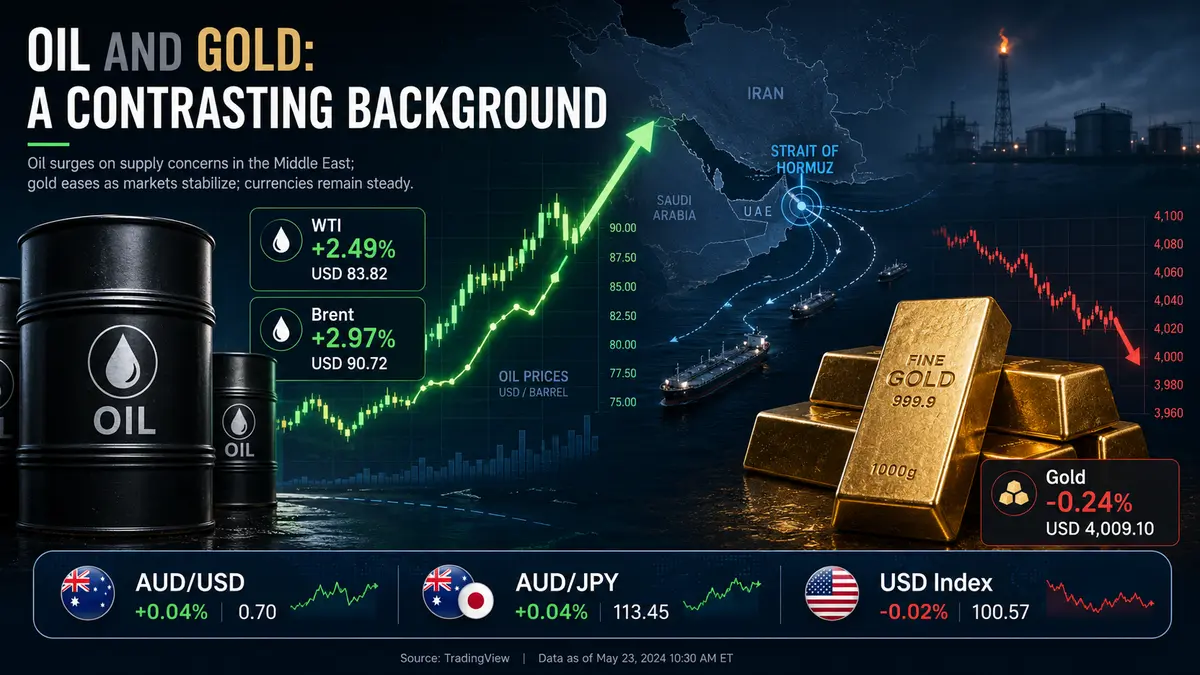
Oil and Gold: A Contrasting Background
While the Australian market remained frozen in uncertainty, commodity markets experienced far more dramatic movements.
September-delivery WTI ... crude oil rose 2.49% to USD 83.82 per barrel, while September-delivery BZUSD ... crude climbed 2.97% to USD 90.72 per barrel. As mentioned earlier, the rise was driven by the conflict in the Middle East entering a new phase. American strikes against Iran, retaliatory Iranian attacks, and disruptions to shipping through the Strait of Hormuz have all pushed energy prices higher.
XAUUSD ... Gold, by contrast, edged 0.24% lower to USD 4,009.10 per ounce. Although the decline was modest, it suggests that investors are not rushing to purchase safe-haven assets despite rising geopolitical tensions. They may believe that the conflict will not cause long-term supply disruptions, or they may simply be taking profits after the metal’s recent gains.
In the foreign-exchange market, the Australian dollar remained virtually unchanged against the US dollar. The AUDUSD ... pair gained only 0.04% to reach 0.70. Against the Japanese yen, the Australian dollar strengthened slightly, with AUDJPY ... rising 0.04% to 113.45.
Meanwhile, the US Dollar Index futures contract declined 0.02% to 100.57, indicating that the dollar remained stable despite the ongoing turmoil.
What Comes Next? The Outlook for the Australian Market
The Australian market is currently in a state of anticipation. Investors are processing developments surrounding the conflict in the Middle East, preparing for the corporate earnings season, and assessing the potential impact of high oil prices on the global economy.
The key questions facing market participants are how long the conflict will continue, whether it will cause genuine disruptions to energy supplies, and how central banks will respond.
Should inflation accelerate because of rising oil prices, the US Federal Reserve and other regulators may be forced to return to tighter monetary policy. For the Australian market, which is highly sensitive to changes in interest rates, such a development could represent a serious blow.
On the other hand, elevated energy prices support Australian exporters of coal and natural gas. Yancoal has already gained more than 6%, and if the trend continues, other companies in the sector may also deliver strong performance.
The latest trading session on the Australian market demonstrated that overall stagnation does not mean there is no movement beneath the surface. While the main index barely changed, some companies soared, while others fell to record lows.
It serves as a reminder that the market is not a single monolithic entity, but a collection of individual stories of success and failure. Australian investors are holding their breath as they wait for new signals. Once those signals emerge, the market will inevitably begin moving again.


Comments
No comments yet. Be the first to share your thoughts!
Authentication Required
You must be logged in to post a comment.