

Corn on the Rise: How Weather and War Are Driving Prices Higher
Introduction: A Perfect Storm for the Grain Market
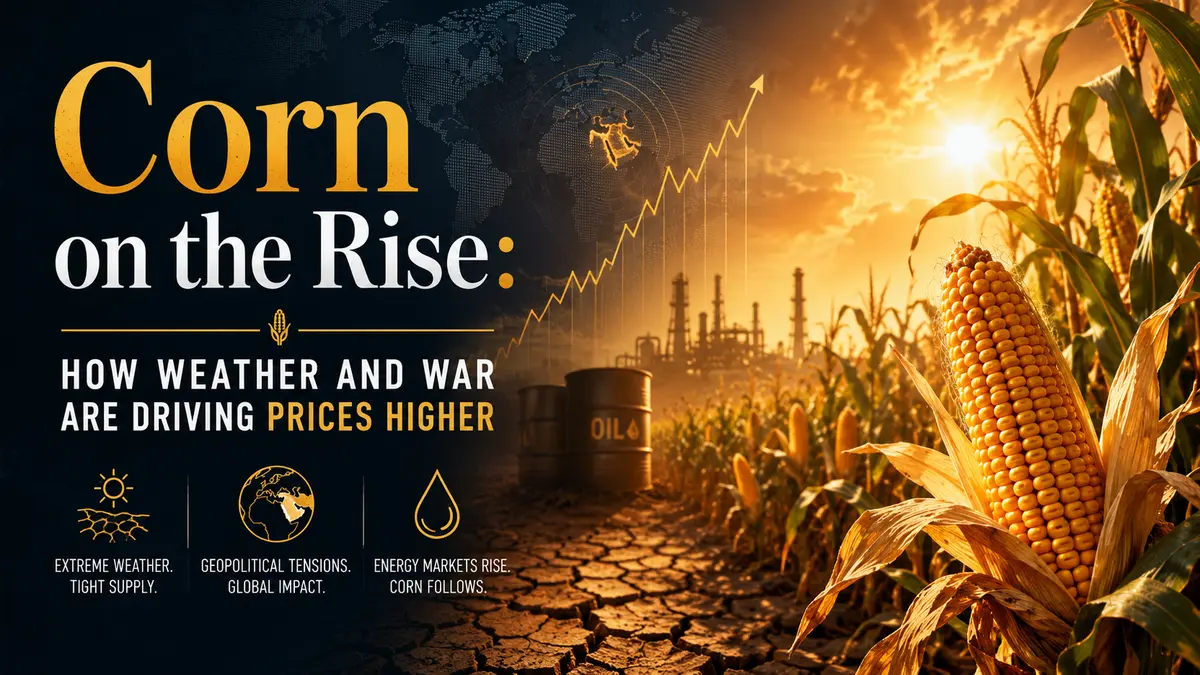
Monday became the day when two completely different factors converged, creating powerful momentum for higher corn prices. Weather forecasts predicting heat and drought across the US Corn Belt, combined with geopolitical tensions in the Middle East that pushed oil prices higher, sent corn futures to their highest levels in more than a month.
The September contract closed 1.5 cents higher at $4.41 per bushel. The new-crop December contract posted an even more impressive gain, rising 2.25 cents to $4.63¼ and reaching an intraday high of $4.69½—the highest level since June 2.
What is driving this rally? Why do weather conditions in American fields and conflict in the Persian Gulf affect the price of corn? And how long could this trend continue? Let us examine this agricultural mystery, in which meteorology, geopolitics, and the biofuel economy are closely intertwined.
The Weather Factor: Heat and Drought Threaten the Harvest
A Critical Period for Corn
July is the month that determines the fate of the US corn harvest. Pollination takes place during this period—a crucial stage that directly affects kernel development. Heat and drought at this time can cause irreversible damage to the future crop.
Forecasters expect hot and predominantly dry weather across the western part of the US Corn Belt this week, with similar conditions potentially continuing into the following week. This is an alarming signal for both farmers and traders.
The Corn Belt is the heart of American agriculture and the region where most of the country’s corn is produced. Iowa, Illinois, Nebraska, and Indiana are among the states at risk. If weather conditions fail to improve, yields could decline significantly.
Moisture Deficits and Their Consequences
A lack of moisture during a critical stage of plant development causes smaller ears to form, while the kernels become smaller and lighter. This directly affects yields, which may decline by 10–20% or more.
At the same time, demand for corn remains strong. It is used to produce animal feed, ethanol, food products, and industrial goods. A reduction in supply amid stable demand inevitably pushes prices higher.
Long-Term Weather Trends
It is also worth noting that weather anomalies have become increasingly frequent in recent years. Climate change is exposing traditional agricultural regions to new challenges. Heat and drought in the US Corn Belt are no longer rare events but an emerging trend.
This creates additional market risks and encourages traders to build a weather premium into corn prices even when there is no immediate threat.
The Geopolitical Factor: Oil Pulls Corn Higher
The Connection Between Oil and Grain
At first glance, conflict in the Middle East and corn prices may appear unrelated. In reality, however, there is a direct connection between them: biofuel.
Corn is the primary raw material used to produce ethanol, a gasoline additive widely used in the United States. When oil prices rise, ethanol becomes more attractive as an alternative fuel. This increases demand for corn and pushes its price higher.
The Reinstatement of the Blockade Against с
President Trump’s decision to reinstate the naval blockade against Iran caused oil prices to surge sharply. Oil gained more than 8%, and the move immediately affected the corn market.
Traders understand that rising oil prices create additional demand for ethanol and, consequently, for corn. Although there is no direct connection between the Strait of Hormuz and the fields of Iowa, the biofuel supply chain makes this relationship very real.
Risks of Further Escalation
If the conflict in the Middle East continues to escalate, oil prices could rise further. This would provide continued support for the corn market and push prices higher.
Conversely, if the situation stabilizes, oil prices may fall, creating downward pressure on corn. This is why traders are closely monitoring news from the region.
Technical Overview: Key Levels to Watch
Breakout Above $4.60
The December corn contract reached an intraday high of $4.69½ per bushel, its highest level since June 2. The breakout above $4.60 represented an important technical signal.
Resistance that previously appeared difficult to overcome may now become support. If corn can remain above $4.60, it could open the way toward the next targets at $4.80 and even $5.00.
Resistance at $4.70
The current resistance level is $4.70. A successful breakout above this level would represent a strong bullish signal. However, the market remains cautious, and investors are reluctant to open large long positions without additional confirmation.
Support, meanwhile, is located at $4.50. If the price falls below this level, a correction toward lower values may follow.
Fundamental Factors: Supply and Demand
Yields Under Threat
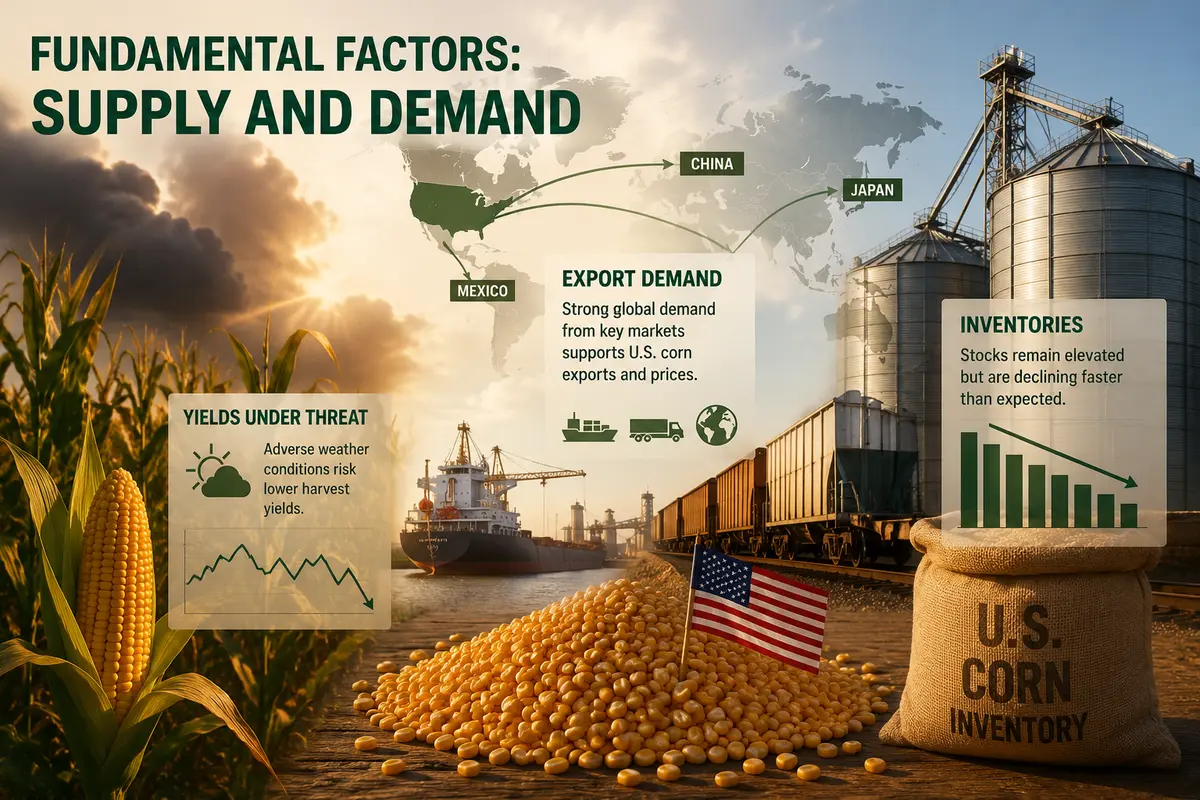
The primary fundamental factor influencing prices is the expected yield. Weather forecasts are creating risks for the harvest, and these risks are already reflected in current prices.
The US Department of Agriculture will continue publishing data on crop conditions. If these reports show further deterioration in the condition of the corn crop, prices could continue rising. If the weather improves, a correction may occur.
Export Demand
The United States is one of the world’s largest corn exporters. Demand from China, Mexico, Japan, and other countries supports prices. Even when prices are high, foreign buyers continue purchasing American corn, especially when harvests in other countries are also being affected by unfavorable weather.
However, elevated prices may encourage buyers to search for alternative suppliers, potentially limiting further gains.
Inventories
US corn inventories remain relatively high, but they are declining faster than expected. If weather conditions deteriorate, stocks could come under pressure, creating additional momentum for higher prices.
The Biofuel Market: Ethanol as a Demand Driver
Ethanol Production
Ethanol production in the United States remains stable. Demand for ethanol as a gasoline additive is supported by federal mandates. When oil becomes more expensive, ethanol becomes more competitive, encouraging ethanol producers to increase their corn purchases.
This creates additional demand that supports corn prices even when overall production remains stable.
The Political Dimension
Biofuel policy also affects the corn market. The US government supports ethanol production through various subsidies and mandates. Any changes to these policies could have a significant impact on the market.
For now, government policy remains favorable to ethanol producers, supporting demand for corn.
Market Psychology: Fear and Hope
The Role of Speculators
Speculators are highly active in the corn market, using weather and geopolitical risks as opportunities to generate profits. When warning signs emerge, they aggressively increase their long positions, pushing prices higher.
However, if these signals are not confirmed by actual data, a sharp correction may follow. The speculative component makes the market more volatile.
Farmer Sentiment
Farmers, meanwhile, closely monitor forecasts and attempt to hedge their risks through futures contracts. Their sentiment and actions also influence the market.
If farmers decide to sell more grain at the current elevated prices, this could place pressure on the market. If they prefer to hold back their crops in anticipation of further gains, prices may continue rising.
What This Means for Investors
Opportunities in Agricultural Commodities
The current situation in the corn market creates opportunities for investors interested in agricultural commodities. Price growth driven by weather and geopolitical factors could generate profits.
However, investors should also consider the risks. Weather conditions may improve, while the geopolitical situation may stabilize. In that case, prices could correct rapidly.
Portfolio Diversification
Corn provides one way to diversify an investment portfolio. Although it is correlated with other commodity assets, it also has its own unique characteristics, which can help reduce overall portfolio risk.
Investors may view corn as a defensive asset during periods of uncertainty, as well as a way to hedge against inflationary risks.
Conclusion: Corn at a Crossroads
The rise in corn futures to their highest levels in more than a month is the result of two combined factors: weather risks in the United States and geopolitical tensions in the Middle East. Heat and drought are threatening the harvest, while higher oil prices are stimulating demand for ethanol.
Technical levels indicate the potential for further gains if corn can break through resistance at $4.70. However, additional confirmation will be required for a sustainable upward trend.
Fundamental factors—including yields, export demand, and inventories—remain at the center of attention. USDA reports and weather forecasts will determine market sentiment over the coming weeks.
For investors, this is a period of both opportunities and risks. The current rally may continue, but it could also prove short-lived. Maintaining balance and diversifying risks remain essential.
Corn continues to be one of the world’s key agricultural commodities, and its price reflects a wide range of factors—from weather conditions to geopolitics. As long as these forces remain active, the corn market will continue to attract significant investor attention.

Comments
No comments yet. Be the first to share your thoughts!
Authentication Required
You must be logged in to post a comment.