

The Foreign Exchange Market: The Dynamic Core of Global Finance
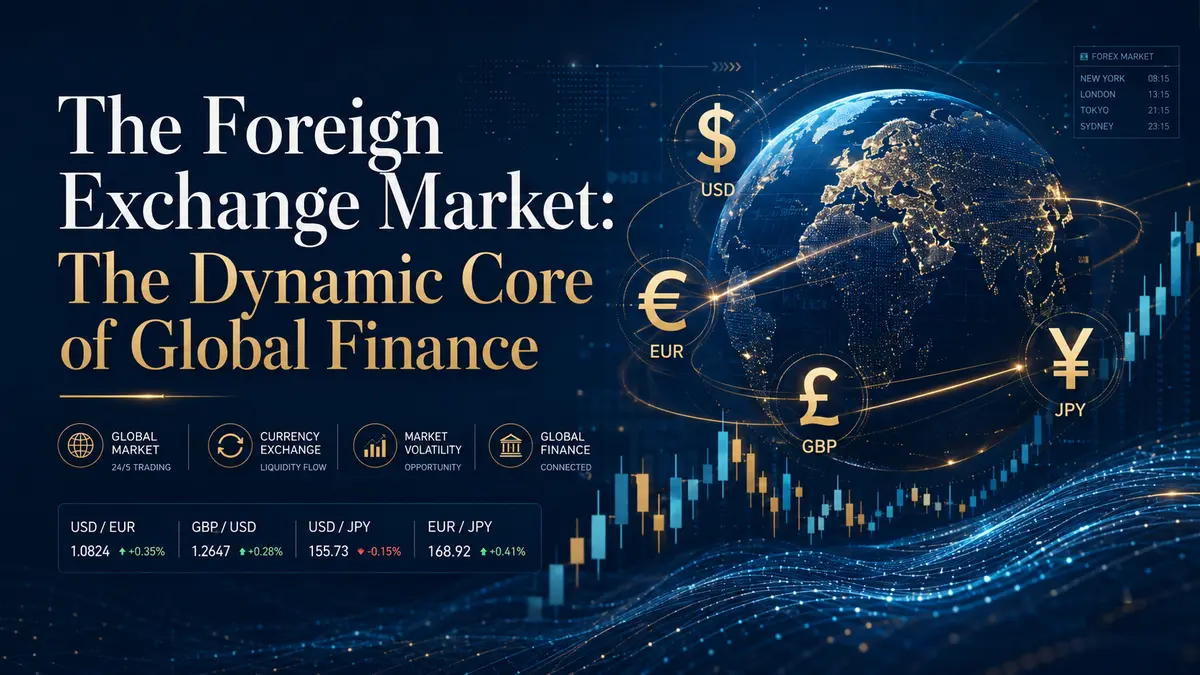
The foreign exchange market, commonly known as Forex or FX, is a highly specialized and massive financial arena dedicated to the exchange of global currencies. Far from being just another sector of finance, it stands as the absolute largest and most liquid financial market in the world, with daily trading volumes frequently exceeding $7 trillion. The Forex market functions as the fundamental mechanism that allows international trade, global investments, and global corporate operations to exist, enabling participants to convert national currencies seamlessly.
A Decentralized, 24-Hour Trading Arena
Unlike traditional stock markets that operate out of centralized physical locations (like the New York Stock Exchange), the Forex market is an Over-The-Counter (OTC) market. This means it has no central physical location or central clearinghouse. Instead, all operations and trades are conducted electronically via a massive, interconnected global network of computers.
Because it relies on this global network, the Forex market operates 24 hours a day, five days a week. The trading day naturally follows the sun, moving seamlessly from one major financial hub to the next. The cycle typically begins in Sydney and Wellington, moves into Tokyo and Hong Kong, transitions to the massive European hubs of London, Zurich, and Frankfurt, and finally closes the day in New York. This continuous operation means the market is highly reactive; an economic event in Asia can trigger massive trading volumes in Europe before the American markets even open.
Key Participants in the Forex Ecosystem
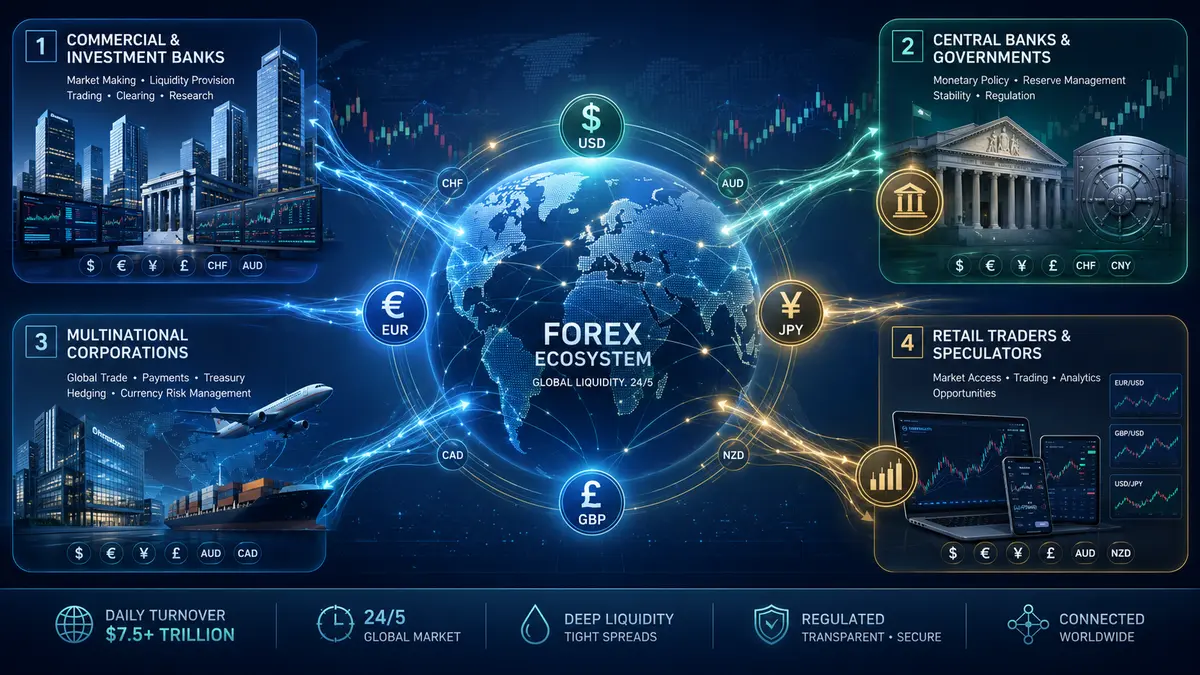
The immense liquidity of the foreign exchange market is driven by a diverse array of participants, each interacting with the market for entirely different strategic reasons — from essential risk management to pure financial speculation.
Commercial and Investment Banks
The interbank market is the foundational layer of Forex. Tier-1 global banks such as JPMorgan Chase, Deutsche Bank, UBS, and Barclays trade massive volumes of currency with each other daily. They dictate the bid-ask spreads that eventually trickle down to retail platforms. These institutions trade both on behalf of their massive corporate clients and for their own proprietary trading desks.
Central Banks and Governments
Central banks, such as the United States Federal Reserve (The Fed), the European Central Bank (ECB), and the Bank of Japan (BoJ), are heavyweights in the Forex market. They do not trade for profit. Instead, they participate to stabilize their national economies, control domestic inflation, or manage their foreign reserve portfolios. Occasionally, they will heavily intervene in the market to artificially devalue or prop up their national currency to maintain global export competitiveness.
Multinational Corporations
Global businesses use the Forex market primarily for hedging — protecting themselves against the risk of currency fluctuations. For example, if a major American airline agrees to purchase a fleet of aircraft from the European manufacturer Airbus, the payment will likely be due in Euros years down the line.
To protect against the risk of the Euro becoming drastically more expensive compared to the US Dollar by the time the bill is due, the airline will lock in an exchange rate on the Forex market today.
Retail Traders and Speculators
Individual retail traders make up a rapidly growing segment of the market. Thanks to online brokerage platforms, individuals can now access the same market as the megabanks. Retail traders are almost exclusively speculators; they have no interest in taking physical delivery of a foreign currency but simply aim to profit from the constant micro-fluctuations in exchange rates.
The Mechanics of Forex Trading: Currency Pairs
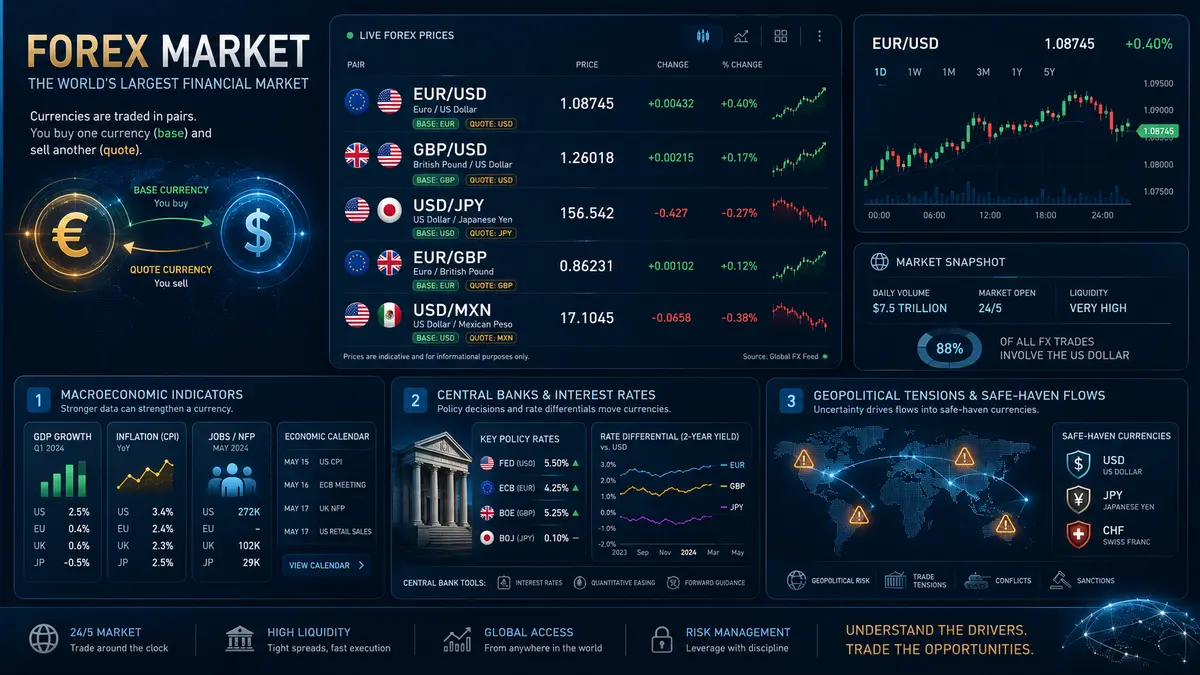
On the foreign exchange market, you cannot simply “buy” a currency in isolation; you are always simultaneously buying one currency and selling another. Therefore, all Forex instruments are quoted as currency pairs.
The first currency is the base currency, and the second is the quote currency. If you look at the EUR/USD pair, it represents how many US Dollars are required to purchase one single Euro.
The market is generally divided into three categories of pairs:
-
The Majors: These are the most heavily traded pairs in the world, and they always include the US Dollar. Examples include EUR/USD, GBP/USD (often called “Cable”), and USD/JPY. They offer the highest liquidity and the lowest trading costs.
-
The Minors (Crosses): These pairs feature major global currencies but do not include the US Dollar. Examples include EUR/GBP, EUR/JPY, or GBP/JPY.
-
The Exotics: These pair one major global currency with the currency of an emerging or smaller economy, such as the US Dollar against the Mexican Peso (USD/MXN) or the Euro against the Turkish Lira (EUR/TRY). These pairs are notoriously volatile and carry much higher trading costs.
Fundamental Drivers: What Moves the Currency Markets?
The Forex market is the ultimate barometer of global macroeconomic health. A currency’s value is essentially a reflection of the market’s confidence in that specific country’s economy. Participants must constantly monitor an array of fundamental factors.
Macroeconomic Indicators and Economic Events
Economic data releases cause immediate, aggressive volatility in the Forex markets. Traders closely watch reports such as Gross Domestic Product (GDP) growth, unemployment rates, and inflation figures (Consumer Price Index). For instance, the US Non-Farm Payrolls (NFP) report, released on the first Friday of every month, is legendary for causing massive spikes in USD volatility based on how many jobs the American economy added or lost.
Central Bank Monetary Policy and Interest Rates
Interest rates are the most significant driver of currency valuation. Capital flows toward economies that offer higher returns. If the Bank of England raises its benchmark interest rate while the European Central Bank keeps its rate near zero, global investors will flock to buy the British Pound to earn that higher yield, driving the value of GBP up against the EUR.
Geopolitical Conflicts and Global Tensions
Currencies are highly sensitive to political instability, trade wars, and global conflicts. When a major geopolitical crisis erupts, risk appetite plummets. Investors rapidly sell off the currencies of developing or heavily exposed nations and park their wealth in “safe-haven” currencies. The US Dollar, the Swiss Franc (CHF), and the Japanese Yen (JPY) historically act as these safe harbors during times of global panic.
Analytical Approaches: Navigating Market Volatility
Trading in this high-velocity environment requires rigorous analysis, financial literacy, and split-second decision-making. Traders generally rely on two distinct schools of thought to predict future price movements.
Technical Analysis
While fundamental analysis looks at the “why” of the economy, technical analysis looks entirely at the “what” of the price charts. Technical analysts believe that all global news and economic data are already instantly “priced in” to the market.
Therefore, they study historical price data, candlestick patterns, and mathematical indicators (like Moving Averages or the Relative Strength Index) to identify repeating market trends and forecast where the price is statistically likely to go next.
Leverage and the Critical Importance of Risk Management
A defining characteristic of the modern retail Forex market is the heavy utilization of leverage. Leverage is essentially a line of credit extended by the broker that allows a trader to control a massive market position with a relatively tiny amount of personal capital.
For example, with a 30:1 leverage ratio — the legal maximum for retail traders under the European Securities and Markets Authority (ESMA) — a trader with just €1,000 in their account can control a €30,000 position in the market.
While leverage can exponentially magnify potential profits from tiny currency movements, it is a dangerous double-edged sword. It equally magnifies potential losses, meaning a small market movement in the wrong direction can instantly wipe out a trader’s entire account balance.
Because of this, exceptional risk management is the true key to survival in the foreign exchange market. Successful participants rely heavily on strict position sizing, the disciplined use of stop-loss orders (automated instructions to close a losing trade before the loss becomes catastrophic), and ironclad emotional control.
Ultimately, the foreign exchange market is an indispensable pillar of the global financial system. It provides essential liquidity for international commerce while offering uniquely lucrative — yet inherently risky — opportunities for those who take the time to master its complexities.

Comments
No comments yet. Be the first to share your thoughts!
Authentication Required
You must be logged in to post a comment.